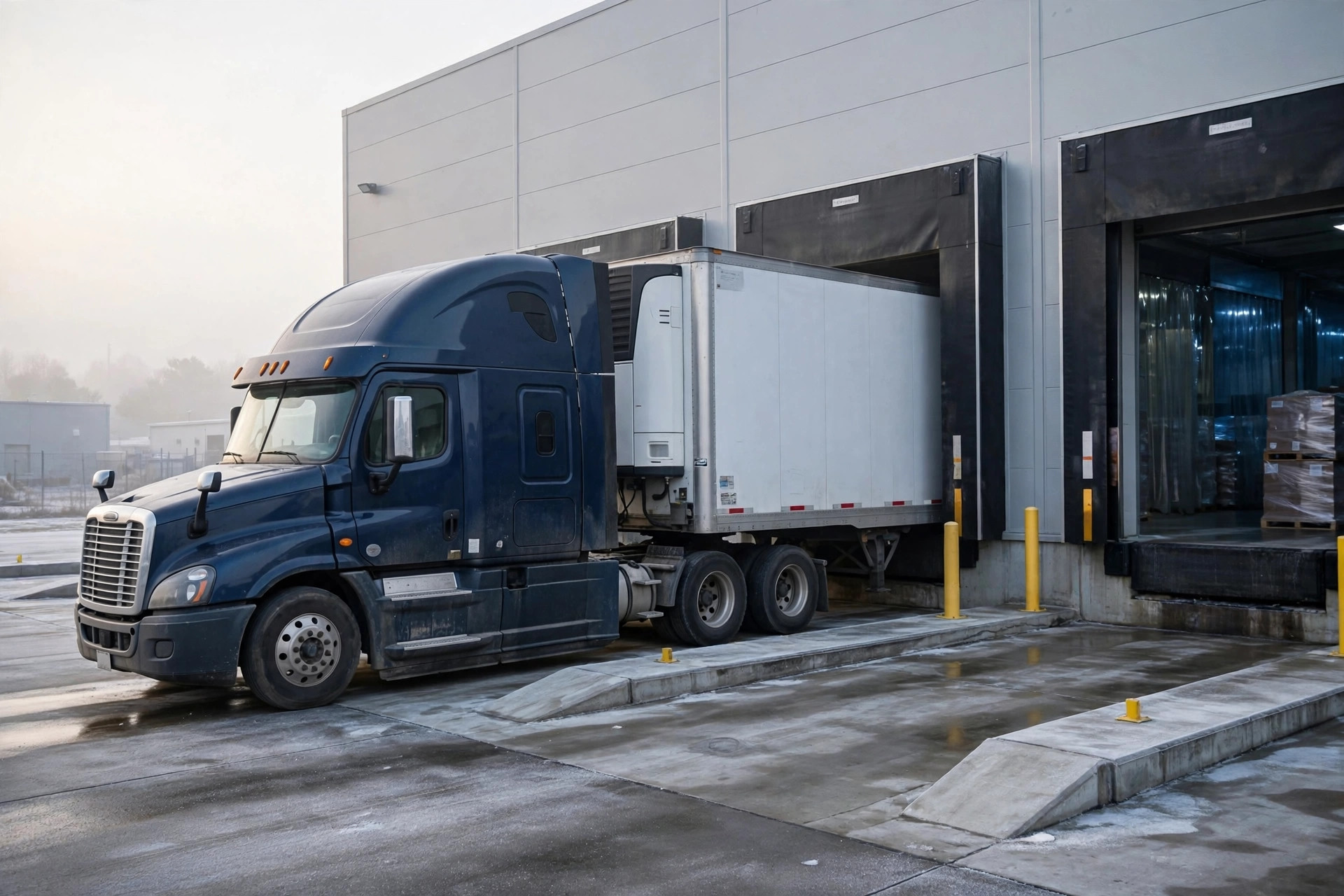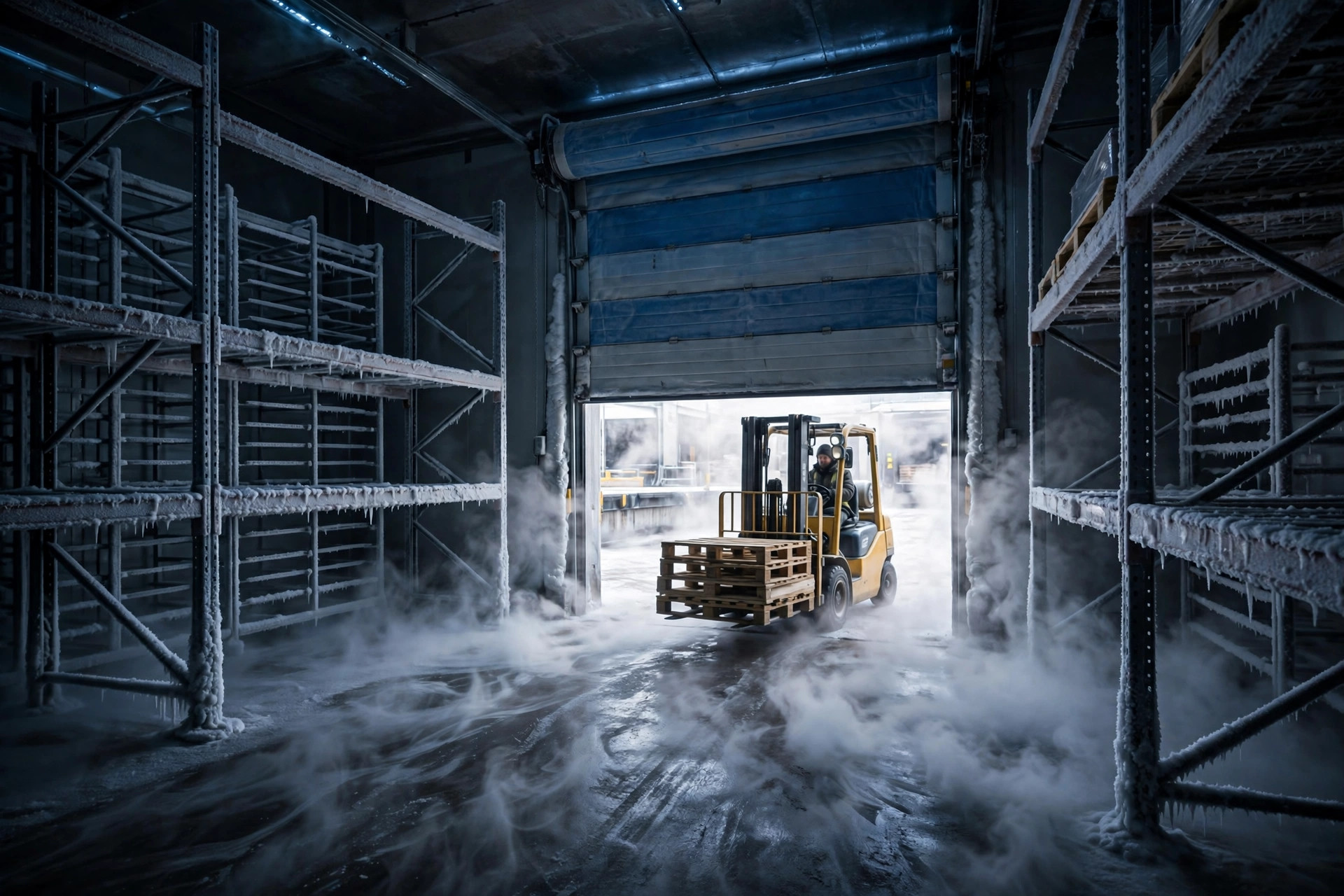
Last December I walked into a frozen-food 3PL outside Fresno. Minus 22 in the freezer, and the high-speed roll-up door at the main dock was cycling more than 400 times a day. The warehouse manager was venting: they'd paid $28,000 for this "high-speed door" three years ago — rated at 2.5 meters per second — but the refrigeration power bill kept climbing, and they'd already replaced the curtain twice.
One look and I knew. That door was never designed for a freezer. It was a standard ambient-warehouse high-speed door, shoehorned into a cold storage application.
Here's the bottom line up front: in cold storage high speed door selection, the first principle isn't "how fast it opens." It's "how tight it seals, how little it ices up, and how rarely it breaks." Opening speed is one of three variables — and it's the one salespeople love to talk about, because it's the prettiest number.
The physics: what a freezer door fights every day
Think of it this way: a cold storage door fights three battles at once, every single day.
Battle one is against hot air. Thirty degrees outside, minus 22 inside — a 52-degree delta. Every opening is a heat exchange event. The difference between a 1.0 m/s door and a 2.0 m/s door isn't the two seconds you save. It's how much hot air gets in per cycle. For a 4×5 meter opening, cutting open time from 8 seconds to 4 cuts the per-cycle heat load by more than 30%.
Battle two is against moisture. Hot air carries water vapor, and at minus 22 that vapor turns straight to frost — on the curtain, in the guides, on the evaporator coils. Frost is a vicious cycle: the thicker it gets, the worse the door seals, the more hot air leaks in, the more frost forms. The worst case I've seen: two inches of ice built up inside the guide rails, the door jammed halfway, and the crew had to melt it out with hot water.
Battle three is against people. Forklift drivers in a hurry drive through before the door is fully up. Curtain impacts are a daily fact of life in cold storage. A standard curtain takes two hours minimum to repair after a hit. A self-repairing curtain pops back into its guides on its own — 30 seconds and you're running again.
So cold storage high speed door selection is really about balancing three specs: opening speed (v, in m/s), insulation performance (U-value or equivalent thermal resistance), and impact self-repair capability. Sales talks about the first one because it's the easiest number to sell.
The selection line: three calculations, one at a time
Calculation one: the speed math.
High-speed doors typically run 1.5 to 2.5 m/s. But note — that's the rated speed under no load. In a freezer, frost on the curtain and guides adds friction, so knock 20% off the brochure number. The question to ask isn't "how fast is it rated" but "how fast does it actually run at minus 20." My rule of thumb: under 200 cycles a day, 1.5 m/s is fine. 200 to 400 cycles, start at 2.0 m/s. Over 400 cycles a day, go 2.5 m/s and add an air curtain.
And here's a sacred cow to slaughter: plenty of salespeople push "faster is always better," waving 3.0 m/s as a selling point. Past 2.5 m/s, every extra 0.5 m/s steps up motor power and control system cost — while the marginal heat-load reduction gets tiny. A small warehouse cycling a door 100 times a day, paying premium money for a 3 m/s door, is just donating to the vendor's margin.
Calculation two: the insulation math.
Two things matter: the curtain's insulation build (single-layer PVC, double-layer with insulation batting, inflatable seals) and the frame sealing (brush seals vs. inflatable gaskets). A single-layer PVC curtain runs around 5.0 W/(m²·K); a double-layer insulated curtain gets under 2.0. More than a 2x difference.
Run the numbers:
| Single-layer PVC curtain | Double-layer insulated curtain | |
|---|---|---|
| U-value | ~5.0 W/(m²·K) | under 2.0 W/(m²·K) |
| Heat transfer, 4×5 m opening, 50° delta | ~5 kW | ~2 kW |
| Daily consumption (24 h) | ~120 kWh | ~50 kWh |
| Annual gap | — | 25,000+ kWh saved |
| At ~$0.20/kWh industrial rate | — | ~$5,000/year saved |
The insulated curtain costs $8,000–10,000 more up front. Payback in two years. Not a hard calculation — but almost nobody runs it.
Calculation three: the maintenance math.
Cold storage doors die three ways: curtains destroyed by impacts, guides frozen solid, motors giving up in the cold.
Curtain impacts: a standard curtain costs $1,500–3,000 per hit in parts and labor, plus half a day of downtime. Self-repairing curtains cost about 30% more but reset themselves. My advice is simple: self-repairing on high-traffic main aisles, standard curtains on low-traffic secondary doors. Specifying one type for the whole building is just waste.
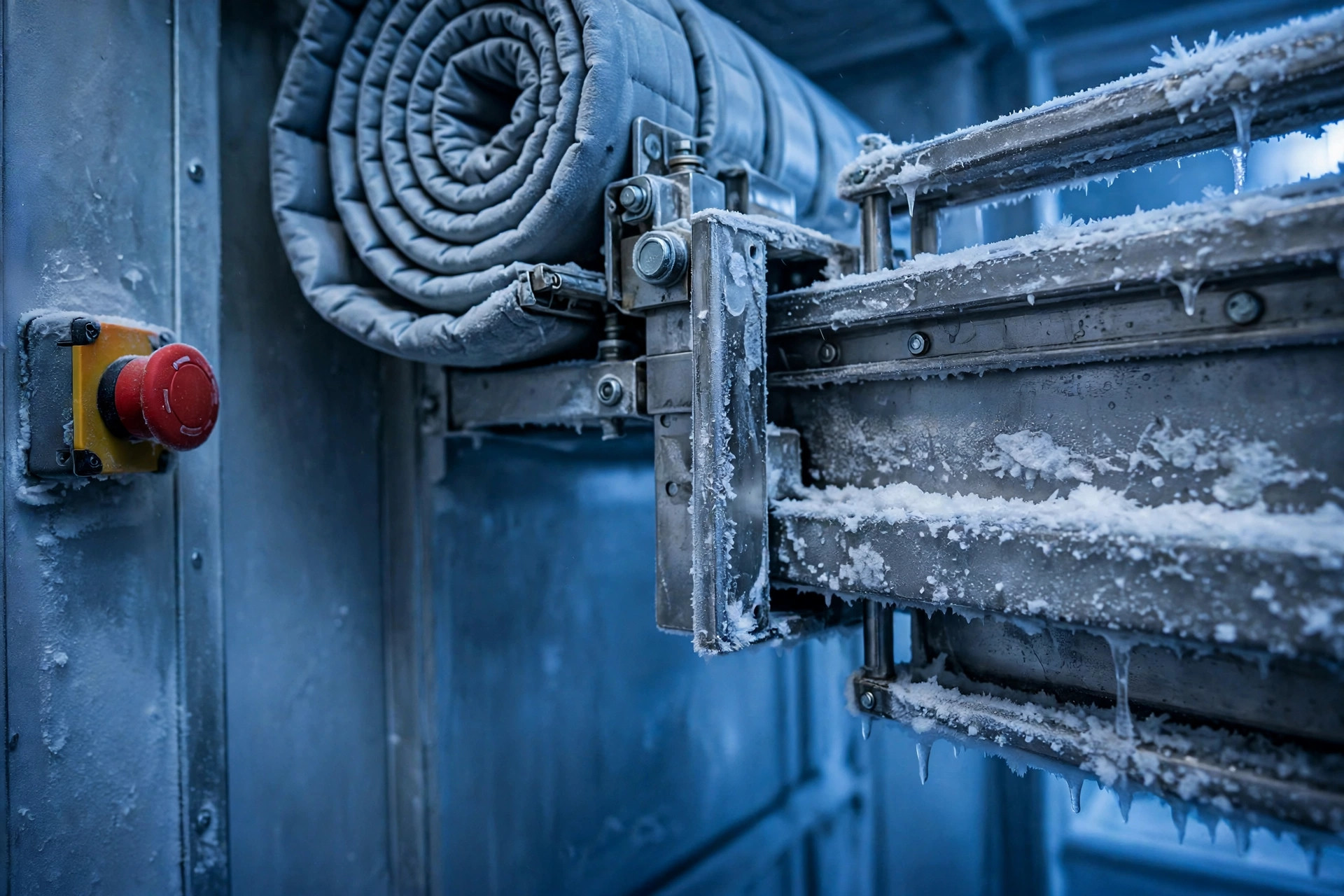
Frozen guides: the fix is guide heaters — a few hundred watts, trivial power draw, and no more melting ice with hot water in January. Check whether heaters are standard or an option. Plenty of lowball quotes make them an option. Looks good on the quote, miserable in winter.
Cold-rated motors: below minus 25, standard motor grease solidifies, inrush current spikes, and burnout risk climbs fast. Freezer door motors need to be cold-rated (minus 30 duty) or fitted with heaters. I've seen this exact failure three times — all of them cheap ambient-rated motors, all of them dead by the first winter. The replacement motors cost more than what was "saved."
The maintenance trap: you buy the door, you raise its lifespan
MTBF on a freezer high-speed door: three to five years with good maintenance, barely a year without. The difference comes down to three habits.
One: regular defrosting of guides and curtains. Weekly, plastic scraper, never metal — metal scratches the curtain coating and frost forms faster on the scratches.
Two: seal inspection. Aged, cracked seals double your air leakage. Seals are consumables. Replace yearly. Don't cry over a few hundred dollars.
Three: safety device testing. Infrared sensors and safety edges drift in the cold. Test monthly — does the door actually stop when someone walks through? This isn't about saving money. One accident and you're paying for it for years.
One unpopular opinion to close: this product category is murky. Two doors both labeled "2.0 m/s high-speed" — one built for ambient warehouses, one for freezers — can differ 40% in price. The difference is in the insulation build, the cold-rated motor, the guide heaters. All the things you can't see on a quote. If you buy on total price alone, your power bill and repair invoices will educate you within three years.
Is the money worth it? Watch one number: after the first winter with the new door, compare a month of refrigeration power against the same month last year. Down 15% or more — the door paid for itself. No drop? Check the curtain seals and your actual cycle count. The problem is always in one of those two places.
By Da Liu, Automation Engineer