Let me lay my cards on the table first: I run a 3,000-square-meter warehouse. We ship 80 to 120 pallets a day, up to 150 in peak season, with a packing crew of four. Last fall, two of my guys were hand-wrapping pallets all day - circling each pallet like it owed them money - and our monthly stretch film bill was pushing $4,000. As the owner (hi, that's me), I felt every dollar.
So I did what any cheap warehouse owner would do: I investigated both mainstream ways to secure a pallet - "stretch hood vs stretch wrapper" - and ran the numbers from a small-warehouse perspective. Here's the unfiltered version.
The mess we were in: hand wrapping is a money pit
September 2024, pre-holiday rush. Our daily pallet count jumped from 70 to 120. Two packers, hand wrap only: about 20 turns per pallet, 8 to 10 minutes each. That's over 1,000 minutes of wrapping a day - two people spending their entire shift walking in circles, everything else piling up.
The film waste was worse. Hand wrapping can't pre-stretch the film, so you're basically stacking raw film onto the pallet: 0.6 to 0.8 kg per pallet. An 18 kg roll covers barely 25 pallets. Do the math: 120 pallets x 0.7 kg is about 84 kg a day, roughly 2.2 tons a month. At prevailing consumable prices (check your supplier's latest quote), that's nearly $4,000 a month on film - before paying the two guys doing the wrapping. We weren't wrapping pallets; we were wrapping money and throwing it away.
The fancy option I walked away from
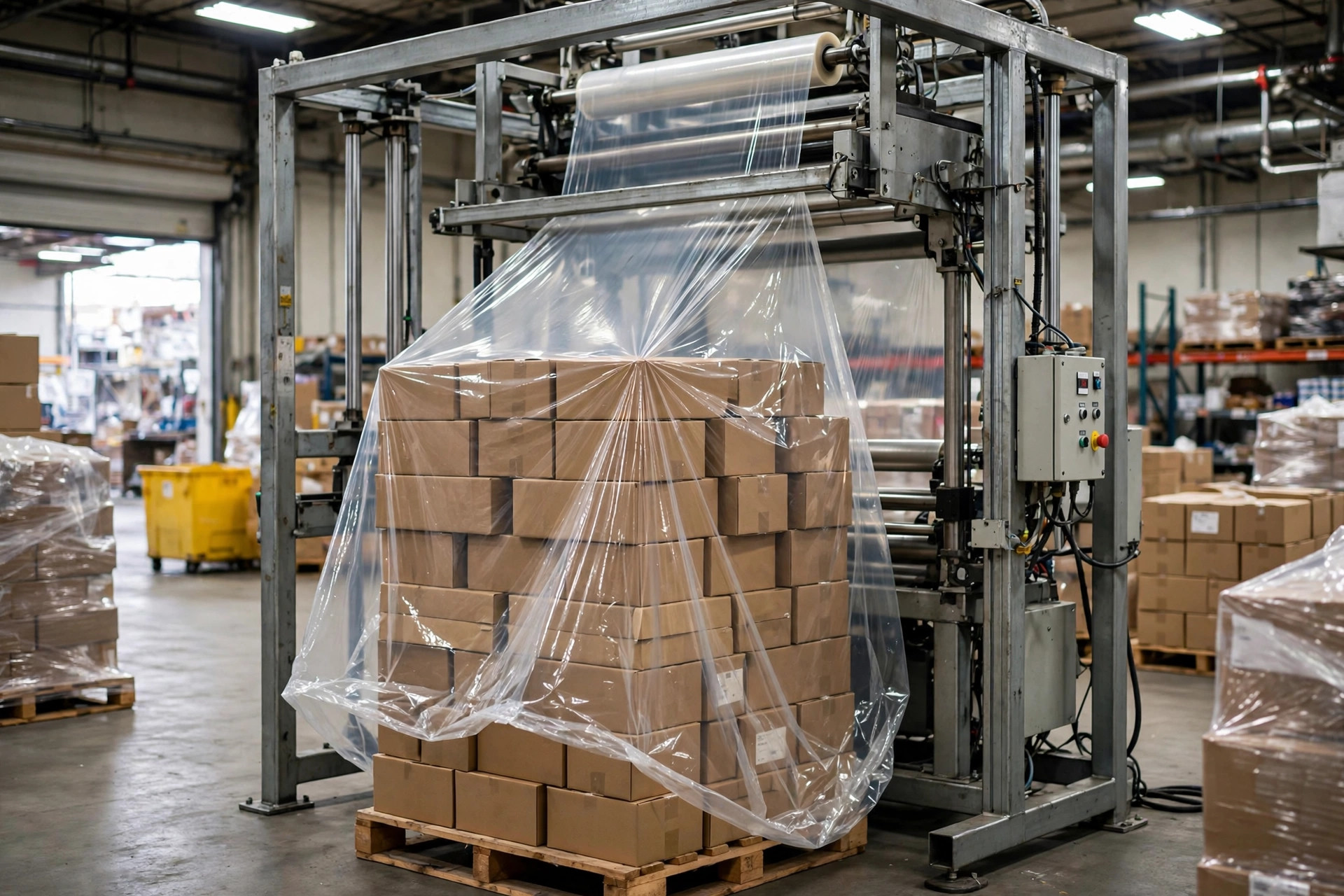
In March 2025 I toured a big distribution center in Suzhou - 2,000 pallets a day. They run fully automatic stretch hood machines: a film bag drops from above and shrink-hugs the entire pallet in about 20 seconds, top fully sealed, rainproof, dustproof. Gorgeous. I was sold - until I asked the price. Domestic hood machines run $60,000 to $150,000; imported brands start well above $150,000. I quietly closed the quote sheet. We small warehouses can't burn that kind of money.
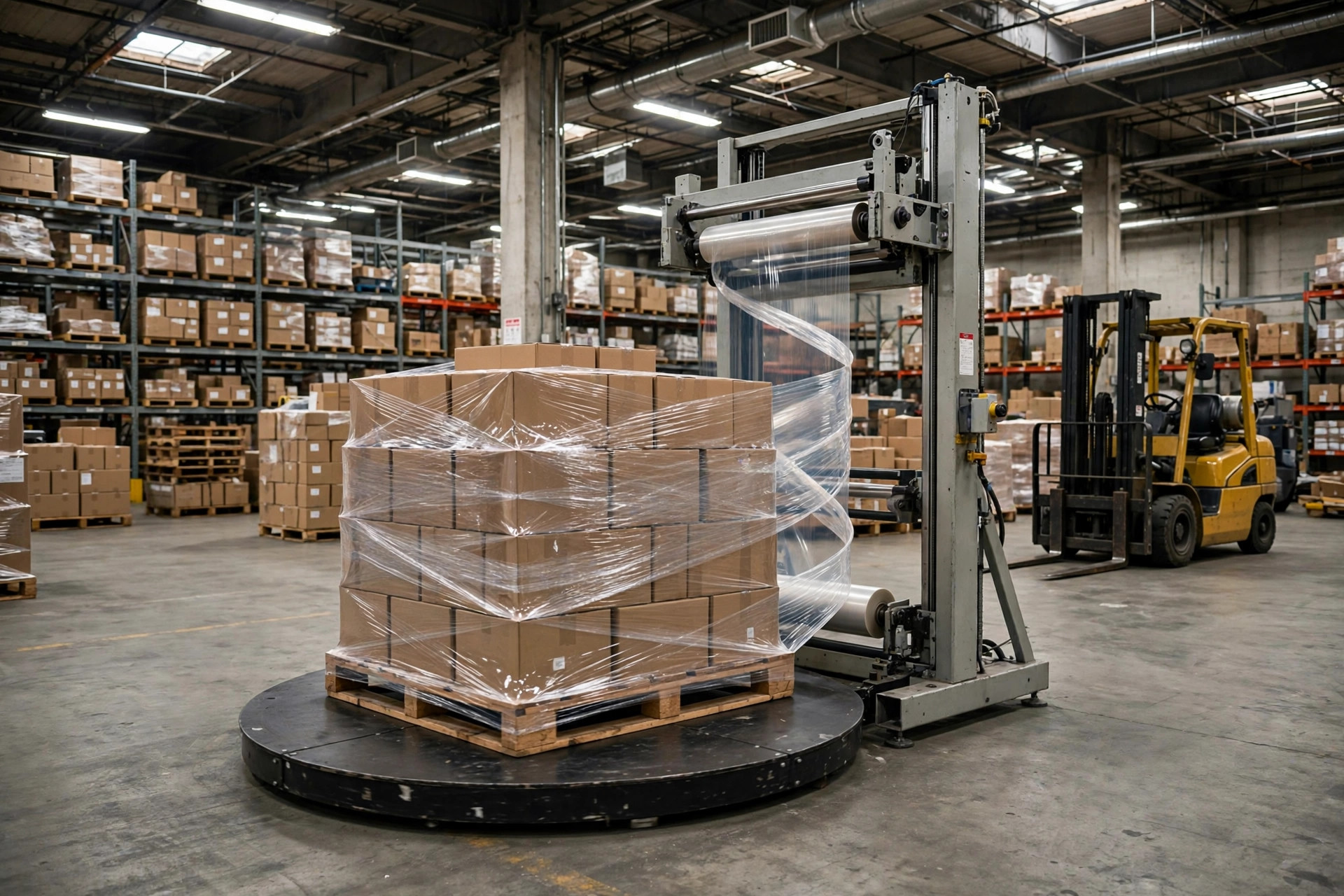
My neighbor Lao Zhao is more my speed. In 2024 he bought a used domestic turntable wrapper for about $1,700, spent another $400 on new pre-stretch rollers, and it hums along just fine. His philosophy: "Xiao Ma, a machine just needs to be good enough. Face doesn't pay the bills."
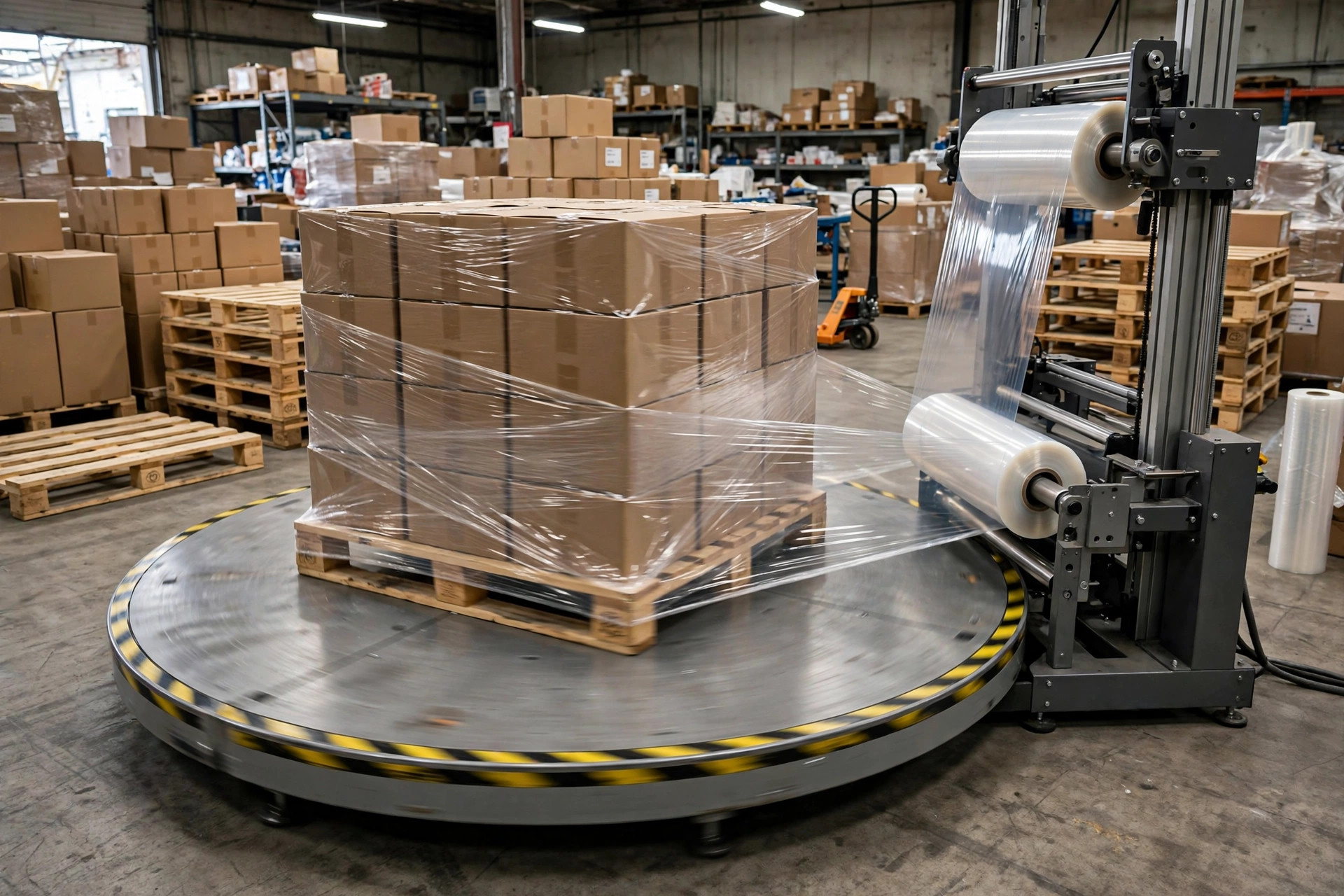
Running the numbers: "stretch hood vs stretch wrapper" side by side
Here's the comparison that matters (equipment prices are 2025-2026 public market ranges; confirm with the manufacturer's latest quote):
| Stretch Hood Machine | Turntable Wrapper (semi-auto) | Rotary-arm / Robot Wrapper | |
|---|---|---|---|
| Equipment cost | $60K-$150K+ domestic; $150K+ imported | $3K-$8K domestic; $6K-$12K imported | $4K-$9K (mobile robot type) |
| Film per pallet | ~100-200 g (custom hood bag) | ~200-400 g (pre-stretched film) | Same as turntable |
| Speed | 20-40 sec/pallet (fully auto) | 60-90 sec/pallet | 2-3 min/pallet |
| Weather protection | Fully sealed top - best in class | Open top; top sheet costs extra | Same as turntable |
| Changeovers | Bags are size-specific - a nightmare with mixed SKUs | Film is universal | Film is universal |
| Maintenance | One breakdown hurts | Simple build, cheap to fix | Rugged |
| Best for | 500+ pallets/day mega-DCs | 50-300 pallets/day small and mid warehouses | Odd-shaped or overweight loads |
Now the payback math, using my warehouse at 120 pallets a day. A domestic hood machine at around $70,000 uses maybe 150 g of film per pallet - call it roughly $1,300 a month in film. A $3,500 turntable at 300 g per pallet costs around $1,500 a month. The monthly film gap is a couple hundred bucks. The equipment gap is $66,000. How many years of film savings does it take to close that gap? Answer: longer than the machine will live. For a small warehouse, the equipment price difference is the whole story; the film difference is a footnote.
The counterintuitive part of "stretch hood vs stretch wrapper": a hood saves film, not hassle
Three things surprised me in this matchup.
First, the hood looks premium - but small warehouses live on mixed SKUs and odd sizes. Hood bags come in fixed sizes, so you stock multiple specs: overstock and your cash is tied up, understock and you're waiting on lead times. We can't afford that kind of elegant trouble.
Second, film isn't the real cost driver - people are. A wrapper does a pallet in 60-90 seconds versus 8-10 minutes by hand, 6-8x faster. But flip it around: at around 100 pallets a day, hand wrapping just means one extra hire - a few thousand a month - while a hood machine's monthly depreciation alone is five figures. Always do total cost, not line items.
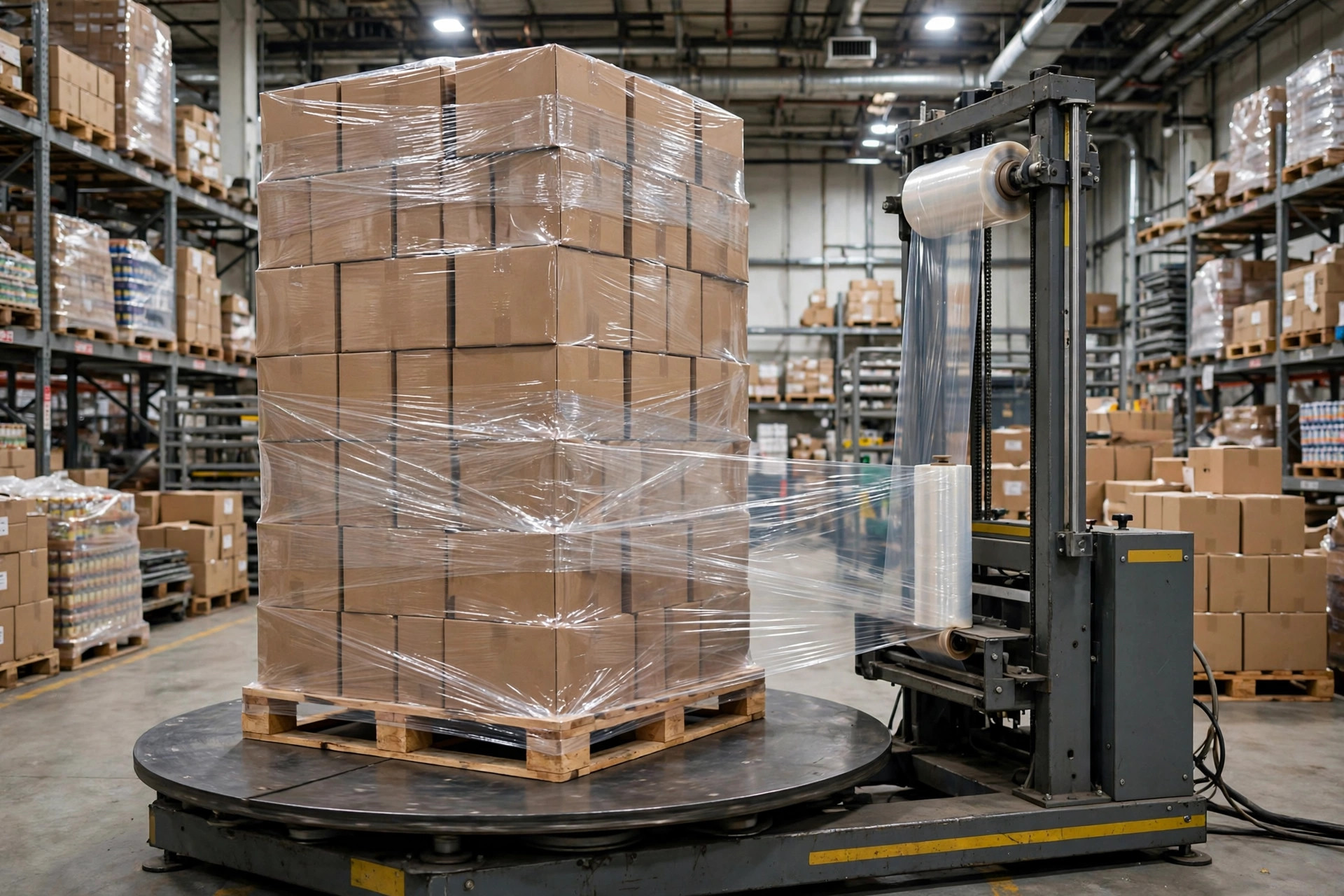
Third, pre-stretch is the small warehouse's real money saver. A turntable with 200-250% powered pre-stretch turns one meter of film into three. After we installed our used turntable, film per pallet dropped from 0.7 kg to 0.3 kg, and the monthly film bill fell from nearly $4,000 to about $1,200. The machine paid for itself in three months.
Advice for fellow small warehouses
- Under 300 pallets a day? Don't even browse hood machines - you're wasting your time. A semi-auto turntable with pre-stretch film is the no-brainer pick.
- Tight budget? Buy used. A $1,500-$2,500 used turntable with fresh rollers works fine - just test that the turntable runs true and the pre-stretch feeds smoothly.
- Don't cheap out on film. Weak stretch or poor tear strength means snapped film and rework, and every reworked pallet eats the savings. Get quotes from two or three consumable suppliers and negotiate terms on volume.
- Odd-shaped goods or overweight pallets (2 tons plus)? A turntable can't spin those - look at a mobile robot wrapper at $4K-$9K, an order of magnitude cheaper than a hood machine.
And if you can't even swing two grand (no shame - that was me in year one), three low-budget hacks: a handheld pre-stretch dispenser for a few hundred bucks cuts film use by about 30%; a one-page wrapping SOP (three locking turns at the base, cross-cross on top) that new hires learn in half a day; and group-buying film with the warehouse next door for 10-15% off. Pennies add up when every penny comes out of your own pocket.
Here's the honest truth: big DCs optimize for extreme throughput; small warehouses optimize for survival. A hood machine is a fine piece of engineering - just not for us. Keep the $70,000, stock more inventory, cover two more months of payroll. Small warehouses have their own way of surviving.
By Xiao Ma, Small Warehouse Owner