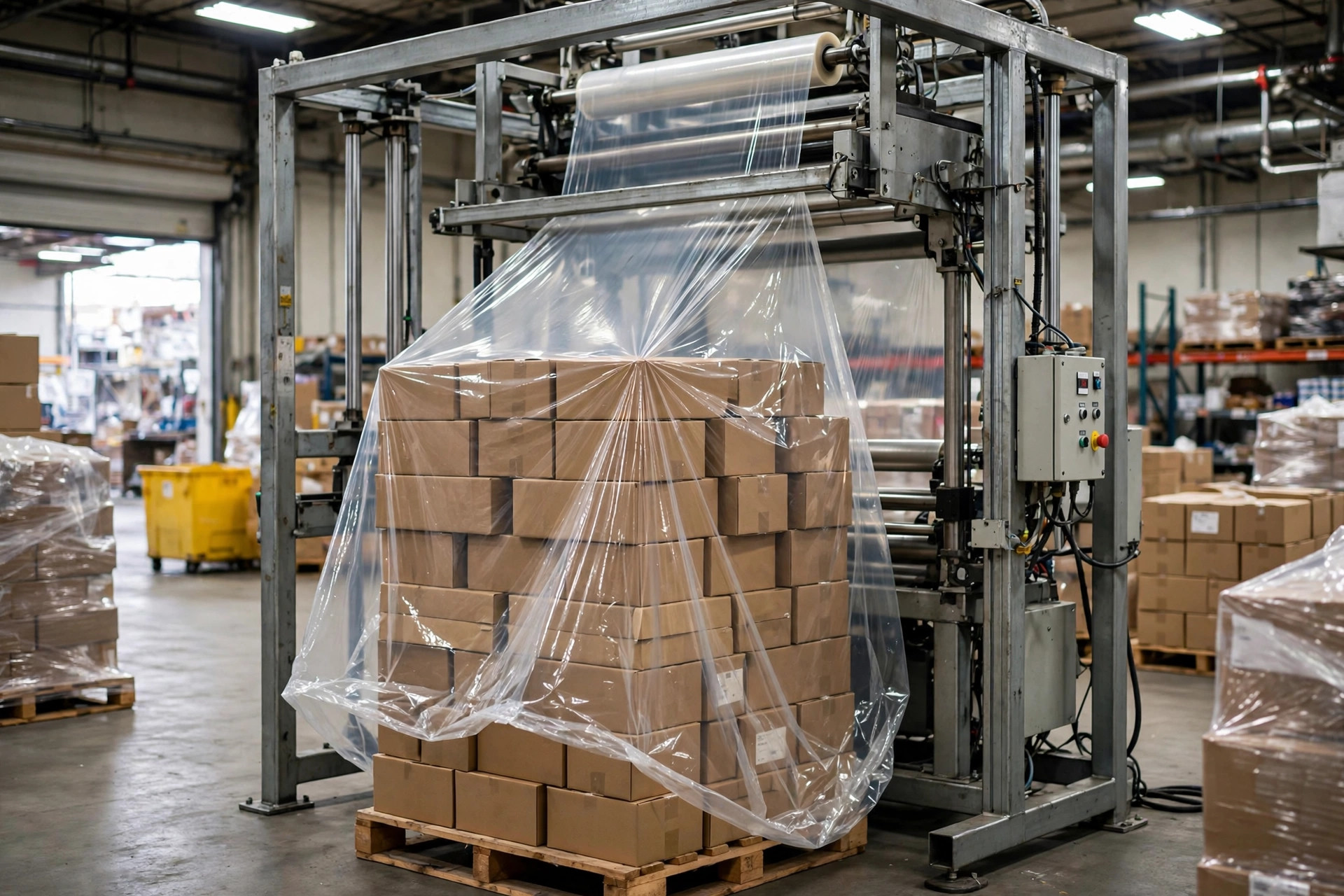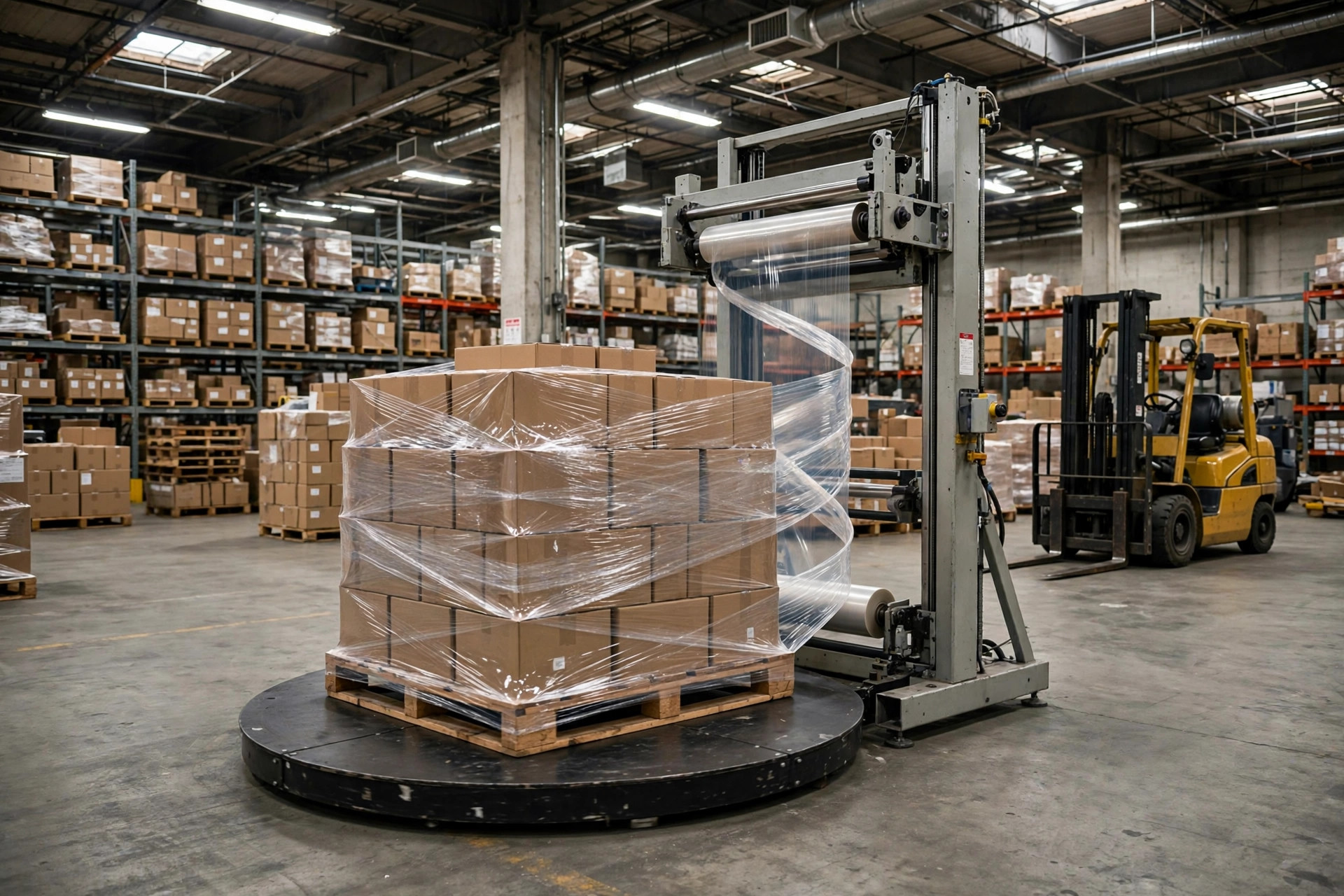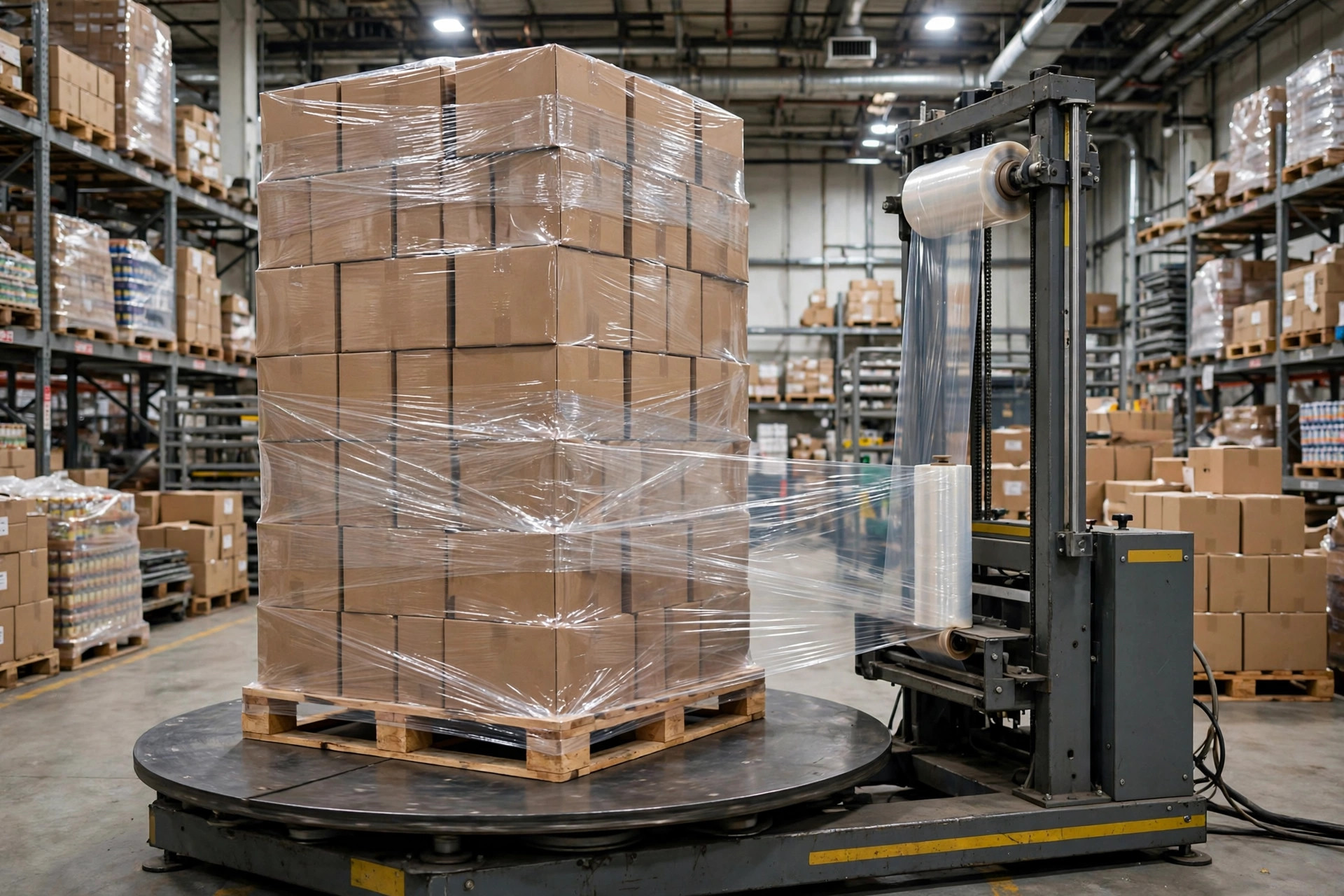
Our warehouse is 3,000 square meters. Until last year, every pallet was hand-wrapped. Two guys circling a pallet with a roll of film, backs aching by end of day, and we were burning nearly $2,000 a month just on stretch film. That was our reality: hand wrapping burns money and backs.
Here is the counterintuitive part: a stretch wrapper does not really save you labor. It saves you film. Hand wrapping stretches film maybe 1:1.5. A machine with powered pre-stretch hits 1:2.5, sometimes 1:3. Same pallet: 400 grams of film by hand, 150 grams by machine. The film savings alone run into the hundreds per month. The labor savings are just a bonus.
At the end of 2024 I gritted my teeth and bought a used turntable wrapper for $6,000. Three months later we had saved almost $5,000 on film. I will show the math below. Bottom line up front: if you wrap more than 50 pallets a day, buy a turntable wrapper with your eyes closed. Below 50, get your hand-wrapping SOP right first.
Stretch Wrapper Machine Selection: Three Types, Pick Your Match
| Type | Price range | Speed | Pre-stretch | Best for |
|---|---|---|---|---|
| Turntable | A few thousand to $20K | 1–2 min/pallet | ~250% | 50–200 pallets/day |
| Rotary arm | From ~$30K | Faster, handles tall loads | 300% | Heavy or extra-tall pallets |
| Ring wrapper | Most expensive | Fastest | Lowest film use | Hundreds of pallets/day |
We are a small warehouse, so we only look at the first row. The other two are nice to dream about — "we small warehouses cannot afford to burn that kind of money."
For a turntable, check three numbers: turntable diameter (65 inches covers a standard 48x40 pallet), powered pre-stretch ratio (insist on 250% or above, walk away from anything lower), and whether it has a built-in scale (optional, but it saves you buying a floor scale).
My neighbor Lao Chen bought a rotary arm machine for over $40,000. He wraps 80 pallets a day — the machine naps half the day. Classic case of using a cannon to kill a mosquito. Rule number one of stretch wrapper machine selection: buy for the pallet volume you have, not the volume you dream about.
Buying Used Is a Minefield: Check These Three Things
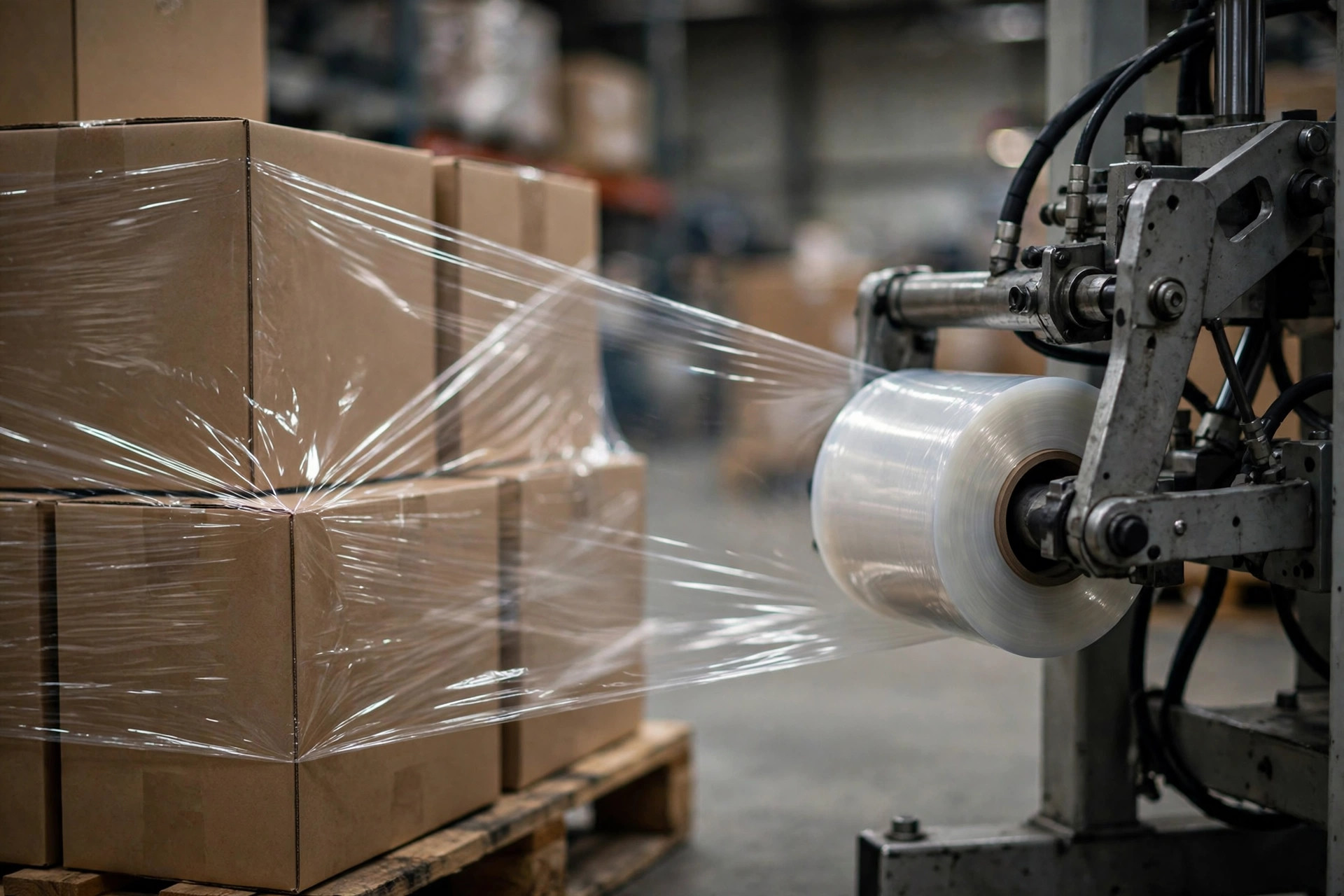
Mine was used. I checked exactly three things: 1) Does the turntable wobble when it spins — worn bearings mean walk away, repairs cost more than a new machine; 2) Does the film carriage move up and down smoothly — jerky movement means the motor is dying; 3) Any cracks on the pre-stretch rollers. If those three check out, you are probably fine.
One more trick: ask the seller to wrap three pallets on the spot and check whether the film tension is even. I tested this myself and it works — if the film is tight in some spots and loose in others, the pre-stretch rollers are slipping, and you would be buying yourself a headache.
The Film Math, Done for You
Before: about 0.4 kg of film per pallet by hand, 1,500 pallets a month, film at $2.20/kg — that is $1,320 a month on film. After the machine: 0.15 kg per pallet, $495 a month. Savings of $825 a month, nearly $10,000 a year. The $6,000 machine paid for itself in 7 months. And that ignores labor — the two guys now work on sorting. It is like getting two sorters for free.
Second counterintuitive lesson: do not pair the cheapest film with the best machine, or vice versa. Film and machine are a married couple; they have to match. A 250% pre-stretch machine running cheap low-stretch film is money wasted. Good film in human hands is wasted too. Buy the machine and the matching film together, and make the seller quote you a per-pallet film cost. Any proposal above $0.50 per pallet gets cut.
Three Rookie Traps in Daily Use
Trap one: too few wraps at the bottom. A pallet's biggest enemy is the forklift pickup — the whole load shifts. Minimum 3 wraps at the base. We once had a pallet collapse at the customer site and paid $800 in damages, all because the bottom got a single wrap.
Trap two: leaving the top open. Pallets staged outdoors in the rain soak water right through the film gaps and ruin the cartons. Cap the top — it costs 20 extra grams of film and saves you cargo damage claims.
Trap three: wrong carriage height. The film should start wrapping about 2 inches from the pallet base. Plenty of people start mid-pallet and end up with a loose bottom. First week on the machine, pull three pallets a day for inspection, and adjust until it is right.
Small Warehouses Have Their Own Way
Three takeaways: over 50 pallets a day, get a turntable stretch wrapper, no hesitation. Buying used is fine, but never skip the three inspection steps. Buy film and machine as a pair, and do the math on per-pallet film cost.
Small warehouses have their own way of surviving — spend where it counts. I already tested the stretch wrapper gamble for you. It is worth it.
What I Would Do Differently
If I could do it again, I would measure our real pallet volume for two weeks before buying. We guessed 60 pallets a day; the real number was closer to 45 in slow weeks and 90 at peak. A turntable still worked out, but the sizing exercise would have given me leverage to negotiate another $800 off the used machine — the seller knew we had not done our homework.
I would also budget for spare parts on day one: one extra pre-stretch roller set and a spare carriage belt, about $300 total. When our belt snapped in month five, the machine sat idle for four days waiting on parts. Four days of hand wrapping felt like going back to the stone age, and the film bill that month jumped right back up.
One last thing for fellow small-warehouse owners: do not let the vendor upsell you a fully automatic model with conveyor infeed. We were quoted one at nearly triple the price. For our volume, an operator loading pallets with a hand pallet jack takes 30 seconds. The fancy infeed would save us maybe an hour a day at ten times the capital cost. The math never worked. Semi-auto is the sweet spot for the little guys — good enough is good enough, and the money you save buys a lot of film.
By Xiao Ma, Small Warehouse Owner