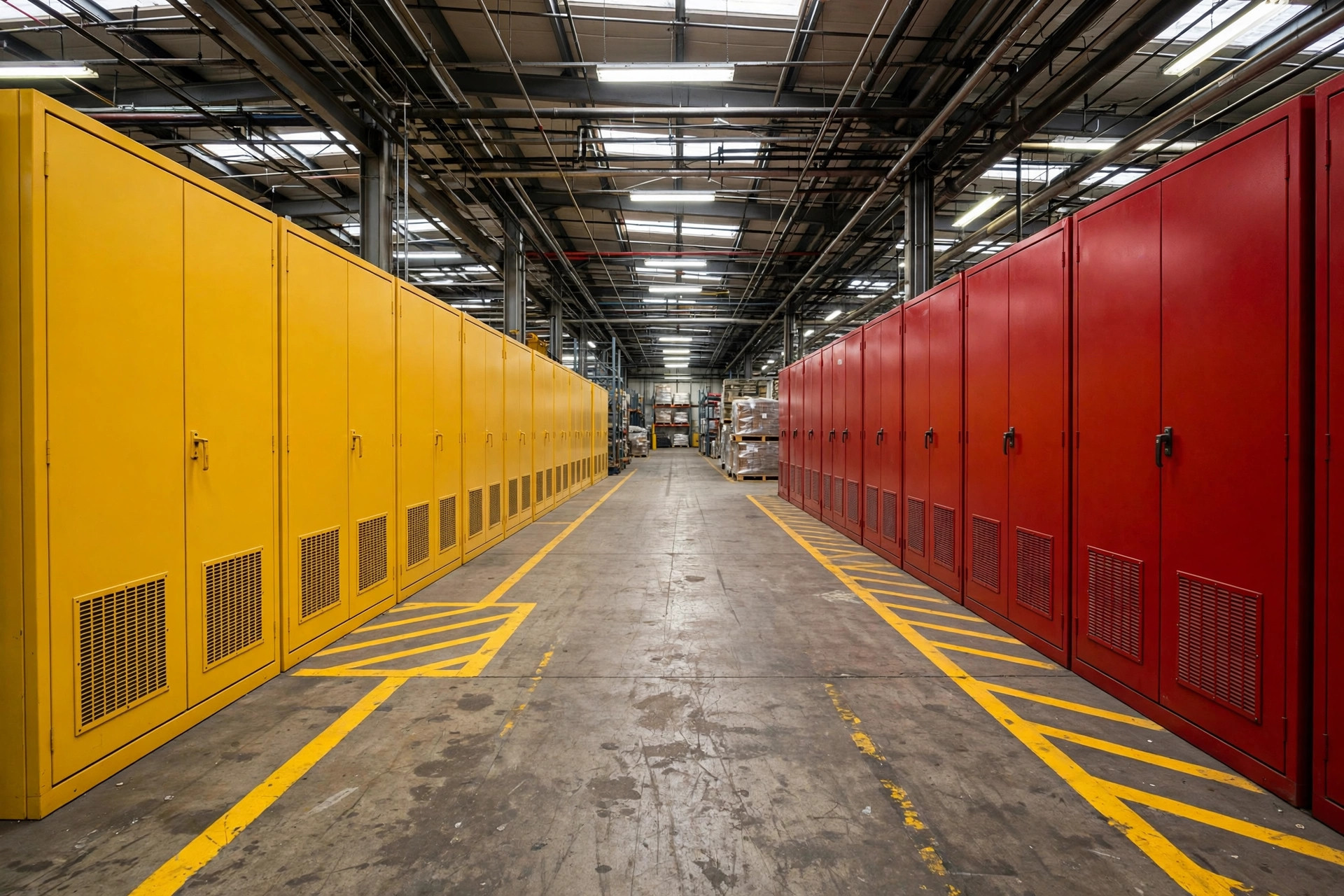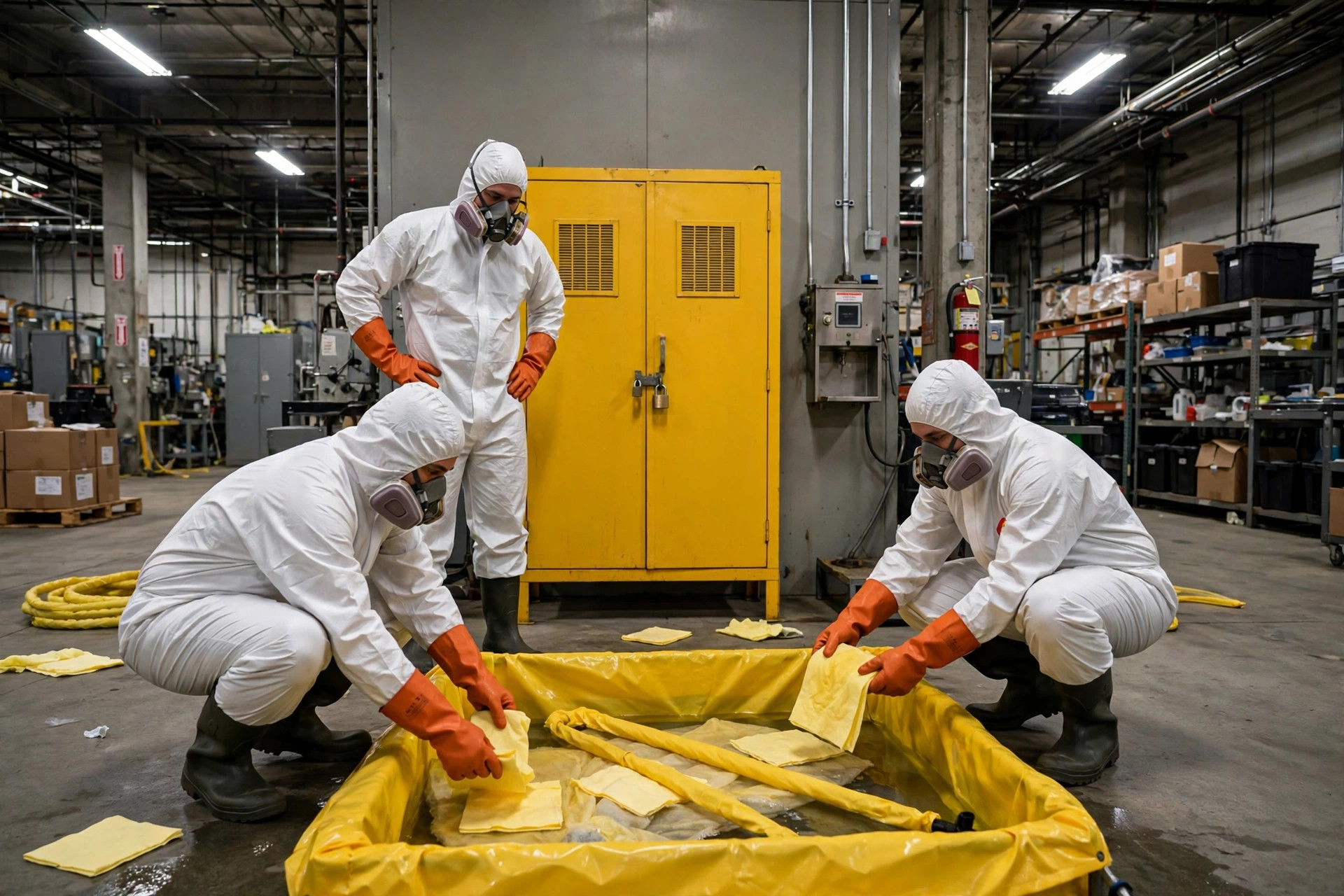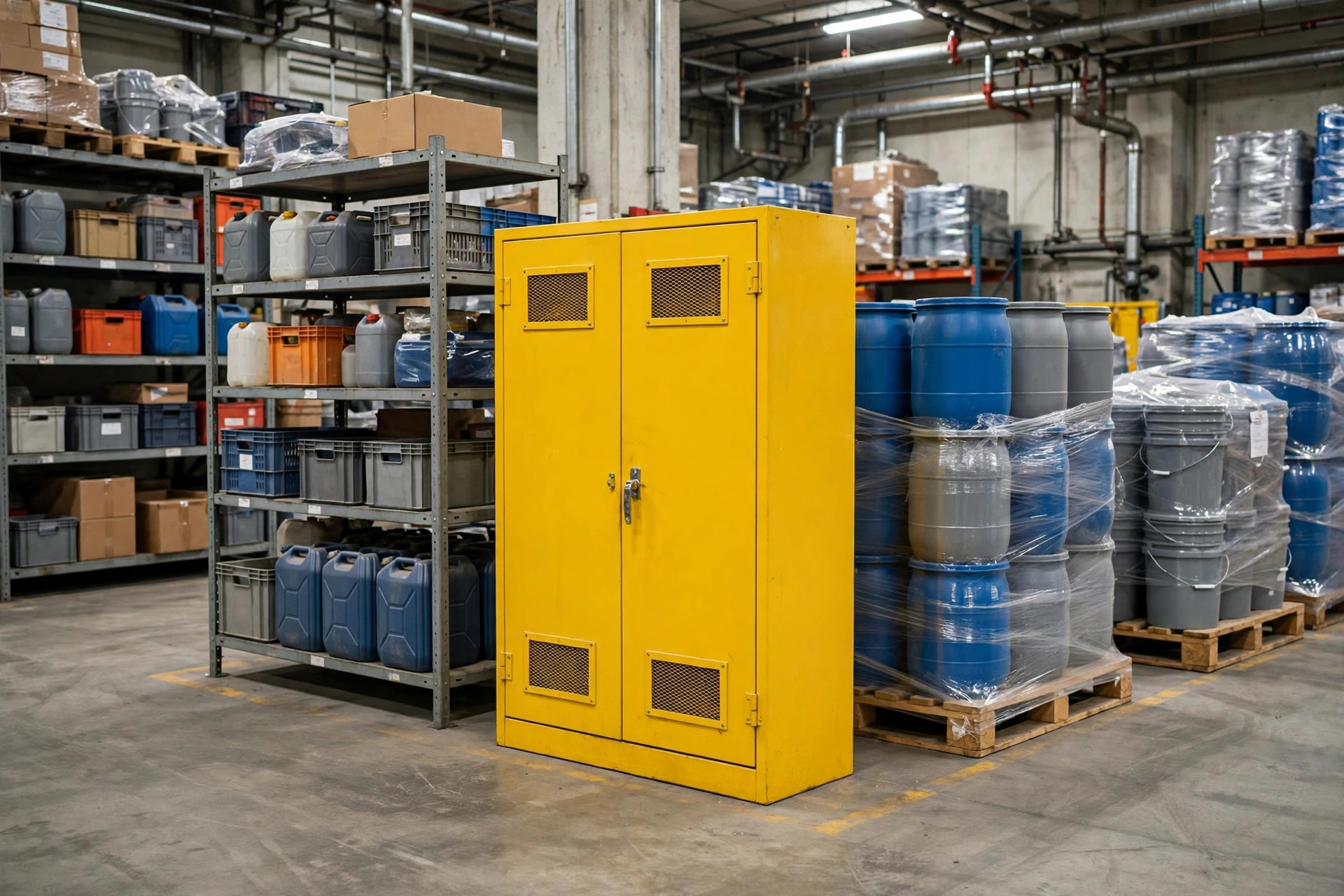
October 2024, Inland Empire, California. I was auditing a 3PL warehouse's compliance with osha flammable storage cabinet requirements warehouse — the rules for flammable storage cabinets under OSHA 1910.106. The hazmat area had two yellow cabinets. One was marked FLAMMABLE – KEEP FIRE AWAY. The other was bare, its label long gone. The warehouse manager shrugged: "Same batch. The label fell off." I skipped the label talk and did the math instead: the area held roughly 150 gallons of Category 2 flammable liquids, and OSHA 1910.106 caps a single safety cabinet at 60 gallons of Category 1/2/3 flammable liquids. 150 divided by 60, rounded up: he needed three cabinets and owned two. And the 150 gallons wasn't an estimate — we counted it together: twelve 5-gallon pails plus three 30-gallon drums. Twelve times five is 60, three times 30 is 90, 150 on the nose. Twenty minutes to count, ten seconds to conclude: one cabinet short. A missing label is a footnote. A missing cabinet is real money.
Four Numbers from OSHA 1910.106 — Memorize Them, Save Money
Section 29 CFR 1910.106(d)(3) is short. There are exactly four numbers in it that translate into dollars. Memorize them and you stop wasting money.
First: 25 gallons. Category 1 flammable liquids stored above 25 gallons must go inside a safety cabinet. That is the threshold line for "what must go in a cabinet." Below it you have options; above it there is no negotiation.
Second: 60 gallons. A single safety cabinet holds at most 60 gallons of Category 1, 2, or 3 flammable liquids. That is a per-cabinet cap, not a per-area cap.
Third: 120 gallons. For Category 4 liquids, the per-cabinet limit doubles to 120 gallons. Different category, different cap — classify your liquids before you buy cabinets, because a misclassified inventory makes every downstream decision wrong.
Fourth: 3 cabinets. No more than three safety cabinets in a single fire area. Want a fourth? Fine — build another fire area first. This is a quantity ceiling, separate from the volume caps above. Both must be satisfied at the same time.
The fifth rule costs nothing: the cabinet must bear a conspicuous FLAMMABLE – KEEP FIRE AWAY marking. In the warehouses I have walked through, a missing marking is one of the most common field findings — it is the first thing an inspector looks at when entering the hazmat area. My acceptance test is simple: readable from ten feet away, or it doesn't count. Crooked, dust-covered, or curling at the edges all mean the same thing as missing — no inspector is going to walk up and squint on your behalf.
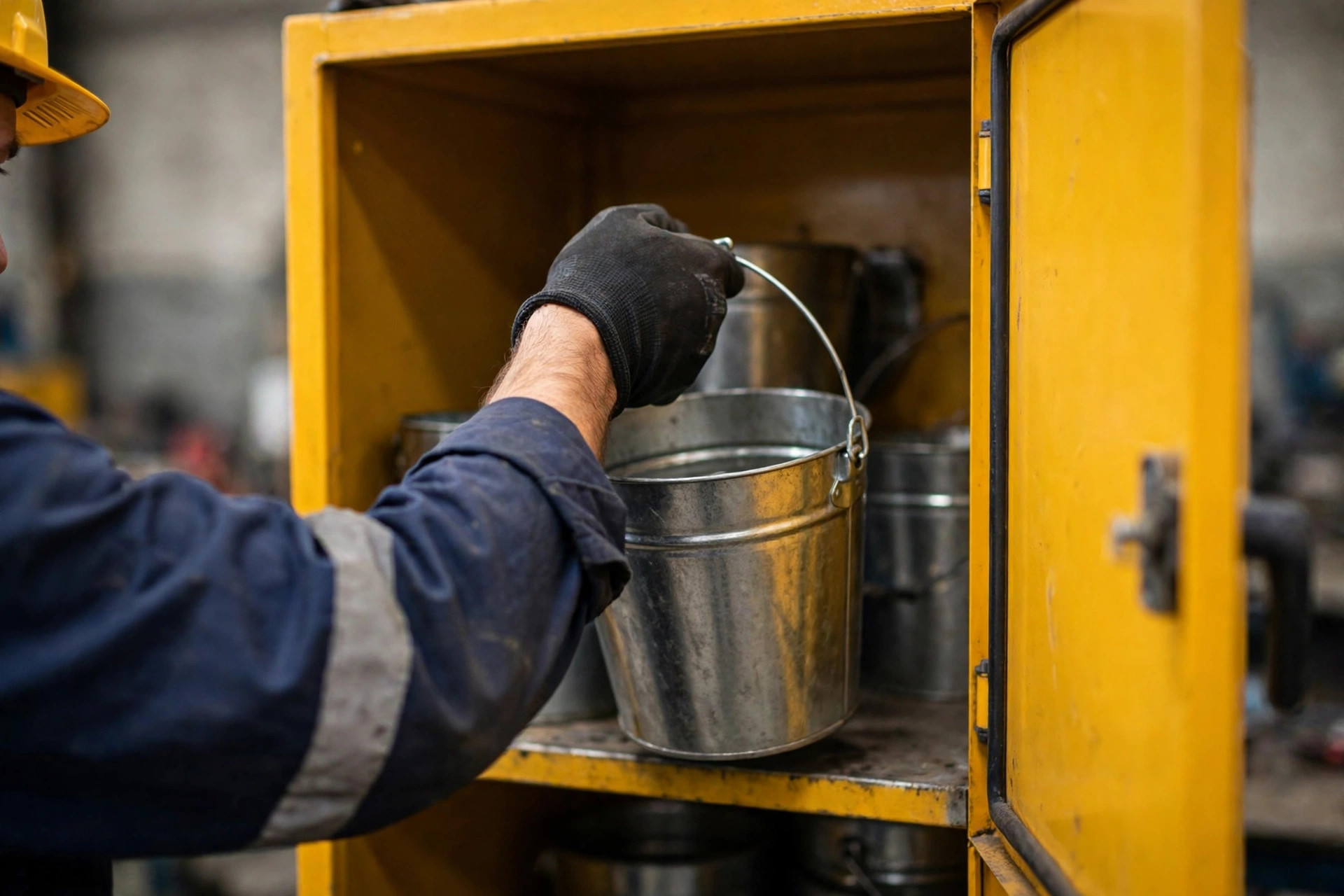
Safety Cabinet vs. Fine vs. Fire: Three Kinds of Money on One Table
| Where the money goes | Nature of the cost | When you pay it | My read |
|---|---|---|---|
| Buying safety cabinets | One-time capital, then routine inspections | After you compute the cabinet count | Mandatory spend, but not one dollar more — the count is calculated, not estimated |
| Markings and fire-area layout | Near-zero cost | Before opening, verified at every cycle count | The cheapest rule, and the easiest one to miss on the floor |
| OSHA citations | Per-violation | Every time an inspection finds it | Not in the same order of magnitude as cabinet costs |
| A fire loss | Downtime, liability, insurance hikes | Once is enough to break you | All of the above combined wouldn't cover the change |
In 2023 I saw the classic version at an auto-parts warehouse in Nevada: three safety cabinets, two labeled. The manager said the third was new and "the label is on order." The marking is the only zero-cost item among the five rules — and the easiest one to get cited for. "On order" means "not posted" to an inspector.
People ask me: how far apart are a citation and a fire, really? My answer: citations are priced per violation — however many findings one inspection turns up, that's how many line items, and the total is not in the same order of magnitude as cabinet costs. A fire is priced per incident — one is enough to throw every ledger out the window. So read the table top-down: get the first row's money right, don't skimp on the second row, and the third and fourth rows stay words on a table forever.
Three Levers That Actually Save Money
Lever one: compute inventory first, buy cabinets second. The formula is simple — cabinets = inventory ÷ per-cabinet limit (60 for Category 1/2/3, 120 for Category 4), rounded up. 150 gallons of Category 2 means three cabinets. Never buy on "two should be enough" — "should" is my least favorite word in this business. It only ever shows up on citations.
Lever two: respect the 3-cabinets-per-fire-area line. Three cabinets times 60 gallons equals 180 gallons — the ceiling for Category 1/2/3 liquids in a single fire area. At 190 gallons of inventory, adding the fourth cabinet means opening a second fire area. The marginal cost of that fourth cabinet is not "one more cabinet"; it is "one more fire-rated area's worth of construction." So if your inventory sits near the 180-gallon line, the cheapest move is not buying cabinets — it is cutting inventory and speeding up turnover to fit back under three cabinets.
Take Category 2 as the example — one table shows the cliff:
| Inventory | Cabinets (÷60, round up) | Fire areas (÷3, round up) | Read |
|---|---|---|---|
| 120 gal | 2 | 1 | Comfortable, one cabinet of headroom |
| 150 gal | 3 | 1 | One fire area maxed out; one more gallon means a new area |
| 190 gal | 4 | 2 | The fourth cabinet triggers a second fire area |
| 200 gal | 4 | 2 | Same |
See it? From 180 gallons to 181 gallons — one gallon apart, one whole fire-rated area apart in cost. That is what translating osha flammable storage cabinet requirements warehouse from regulation into a purchase order actually looks like. The cliff is not on the cabinet. It is on the fire area.
Lever three: don't let the cabinet go "out of spec." The 25-gallon threshold is the most overlooked one — "just 30 gallons on the shelf, it's convenient" is a standalone citable violation. And if a marking falls off, replace it the same day. "Later" means "at the next inspection."
What if you can't cut inventory and the extra fire area is unavoidable? Then it is a straight choice: Option A, build the second fire area — one-time construction cost. Option B, cut inventory and speed up turnover — ongoing management cost. My rule: if one year of Option B costs less than Option A's construction amortized over three years, do B first. If you can't run the numbers, don't sign off — "roughly" doesn't count in my book.
Here is the counterintuitive part: a more expensive cabinet is not a more compliant cabinet. OSHA reads four numbers and one marking — not brands, not price tags. I have seen imported premium cabinets cited because the marking was missing, and plain commodity cabinets pass clean because the count and the marking were right. Spend compliance dollars on getting the quantity right and the marking secured. Spending them on brand premium for the cabinet itself is money down the drain. That is not to say a premium cabinet is never worth it — if it seals better and lasts longer, the value sits in "fewer replacements," not in "more compliant." There is no brand column in the OSHA text.
A Conclusion You Can Calculate
Take this formula with you: cabinets = inventory ÷ per-cabinet limit (60 for Category 1/2/3, 120 for Category 4), rounded up; fire areas = cabinets ÷ 3, rounded up. 150 gallons of Category 2 → 3 cabinets → 1 fire area. 200 gallons of Category 1 → 4 cabinets → 2 fire areas. Run the math before you place the order: one cabinet too many is waste, one too few is a citation. Print the table above and pin it on the hazmat area wall — the real question behind osha flammable storage cabinet requirements warehouse was never "are cabinets expensive." It is "how many cabinets, and how many fire areas, does your warehouse actually need." For the exact regulatory text, always check the current OSHA and NFPA standards.
By Lao Zhou, Logistics Cost Analyst