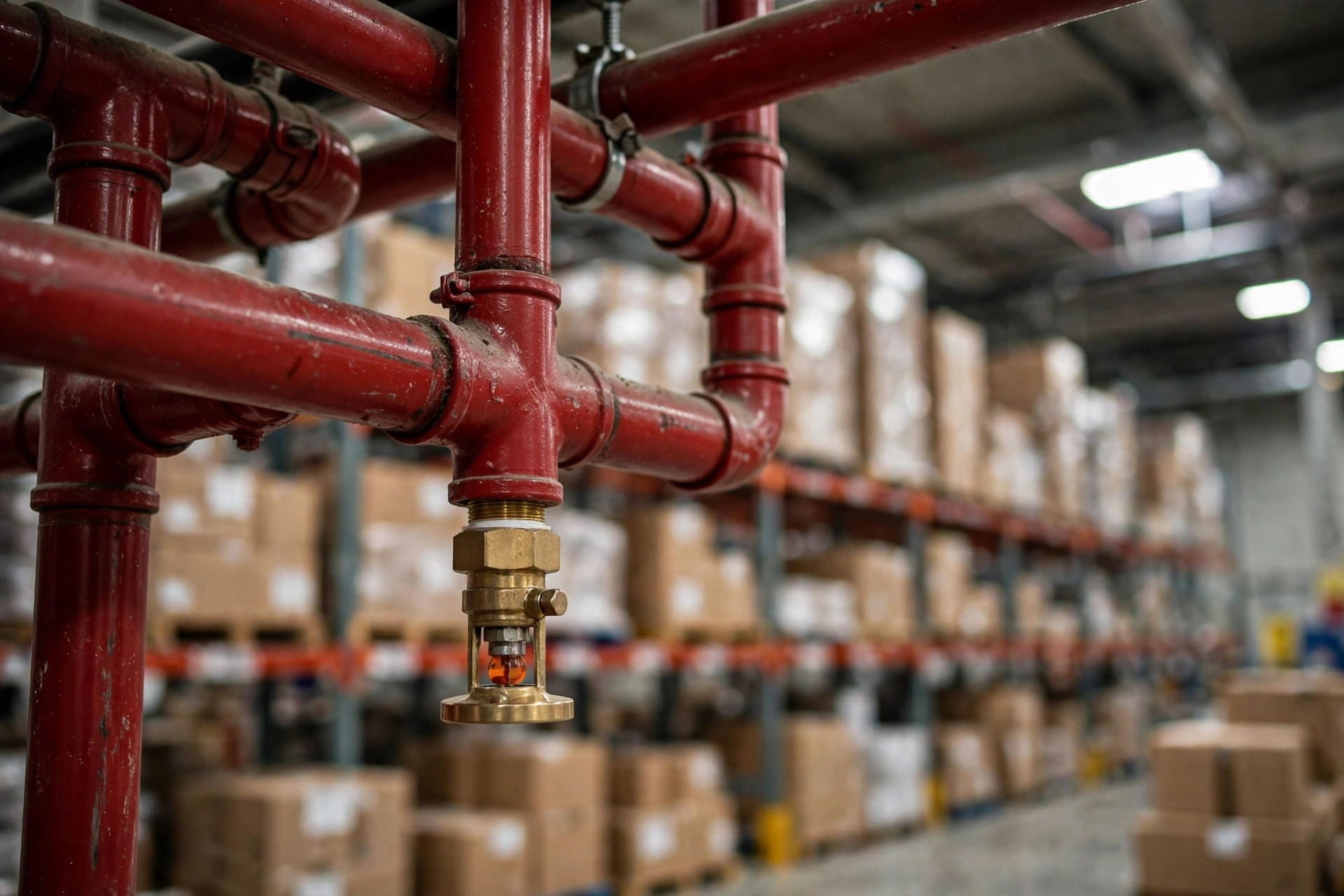
Take a 300,000-square-foot warehouse. What does fire sprinkler maintenance actually cost per year under the NFPA 25 fire sprinkler inspection requirements? Here is the number first: inspection alone runs roughly $3,000–$8,000, based on publicly quoted ranges in the U.S. fire protection maintenance market (confirm with your local AHJ and contractor). But that is only the first line of the bill. The real money is never in the inspection fee. It sits in the deficiency list stapled to the back of the inspection report — remediation, re-inspection, partial shutdowns, and a harder insurance renewal. Spread over five years, the inspection fee often accounts for less than a third of the total spend.
The NFPA 25 fire sprinkler inspection requirements are the U.S. benchmark for inspection, testing, and maintenance of water-based fire protection systems, and most jurisdictions enforce them directly. The standard splits maintenance into four fixed intervals: monthly, quarterly, annual, and every five years. Once you know what each interval covers, who performs it, and what it costs, you can see exactly where the money should go — and which dollars are wasted.
The Four NFPA 25 Inspection Intervals, on One Ledger
| Interval | What gets checked | Who does it | Cost range |
|---|---|---|---|
| Monthly | Control valve position (open/closed), tamper seals intact, dry-system air pressure | In-house staff can do it | Near zero — labor time only |
| Quarterly | Waterflow alarm device test, supervisory switch test, main drain test | Licensed contractor | Usually bundled into the annual service contract |
| Annual | Full sprinkler/piping/hanger inspection: corrosion, paint coverage, obstruction, 18-inch clearance | Licensed contractor | About $1,000–$5,000 under 250k sq ft; $4,000–$10,000+ over 500k sq ft |
| Every 5 years | Internal pipe inspection, gauge calibration or replacement, 150 psi hydrostatic test of the fire department connection for 2 hours | Licensed contractor | $1,000–$10,000, billed separately |
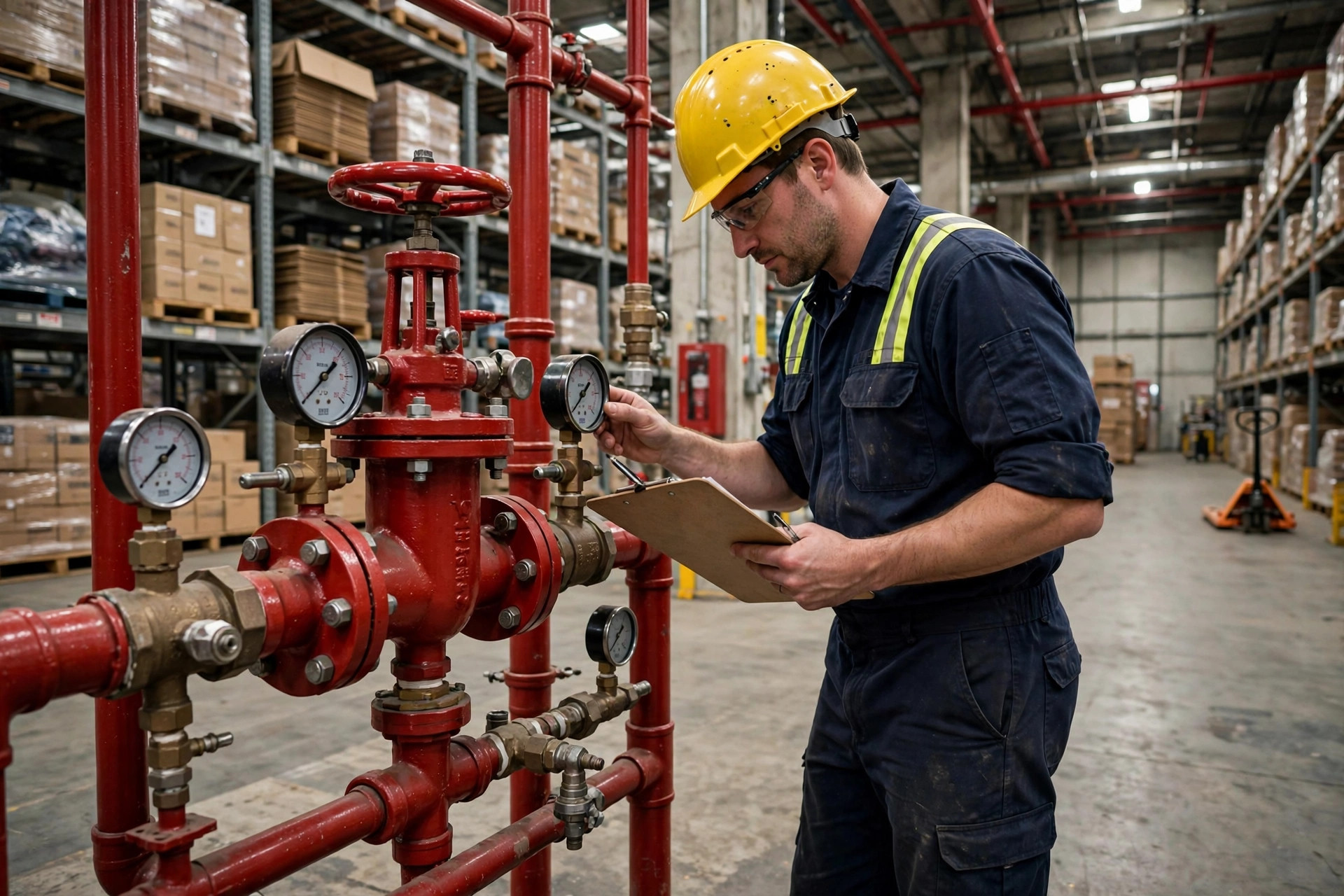
Read that table once and the first conclusion writes itself: of the four intervals, only the monthly check is one you can get for free. Verifying that nobody closed a control valve, that the seals are intact, and that dry-system pressure has not drifted requires no license — your own facilities or safety person can do it with a checklist and a phone camera in 15 minutes. Yet most warehouses skip even those 15 minutes.
Two Scenarios: How "Inspection Fees" Become "Remediation Bills"
Scenario one: a 350,000-square-foot 3PL warehouse in Ontario, California. Its 2024 annual inspection came back with 19 deficiencies — 17 sprinklers coated by that year's rack repainting, plus 2 branch lines bent by forklifts. Under NFPA 25, a painted sprinkler must be replaced, not cleaned; that is non-negotiable. Replacing the heads, repairing the pipe, and the re-inspection totaled about $6,500 — more than double that year's inspection fee. Worse, remediation dragged on for two weeks, and the insurer asked for three extra rounds of documentation at renewal. The premium negotiation started from a weak position.
Scenario two: a 600,000-square-foot dry-system warehouse in Dallas, Texas. Nobody performed the monthly checks, so a slow winter air-pressure loss went unnoticed until the spring annual inspection found a corroded valve assembly. The internal pipe inspection — originally scheduled five years out — had to be pulled forward, adding roughly $8,000. The root cause, on review, was skipping a 15-minute monthly pressure reading.
Both scenarios point to the same counterintuitive conclusion: the most expensive part of fire protection maintenance is never the inspection fee — it is the remediation that follows a failed inspection. Inspection fees are published and comparable. Remediation is reactive and non-negotiable. Every dollar you save by skimping on inspections comes back multiplied in remediation, downtime, and insurance risk.
DIY vs. Contractor: Split the Costs Apart
| Item | Do it in-house | Hire a contractor | My call |
|---|---|---|---|
| Monthly checks (valves/seals/pressure) | Negligible labor cost | Still billed inside a contract | Do it yourself — pure margin |
| Quarterly tests (waterflow/main drain) | Not possible — license and equipment required | Cheapest when bundled into the annual contract | Outsource, but confirm it is in the contract |
| Annual full inspection | Not possible | $1,000–$10,000+ by footprint | Outsource; get at least three quotes |
| Five-year internal inspection/hydro test | Not possible | $1,000–$10,000 | Outsource; start quoting a year ahead |
| Deficiency remediation | Small fixes in-house (e.g., moving stock for clearance) | Billed per item at high unit rates | Decouple: inspection contract and remediation quotes separate |
Note the last row — it is where the industry's favorite pricing game lives: quote the inspection cheap, bill the remediation dear. Insist during negotiation on one rule: the annual inspection contract covers inspection only, remediation is quoted separately, and you reserve the right to get a second bid. That single clause routinely saves more than the inspection fee itself.
Four Money-Saving Levers, Ranked by ROI
Lever one: self-audit the 18-inch clearance — infinite ROI. The single most common warehouse inspection deficiency is stock piled too close to sprinklers; the standard requires 18 inches of clear space below the deflector. Remediation costs zero — just move the pallets. But once it lands on the report as a deficiency, you pay a re-inspection fee and leave a paper trail with the fire marshal and your insurer. Have your stock crew eyeball it weekly. Zero cost.
Lever two: put impact protection on risers and valve assemblies. Forklift strikes on sprinklers and piping are the second-biggest deficiency source. A set of column guards costs a few hundred dollars; repairing one bent branch line costs several times that. This math needs no second pass.
Lever three: keep the fire department connection clear. The FDC is where responding engines hook up their supply, and blocked FDCs — pallets, dumpsters parked in front — are a routine inspection finding. Clearing it costs nothing; a blocked connection during an actual fire costs more than money.
Lever four: budget the five-year inspection a year early. Internal pipe inspection plus the 150 psi hydrostatic test is a big-ticket item, and the $1,000–$10,000 spread depends entirely on pipe condition. Start quoting twelve months out and fold it into the annual budget instead of accepting a take-it-or-leave-it price three months before the deadline.
NFPA 25, 2026 Edition: Three Changes That Hit Your Budget
The 2026 edition carries three changes warehouse operators should price in. First, spare-sprinkler inventory must now record the installed quantity of each model — previously you just had to stock spares; now the log must tie to what is actually installed, so the counting workload goes up. Second, more situations require removing escutcheon plates for inspection, which adds labor hours — confirm whether your quote includes it. Third, both planned and emergency impairments must now be reported to the authority having jurisdiction, adding a coordination step that raises the cost of ad-hoc shutdown remediation. None of this changes the four-interval framework, but all of it thickens the quote. Verify each line item in negotiation so "new-edition pricing" does not become a blank check.
The Bottom Line: A Number You Can Compute
Stop asking "what does fire protection maintenance cost per year" — the question has no answer. Run your own warehouse through this formula instead:
(Annual inspection fee + five-year cost ÷ 5 + estimated annual remediation) ÷ warehouse square footage = annual maintenance cost per square foot
Plug in mid-range values for a 300,000-square-foot building: (5,000 + 5,000 ÷ 5 + 3,000) ÷ 300,000 ≈ $0.03 per square foot per year.
Three cents. That is your negotiating baseline with contractors and your budget justification with the boss. Come in under it, and your monthly self-checks are doing their job. Come in well over it, and go look at the remediation and re-inspection lines — that is where the money went.
By Lao Zhou, Logistics Cost Analyst