A failed warehouse fire inspection costs real money before it costs you anything else. Two to four weeks waiting for a re-inspection. Two weeks of rent, payroll, and insurance with no freight moving in or out. For a 50,000-square-foot building, that idle cost runs roughly $80,000–$150,000, depending on your local numbers — do the math on your own rates. And the reason that most often kills the inspection is warehouse sprinkler coverage blind spots fire inspection officials are trained to hunt down.
The logic inspectors work from is NFPA 13's full-coverage rule: every area has to be protected, including the unprotected spaces under large ducts and above concealed ceilings. Port authority acceptance procedures state it plainly — verify full coverage, including the spots nobody looks at. Here are the five blind spots where I have seen operators lose the most money.
Where the money goes: the five blind spots
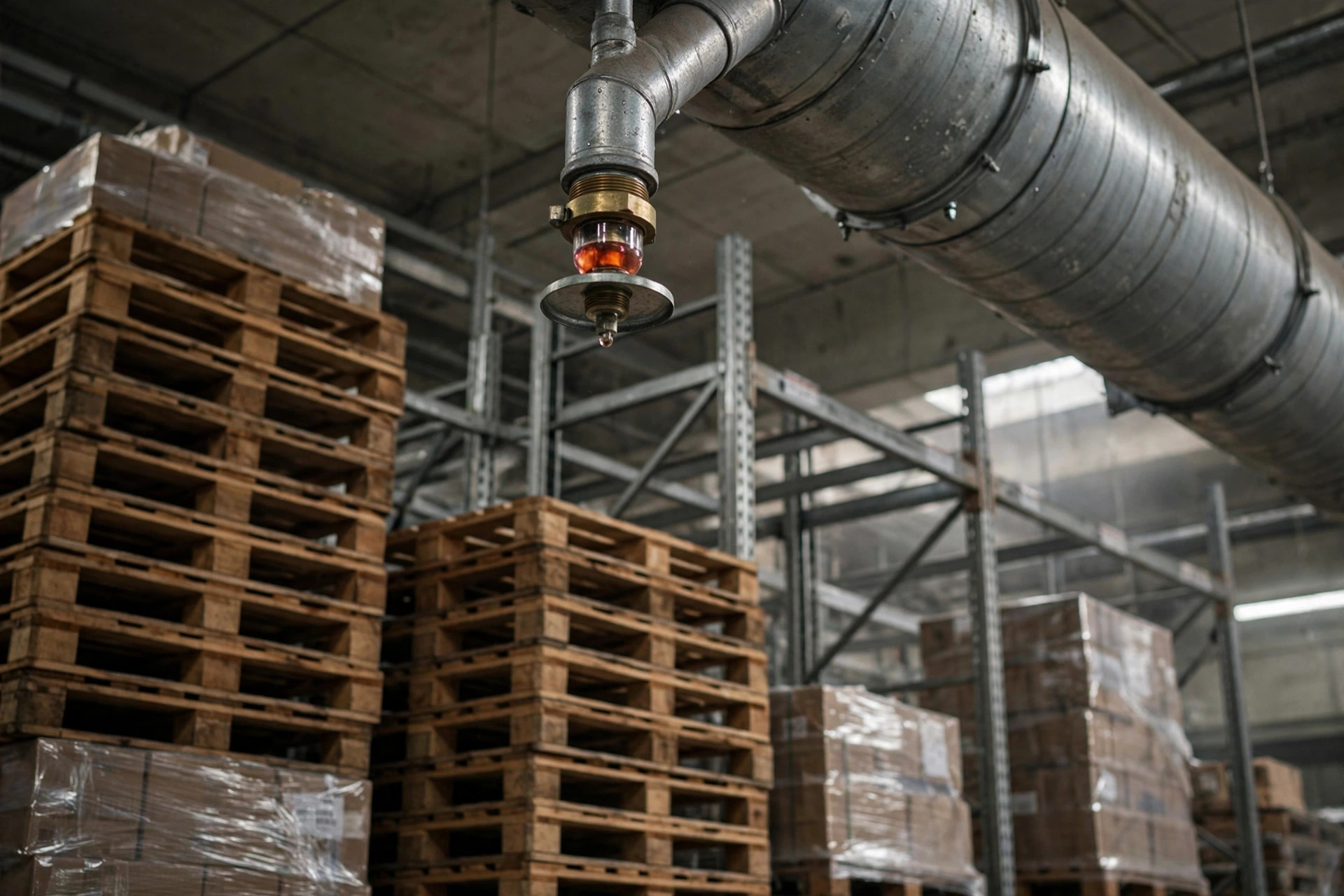
1. The shadow under the big duct. HVAC runs get installed, sprinklers stay where they were. A sprinkler protects by throwing a cone of water; put a 30-inch duct through that cone and the area underneath it gets nothing. The inspector walks under your main duct, looks up, and writes you up.
The fix is usually the cheapest of the bunch: add heads under the duct. If the branch line reaches, a new head lands somewhere around $600–$1,200 all-in per position (material, labor, ceiling patch — use your local fire contractor's quote, these are ranges, not bids). A 100-foot duct needs roughly 8–10 heads on 10–12-foot spacing, so a few thousand to low five figures. Compare that to two weeks of idle facility cost and tell me which is the better spend.
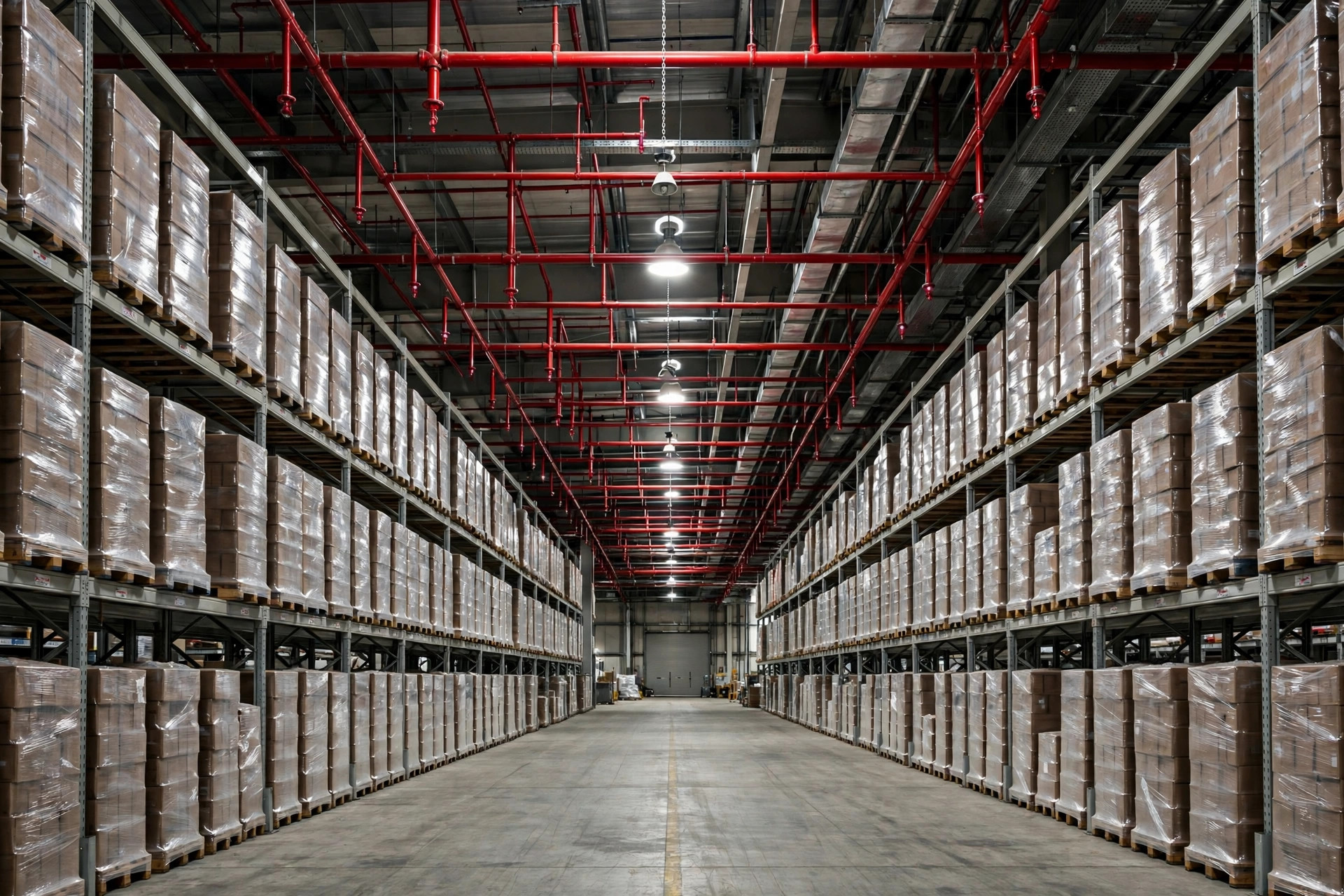
2. Racks got taller, sprinklers didn't. This is the one I see on every acquisition walkthrough. A building designed for 20-foot racks gets re-racked to 30 feet. Sprinkler height is tied to storage height and commodity class under the coverage logic — when either changes, the old system may no longer protect the current configuration. Fire protection engineers have noted that plenty of fire officials themselves can't always identify when a sprinkler system falls short of the actual commodity stored. Don't count on anyone else catching this for you.
Cost depends on the gap. Adding a layer or two of racks might mean extra heads or higher-K-factor sprinklers — a few hundred to a couple thousand per head. But if the commodity class changed too (say from ordinary goods to plastics or aerosols), the whole zone needs recalculation and the cost jumps an order of magnitude. The worst version of this story: racks were raised in one project and the commodity changed in another, each modification tripping its own failed inspection. You pay for the redesign twice.
3. The small room someone walled off, with no heads at all. Print rooms, battery-charging rooms, sample rooms — every warehouse grows these. A real case: late 2024, a California 3PL walled off a roughly 12-by-15-foot charging room on its mezzanine for AGV batteries. The contractor skipped the sprinklers to save time. The inspector opened the door, saw no coverage, and failed the building. Adding heads after the ceiling was finished meant demolition, piping, and restoration — close to $20,000 for that one small room (local contractor quotes will vary), more than the partition itself cost to build.
An even more expensive variant: a New Jersey operator put its charging room in a corner near heavy racking in early 2025. After the fail, they needed new heads and had to relocate the room because it interfered with an egress path. One rule that pays for itself: call your fire contractor before the partition goes up, not after. After costs at least double.
4. Storage piled above the design limit. Every system is designed for a maximum storage height, and once you exceed it, pressure and coverage don't hold. The most common violation in warehousing is the 18-inch clearance rule — nothing stored within 18 inches below the sprinkler deflector. It sounds simple, but during peak season someone double-stacks the top level and nobody fixes it before the inspector arrives.
Here's the interesting part: this blind spot is often the cheapest to fix, because it rarely requires touching the fire system. Re-plan top-level slotting rules, move over-height freight to zones designed for it. Cost is mostly labor and one cycle count — low four figures. But if over-stacking has become the norm and operations won't change the habit, the only path is a system upgrade, which jumps to six figures. My advice: try managing the storage rules first. You can only spend money on the system after you've failed at the cheaper lever.
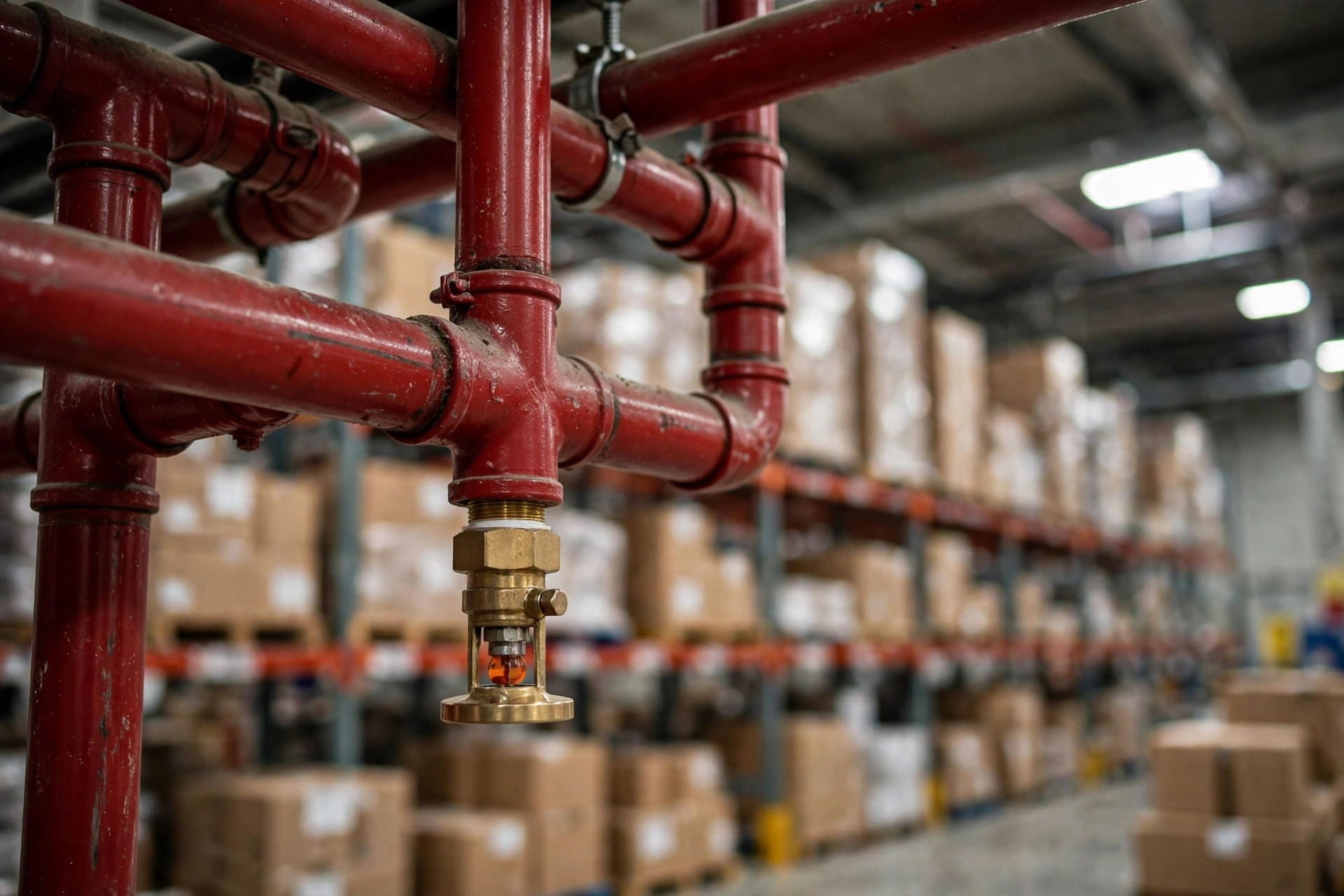
5. ESFR heads blocked by rack beams. Early Suppression Fast Response heads are standard in high-bay warehouses, and they're famously sensitive to obstructions. The distance from the head to the rack beam, the width of the beam's bottom flange — a few inches off and you have a dead spot. Measuring this is one of the most common things inspectors do with a tape measure.
This one is the most painful to fix, because the heads are installed and piped — they're just inches off. In new construction, you widen head spacing or shift the beams while everything is still adjustable. In an existing building, relocating heads means re-piping: $800–$1,500 per position (local quotes govern), tens of positions adding up to real money. The most galling version: the drawings were fine, but the beams landed a few inches off during construction, and nobody found out until the inspection. That money is pure management cost.
The self-audit checklist: run through these five before the inspector does
| # | Check location | What to look at | Retrofit cost range | Cost of failing |
|---|---|---|---|---|
| 1 | Under large ducts | Stand under the duct, look up — head directly below? | ~$600–$1,200 per head (local quotes) | 2–4 week re-inspection wait + idle plant |
| 2 | Re-racked areas | Current max storage height vs. system design height | Thousands to six figures (commodity change?) | System recalculation + second round of construction |
| 3 | Newly partitioned rooms | Open every door, check the ceiling for heads | ~$10k–$20k per room (demo + restore) | Retrofit + tearing up finished work |
| 4 | Over-height storage zones | Measure top-tier freight to sprinkler; keep 18-inch clearance | Near zero (enforce the rule) | Forced system upgrade |
| 5 | ESFR-to-beam distances | Tape-measure each head to the beam per the drawings | ~$800–$1,500 per head to relocate | Re-piping + re-inspection |
Now the counterintuitive part. Blind spot #4 is the cheapest to fix (it costs almost nothing) and also the most common reason inspections fail on the floor — because storage rules don't enforce themselves. The one worth spending on before the inspection is #5: a few thousand dollars for a pre-construction obstruction survey from your fire contractor is at least an order of magnitude cheaper than relocating piped heads after a fail. Saving money was never about installing fewer heads. It's about not installing them in the wrong place.
The computable conclusion: take your warehouse's monthly fixed cost — rent, labor, insurance — divide by 30, multiply by 14. That's the rough cost of one failed inspection. Line that number up against each row of the table. Any blind spot whose retrofit costs less than that figure deserves a self-audit today. Run the numbers and you'll find the same thing I always find: with this line item, early money is always cheaper than late money.
By Lao Zhou, Logistics Cost Analyst