Any serious study of montevideo uruguay warehouse logistics has to begin with an apparent contradiction. Uruguay's domestic population and consumer market are modest by South American standards, and a purely local calculation would predict a warehousing footprint sized to national demand. What one observes instead is a persistent stock of distribution-oriented warehousing around Montevideo that exceeds local consumption, handling goods that are not primarily destined for Uruguayan shelves at all, but are held, recombined, and dispatched onward to Argentina, Paraguay, and southern Brazil. The phenomenon itself carries the analytical lesson: a warehouse node should not be evaluated only by the market beneath it, but also by the markets behind it, and by the flexibility goods acquire while they wait there.
The demand side resolves into three broad groups. The first consists of brands selling simultaneously across several Southern Cone countries, none of which individually generates enough volume to justify a complete local inventory system, but which together can sustain one regional stock pool. The second consists of trading companies engaged in transit and re-export, consolidating, splitting, relabeling, or lightly configuring goods before dispatching them in batches to each destination. The third consists of categories with pronounced seasonal offset — agricultural machinery parts, apparel, and parts of consumer electronics — whose peak seasons arrive at different times in different countries, so that the same inventory can serve two markets in sequence within a year. Cargo volumes, rents, and sailing frequencies fluctuate considerably from year to year, and the discussion here is confined to structure and orders of magnitude; operational decisions should rely on the latest figures published by ports, zone operators, and carriers.
The value of a Montevideo distribution node is pooling, not proximity
Centralizing inventory at one regional node is, in essence, a decision to let the demand uncertainty of several countries offset one another inside a single pool. Under a dispersed model, each national warehouse faces its own forecast error alone: overestimates become idle stock and underestimates become stock-outs, and both losses occur simultaneously in different countries without compensating each other. Under a pooled model, surplus stock in one market can be absorbed by orders from another, and the total safety stock the company must carry falls accordingly. This is a familiar principle in inventory theory, but the Southern Cone gives it unusual force, because the economic cycles and consumption rhythms of the countries involved are imperfectly synchronized, and imperfect correlation is precisely the condition under which pooling works best.
Documented cases follow this pattern. A home-goods brand selling across several Southern Cone countries originally operated a small warehouse in each market; volumes at each site were too thin to support regular replenishment, and the company suffered excess stock and stock-outs at the same time. After consolidating regional inventory at a single Montevideo site and retaining only light cross-docking points in destination countries, its total inventory declined while availability improved, because national demand fluctuations were partially canceling inside the shared pool. A second pattern appears among agricultural parts distributors, whose demand peaks migrate with planting seasons: parts held at a node from which they can be dispatched seasonally across borders effectively serve two offset peak seasons per year, raising the sales supported per unit of inventory well above what single-country placement achieves.
This produces a judgment that runs against the usual site-selection instinct. What a company buys at such a node is not primarily warehouse space — space can be rented anywhere — but flexibility in where inventory sits. Flexibility depends on how many markets the node connects to, how clear the dispatch rules are, and how stable the cross-border corridors remain. A comparison based mainly on rent per square meter therefore misses the largest component of the node's value, a point worth remembering whenever montevideo uruguay warehouse logistics is priced against a purely local alternative.
Free-port and free-zone arrangements are one piece, not the whole picture
Institutional conditions form part of the explanation, though they should not be inflated into the whole of it. Under Uruguay's long-standing free-port and free-zone frameworks, goods entering the designated areas can generally be stored, consolidated, and re-exported without immediately triggering import duties and certain taxes; the tax obligation arises when goods formally enter the Uruguayan domestic market or enter a destination country under the applicable regime. Specific tariff treatment, permitted activities inside the zones, and filing requirements vary by product and should always be confirmed against the latest rules of Uruguayan customs and the zone operators; no rate quoted in general commentary should be treated as a filing basis.
The economic effect is chiefly one of timing. The duty cost of inventory is deferred until its destination is actually decided, and the value of that deferral rises with slow turnover and uncertain destination, while fast-moving goods bound for a single country gain almost nothing. Uruguay's comparatively continuous and predictable regulatory environment adds a further, quieter benefit: it lowers the policy-risk premium on inventory held for months at a time, functioning in site-selection models as an implicit discount. Yet the institutional advantage answers only the question of what it costs to hold stock at the node. It says nothing about how quickly stock can be moved onward, which is a question of corridors — and treating the words free zone as a site-selection conclusion mistakes one piece of the puzzle for the completed picture.
Inventory near the port, or inventory near the market
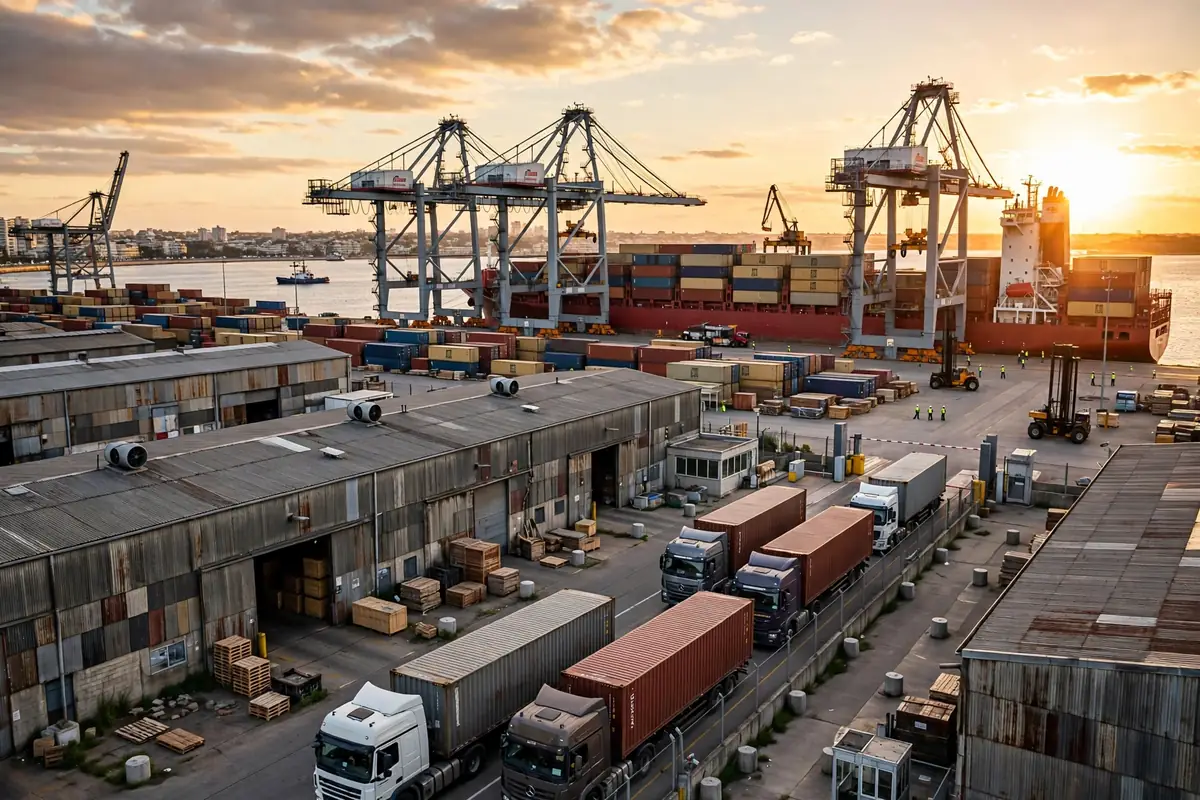
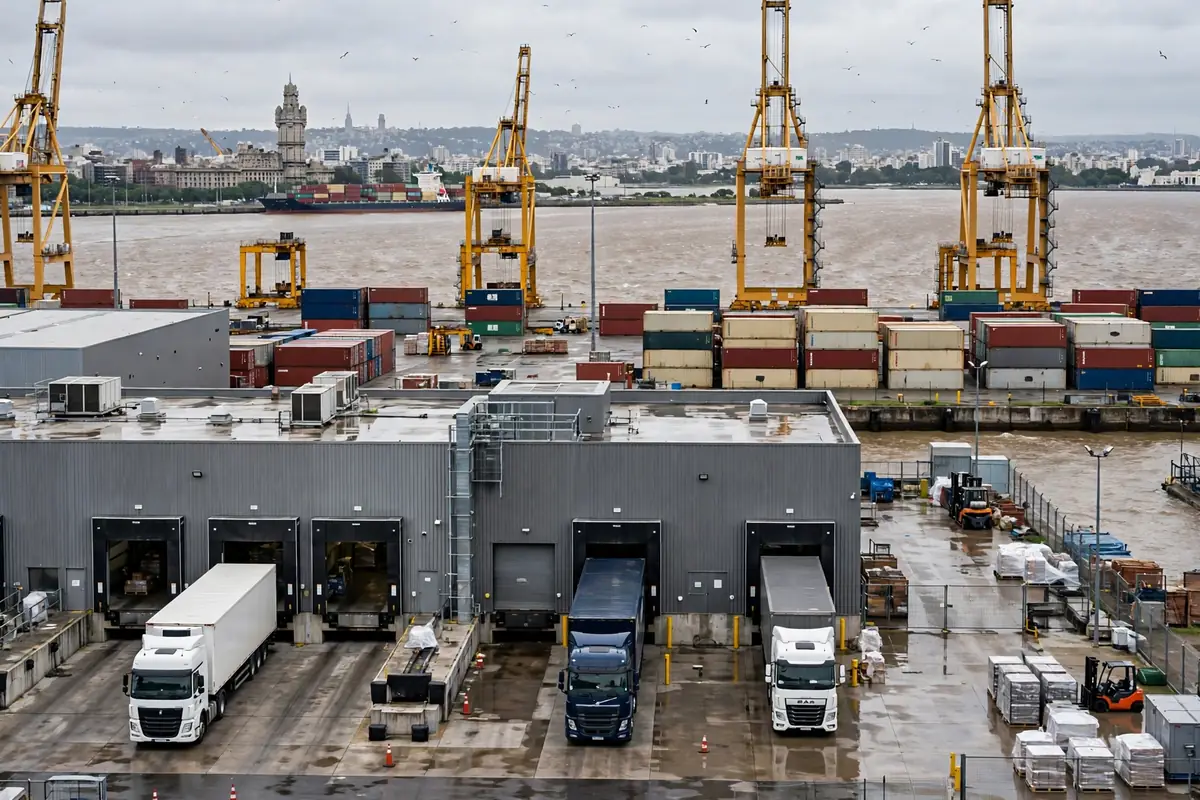
Montevideo's port sits on the Río de la Plata estuary and serves as Uruguay's principal foreign-trade gateway, with warehousing and bonded facilities clustered around the port, the airport, and the highway corridors leading inland, so the port-to-warehouse leg is structurally short and its cost comparatively controllable. Across the river, mature waterborne and land-air links connect the city with Buenos Aires, giving inventory held in Montevideo natural access to a far larger consumer market opposite. Toward Paraguay and southern Brazil, by contrast, movement depends more heavily on combinations of road and river transport, whose cost and transit time vary with season, river conditions, and border processing; planning should use carriers' current schedules and quotations rather than any static transit promise.
The resulting trade-off can be stated precisely. Inventory placed near the port and its bonded facilities enjoys the smoothest import handling and the full benefit of deferred duty, but sits farthest from final consumers, so every cross-border dispatch adds a layer of variability. Inventory placed inside each destination country delivers the fastest and most stable last leg, at the price of duplicated stock and parallel compliance regimes. Neither structure is superior in itself; each matches a different cargo profile, as the comparison below summarizes.
| Dimension | Montevideo regional node | Local warehouse in each destination |
|---|---|---|
| Inventory structure | One pool serving several markets | Independent stock, duplicated buffers |
| Duty timing | Deferred until destination is decided | Triggered on entry into each country |
| Cross-border dispatch | Frequent, corridor-dependent | Limited; mostly domestic delivery |
| Final-leg reliability | Exposed to cross-border variability | Fastest and most stable |
| Best fit | Slow-turning, multi-country, seasonally offset goods | Fast-turning, single-market, time-critical goods |
Taken together, the phenomenon, the demand structure, and the corridor evidence support a restrained conclusion about trajectory. The regional distribution role of montevideo uruguay warehouse logistics is unlikely to change in character over the next several years: the domestic market is too small to turn the city into a consumption-driven mega-hub, and its service radius will continue to be set by neighboring demand and cross-border corridor conditions. The more plausible evolution is a gradual shift in cargo mix — from traditional transit trade toward spare-parts distribution, regional stocking of higher-value goods, and cross-border e-commerce returns handling — with competition moving from floor space toward customs coordination, inventory visibility, and dispatch responsiveness. For companies evaluating a South American footprint, the implication remains conditional. Single-market, fast-turning, time-critical goods gain nothing from routing through this node; multi-country, slow-turning, seasonally offset goods are exactly the profile for which the pooled alternative deserves to be modeled line by line against local warehousing — because an institutional advantage, multiplied by one's own volume structure and turnover speed, is the only version of the number that belongs to the decision-maker.
By Dr. Chen, Supply Chain Researcher