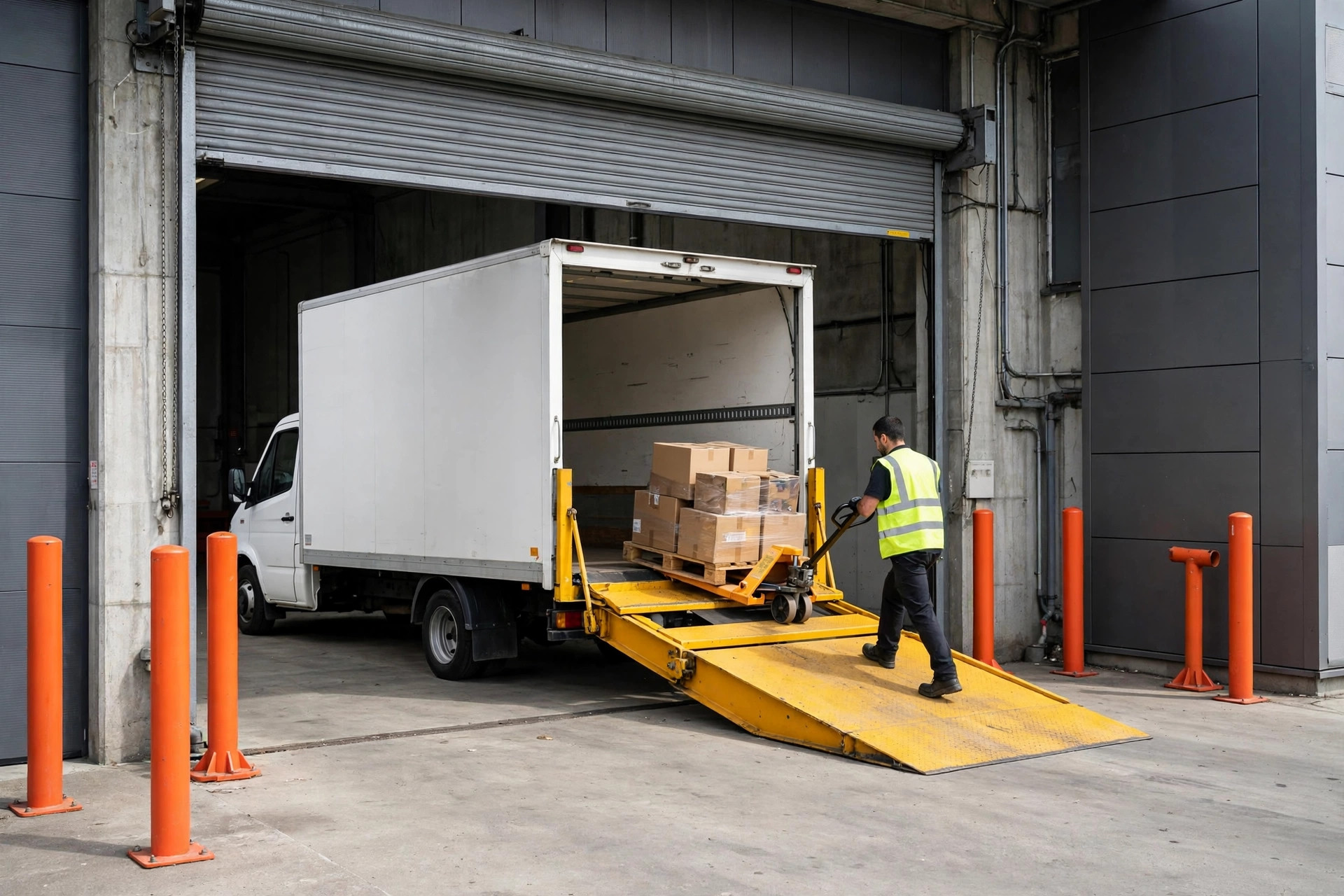
Here's the short version: my 3,000-square-meter warehouse has exactly one dock door, switching daily between box trucks and container trailers. We survived not by rebuilding the dock, but with a secondhand dock leveler and a few redneck tricks. This is how a small warehouse owner fumbled through the "dock science" big warehouses take for granted — in plain English.
The Predicament: One Dock Door, Two Kinds of Trucks
When I took over this warehouse in early 2024, the landlord thumped his chest: "Standard dock, 1.2 meters, any truck can unload here." I believed him. Then I learned there's a 20-centimeter gap between "any truck can unload" and "any truck can unload well."
The industry-standard dock height is about 1.2 meters (48 inches), and that number wasn't pulled out of thin air — it's matched to the most common trailer beds on American highways. A 40-foot container on a chassis, a 53-foot dry van: their beds sit roughly in the 1.2–1.35 meter range, a bit higher when empty, pressed down a bit when fully loaded. So a big warehouse's standard dock hugs those trailers perfectly. Drop the leveler plate, drive the forklift straight in, flat as a pancake.
But small warehouses like mine take whatever work comes. Besides the containers we pull from the Port of LA, half our local customers show up in box trucks — 16-footers, 24-footers — with beds around 0.9 to 1.15 meters, way below the dock edge. The first time a 24-foot box truck backed in, the driver dropped the tailgate, and I stood on the dock looking down: nearly 30 centimeters of daylight between dock and truck bed. My forklift guy leaned over and said: "Boss, that's a cliff dive."
You don't cliff-dive a forklift. Anything over about 10 centimeters gets bone-jarring; 30 centimeters gambles with the cargo and the driver. And forget about pallet jacks — you can't push one up that.
For a while we MacGyvered it: two thick steel plates as a makeshift ramp, and the forklift guy's "gentle leap" on pure skill. Then one rainy day a plate slipped, the front wheels hung in the air, and the warehouse sat idle half an hour waiting for a tow. The driver squatted nearby smoking: "Man, your dock discriminates against small trucks." I laughed along, but inside I was bleeding — a warehouse our size can't afford to rebuild a dock.
The Redneck Fix: Leveler Plus a Custom Ramp
The wake-up call came from Old Chen, my neighbor. He runs an even smaller warehouse doing e-commerce returns, and he doesn't even have a dock — he rents a unit with a drive-in ground ramp, and box trucks just drive up the ramp and unload through the ground-level door. He said: "Why are you forcing every truck to match your 1.2 meters? Let the bridge match the truck."
That one sentence rearranged my brain. The dock height is fixed, but the plate between the dock and the truck doesn't have to be.
I did three things, for less than one month's rent total:
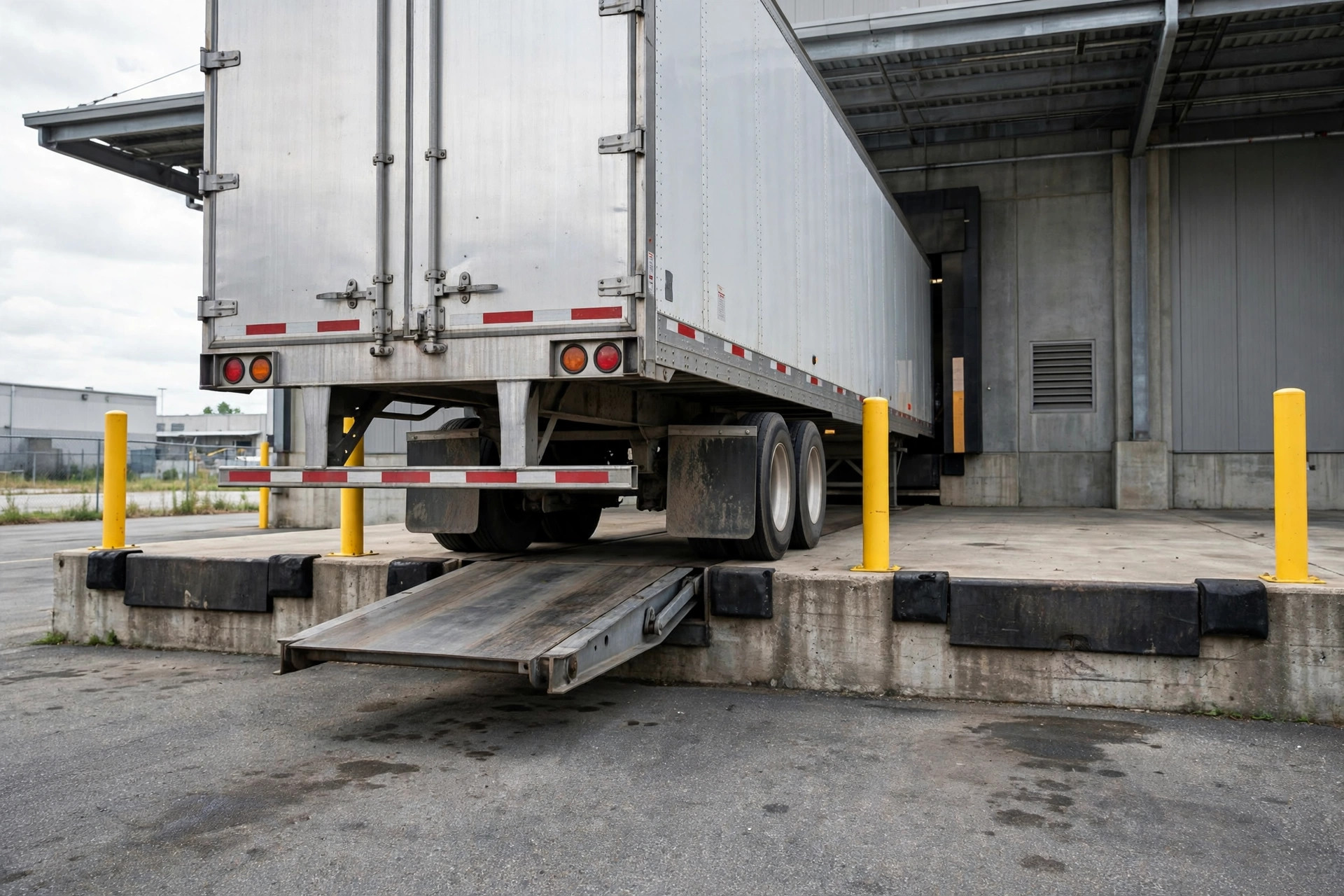
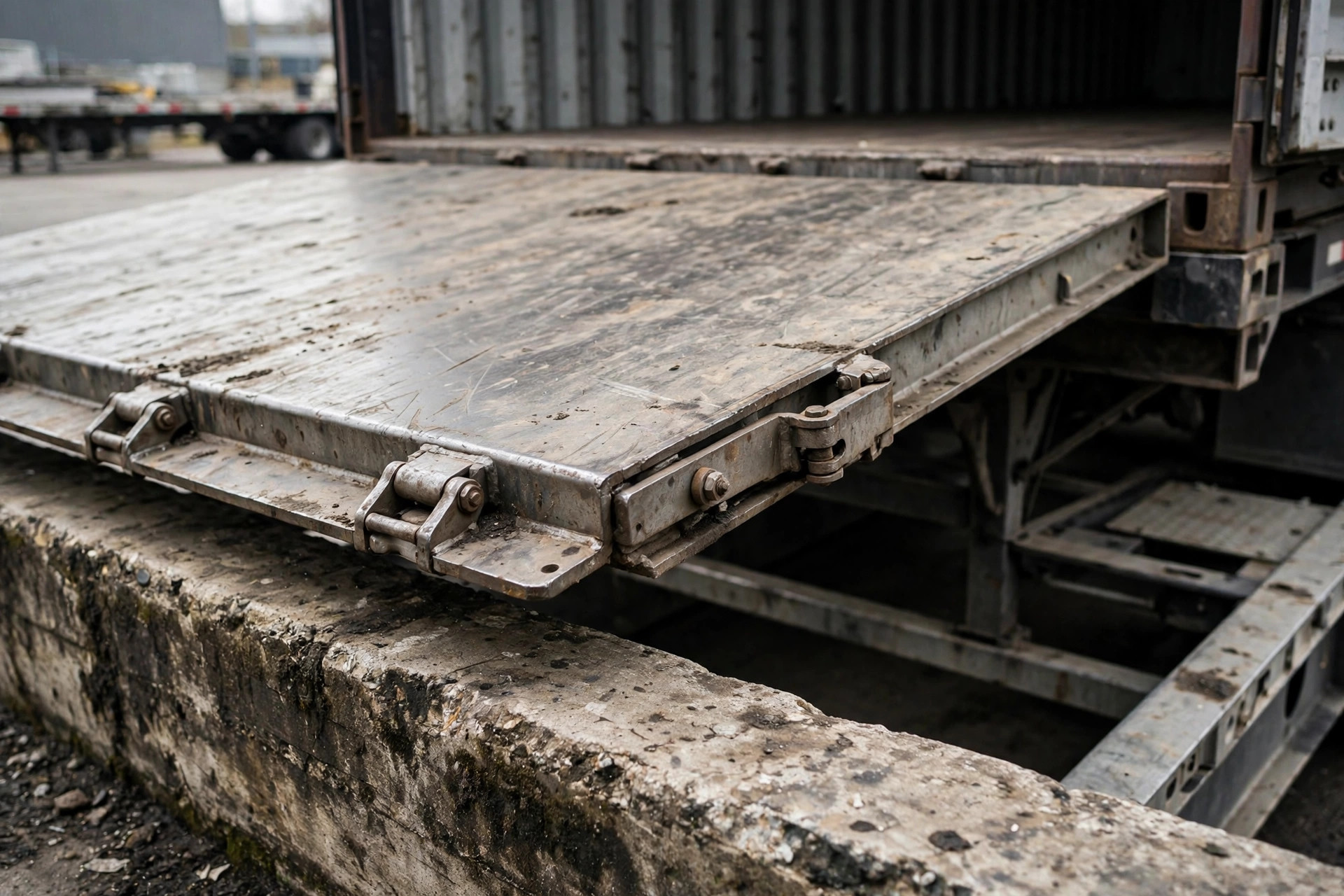
First, a used manual dock leveler. eBay and local used-equipment dealers are full of them. A six-foot-wide manual leveler, decent shape, a few hundred bucks. It bridges roughly ±10 centimeters — enough for the gap to a 24-foot box truck. Someone has to flip it by hand, but two or three trucks a day is just exercise.
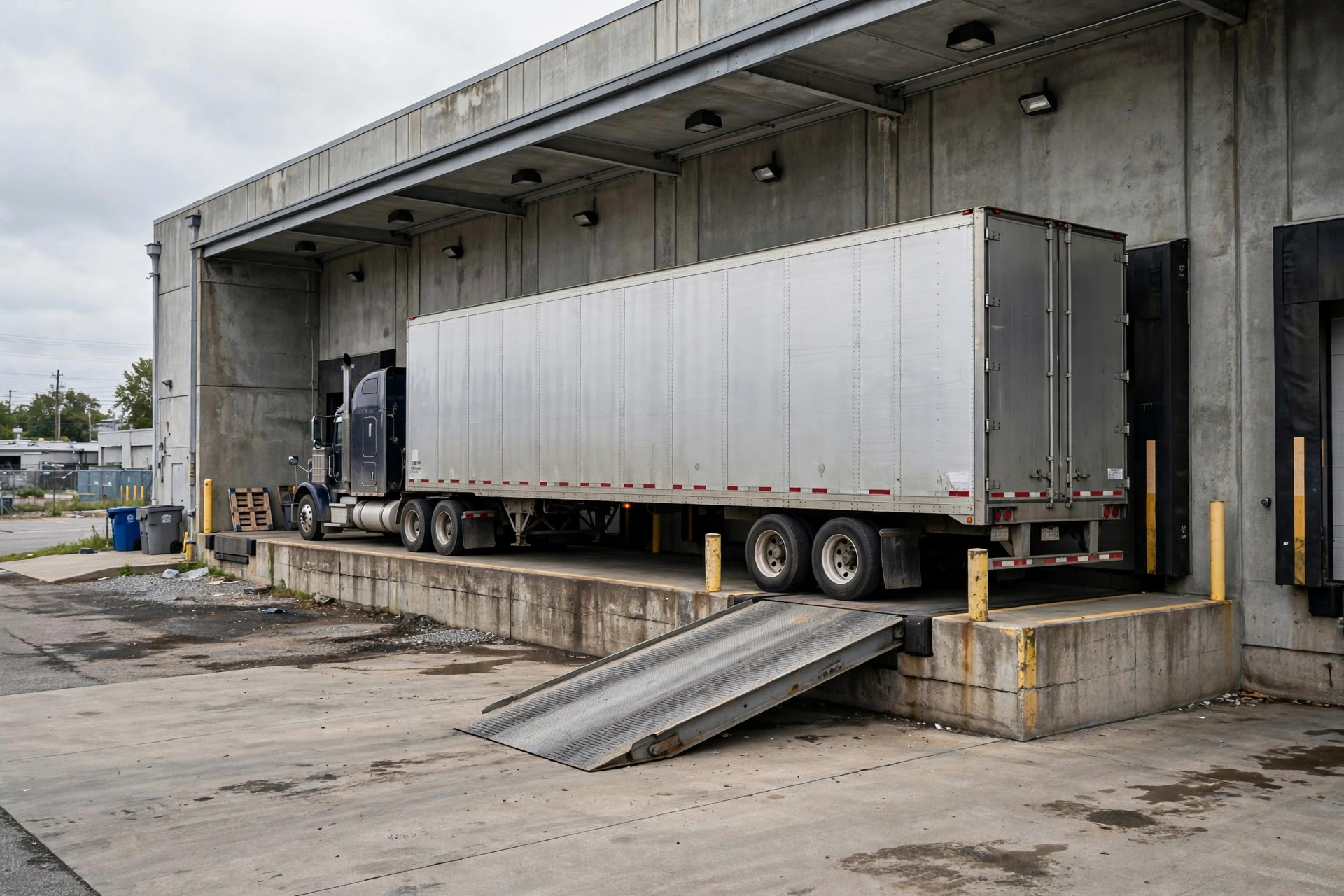
Second, a custom steel ramp, welded to order. The 16-footers sit lower — 20-plus centimeters of gap, beyond the leveler's reach. A welder buddy built me one with anti-slip texture and a gentle slope. Cost? Two barbecue dinners.
Third, a hard rule: container trailers get the dock door, box trucks use the side ground door. The dock door is reserved for 40-foot containers and 53-foot vans — a perfect match for 1.2 meters, no bridge needed. Box trucks back up to the ground-level side door and drive straight in off a ramp. Drivers grumbled about "the back door" until they realized unloading was twice as fast.
The results? We haven't gotten a forklift stuck since. Unloading a 24-foot box truck went from a 40-minute wrestling match to just over 20 minutes. Drivers wait less, so they send us more loads — for a small warehouse, business sometimes comes down to a reputation for fast unloading.
Running the Numbers: Leveler vs. Ramp, What's Worth It
Here's my comparison table, from two years of asking around plus my own scars. Prices are rough ranges — check your local market:
| Option | Gap it bridges | Rough cost | Who it's for |
|---|---|---|---|
| Manual dock leveler (used) | ±10 cm | A few hundred USD | Fixed truck types, few loads a day |
| Custom steel ramp | Fixed gap, 15–25 cm | A few hundred USD | One kind of small truck, long-term |
| Hydraulic dock leveler (new) | ±25 cm or more | A few thousand USD | Mixed trucks, high volume, budget allows |
| Mobile yard ramp | Drives straight up to dock height | Ten thousand USD+ | No dock at all, pure ground operation |
And a rough labor calculation. Say you're like me: two box trucks a day, 10 extra minutes each time laying plates and directing the back-in, two people on it. That's 20 minutes a day, 250 working days — about 83 hours a year. At 20 bucks an hour, that's over $1,600 a year burned on fiddling with steel plates. A used leveler costs a few hundred. It pays for itself in two months. You don't even need a calculator for that one.
But that math only works when your truck mix is stable. If today brings a 16-footer, tomorrow a 26-footer, the day after a box truck with a liftgate — a used manual leveler won't cut it. Then you need hydraulic, or a few ramps of different heights. Look at your actual truck mix first, then decide how much to spend. Not the other way around.
The Counterintuitive Part: Don't Lower the Dock
Now the counterintuitive take — and it's a trap I fell into myself back in the day, along with plenty of other small warehouse owners: when the dock "doesn't fit" small trucks, the instinct is to lower the dock a bit so it kind of fits everything.
Don't. The 1.2-meter height is a standard the entire North American freight system converged on. Container chassis, 53-foot vans — their beds are all designed around it. Lower your dock 20 centimeters and box trucks unload beautifully, but then every container trailer needs a bridge — and containers are where the big freight is. That's trading watermelon for sesame seeds.
The correct logic runs the other way: the dock serves whichever truck type shows up most; the minority adapts with bridges and ramps. In my warehouse, containers are 60 percent, box trucks 40, so the dock stays at 1.2 meters and box trucks get the bridge. If your warehouse is the opposite — 90 percent box trucks, a container twice a year — you shouldn't have rented a standard-dock warehouse at all. A drive-in ground unit is cheaper, rent included.
The big players run "one dock door with three levelers plus a height-adjustable dock." Sounds lovely. We can't afford that. But the logic is the same: compatibility doesn't come from rebuilding the dock — it comes from the flexible connection between the dock and the truck. They do it with hydraulics; I do it with a secondhand leveler and a homemade ramp. Same principle, different wallet thickness.
Advice for Fellow Small Warehouse Owners
- Measure the trucks before buying the bridge. Tape-measure your three most common truck types, empty and loaded (air-suspension trucks vary several centimeters). Know your gap range, then pick the bridge. Don't order on vibes.
- Check the used market first. A used leveler does the same job as a new one; the difference is the price tag. eBay, local dealers, warehouse auctions.
- Make rules for drivers. Which trucks use which door, how the bridge gets set, who puts it away — one sheet of paper taped to the door. Small crews run best on simple rules.
- Don't cheap out on safety. Ramps need anti-slip texture; leveler edges get yellow paint. Redneck tricks save money; gambling with safety doesn't — one injury wipes out every dollar you saved, and then some.
One last honest word: big warehouses study "dock science"; we small warehouses study "how to stay alive." The 1.2-meter dock won't shrink for us, but we've got bridges, ramps, and redneck ingenuity. Trucks come in all shapes, gaps in all sizes — lay down a plate and roll over it.
Small warehouses have their own way of living.
By Xiao Ma, Small Warehouse Owner