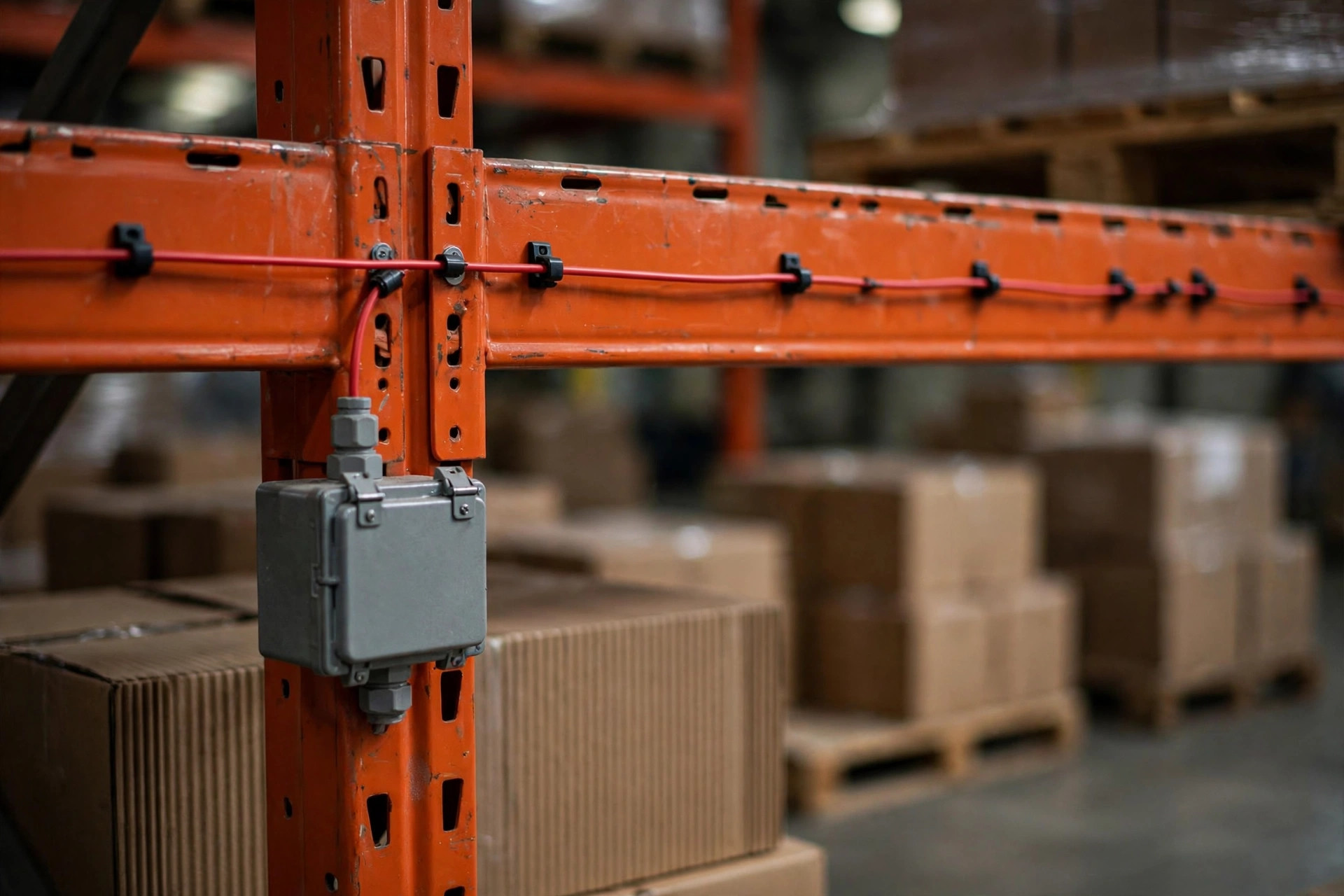
Last fall I sat at a 3PL dock in Fontana for four hours waiting on a load. Bored out of my mind, I watched a fire-protection tech run a thin red cable along the top of the pallet racks — about as thick as an ordinary wire. I walked over and asked what it was for. He didn't look up: "Linear heat detection cable. If a fire starts deep in the racks, this is what finds it first."
I've been driving a truck for fifteen years and been in and out of hundreds of warehouses — hydrants, sprinklers, ceiling smoke detectors, I've seen them all. That red cable? First time. I'm no fire-protection guy, but I spend my days inside warehouses, and I've seen plenty of stuff that's "supposed to work" and doesn't when it counts. So here's what I found out about that cable, in plain words.
Why Smoke Detectors Are Always Late to a Rack Fire
Let me tell you a true story first. Summer of 2023, a home-goods 3PL warehouse in Fontana — racks a good 30 feet tall. Cartons on a mid-level bay started smoldering. The ceiling was full of smoke detectors. They should have screamed, right? Not one of them made a sound. A picker smelled something burning and went looking. By the time they found it, the fire had grown enough to pop two sprinkler heads. Water came pouring down, the fire died — and the goods on three levels were soaked and ruined.
Here's the takeaway: in a high-bay warehouse, the smoke detector often loses the race to the sprinkler head. Sounds backwards, but the logic is simple. A fire starts deep inside the racking. Smoke and heat rise, but layer after layer of racking breaks the plume apart and scatters it. By the time anything reaches a ceiling 30 to 40 feet up, it's diluted to nothing. The fire folks call it stratification — the smoke rises until it's about the same temperature as the surrounding air, then just hangs there mid-air, never reaching the detector. Every fire-protection tech I've talked to agrees: once the ceiling is past 15 to 20 feet, spot smoke detectors are basically decoration. You can't count on them.
So the fire logic of a high-bay warehouse is twisted: detectors exist to catch fires early and save lives; sprinklers only kick in when things are already bad. And yet in a real fire, the goods-saver beats the life-saver to the punch. Not because anybody's product is junk — the smoke just never gets up there.
Linear Heat Detection Cable: Two Wires and a "Dumb" Idea That Works
So what is that red cable? The maintenance tech broke it down for me, and honestly, the idea is almost embarrassingly simple — which is exactly why it works.
It's two steel wires twisted together, separated by a layer of heat-sensitive polymer insulation, all wrapped in a protective jacket. Normally the two wires are an open circuit — nothing happens. But wherever the temperature hits the rated point, that section's insulation softens, the two wires touch, the circuit closes, and the panel alarms instantly. The entire cable is the detector. Fire reaches any point along it, that point alarms. No waiting for smoke to drift up to the ceiling.
The temperature ratings come in fixed steps. The workhorse is 155°F (68°C). Above that: 190°F (88°C), 280°F (138°C), 356°F (180°C). There's also a low-temp 135°F (57°C) version for cold environments. And here's what surprised me: lower is not better. The 155°F cable tops out at 115°F (46°C) ambient. In a California summer it gets brutally hot up near the roof — pick too low and you'll get false alarms every heat wave, and after a few of those, everybody stops taking the alarm seriously. So the selection logic runs backwards from what you'd guess: find your building's normal hottest day, then pick a rating a comfortable margin above it.
One more thing I picked up. Early 2024, a frozen-food cold storage in Ontario running around -25°C — spot smoke detectors were useless in there. Condensation, dust, constant false alarms or total blindness. They ran linear heat cable along the racks and the false alarms stopped overnight. The cable keeps working down to -40°C. Cold storage, hot industrial shops — anywhere smoke detectors can't cope — that's this cable's home turf.
Running the Cable Right: Layout Lessons From Real Racks
Okay, the idea makes sense. Now the practical part: how do you actually run this cable on racking?
The standard move is one run along the top beam of each rack row, clipped high where heat collects. The fancier version adds a run at each level — a mid-rack fire gets caught much faster, since a top-only run waits for heat to punch through several levels of goods. More runs mean more cable and labor, though. That's the trade-off; we'll do the math in a minute.
The install manuals are strict: support clips every 1 to 1.5 meters so the cable never sags; minimum bend radius 50 mm (2 inches) — no sharp kinks; never paint the cable, since paint insulates it from the heat it's supposed to feel; never mix temperature ratings on one run; and don't lay it tight against big heat-sinking steel, which wicks heat away and delays the alarm.
Spacing has listed numbers too: UL lists these cables at 50 feet (about 15 meters) between runs; under FM rules it's typically 25 to 30 feet (about 7.6 to 9 meters). Your fire-protection contractor sizes it to your ceiling height and rack layout — don't guess this yourself.
One more thing that matters: zoning. One rack row, one zone. When the panel says Zone 4 is in alarm, the crew runs straight to aisle 4 instead of searching the whole building blind.
And here's a lesson I saw with my own eyes — also counterintuitive: this cable's worst enemy isn't fire. It's the forklift. At another warehouse I watched a red cable that a fork tine had snagged and pulled loose, dangling off the beam for half a year. Nobody fixed it. A cable that's hanging in mid-air can't detect a thing. So installation isn't the finish line — it needs the same routine walkdowns as your sprinklers and detectors. Cable in place? Clips tight? Junction boxes dry? Takes one look, twice a year.
The Math: What That Red Cable Actually Costs
Hearing "fire-protection retrofit," most people assume five figures. This cable is one of the rare bargains in the fire world.
Market price: 500-foot rolls, around $1,500 each — roughly $3 a foot. Say a small warehouse has 6 rows of high-bay racking, 200 feet per row, one run along each top: 1,200 feet, two and a half rolls, a little over $3,700 in cable, plus a panel, junction boxes, and clips. Labor goes to a licensed fire-protection contractor as one design-and-install package. Don't cheap out there — a DIY fire system won't pass inspection.
Stack it against the alternatives and the picture gets clear:
| Option | Deep-rack coverage | False alarms | Cost scale | Maintenance |
|---|---|---|---|---|
| Spot smoke detectors (ceiling) | Poor — smoke never arrives | Barely any — because they never alarm | Low | Annual lift-rental testing, a pain |
| Linear heat cable (on racks) | Good — runs right at the risk | Low — alarms on temperature only | Medium, about $1,500 per 500-ft roll | Walkdown to check it's in place, easy |
| Beam smoke detectors | Fair — needs smoke in the beam | Medium — dust triggers them | Medium | Keep the optics aligned and clean |
| Air sampling (VESDA) | Good — tubes reach into racks | Low | High — panel plus pipework, tens of thousands | Filter changes on schedule, pricey |
(Costs are relative scales — get a real quote from your contractor.)
See the positioning? Mid-range money for the hardest job in a high-bay warehouse: catching a fire deep in the racks early. It doesn't replace sprinklers — you still need water to kill a fire — and it doesn't replace smoke detectors for occupant warning. It fills the one gap neither of them covers: the fire buried inside the racks.
Fire protection is like brake pads — you resent the cost right up until the one day it saves everything. I'm a truck driver, not a fire engineer. But fifteen years of warehouse docks taught me this: disasters are always the ones everybody assumed couldn't happen. Next time your fire contractor comes through, ask one question: "If a fire starts deep in our racks, how many minutes before we'd know?" If they hesitate — that red cable is worth a serious look.
By Shifu Zhao, Trucking Veteran (15 yrs)