When a Chinese AGV maker decides to sell into Korea, the first question the export team has to answer is not simply how much does KC certification cost, but how many KC certificates the product actually needs — because KC is not a single certificate. It is a classification system, and misclassifying the product sends both money and time to the wrong place. Search results for this question are dominated by certification-body sales pages: quote forms, but no field guide. This article fills the second half, using warehouse electrical equipment — AGVs, conveyor control cabinets, charging cabinets — as the worked example.
KC Is Not One Certificate: Safety, EMC, and Radio Are Three Separate Tracks
Behind Korea's KC mark sit two legal regimes. Electrical safety falls under the Electrical Appliances Safety Control Act; electromagnetic compatibility and radio fall under the Radio Waves Act, and their certification logic differs completely. According to Intertek's publicly released KC guideline, the safety side has three tiers: Safety Certification (factory inspection by a designated body, an initial audit plus a follow-up every two years), Safety Confirmation (product testing only, no factory inspection), and Supplier Compliance (self-testing plus a declaration of conformity). The radio side runs through conformity certification or conformity registration under the Radio Research Agency (RRA) system, with products that intentionally emit radio waves generally taking the certification route.
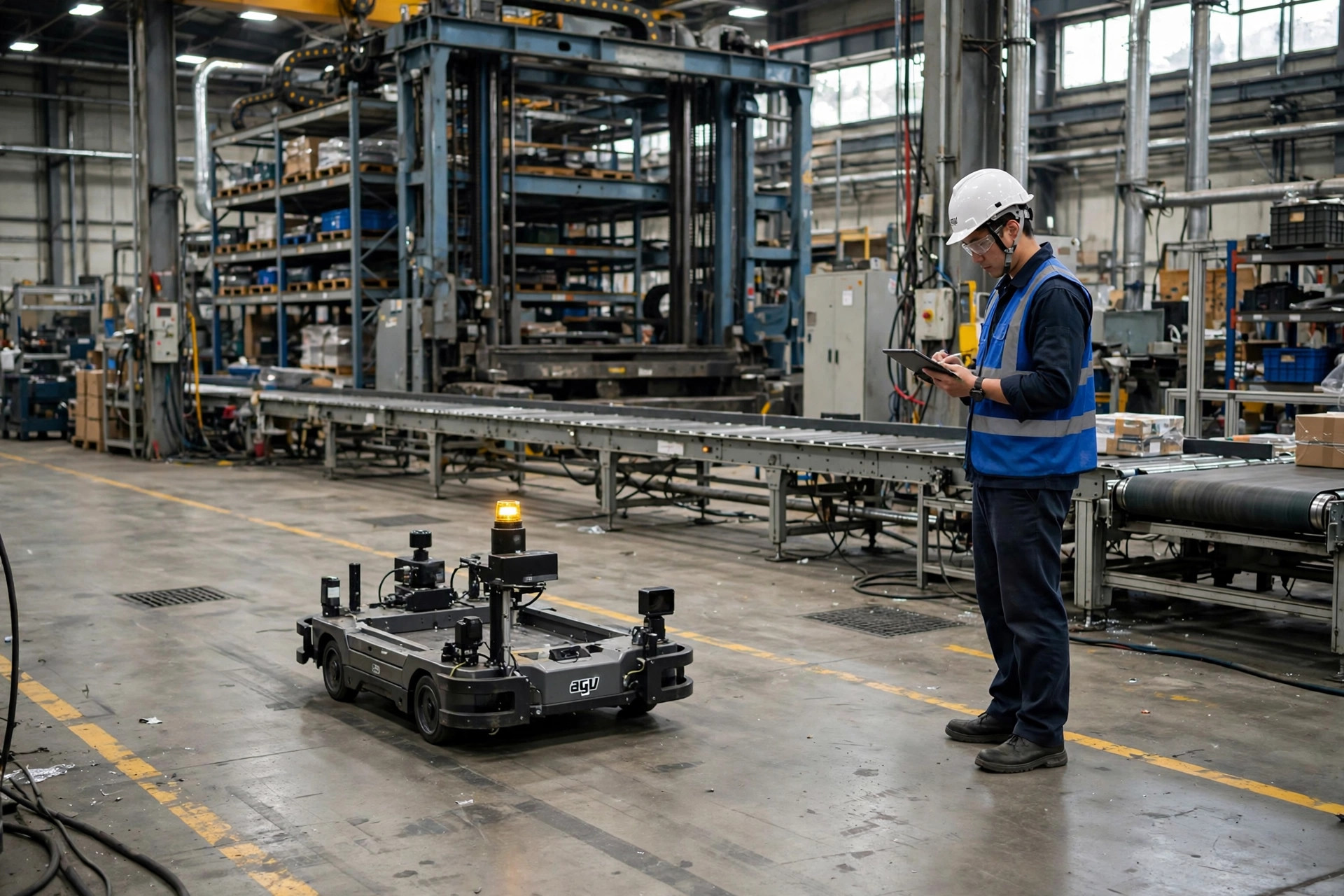
Mapped onto warehouse equipment, the decision logic looks like this: an AGV carrying a lithium battery, motor drives, and WiFi communication typically triggers all three tracks — KC Safety for whole-machine electrical safety, KC EMC for emissions and immunity, and radio certification for the wireless module. A conveyor control cabinet with no wireless function usually needs only Safety plus EMC. A charging cabinet needs Safety and EMC, with high-power models facing additional test items such as harmonic currents. Get the classification wrong and the consequences are concrete: an AGV that needed radio certification but only completed Safety and EMC can be held at a Korean port; a non-wireless cabinet put through a full radio test wastes tens of thousands of yuan. The answer to "how much" always starts with product classification, which is why experienced export teams treat the classification review — not the quotation — as step one.
How Much Does KC Certification Cost for an AGV or Control Cabinet?
There is no single official price list, but each cost component is transparent. The table below lists common items as reference ranges, drawn from certification bodies' public materials or prevailing industry quotes; confirm every figure against a certification body's latest quotation before budgeting.
| Cost item | Reference range | Notes and source |
|---|---|---|
| KC Safety testing (CB transfer / delta testing) | CNY 30,000–60,000 | Delta tests only, with a CB certificate covering Korean deviations; subject to latest quotes |
| KC Safety full testing (no CB report) | CNY 60,000–100,000+ | Priced by number of test items; subject to latest quotes |
| KC EMC testing | KRW 1.3M–1.55M (approx. USD 930–1,100) | Per SGS Korea's public fee schedule: IT equipment approx. KRW 1.3M, industrial/scientific/medical approx. KRW 1.55M, covering emissions and immunity; subject to latest quotes |
| Radio (RF) testing and grant | KRW 2M–8M per item (approx. USD 1,400–5,700), cumulative across bands and modes | Per DEKRA Korea's public test-fee and lead-time procedure; subject to latest quotes |
| Factory inspection | CNY 20,000–40,000 | Safety Certification tier only, includes auditor travel and man-days; subject to latest quotes |
| Agency service / documentation / certificate fees | CNY 5,000–15,000 | Korean manual preparation, label rework, application handling; subject to latest quotes |
Adding up typical combinations, a WiFi-equipped AGV running all three tracks usually lands in the CNY 100,000–200,000 (approx. USD 14,000–28,000) band; a non-wireless control cabinet needing only Safety plus EMC more often falls in the CNY 50,000–100,000 band. These are order-of-magnitude estimates assembled from the rows above, not any body's quotation — budget against a certification body's latest quote.
Beyond fees sits the cost most teams underestimate: time. Most certification bodies quote 4–8 weeks as the reference timeline for a complete KC process. Testing itself is not slow — SGS Korea's public schedule puts EMC at 1–3 days, and DEKRA Korea's procedure lists most radio items at 3 days to 2 weeks. Four things stretch the timeline: sample preparation and EMC rework (failed emissions is the classic case, each rework adding at least two weeks), documentation (the Korean manual, product labeling, and critical-component certificates — a power supply, motor, or battery without a valid certificate means retesting or part substitution), factory-inspection scheduling (the Safety Certification tier), and band-by-band radio testing. The rejection causes that recur in certification bodies' technical notes and practitioners' write-ups map almost exactly onto these four: a missing Korean manual or visibly machine-translated text, labels lacking the required KC information and ratings, critical components without valid certificates, failed EMC emissions, and wireless module changes that were never re-evaluated.
The CB-to-KC Shortcut: What an Existing CE/CB Report Can Save
This is the most practical cost lever in the whole process. Per Intertek's KC guideline, KC safety testing accepts a CB report "with Korean deviation": the laboratory only runs supplementary tests for Korea's national deviations instead of repeating the full safety suite. For a conveyor control cabinet that already holds CE and CB, the KC safety workload is typically a fraction of a full retest — saving both repeated test fees and weeks of schedule.
Two preconditions, both non-negotiable: first, the CB report must actually include the Korean national deviations — a CB report without them is not recognized for KC transfer; second, the model and construction on the CB report must match the submitted sample, because a changed critical component or modified structure sends the delta tests back to a full retest. The deeper savings are front-loaded: at the sourcing stage, require suppliers to provide CB reports that include Korean deviations, prefer critical components (power supplies, contactors, batteries) that already carry CB or KC certificates, and run a pre-compliance EMC check before formal testing. The most expensive line item in any certification budget is always rework.
Why More Exporters Are Asking About KC Now
A September 2026 industry report noted a Chinese autonomous-forklift maker listing Korean KC certification alongside CE and UL in its public compliance credentials. The detail matters: KC is shifting from a "nice to have" to standard equipment for entering Korea. Three forces explain it. First, demand: Korean e-commerce and 3PL operators keep expanding warehouse footprints, and Chinese automation vendors are looking at the market next door. Second, enforcement: Korean market surveillance of electrical products has tightened, and the cost of a penalty and delisting dwarfs the certification fee. Third, procurement: more Korean buyers now ask for the KC certificate number at the RFQ stage, turning certification from a pre-shipment afterthought into a pre-quotation requirement.
The trend judgment is that KC is moving from a cost line to an entry ticket. Once buyers write the certificate number into tender documents, the fee is no longer optional — it becomes part of the quotation. So how much does KC certification cost is, in the end, not a single number: it depends on which combination of the three tracks your product falls into, whether you hold a CB report, and how high your first-pass documentation rate is. The question worth watching next: after KC, will Korea add functional-safety expectations for warehouse mobile robots? That will decide whether today's certification spend is a sunk cost or an early move.
By Dr. Chen, Supply Chain Researcher