The EU GPSR general product safety regulation — Regulation (EU) 2023/988 — has been fully applicable since December 13, 2024, nearly a year now. Replacing the 2001 General Product Safety Directive, it puts one question in front of every cross-border parcel, every online listing, and every warehouse inbound receipt: who, inside the EU, is responsible for the safety of this product?
What is striking is who has actually changed the way they work: rarely the legal department — it is the warehouse receiving team and the seller's operations staff. According to the European Commission's Safety Gate 2024 annual report, the EU rapid alert system issued 4,137 alerts in 2024: a record since its 2003 launch, up from 3,412 in 2023 and 2,117 in 2022. Cosmetics led at 36%, followed by toys (15%), electrical appliances (10%), motor vehicles (9%), and chemical products (6%); 97% of the cosmetics alerts traced back to a single banned fragrance ingredient, BMHCA. National authorities took more than 4,200 follow-up actions.
The reading matters more than the data: products did not suddenly become more dangerous; the enforcement net became denser. With 2025 the first full year of applicability, the alert count will very likely keep climbing.
Why now: three structural drivers
First, the old rules predated e-commerce. Directive 2001/95/EC governed "products placed on the EU market" but had almost nothing to say about goods sold directly to EU consumers from foreign websites — a blind spot that lasted two decades.
Second, the structural shift in parcel volumes. Once small parcels exploded, port spot-checks could no longer cover risk dispersed across tens of millions of parcels. GPSR's answer was not more inspectors but moving responsibility upstream: every consumer product sold in the EU must now have an economic operator established inside the EU.
Third, political pressure over platform liability. Through 2023–2024, the European Parliament and consumer groups pushed marketplaces to take responsibility for third-party goods. GPSR answered with hard deadlines: two working days to act on an authority removal order, three working days to process notices from non-authorities.
GPSR is thus not a routine update but a philosophical shift: from policing products to policing the chain of responsibility, from post-hoc spot checks to pre-emptive traceability.
GPSR's four core obligations that create real work
One: a responsible person inside the EU (Article 16). The sharpest provision: products sold online to EU consumers may not be sold unless an economic operator established in the Union is responsible for them. EU importers usually serve this role themselves; sellers outside the EU must designate an EU-based responsible person — agreed in writing and genuinely performing the role. A freight forwarder that only moves boxes cannot fill the slot.
Two: products must be traceable. Products or packaging must carry identification — model, batch, or serial number — plus the manufacturer's name, registered trade name, postal address, and electronic contact, with safety information in the official language of the country of sale. Online, this must be directly visible on the product page before the transaction; EU guidance has made clear a mere hyperlink is not enough.
Three: platform self-certification and takedown. Marketplaces must collect responsible-person and manufacturer information from third-party sellers and require self-certification of compliance. Once a product is flagged, the two-working-day takedown clock starts — compliance is now subject to routine platform screening, not handled "when caught."
Four: accident reporting. When an economic operator learns of an accident caused by a product, it must notify the competent authority via the Safety Business Gateway, with technical documentation retained for inspection. Penalties are set by each member state — authorities such as France's DGCCRF have gained expanded powers — so consult each country's official sources for specifics.
Case one: the overnight delisting
This script played out repeatedly in the first half of 2025. A home-goods seller in eastern China woke up to find dozens of EU listings suspended for "missing EU responsible person information." The inventory sat untouched in a Polish fulfilment center. The supplier in Ningbo replied within the hour: "No problem, we have a CE certificate." That fixed nothing — the platform was not asking about CE. It was asking about GPSR.
Three misalignments make the case instructive. First, the seller equated "CE certified" with "compliant" — but CE addresses a product's technical conformity while GPSR asks who inside the EU stands behind it. Second, the supplier's goodwill could not cure the seller's legal obligation: the responsible person must be EU-established, and a Ningbo factory cannot serve that function. Third, the goods were "safe" in the warehouse while the sales channel was severed — inventory kept accruing storage fees while cash flow stopped, and appeals often consumed half the peak-season window.
Case two: the German 3PL that rewrote its receiving SOP
Starting in 2025, multiple third-party warehouses in Germany and Poland wrote "label verification" into their receiving procedures. For each inbound shipment of new SKUs, the receiving team photographs the product nameplate and checks four items: model number, batch number, manufacturer contact details, and EU responsible-person information. Anything missing means the shipment is held — no putaway — until the seller completes the documentation or arranges rework labeling.
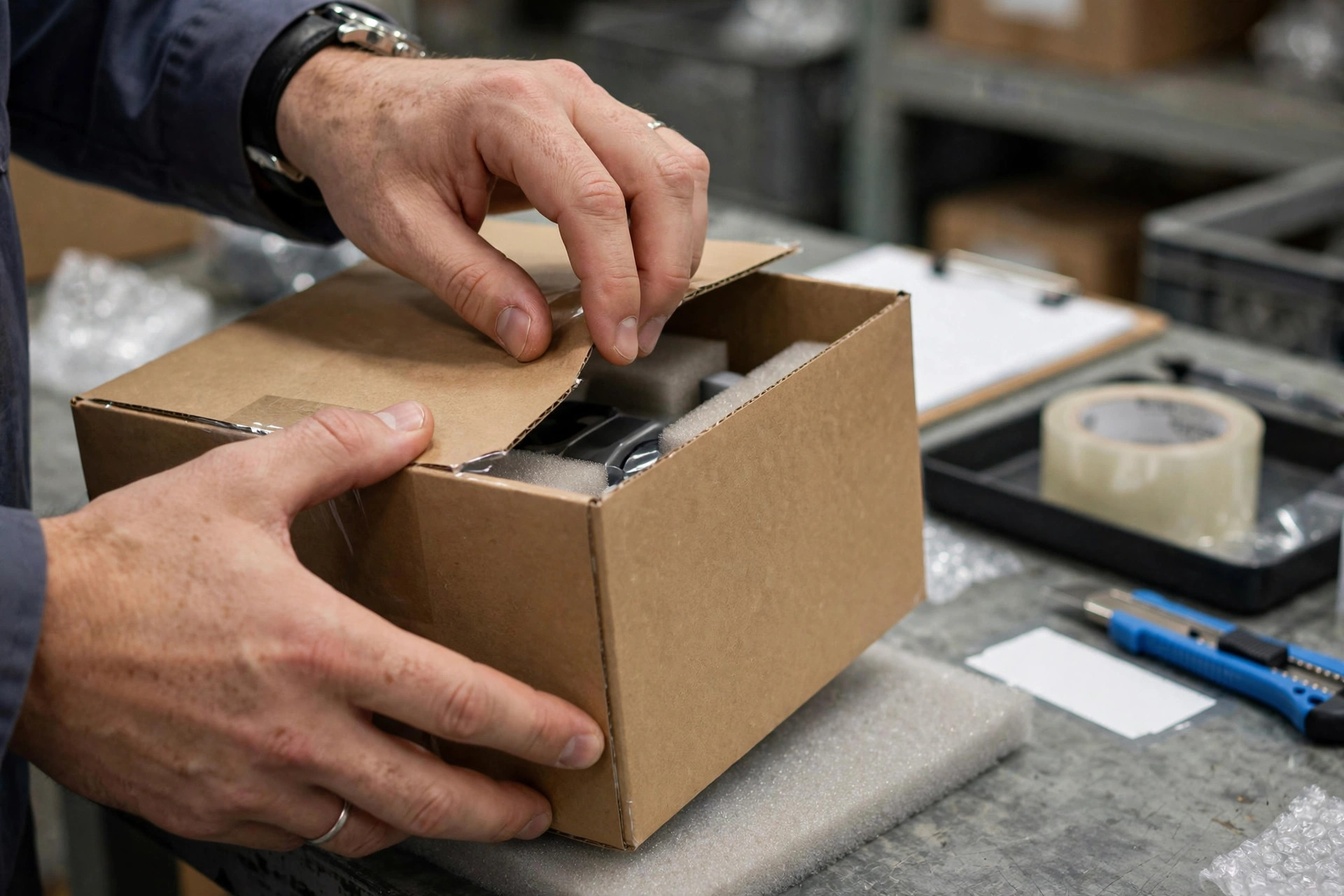
Notably, the warehouse is not legally an "economic operator" under GPSR and has no duty to police sellers. But warehouses did the math: once stored goods are flagged, regulators demand cooperation on recalls and batch-level movement records, and the cost lands on the warehouse itself. Inbound verification has thus become a de facto first gate in the chain — adopted voluntarily because the alternative was worse.
Five preparation steps under the EU GPSR general product safety regulation
| Preparation | What the seller must do | What the warehouse must do |
|---|---|---|
| EU responsible person | Designate an EU-based responsible person with a written agreement; display their details on every EU listing | Verify responsible-person information at inbound; hold shipments if missing |
| Traceable identification | Print model, batch number, and manufacturer details on product or packaging before it leaves the factory; manuals in the language of sale | Photograph nameplates at receiving; link batch numbers to locations and outbound orders |
| Online product pages | Show responsible-person details, product identifiers, and safety warnings directly on the page — not behind a link | Offer seller self-audit reminders as a value-added service |
| Accident and recall readiness | Define a reporting workflow with timelines; centralize technical files | Build batch-level freeze and batch-level outbound traceability |
| Returns handling | Define compliance re-inspection criteria for returned goods | Re-verify label completeness on returns; do not restock items with missing labels |
GPSR compliance is a classic "cheap upfront, expensive after the fact" cost: building labeling and responsible-person information into the factory standard is the lowest-cost path for new products, while inventory already on the water or in EU warehouses can only be reworked — and the sooner the better.
A counterintuitive judgment: the test reports are not the expensive part
Industry conversation focuses on testing and certification. But the regulation's structure points to the responsible person as the real cost center — an ongoing organizational cost, charged annually and per SKU, while test reports are one-off. A brand with 20 SKUs and a seller with 2,000 face entirely different cost curves. The EU GPSR general product safety regulation is therefore objectively harshest on the "many SKUs, thin margins" model. The regulation never names the business models it disfavors — the cost structure does that on its behalf.
The second counterintuitive point: warehouses are among the quiet beneficiaries. Verification, photographic archiving, rework labeling, batch traceability — all billable line items now, which is why the leading European 3PLs moved fastest on receiving verification.
Three trends worth watching
First, diverging enforcement tempo: Germany and France have historically been most active, while southern and eastern Europe may move more slowly. But Safety Gate is EU-wide — an alert in one country triggers follow-up across the network.
Second, a price war in responsible-person services. Low-cost providers were already visible in 2025, but a cheap responsible person is itself a risk: the role requires cooperating with investigations, holding technical files, and handling accident reports. Select on genuine capacity to perform, not price.
Third, the 2025 alert numbers. The 4,137 alerts of 2024 were already a record, and 2025 is the first full year of applicability — the count will most likely keep rising, not because products got more dangerous but because enforcement visibility keeps improving.
The longer observation: GPSR has turned "who is responsible for this product inside the EU" from a legal-department question into a supply-chain organization question. For a decade, cross-border e-commerce competed on speed and price; the next decade may belong to those who are fast, cheap, and fully traceable end to end. Until the 2025 data answers how fast, getting the labels right at the factory is the highest-return preparation on the list.
By Dr. Chen, Supply Chain Researcher