
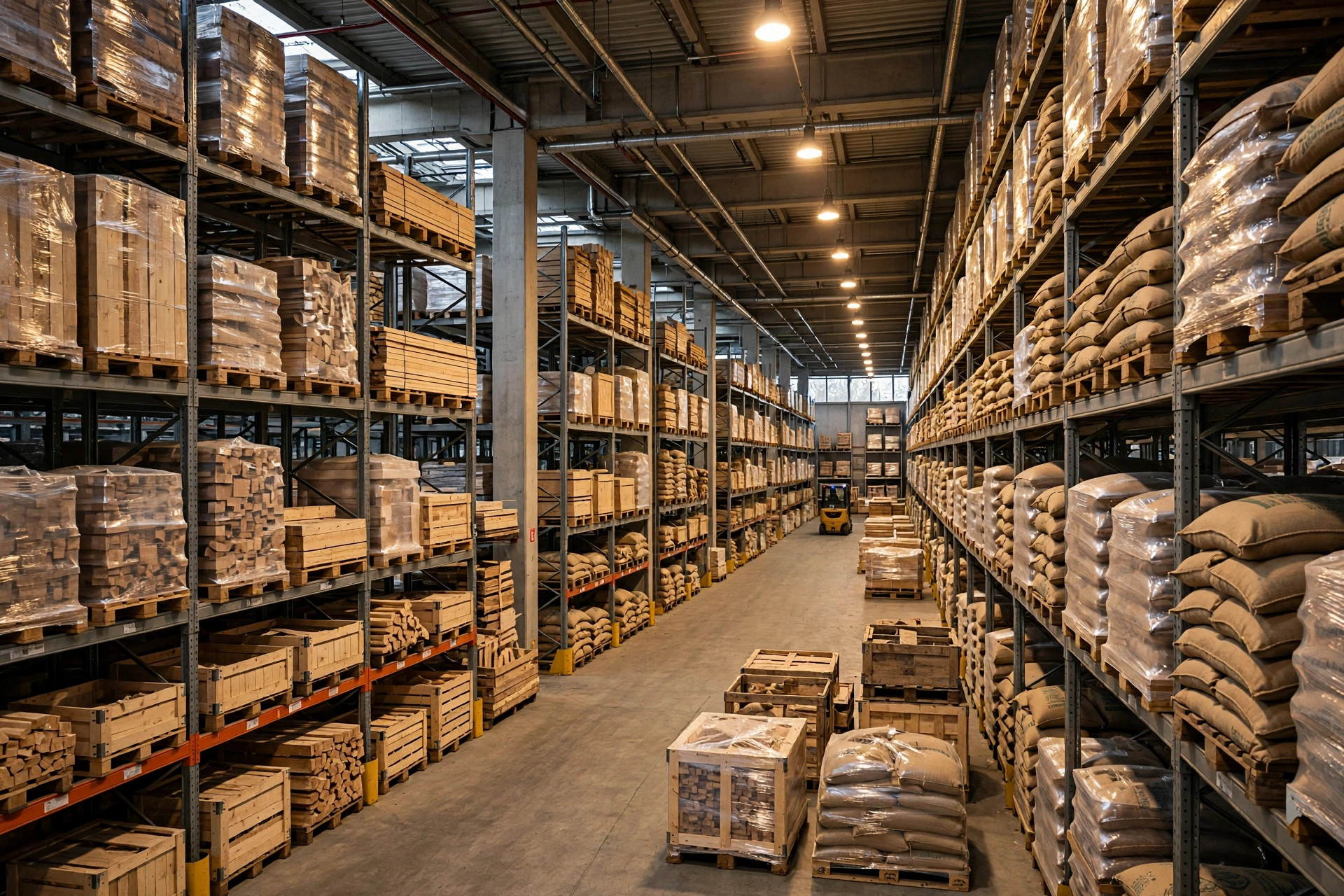
We had a client, a timber importer out of Fujian, who had been storing with a 3PL in Hamburg for years. In October 2024, he got an email from his big downstream buyer: please provide the geolocation coordinates of the harvest plot for every batch of timber, to be attached to the due diligence statement. He turned around and asked the warehouse. The warehouse froze — the pallets were stored mixed, batch numbers didn't match the physical goods, and nobody had ever recorded a single coordinate, exactly the kind of gap the EUDR warehouse compliance requirements punish.
How did it end? All 120 pallets were pulled out and trucked to another warehouse in Rotterdam that could do batch segregation, then received all over again. Six weeks of chaos, plus a fat bill for transport and relabeling. On the phone, the client said exactly one thing: "EUDR goes live December 30, and your warehouse can't even tell batches apart — you think I'm leaving my goods with you?"
That story is the most honest face of the EUDR warehouse compliance requirements: the fine goes to the cargo owner, but the warehouse is always the first one replaced.
What the EUDR Warehouse Compliance Requirements Actually Ask of You
EUDR is the EU Deforestation Regulation ((EU) 2023/1115), covering seven commodity groups — cattle, coffee, cocoa, oil palm, rubber, soya, wood — plus their derived products. The core demands fit in three sentences: deforestation-free after December 31, 2020; legally produced; and a due diligence statement filed in the EU information system for every batch.
The timeline: large and medium companies fall under it from December 30, 2025, micro and small enterprises get until June 30, 2026 — check the latest official policy for exact dates, since the EU has already delayed once and you shouldn't bet on a second delay.
The penalties are real: up to 4% of a company's annual EU turnover, plus seizure of goods and market bans. Confirm the exact figures against official sources, but the 4% order of magnitude alone is enough to keep any client awake at night.
Here's the counterintuitive part: EUDR fines target the "operator placing the product on the EU market," not the warehouse. Plenty of 3PL owners hear that and relax. Don't. The warehouse may not be the fined party, but it's defendant candidate number one: when your mixed storage makes the client's due diligence impossible, the client comes after you under the contract. Since the second half of 2024, European 3PLs have started writing EUDR clauses into contracts — "duty to cooperate" on one side, "liability waiver" on the other. The service providers who see it coming are already putting on armor.
The Coffee Math That Made the Client Sign on the Spot
Second client. A coffee trader, Brazilian beans, stored in Rotterdam. When EUDR hit the news, he panicked more than anyone — coffee arrives by batch, and a single container can mix beans from three or four growing regions.
His 3PL offered a package: segregated batch storage, batch-level labeling, and a due diligence data pack, billed per batch. He balked at the price at first, then they sat down and did the math. The service costs tens of thousands of euros a year. One container held at customs for unclear batching — demurrage plus return shipping — easily beats that. Never mind a fine in the 4%-of-turnover league.

The client signed on the spot and asked one more question: "Can you handle our rubber too?" See — compliance, once the math is clear, is just business.
Warehouse owners need to run the same math:
| Spend item | Order of magnitude | Cost of not spending |
|---|---|---|
| Physical batch segregation (fencing, zones, labels) | One-off, depends on warehouse size | Mixed storage = no due diligence = lost client |
| Batch-level data service (coordinate flow) | Per batch, tens of thousands of euros a year | Client can't do it alone, moves to a warehouse that can |
| IT batch-traceability module | Medium investment | Manual reconciliation — every error is a claim |
| Contract revision (legal fees) | Small money | No waiver clause when things blow up, you eat the full claim |
| Client fined 4% of EU annual turnover | Catastrophic | You're the first one the client asks to share it |
Get it? The EUDR warehouse compliance requirements aren't a cost for warehouses — they're a filter. Those who can comply stay; those who can't are out.
Five Things to Do Now for EUDR Warehouse Compliance
First: get "batch" off the paper and onto the racks. EUDR regulates by batch, not by warehouse. The prettiest batch numbers in your WMS mean nothing if the physical goods are mixed. The playbook: fence off high-risk goods (timber, coffee, rubber, soya) in dedicated zones; one batch, one pallet position; the batch number on the label must match the batch number in the due diligence statement one-to-one; scan at inbound and outbound — no batch scan, no putaway.
Second: the data chain — geolocation must travel with the goods. The heart of EUDR due diligence is the geolocation coordinates of each batch's production plot. The cargo owner is obliged to supply that chain; the warehouse is obliged to catch it, keep it, and pass it downstream. Go ask your clients three questions right now: in what format do the coordinates arrive? Which WMS field stores them? How do they travel with the outbound paperwork? If you can't answer, every order after December 30 is a landmine. The client won't care whose job it was — he'll only ask: why can the other warehouse provide it and you can't?
Third: rewrite the contract now — how to word the EUDR liability clause. This is where the 3PL protects itself. Old "goods compliance" clauses are vague hand-waving; they won't survive EUDR. Three suggestions: one, add a "client cooperation duty" — the client must supply batch-level due diligence data on time; late or wrong data is not the warehouse's problem. Two, add a "scope boundary" — the warehouse provides storage plus batch management; the due diligence statement itself is the client's statutory duty, and the warehouse doesn't carry it. Three, pricing — batch segregation and data services are new services, quoted separately, not buried in the old storage rate. Say the ugly stuff up front and the business lasts longer.
Fourth: IT — batch traceability must be retainable and retrievable. EUDR requires the underlying documents and data to be kept for inspection. Can your WMS do this: type in a batch number, pull its complete inbound-to-outbound trail within five minutes? If not, get IT on a schedule now. After December 30, regulators won't wait for your "system upgrade next week."
Fifth: location arbitrage — a warehouse in a low-risk country is the hidden option. Here's the insider bit only the乙方 know: EUDR has a country benchmarking system, and goods from low-risk countries qualify for simplified due diligence. Same shipment, stored in a low-risk country's warehouse, and the due diligence workload gets cut in half. That's why some cargo owners are re-selecting warehouses right now — not the cheapest one, the one with the lowest compliance cost. Warehouse sales teams, this is your new pitch: "our warehouse sits in a low-risk country, we save you half the due diligence work." That line beats a 5% storage discount at any negotiating table.
Next Time You Negotiate a Contract, Ask These Three Questions
Question one: in what format does the client's EUDR due diligence data arrive today, and how fast can they deliver it? A client who can't answer is probably a landmine after December — price the risk in.
Question two: does our contract spell out the EUDR liability boundary? If not, fix it now, before something blows up and you're arguing afterward.
Question three: can this shipment move to a warehouse in a low-risk country? If yes, help the client move it proactively — you'll be the most knowledgeable service partner he's ever worked with.
The EUDR door closes on December 30, on time. People outside the door see fines; people inside see business. Which side you're on depends on whether you move now.
By Susan, 3PL Sales Director





