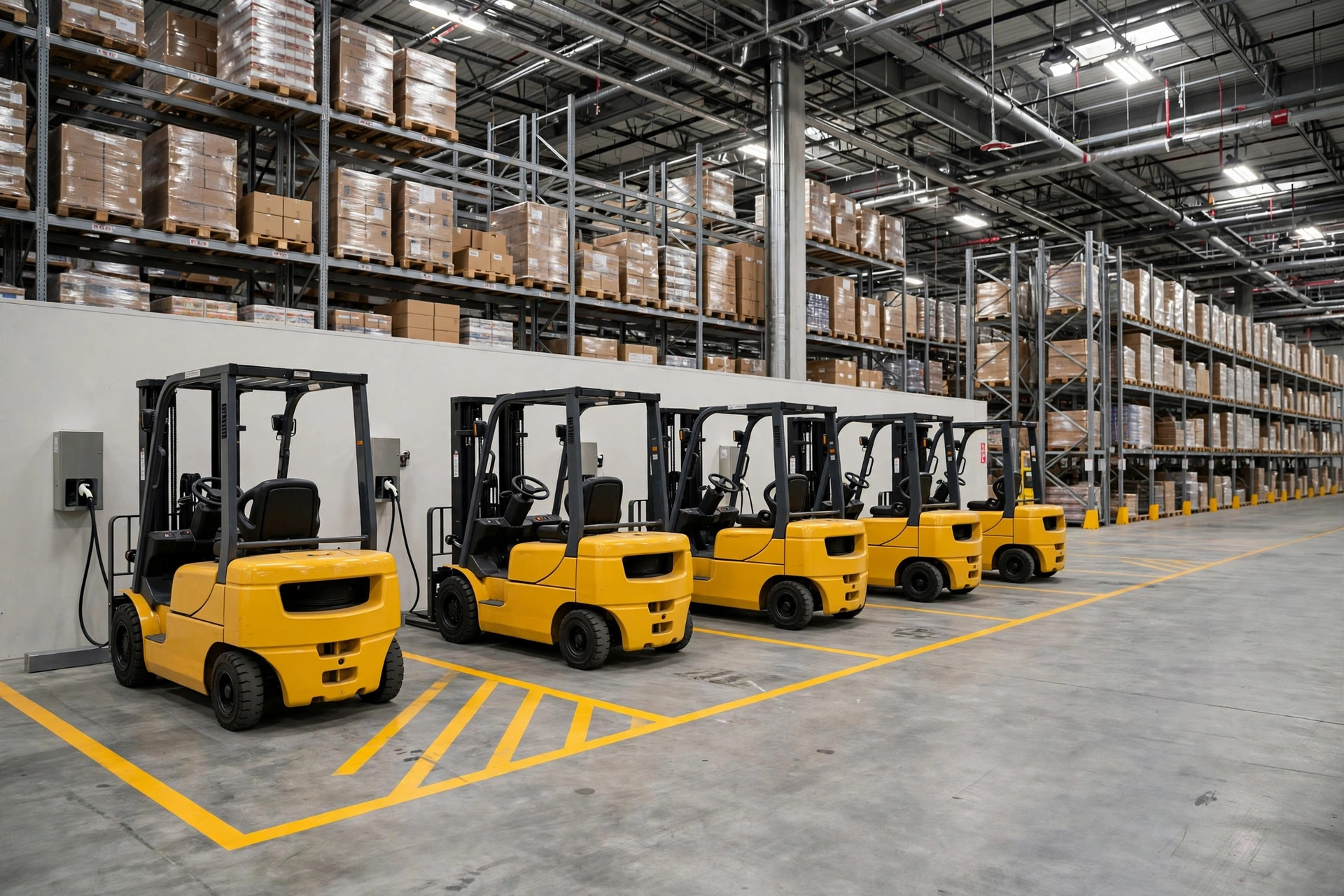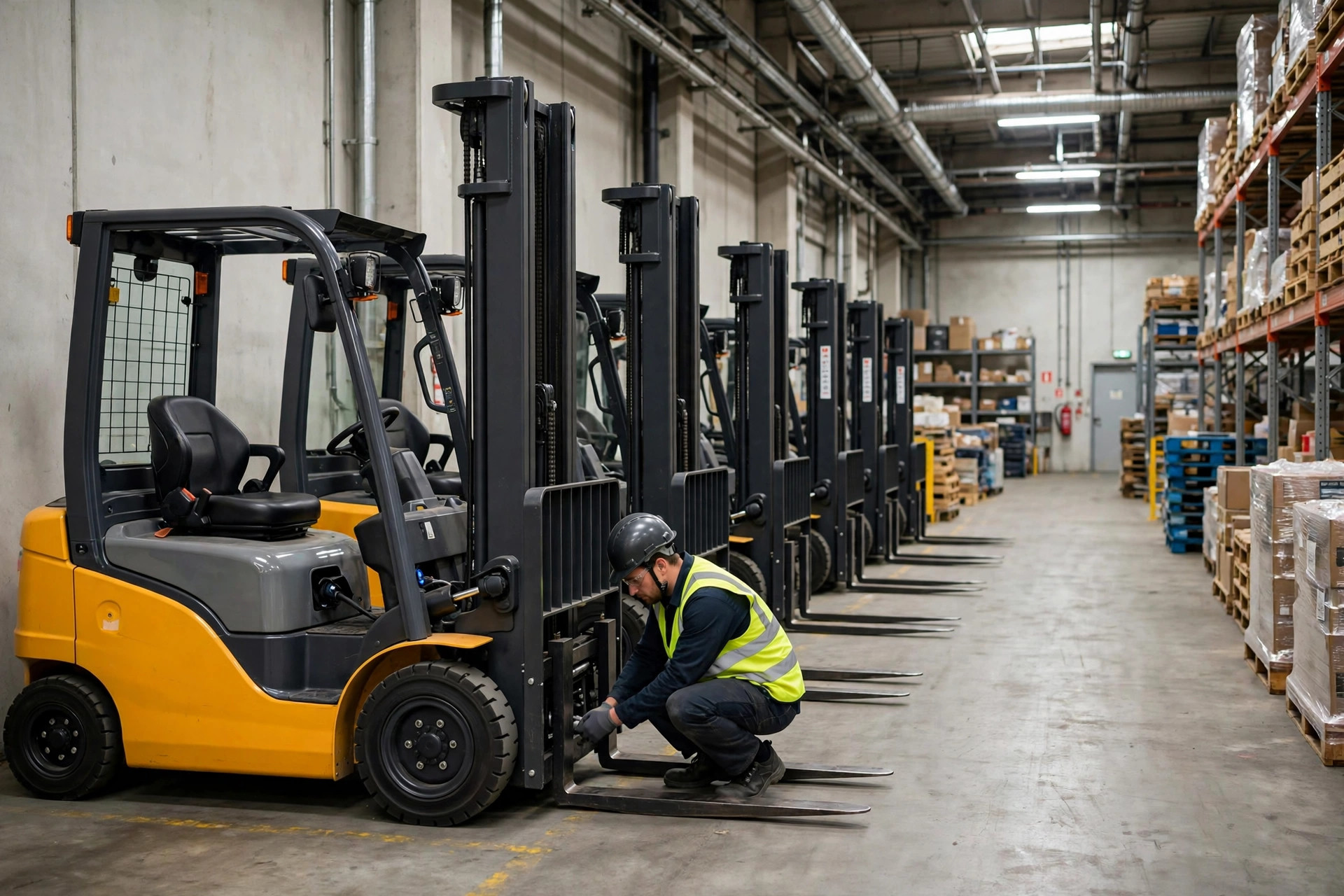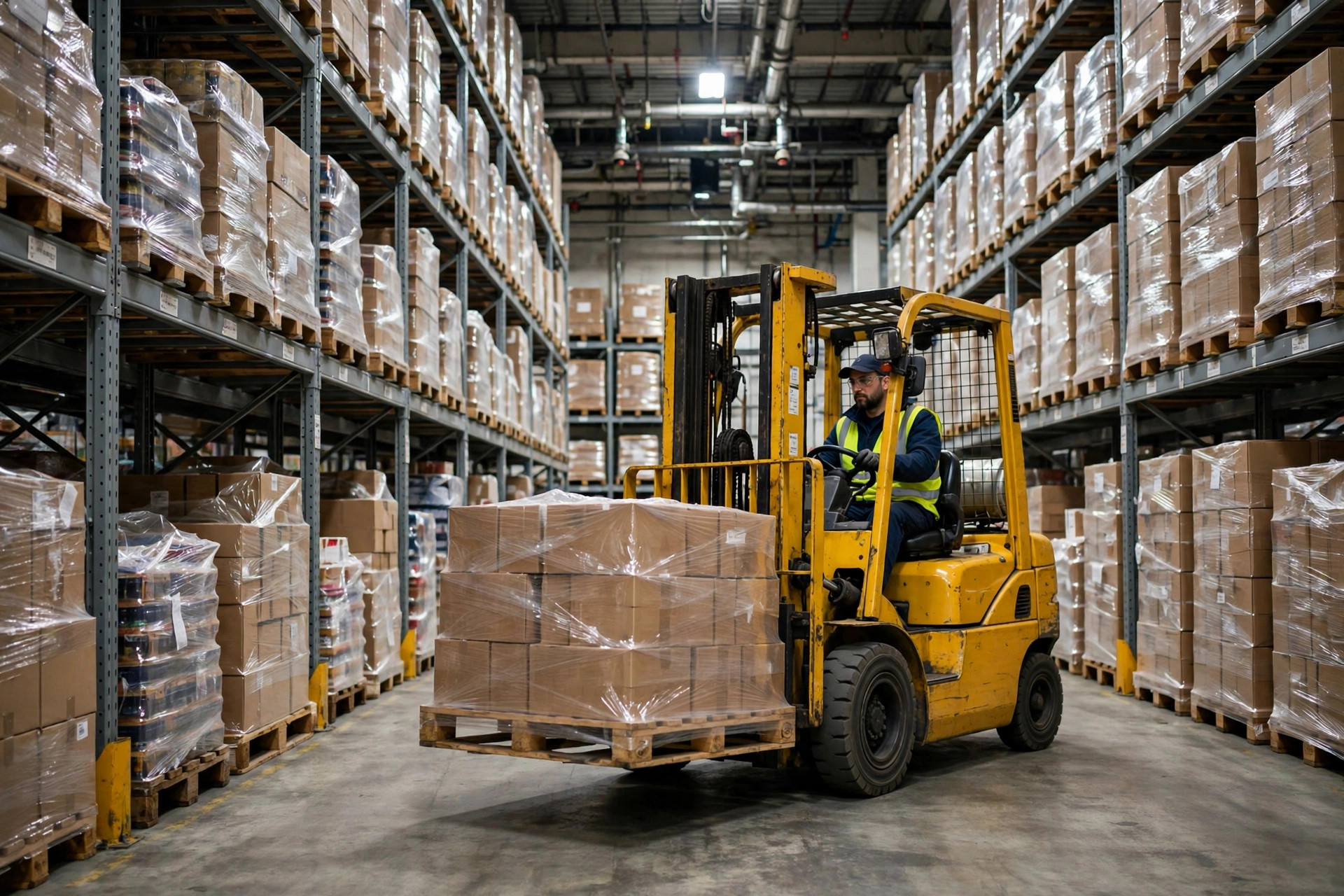
How many forklifts does a warehouse need? I'll give you the uncomfortable answer first: at least one forklift in your warehouse is redundant. That's not provocation, it's arithmetic. In my years running engineering at a systems integrator, I sized forklift fleets for more than twenty warehouses. Gut-feel fleet sizes are almost always too big. The rare ones that come in too small have it worse — peak season takes them straight offline.
Fall 2023, a 3PL in Ontario, California called me in: 85,000 square feet, twelve electric counterbalance trucks, asking whether to rent four more for the holiday peak. I didn't answer. I shadowed their shifts for three days. The 8 a.m.–noon window was the peak — all twelve trucks running. After 2 p.m., four sat in the charging area while drivers scrolled their phones. Night shift was worse: six working, six asleep. I pulled a week of pallet-move records from their WMS: 168 pallet moves in the peak hour. In short-distance dock shuttling, one truck does 25–30 cycles an hour. 168 divided by 28, divided by a 0.7 target utilization — 8.5 trucks. At least three of the twelve were pure decoration, burning tens of thousands a year in rent and maintenance. They didn't rent more. They returned two long-term leases.
That's sizing by utilization, backwards. Think of it like sizing servers: CPUs parked at 30% utilization mean you overbought; CPUs pinned at 95% mean queues that kill the business. A forklift fleet works the same way. The healthy band is 60–75%.
Forklift Fleet Sizing Starts With Single-Truck Hourly Throughput
The fleet formula looks like this:
Trucks needed = peak-hour pallet moves ÷ single-truck hourly throughput ÷ target utilization
The numerator is easy: pull a week of data from the WMS and take the peak hour. No WMS? Shadow the floor for three days and count.
The denominator is where everyone guesses. Single-truck throughput is pinned to three variables: truck type, travel distance, and task type. Here are reference numbers you can actually use, for full-pallet moves:
| Task | Typical cycle | Single-truck throughput (ref) | | Dock shuttling, under 50 m | Pick–travel–drop | 25–30 pallets/hour | | Putaway / retrieval, 50–100 m | Includes high lifts | 15–20 pallets/hour | | Full-pallet outbound loading | Includes trailer wait | 12–18 pallets/hour |
Those assume a 2.5t electric counterbalance, a skilled driver, normal floor conditions. A rookie driver: multiply by 0.7. A freezer at −20°C: multiply by 0.8 — nobody moves fast in thick gloves, don't argue with physics.
Hold target utilization at 60–75%. Below 50%, you bought too many trucks. Above 85%, you'll watch drivers queue at aisle ends waiting for rack positions, and the hidden cost of that queuing dwarfs the price of one more truck. It's like highway traffic: past a critical density, throughput doesn't rise — it falls. More trucks in fixed aisles means more yielding, and per-truck productivity drops. Bigger is not faster. That's the first counterintuitive point.
How Many Forklifts Does Your Throughput Actually Require? Get the Truck Type Right First
Most people botch fleet sizing before they even reach the math: they pick the wrong truck. Three mainstream types do fundamentally different jobs:
- Electric counterbalance (2.5t and 3.5t are the common classes): the dock and shuttle workhorse, 10–20 km/h travel speed, but a wide turning radius — you need 3.5 m+ aisles.
- Reach truck: the high-bay putaway specialist, lifts past 10 m without breaking a sweat, fits 2.8 m aisles, but slow travel — terrible for long shuttles.
- Pallet jack / stacker: cheap and cheerful for low, short moves, but limited lift height and speed.
The worst mismatch I ever saw: a 50,000-square-foot B2B full-pallet outbound warehouse running an all-reach-truck fleet. Drivers shuttled 200 m between dock and storage on reach trucks, grinding out 12 cycles an hour. Two counterbalance trucks did the same job at 25 cycles an hour, and the fleet went from eight trucks to five. Get the truck wrong and every number downstream is wrong.
So the order is: pick the truck type first, then compute throughput, then size backwards. Reverse the order and the formula can't save you.
The Battery Strategy That Eats Two of Your Trucks
The line item 90% of fleet plans miss: charging and battery-swap time.
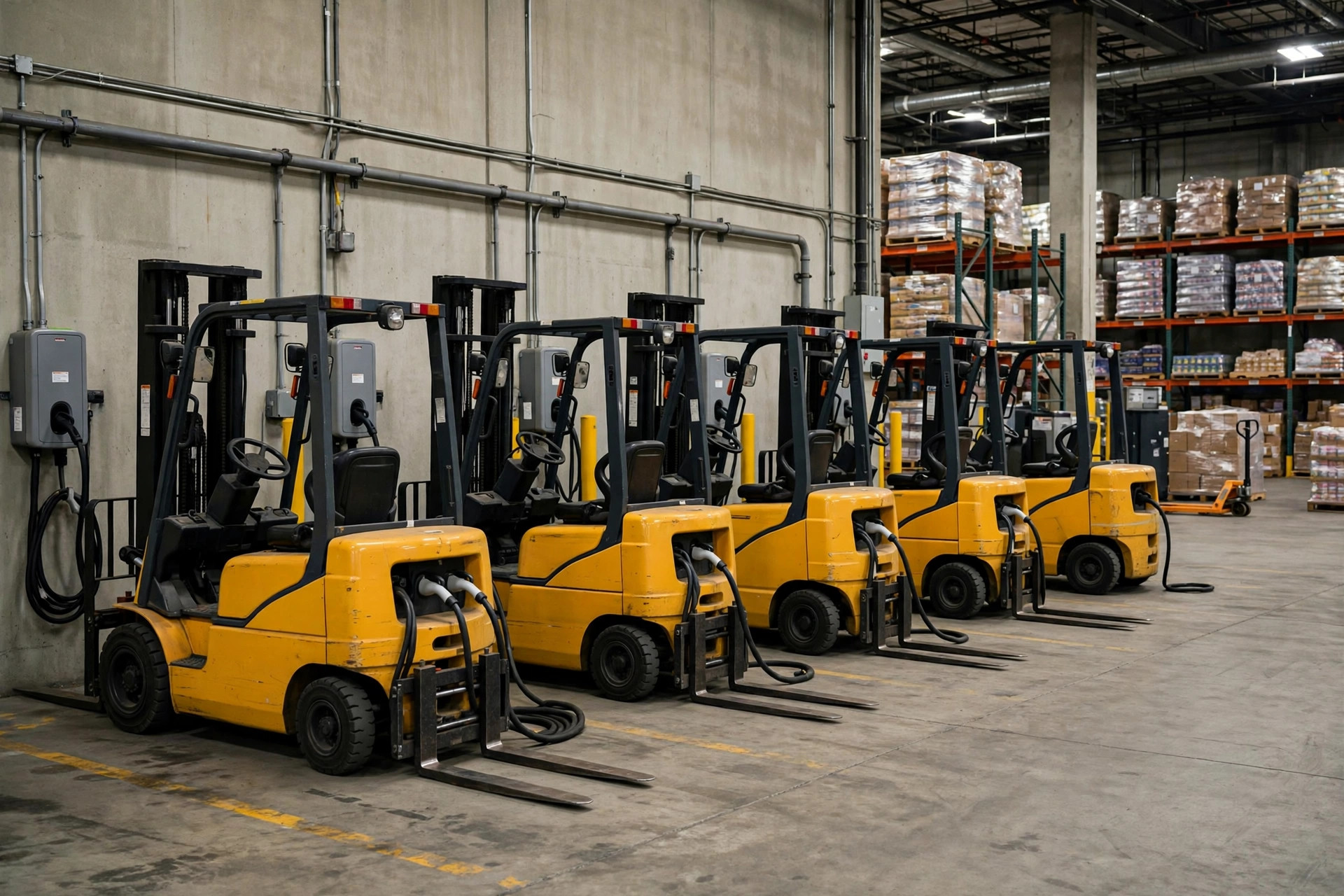
Winter 2024, a cold-storage warehouse in the Dallas–Fort Worth area: ten lead-acid counterbalance trucks, three shifts, night shift always short — they wanted two more trucks. One look at the charging area told the story. Lead-acid needs 8 hours to charge plus an hour to cool. Three-shift operation means two to three battery packs per truck in rotation. They had 1.5. Half the night-shift fleet wasn't working — it was waiting on batteries. The math: two more trucks, tens of thousands of dollars. Or lithium: 1–2 hour fast charge, opportunity charging, one pack runs all day. They didn't add trucks. They converted four trucks to lithium, closed the night-shift gap, and had one to spare.
Lead-acid vs. lithium is a shift-pattern decision:
- One shift, 8 hours a day: lead-acid is fine, charge overnight, lowest cost.
- Two or three shifts: lithium. The 1–2 hour fast charge eliminates swap labor and spare packs, and total TCO comes out lower.
- Freezers below −20°C: low-temp lithium. Lead-acid can lose 30–40% of capacity in the cold. Don't cheap out here.
And while I'm at it: sizing by square footage is a pseudo-requirement. "Six trucks per 100,000 square feet" is numerology. Floor area has no necessary relationship with workload — a 100,000-square-foot automated high-bay might need zero forklifts, while a 30,000-square-foot cross-dock might need ten. Sizing by area is like dosing medicine by body weight alone. It sounds rigorous and means nothing.
The One Number That Tells You If the Money Was Worth It
Fleet size set, final check: cost per pallet move.
Annual fleet cost (depreciation or rent + electricity + maintenance + allocated driver labor) divided by annual pallet moves. If the number trends down, the sizing is right. If it climbs, check utilization first, truck-type match second, battery strategy third.
Across the warehouses I've worked, 3–5 currency units per pallet all-in is excellent; above 8, start optimizing. That's fully loaded cost, not just electricity — don't lie to yourself.
So: how many forklifts does a warehouse need? Don't guess. Pull the WMS data, compute peak-hour workload, divide by single-truck throughput, divide again by 0.60–0.75 target utilization. The math says 8.5, you buy 9. Round up — the extra half truck is headroom for peak season and breakdowns, not a license to guess.
By Da Liu, Automation Engineer