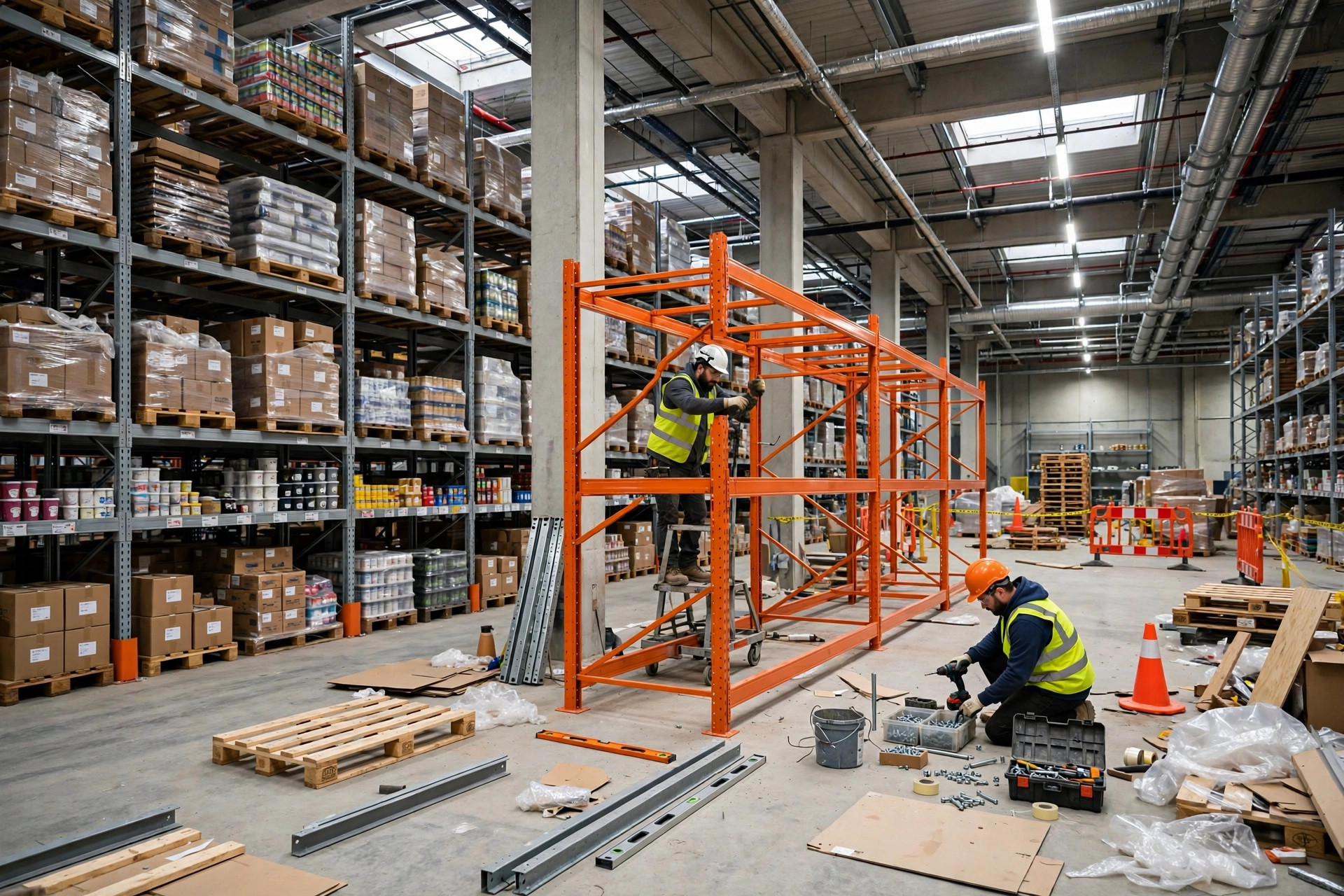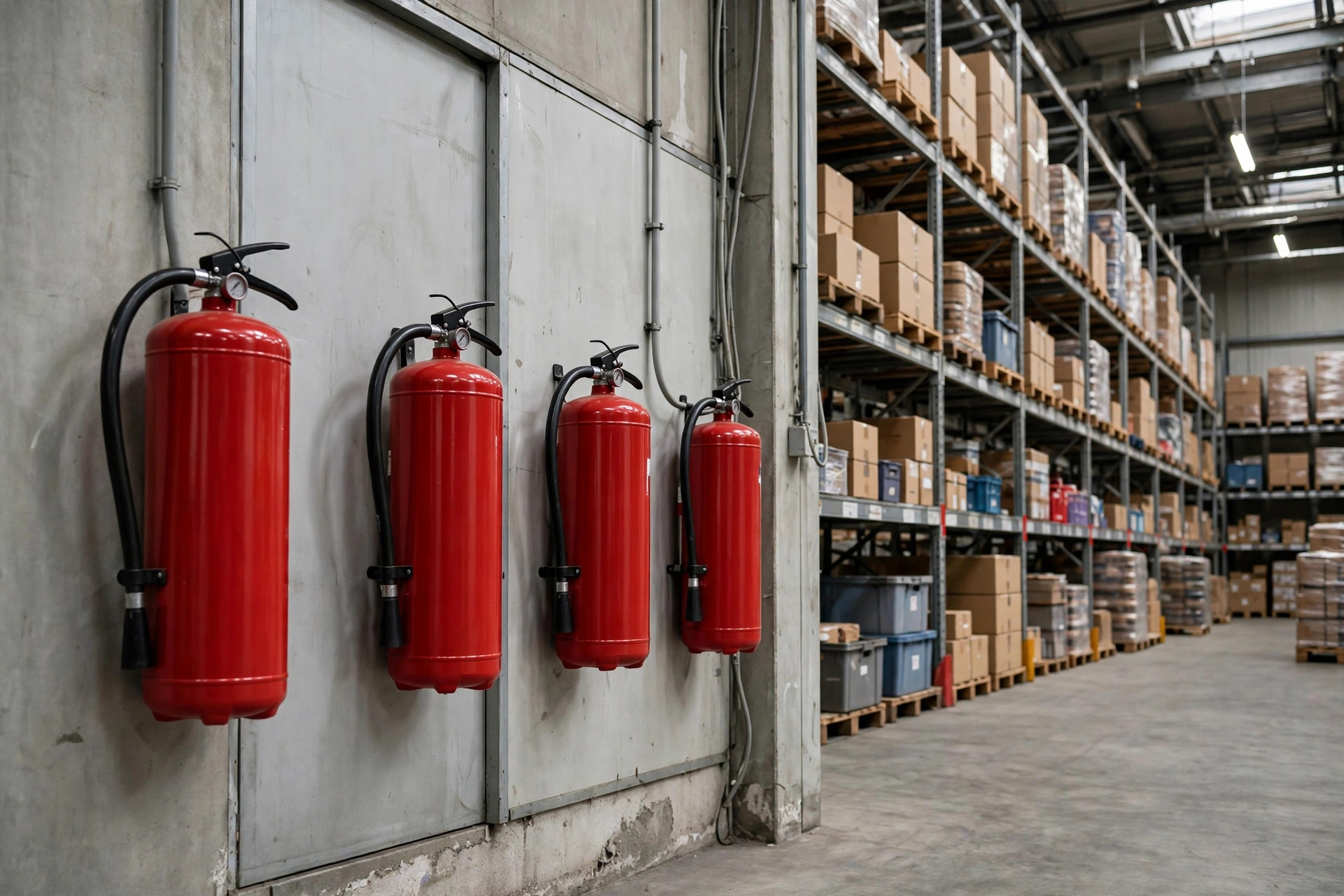
How many fire extinguishers does a warehouse need? I never thought hard about that question until the summer of 2023, outside a 3PL warehouse in Ontario, California.
I was there for a pickup. Truck parked, paperwork in hand, when I saw smoke curling up from the packing area. A stack of cartons had caught — nobody knew whether it was a cigarette or a frayed wire. A few workers stood around it, frozen. The nearest extinguisher hung by the office door, a good 180 feet away. One kid took off sprinting and came back nearly a minute later, extinguisher in his arms. They put the fire out, but two pallets of goods were smoked beyond saving — and the warehouse manager's face was about the same color.
I'm telling you, after fifteen years running trucks, I've seen this movie play out at warehouse docks more times than I can count. Afterward I asked the manager: how do you guys figure out how many extinguishers this place needs? He mumbled something about calculating by square footage. Enough of them, he said. Enough? When the fire started, the "enough" extinguishers were 180 feet away. Might as well have been on the moon.
Here's what that day taught me: stocking fire extinguishers isn't about buying enough red cans and hanging them on a wall. In the U.S., two separate rules run the show — one about distance, one about quantity — and you've got to satisfy both. Miss either one and you're exposed.
How Many Fire Extinguishers Does a Warehouse Need? Two Rules, Both Count
Rule one is about distance, and it comes from OSHA — 29 CFR 1910.157(d)(2). For Class A fires (ordinary combustibles: cartons, wood pallets, packing material), no employee should have to travel more than 75 feet, about 23 meters, to reach an extinguisher. Travel, not straight-line distance.
Rule two is about quantity, from NFPA 10. Warehouses generally fall into the "ordinary hazard" bucket, and the working rule is: extinguishers rated at least 2-A, at least one per 3,000 square feet of floor area. (2-A is a firefighting-capability rating; the 10-pound ABC dry-chemical units you see everywhere in warehouses are typically in that neighborhood — check the label on the bottle.)
Put the two side by side:
| OSHA's 75-foot rule | NFPA's 3,000-square-foot rule | |
|---|---|---|
| Controls | Distance — can a person reach one while the fire is still small? | Quantity — does the floor area have enough, on paper? |
| The number | No more than 75 feet of travel | At least one (2-A minimum) per 3,000 sq ft |
| How you measure | Along the path a person actually walks — around racking counts | Total floor area ÷ 3,000, round up |
| Who checks | OSHA inspectors and the fire marshal both honor it | Your local fire department signs off on it |
Now here's the thing: eight out of ten warehouses I've seen fail on rule one. They do the area math, the count checks out, the form gets filled — but every extinguisher is clustered by the office and the main door, and there's nothing within 75 feet of the racking aisles. When a fire starts, that's the same as having none.
75 Feet Means Walking Distance, Not a Straight Line
Why does "travel distance" matter so much? Because a warehouse is full of racking. You can't walk through steel.
Say an extinguisher hangs at the mouth of aisle A, and you're mid-aisle in aisle B. Straight line, maybe 40 feet. But you've got to walk to the end of your aisle, cut across, and come back up — 120 feet, easy. That's over the limit.
So when you lay this out, grab the floor plan. From each extinguisher, trace 75 feet along paths people can actually walk, and make sure every racking bay, packing station, and charging area falls inside somebody's circle. Any corner left uncovered needs another unit.
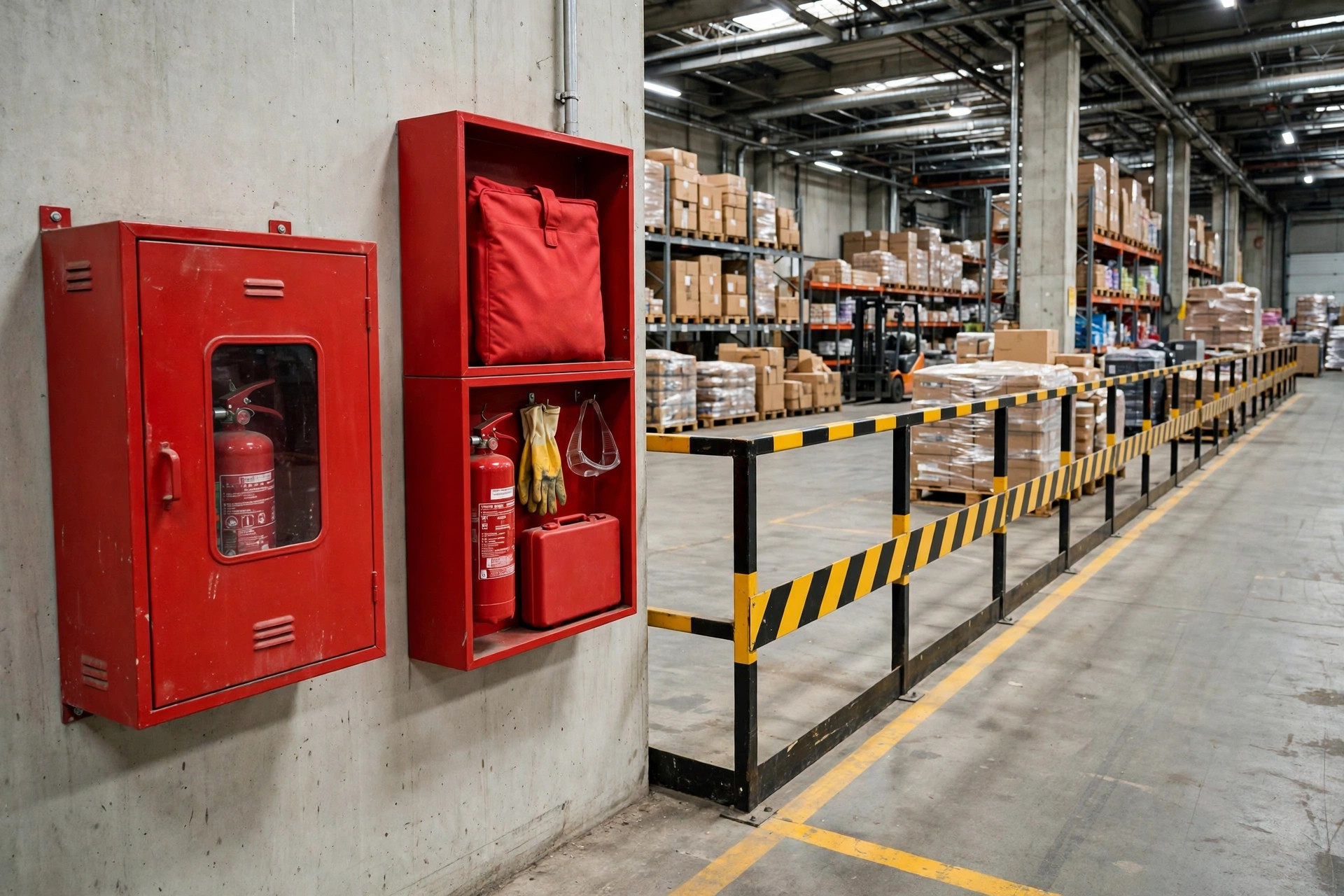
One more detail people get wrong: mounting height. OSHA says extinguishers weighing 40 pounds or less must hang with the top no higher than 5 feet off the floor; heavier units, no higher than 3.5 feet; and the bottom needs at least 4 inches of clearance. Hang one too high and half your crew can't reach it in a hurry. (Check the current text on OSHA's site — code details get tweaked over the years.)
How Many Is Enough? The Math on a 100,000-Square-Foot Warehouse
Let's run the numbers on a standard big-box warehouse: 100,000 square feet.
By area: 100,000 ÷ 3,000 = 33.3, round up — at least 34 extinguishers.
By distance: a 100,000-square-foot box is a few hundred feet on each side. Lay 75-foot walking-distance coverage over it, weave around the racking, and 34 almost never cuts it. In practice you land somewhere around 40 before every corner is covered.
The answer: take the bigger number. Thirty-four is the floor; distance pushes you up from there.
Now the counterintuitive part — and I'm telling you this because I've watched warehouse managers try it: you cannot buy your way out with bigger extinguishers. The 75-foot rule doesn't care how big the bottle is. A 4-A unit covers more square footage on paper, but the distance limit is the same, so the count stays the same. Spend the money on putting smaller units in the right spots instead of upsizing the bottles. Two extra 10-pounders hung where the aisles actually are will beat one big bottle by the office door every time.
And a trade-off worth knowing: ABC dry chemical is the warehouse workhorse — a few dozen dollars a bottle, handles A, B, and C fires. But the cleanup after a discharge is brutal. The powder corrodes equipment and contaminates product; spray it over a packing line and you can write off that batch. Clean-agent extinguishers leave no residue but cost several times more. The usual play: ABC dry chemical across the floor, and a clean-agent unit or two by the electrical panels and charging stations. Put the good money where it matters.
Five Mistakes I Keep Seeing at Warehouse Docks
Second story. Last year I was unloading at a warehouse in Fontana when the fire inspector showed up, tape measure in hand, checking the spacing on every extinguisher. The manager vented to me afterward: "We did the area math — 34 units, more than enough." The inspector barely looked up: "Area's fine. Distance isn't. Here's your correction notice." They ended up adding eight more, all deep in the racking aisles.
That tape measure is the whole game. Here are the five mistakes I see most at warehouse docks, and every one of them is about those 75 feet:
First, extinguishers blocked by freight. A pallet gets staged by the dock or the aisle mouth — right in front of the extinguisher. When the fire starts, you're moving pallets before you can fight it, and by then it's too big.
Second, everything by the front door and the office. The area math says the count is fine, but the racking aisles, the packing area, the charging station have nothing within 75 feet. And that's exactly where fires start.
Third, hung too high or not secured. Some places just set them on the floor, where a forklift knocks them over. Others hang them so high a shorter worker can't reach. Either way, useless in a hurry.
Fourth, nobody checks the gauge. OSHA wants a visual inspection every month: needle in the green, pin in place, no rust on the bottle. I've seen units sitting in the red for half a year with nobody noticing. Come fire day, nothing comes out.
Fifth, thinking sprinklers replace extinguishers. Two different jobs. Sprinklers are automatic — they kick in when the fire's already big, and only over their own heads. Extinguishers are for people, for the first minute, when it's still a small flame you can kill. A sprinklered warehouse needs its extinguishers just the same.
My advice to warehouse managers and shippers is three lines, easy to remember: take the floor plan, walk the 75-foot travel distance from every unit, and fill the gaps. Once a month, send somebody on a ten-minute walk to check every gauge in the building. And when a new hire starts, walk them to the two extinguishers nearest their workstation. Fire protection is all small stuff on normal days — and the biggest thing in the world on the one bad day.
There's an old saying where I come from: better to have it and not need it than to need it and not have it. An extinguisher that hangs on a wall untouched for ten years is a good thing. One you can't reach when you need it — that's a disaster.
By Shifu Zhao, Trucking Veteran (15 yrs)