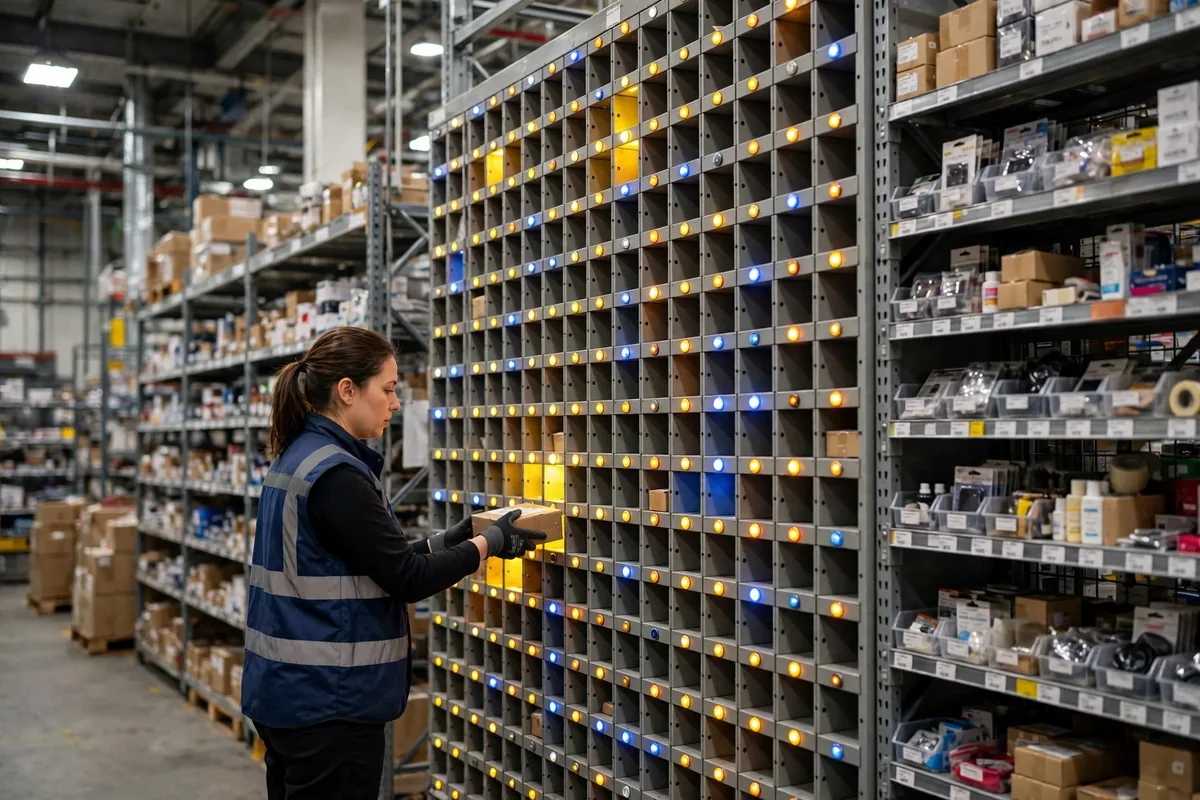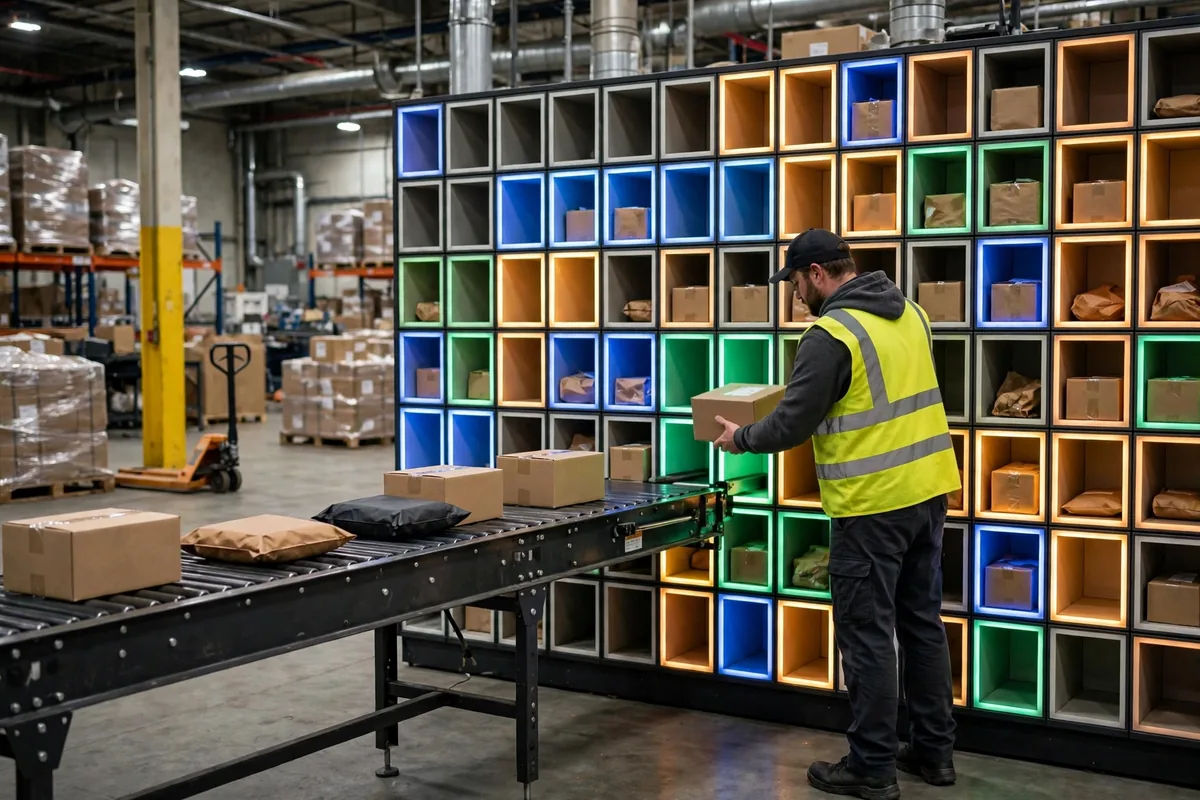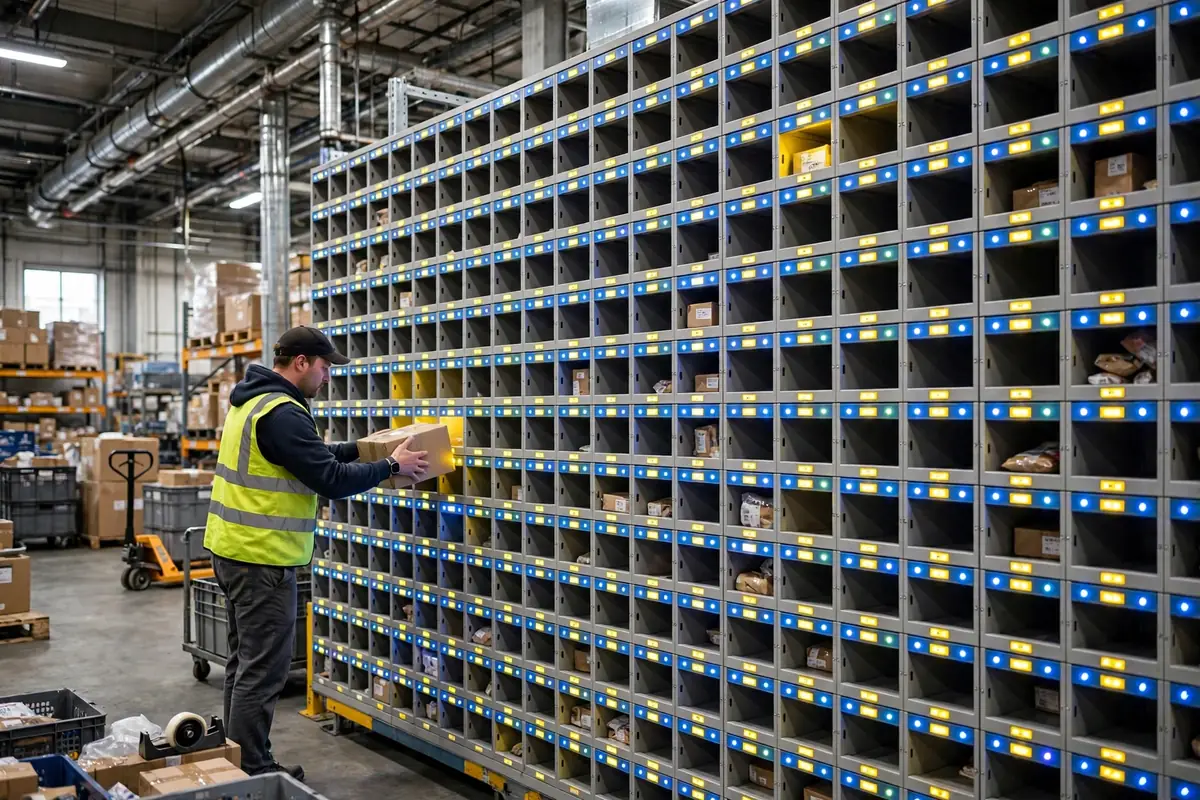
Let me start with the sales pitch I push back on most: a high volume warehouse sorting wall is not better because it has more slots. A slot is just an order waiting to be completed. Picture a wall of mailboxes. Each mailbox is one open order. A worker stands at the wall, scans each item from a bulk-picked tote, watches the indicator, and puts the item into the right slot. When a slot fills, that order gets packed and the slot frees up for the next order. The principle is that plain. Plain principles still burn money when you size them wrong.
I used to lead engineering at an integrator, and I have seen both failure modes. Sites that guessed the slot count and choked in peak because orders queued in front of the wall. And sites that bought a long, impressive wall where half the slots sat empty most of the year, parked on the most valuable floor space next to packing. This piece covers the principle first, then the sizing line, then the maintenance traps. For the general put-wall method, the companion guide on put-to-wall secondary sortation and how slots are worked is a good cross-check; here I focus on sizing at high volume.
High volume warehouse sorting wall slot count comes from the order profile
Do not ask the vendor first. Pull your own order data. Three numbers drive slot count: how many orders are live on the wall at the same moment, the average lines per order, and your wave rhythm.
Here is a worked assumption case — treat the figures as a sizing exercise, not an industry standard. Suppose a wave releases two thousand orders and the wall is planned to clear them in about two hours. The slots you need are not two thousand. Orders finish at different times; early finishers get packed and release their slots to new orders. What you need is the peak count of simultaneously open orders, and the honest way to get it is to replay historical waves: simulate each order's completion moment and count the peak. No replay tooling? Use the floor method. On three peak days, record open orders at the wall every hour, take the high values, and add headroom. How much headroom depends on how promotion-driven your demand is. Volatile demand needs a thicker cushion.
Lines per order drives a different decision: slot physical size and depth. A profile dominated by single-line, single-unit orders tolerates small, dense slots. A profile with multi-line orders and bulky mixed items does not — by the third item the slot overflows, workers start stacking goods at the foot of the wall, and your wall has become expensive shelving. Size slots from the volume distribution of your orders, not from the order count. Pull three months of orders, tabulate lines and cube, and look at the distribution before you ask anyone for a slot quote. Nine out of ten sites that call me have never run that table. It is like asking what shoe size to buy without measuring your feet.
The third number is the single-item put cycle: scan, read the indicator, turn, put, turn back, grab the next item. That loop is your base rate. Whole-wall throughput is roughly headcount times the individual rate, times a coordination discount — add people and they start waiting on totes and on each other; output never scales linearly. And measure that rate on the floor, in peak condition, averaged over a sustained stretch of work. A rate measured in a quiet demo room is fiction, and any sizing built on it is fiction too.
The bottleneck is rarely the wall itself
At high volume, the wall is seldom the constraint. In the projects I have babysat, the choke points sit in three places.
First, tote supply. If bulk-picked totes arrive at the wall slower than the put rate, workers stand idle watching an empty conveyor or cart lane. People waiting on goods kills every rate you calculated. The fix is to align upstream wave release and tote arrival rhythm with the wall's consumption rate, and to hold a small buffer in front of the wall instead of running hand-to-mouth.
Second, full-slot handling. A full slot has to be packed, labeled, cleared, and reset. If that chain is slow, the full light stays on, the slot is effectively dead, and workers route around it. Staff and position your pack-out for the peak rate of slots completing, not the average. In sortation, averages are how you lie to yourself with arithmetic.
Third, exceptions. Damaged items, unreadable barcodes, mis-picks — where do they go? Without a dedicated exception slot and a clear routine, workers park exceptions at their feet, the pile grows, someone has to stop and clean it up, and the wall's rhythm falls apart. The companion piece on exception handling and full-slot routines at a sortation wall covers that organization well enough to borrow directly.
Here is the screening framework I use with clients. Treat the bands as a starting point for discussion, not a purchasing standard — correct them with your own measured rates:
| Factor | Stay with cart / discrete picking | A put wall starts to make sense | Fix the process first; a wall will not save you |
|---|---|---|---|
| Order structure | Mostly single-line orders, little consolidation needed | High share of multi-line orders needing consolidation after bulk pick | Order profile swings wildly day to day, no stable waves |
| Wave scale | Small waves; few orders ever live at once | Peak live orders on the wall is high and stable | Wave release timing is chaotic and unpredictable |
| Labor picture | Walking distance is short; pick rates are acceptable | Walking dominates; bulk pick plus wall putting cuts travel hard | Shortage is at packing; pack-out chokes before the wall does |
| Floor position | No full wall position near packing | Wall position available close to packing | Only wall space is far from packing; full slots travel too far |
Put wall versus cart picking: the honest dividing line
Strip it down and the wall trades walking for standing puts. Cart picking, whether discrete or pick-to-cart with onboard sorting, keeps people moving. At modest volumes with simple orders, that flexibility wins and the math is fine. As volume and multi-line share climb, the cart worker spends more time hunting the right compartment and verifying, and both travel and errors climb with it. That is where bulk picking plus a wall earns its keep: pickers just pick fast in bulk, and all the consolidation work concentrates at one staffed wall.
Now the fake requirement I will call out every time: a site with modest daily volume and mostly single-item orders does not need a sorting wall. Slots sit empty, the extra scan-confirm step slows people down, and pick rates end up worse than plain discrete picking. A wall is a machine fed by order volume. Starve it and it is just a very expensive set of cubbies bolted to your best floor space.
So judge it on one number: peak live orders. If that number stays low wave after wave, your volume cannot feed a wall, whatever the brochure says. If it sits high and stable, and cart travel is visibly eating your labor, the wall math starts to close. Whatever whole-wall rate a vendor quotes you, recompute it with your floor-measured put cycle before you sign anything. The gap between the two numbers is usually the most educational moment of the project.
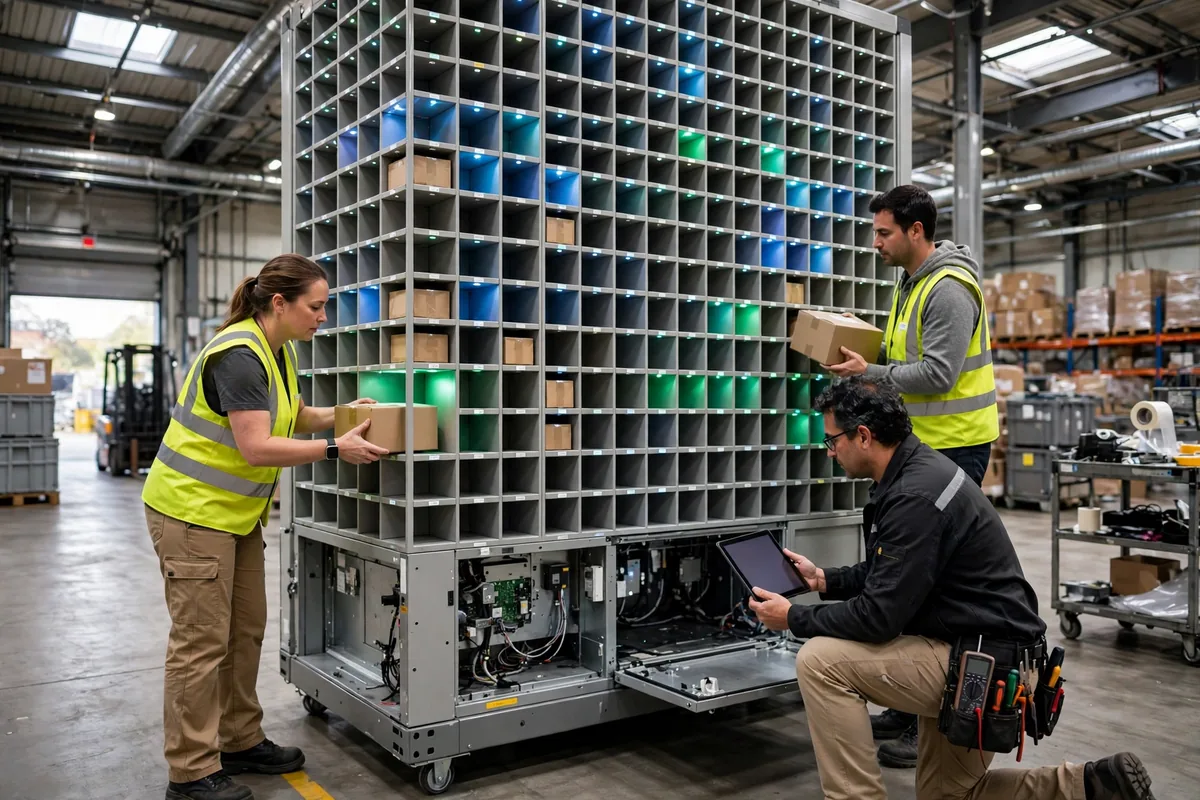
Maintenance, briefly, because this is where walls quietly bleed. Slot lights, buttons, and scanners are high-cycle parts. One dead indicator takes that slot out of service for the day, so hold spares in proportion to slot count instead of starting a purchasing process after the failure. Slot bottoms collect dust and label scraps; foul a sensor and you get phantom full signals. Put slot inspection on the daily checklist — it is cheap insurance. On the systems side, wall control and WMS wave status must agree. If the system shows a slot empty while it is physically full more than a couple of times, operators stop trusting the lights, and a wall nobody trusts performs worse than no wall at all.
Whether the money is well spent comes down to that one number: does your peak live-order count keep slot utilization honestly working? Utilization holding above half across your waves means the wall is earning. Utilization stuck at a fraction of that means you bought too much wall — admit it early and give the floor back to work that needs it.
By Da Liu, Automation Engineer