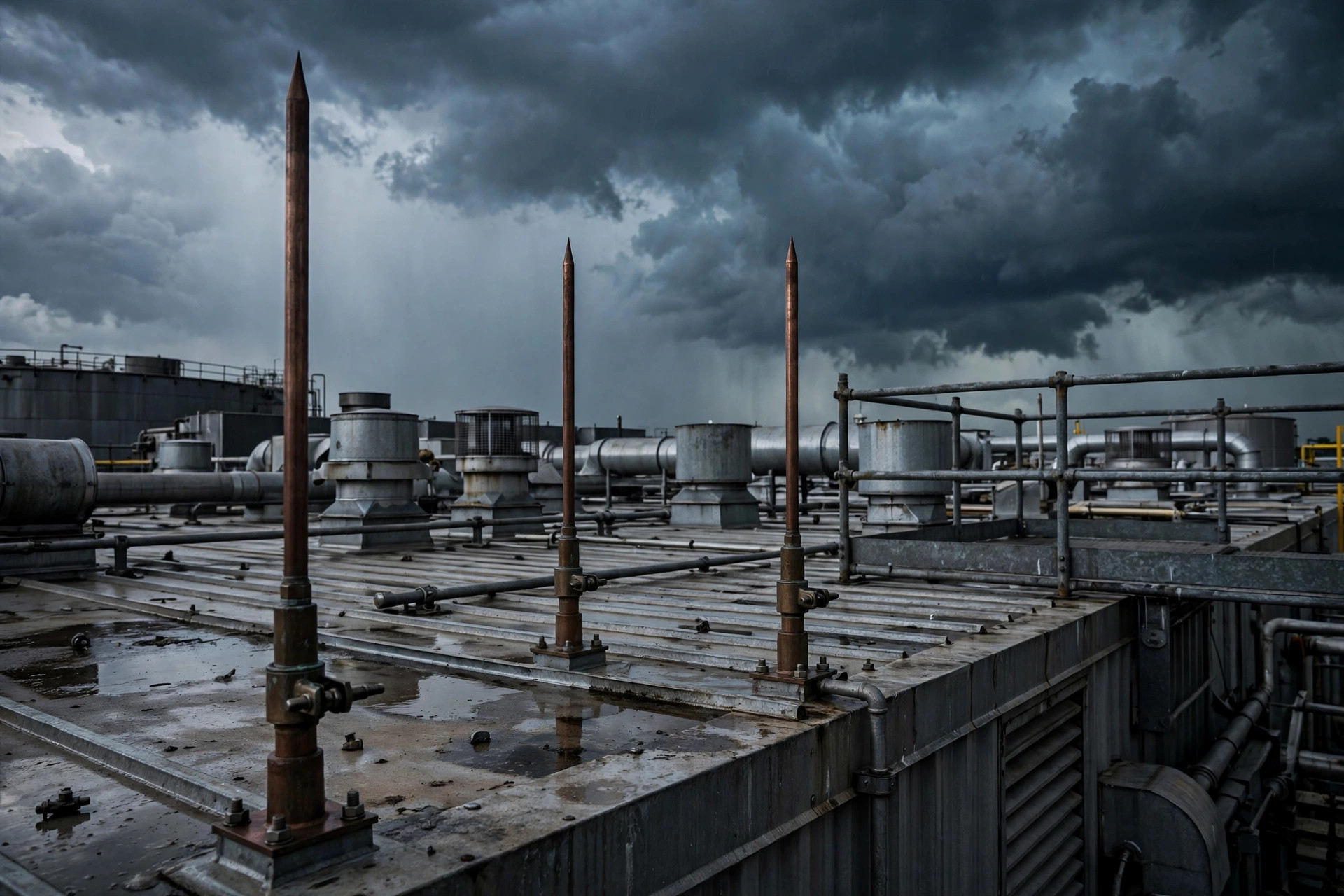
At 3 a.m., the alarm ripped me off the break-room couch. It was June 2023, right in the middle of Houston's ugliest storm season, and the lightning protection for my hazmat warehouse was about to face its toughest test of the year.
My building had just walked into a severe convective cell — lightning, one strike after another. Old Sun, my lead electrician, kicked the door open, rain dripping off his face: “Chief, a surge came through the panel! Every SPD window in the distribution cabinet is red. The WMS servers just dropped.”
My stomach twisted. And honestly, the servers were the least of my worries. On the west side of the building sat 30,000 square feet of hazmat storage: solvent drums, aerosol cans, a few pallets of oxidizers. Lightning plus hazmat — that's the most expensive combination a warehouse can hold.
Folks, here's what twenty years on the floor taught me: surviving storm season with hazmat on the racks is not a couple of rods on the roof and done. It's a system — air terminals, a grounding grid, and SPDs. Miss one piece, and you might as well have none of it.
The 2019 Texas fire that started with a broken weld
There's an incident from our circles I still think about. Late June 2019, a 3PL hazmat warehouse east of Houston took a direct strike on its rooftop air terminal. The system did its job — the rod caught the lightning. But midway down the down conductor, an old weld from over a decade earlier gave out under the strike's heating effect. The current had nowhere to go, so it rode the nearby ventilation duct into the building and ignited solvent vapor rising from drum bungs on a pallet.
Half the warehouse burned. Over $2 million in direct losses, more than forty days of downtime. Insurance paid, but every customer walked.
The lesson in one sentence: the rod can stand as tall as it wants — if the down conductor breaks, you have nothing. A lightning system is only as good as its weakest link, not its tallest point.
Our own wake-up call in 2021: grounding resistance off the charts
In April 2021, one month before storm season, I followed our new rule and brought in a third-party lightning testing firm to test our grounding grid. When the report came back, my back went cold: 23 ohms of ground resistance. NFPA 780 — the U.S. standard for installing lightning protection systems — calls for a grounding system at 10 ohms or less. Check your local fire and electrical codes for the latest requirements, but nobody's code smiles at 23.
Why? Dig it up and two of the ground rods had rusted through underground. The rest weren't far behind. Honest truth: the stuff is buried, you never see it, and nobody checks until something goes wrong.
We drove two new rods, re-welded the connections, and retested at 7 ohms. Since that year, pre-storm-season testing has been a non-negotiable on our calendar: every April, one month before the storms arrive, everything gets done.
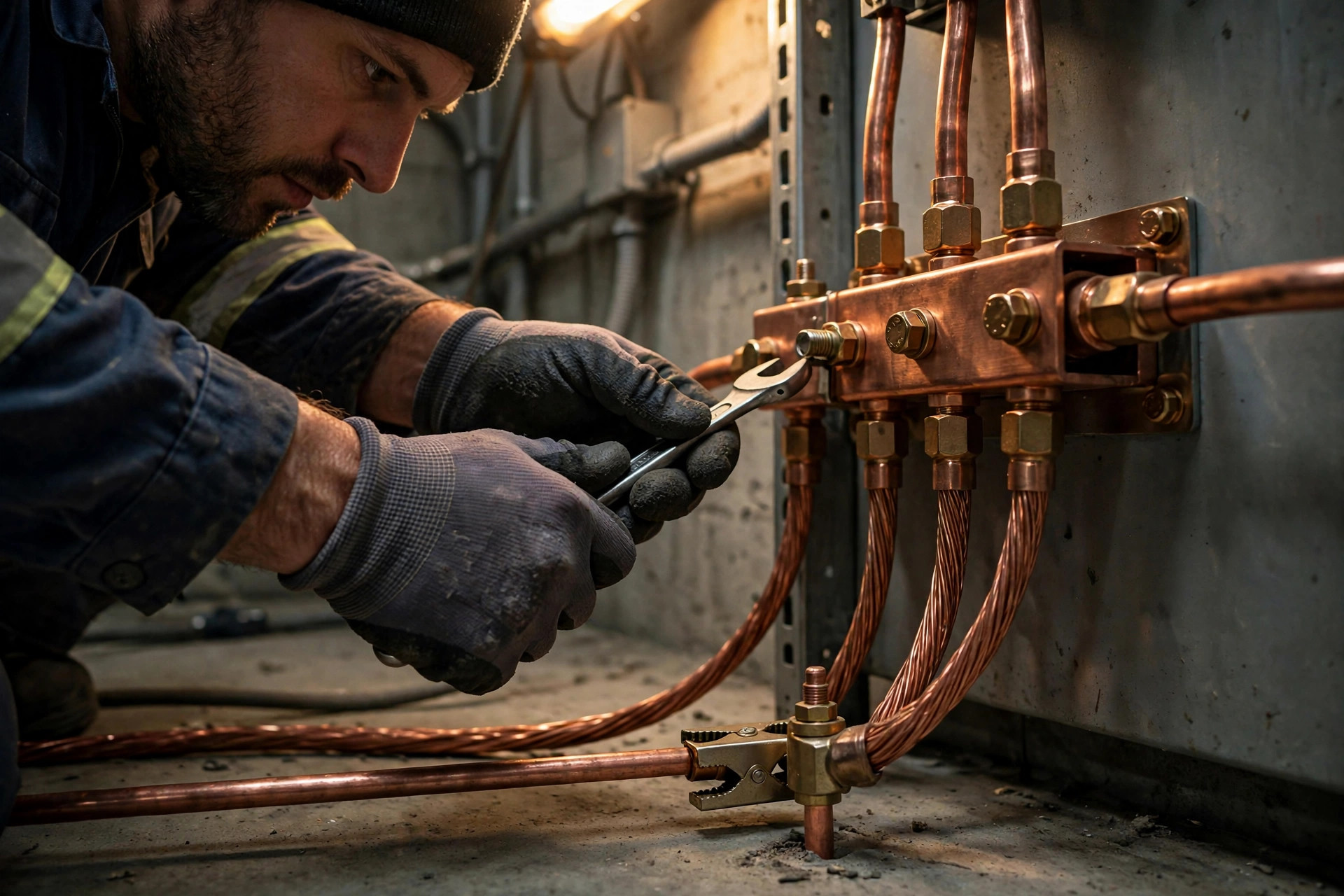
How we do lightning protection now: the pre-storm-season checklist
After years of trial and error, here's the checklist we run with. Steal it, adapt it, pin it to your safety board:
| Area | What to check | When | Owner |
|---|---|---|---|
| Air terminals (rods/strips) | Rod tips intact, no rust or looseness; rooftop equipment and vents inside the protection zone | Annual visual, before storm season | Lead electrician + safety officer |
| Down conductors | Welds and clamps free of rust and breaks; every conductor traced end to end | Annual, before storm season | Electrician |
| Grounding grid | Ground resistance 10 Ω or less per NFPA 780; check ground rods for corrosion | Tested annually; full retest every 3 years | Licensed third-party firm |
| SPDs (surge protective devices) | Status windows green or red; replace red-flagged modules immediately; check service entrance, distribution, and point-of-use levels | Annual before storm season; replace on red any time | Electrician |
| Bonding | Bonding jumpers on racks, piping, and tanks intact; bolts tight | Annual before storm season | Safety officer |
| Records | Test reports and replacement logs filed — fire inspectors and insurers both ask | After every test | Safety officer |
Two honest notes.
First: an SPD is a consumable. Type 1 at the service entrance, Type 2 at distribution, Type 3 at the point of use (per UL 1449) — installing them is not a one-and-done. Every surge ages the metal-oxide varistors inside; a red status window is the device telling you it's retired. My warehouse replaces the degraded modules every spring, no exceptions. Skipping that step is like never installing one — it's the most common mistake I've seen.
Second: make a veteran walk the down conductors with a rookie. Our rule: every April inspection, the lead electrician takes a new hire and traces every down conductor end to end. It looks simple, and it's exactly where failures happen. Walk it once, and the rookie remembers for life how lightning “leaks” into a building.
The math. You might ask what all this burns per year. Here's our warehouse's real 2022 spend: third-party grounding grid test $3,500; two new ground rods plus re-welding $8,000; six replacement SPD modules about $2,500 — roughly $14,000 a year. Compare that against the starting price of one lightning fire: our insurance deductible begins at $50,000, not counting downtime, customer claims, and the fire-permit risk. And for a hazmat warehouse, once OSHA's PSM (29 CFR 1910.119) inspection rolls in, fines are a separate conversation. My insurance broker also told me straight up: a complete testing record gets you a better premium.
A counterintuitive truth about lightning protection
One last thing, and it cuts against the grain. Many people think: the taller and the more air terminals, the safer. Wrong.
An air terminal is really a lightning attractor — installing one is an invitation. You invite the strike in, so you'd better be able to escort it out: unbroken down conductors, a compliant grounding grid, SPDs that hold. If any of those three fails, your air terminal is just a very expensive invitation.
So here's my reminder to fellow warehouse folks: stop asking “does our warehouse need lightning rods?” First go find out: when was the last time someone put a hand on your roof's down conductors?
Storm season is already at the door. For southern warehouses, that inspection belongs on the April schedule; for northern ones, May. Is it on yours?
By Chen Feng, Warehouse Operations Manager