The Pattern Nobody Wants to Talk About
If you spread out a decade of near-miss logs from any chemical warehouse, an uncomfortable pattern emerges: most problems do not originate in storage. They originate in receiving and shipping. Storage is static — product sits on a rack, and the risk profile is known. Inbound and outbound are dynamic — they are the moments when ownership, physical custody, and information change hands at once, and when product identity, batch, quantity, and customer qualification are most likely to misalign. One night shift and one shipping document is all it takes to load an oxidizer where a corrosive was supposed to go. Once that error leaves the dock, every procedure downstream is just paying for a mistake made at the receiving or shipping desk.
This is not alarmism. Consider what the U.S. Chemical Safety Board (CSB) has documented. On April 17, 2013, the West Fertilizer facility in West, Texas — a storage and distribution operation, not a chemical plant — exploded when roughly 30 tons of fertilizer-grade ammonium nitrate caught fire and detonated. Fifteen people died, including twelve firefighters; more than 200 were injured; over 150 buildings were destroyed (CSB Final Investigation Report 2013-02-I-TX). The CSB attributed the disaster to regulatory gaps, poor hazard awareness, and inadequate emergency planning — and noted that 1,351 facilities nationwide store ammonium nitrate, nearly half within half a mile of a school, nursing home, or hospital. West was not an outlier; it exposed a structural fragility in the storage-and-distribution segment of the hazmat supply chain.
A second data point comes from November 27, 2019, when a series of explosions tore through the TPC Group facility in Port Neches, Texas. Highly flammable butadiene escaped after a piping section ruptured; the CSB later determined that "popcorn polymer" had been expanding undetected inside a dead-leg pipe for 114 days. The blast triggered a mandatory evacuation within a four-mile radius — roughly 50,000 to 60,000 residents — fires burned for more than a month, and property damage totaled about $450 million on-site and $153 million off-site (CSB Final Report, December 2022). The telling detail: an internal hazard analysis in 2016 had already recommended flushing exactly that kind of piping, and the recommendation was never implemented. A correct recommendation, written on paper and verified by nobody, is functionally the same as no recommendation at all.
The Data Case for "Two People," and Why They Must Be Independent
The theoretical foundation for dual verification comes from human reliability analysis. The classic THERP methodology (NUREG/CR-1278) concludes that an independent verification step can reduce the human error probability of a single-operator task by roughly an order of magnitude. The operative word is independent: the verifier must examine the documents and the physical goods themselves — not watch the operator work. A second signature from someone who merely glanced over a shoulder has, statistically speaking, almost no error-catching value.
Applied to hazmat inbound and outbound, the logic chain is airtight. Nearly all receiving and shipping errors are human errors — misread labels, wrong batches, transposed quantities. And the cost of correcting those errors is lowest at exactly this point: the goods are still in your hands. Once the truck leaves, correction costs rise exponentially. So dual verification is not "one more procedure." It is the deliberate placement of the error-catching step at the point where correction is cheapest. That is the single most important judgment in this entire design.
The regulatory direction is converging on the same conclusion. OSHA's Hazard Communication Standard (29 CFR 1910.1200) requires workers to recognize chemical hazards; DOT's hazmat employee training rules (49 CFR 172, Subpart H) explicitly cover personnel involved in receiving and shipping; EPA's EPCRA Tier II reporting (40 CFR 370) obliges facilities to report the types and quantities of hazardous chemicals stored. And where does that reported data come from? From the receiving and shipping ledgers. If the inbound and outbound records are unreliable, the entire compliance edifice rests on sand. (Regulation citations should be confirmed against the current OSHA and EPA publications.)
Designing the Process: Two Loops, Not One
A workable dual-verification regime splits receiving and shipping into two independent verification loops rather than sharing one script.
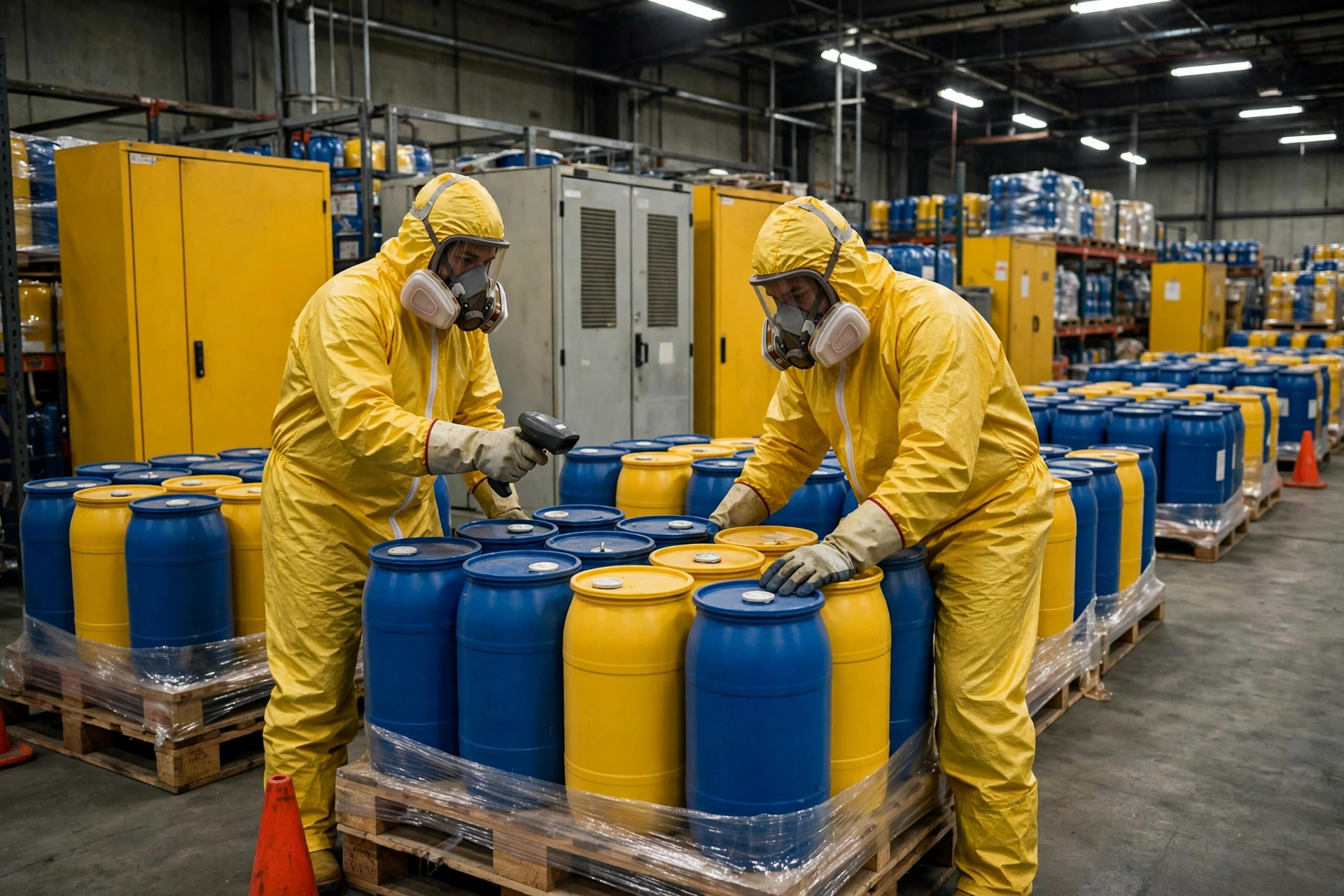
The receiving loop verifies four elements: UN number, product name, batch, and quantity. After the operator unloads and performs the initial check, the verifier independently confirms that the UN number on the paperwork matches the physical label, the product name matches the purchase order, the batch number matches the quality release, and the quantity matches the documents. If any one of the four fails to line up, the goods do not enter stock — they wait in a quarantine area.
The shipping loop verifies a different four: product name, storage location, customer qualification, and transport documentation. The verifier confirms the picked goods match the outbound order, the location matches the system record, the customer is qualified to receive that particular hazmat (some regulated chemicals require the consignee to hold specific permits), and the transport paperwork — SDS, shipping labels — is complete.
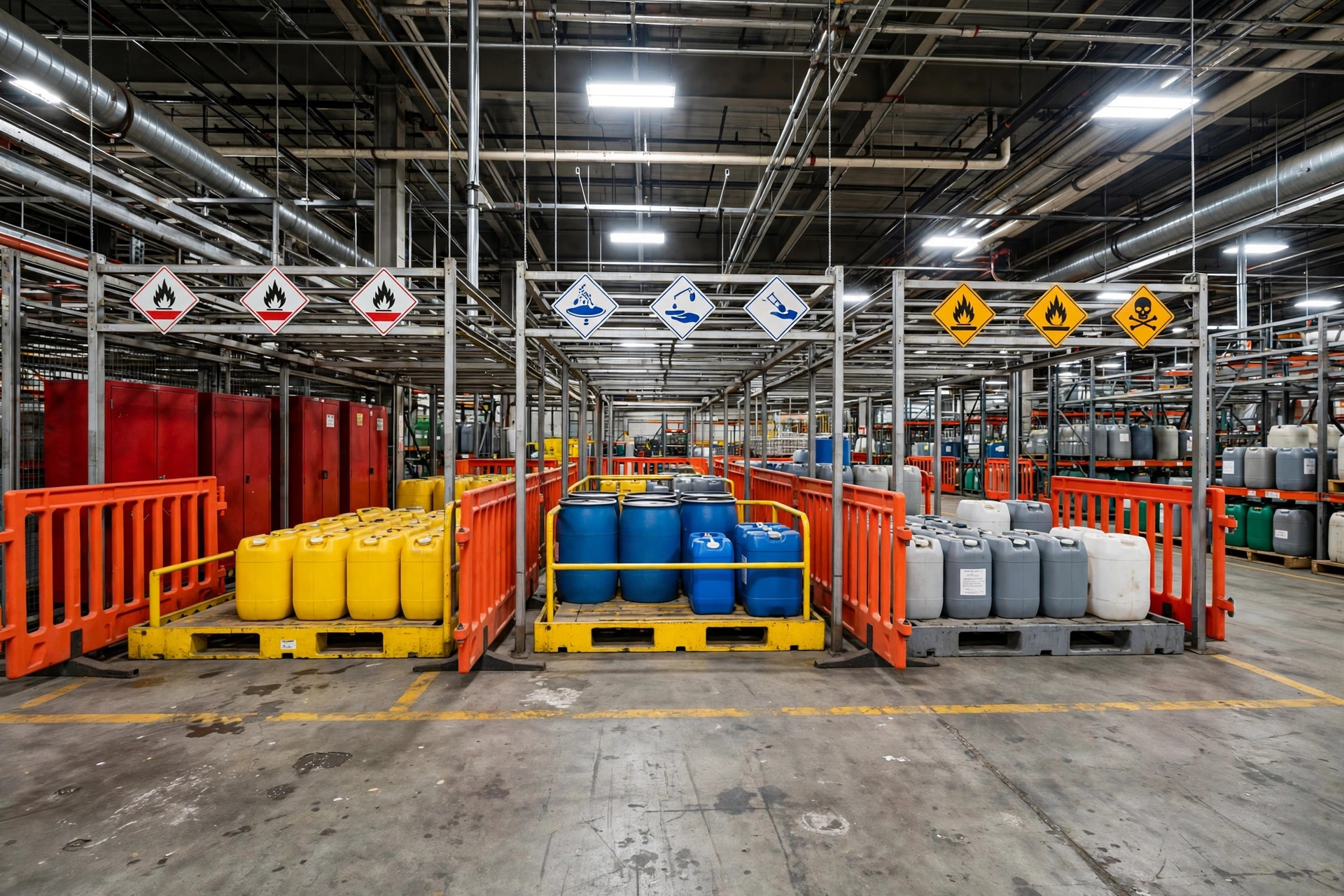
The single most important rule in the entire design is segregation of duties: the operator and the verifier cannot be the same person, and the verifier's performance metrics must not be tied to the operator's throughput. The moment a verifier's bonus depends on how many orders shipped today, independence exists only on paper. This sounds like management common sense, yet it is the real reason most dual-verification programs decay into ritual.
Paper Dual-Signatures vs. System-Enforced Interlocks
| Dimension | Paper dual-signatures | System-enforced interlocks |
|---|---|---|
| When errors are caught | After the fact — goods may already have left | Before posting — non-compliant transactions cannot be confirmed |
| Quality of the audit trail | Signatures can be backdated or signed by proxy | Electronic signature with timestamp; non-repudiable |
| Dependence on human state | Heavily dependent on the verifier's alertness that day | System checks are immune to fatigue and mood |
| Exception traceability | Digging through paper files — slow and lossy | One-click traceability by document number across the full chain |
| Collusion resistance | Weak — two people can simply agree | Combined with access separation, collusion requires defeating system audit |
| Implementation cost | Near zero | Requires WMS modification or a new module |
The table's conclusion is blunt: paper dual-signatures answer the question "does the procedure exist," while system interlocks answer the question "does it actually work." The digital path has three concrete components: scan-based verification (at receiving, both the document barcode and the physical label are scanned, and the system blocks the put-away confirmation on any mismatch); system interlocks (at shipping, a mismatch in product name, location, or customer qualification automatically locks the order and pushes an exception); and electronic-signature traceability (every verification action requires the verifier's own authenticated login, recording time, location, and device — forming a tamper-resistant audit chain).
The Accountability Chain: Four Layers
For dual verification to survive contact with reality, responsibility must be layered — otherwise every incident dissolves into two people pointing at each other. A workable division has four layers: the operator is accountable for the accuracy of execution; the verifier is accountable for the independence of confirmation; the shift supervisor is accountable for approving any exception release; and the facility's responsible executive is accountable for the effectiveness of the verification system as a whole. Each layer's responsibility should be written and auditable. The fourth layer deserves emphasis: when dual verification decays into ritual as a matter of routine, the fault lies not with the two people signing, but with the management that tolerated the decay.
The Trend: From "Required by Policy" to "Default in the System"
Tracing the industry's public record, a clear timeline is forming. In the early 2020s, large chemical and 3PL operators began making system hard-interlocks a precondition for hazmat receiving; EPCRA Tier II data-quality expectations are forcing companies to guarantee the accuracy of their inbound and outbound ledgers; and successive CSB investigation reports keep pointing at the same failure mode — procedures that were written but never executed. On these three grounds, my judgment is that within three to five years, dual verification for hazmat inbound and outbound will move from "required by policy" to "default system configuration," and regulatory inspections will shift from asking "are there signatures on file" to asking "does the system produce interlock records, and how were the exceptions dispositioned."
There is, however, a paradox worth confronting early. When a system can catch every error, does human vigilance decay? Aviation calls it the automation paradox — the more reliable the autopilot, the faster manual flying skills erode. Will hazmat warehousing repeat the pattern? Is the true value of dual verification the second pair of eyes, or the second share of responsibility? And when the second pair of eyes becomes an algorithm, where does that responsibility land? There are no standard answers yet — but every company about to deploy system-enforced interlocks should think these questions through before the project kicks off, not after.
By Dr. Chen, Supply Chain Researcher