Google "freezer warehouse OSHA cold stress rules" right now. Top ten results: all thin supplier Q&As, all saying the same thing — "OSHA has no specific temperature standard for cold." Then nothing.
That sentence is true. And it's useless.
December 18, 2023. 3:40 AM. I'm at our cold chain warehouse in Ontario, California, running night shift during the Christmas peak. Orders are burying us. My night supervisor Lao Zhao calls: "Feng, we got a problem. Ah Hui's right index finger — frostbite. Blistering."
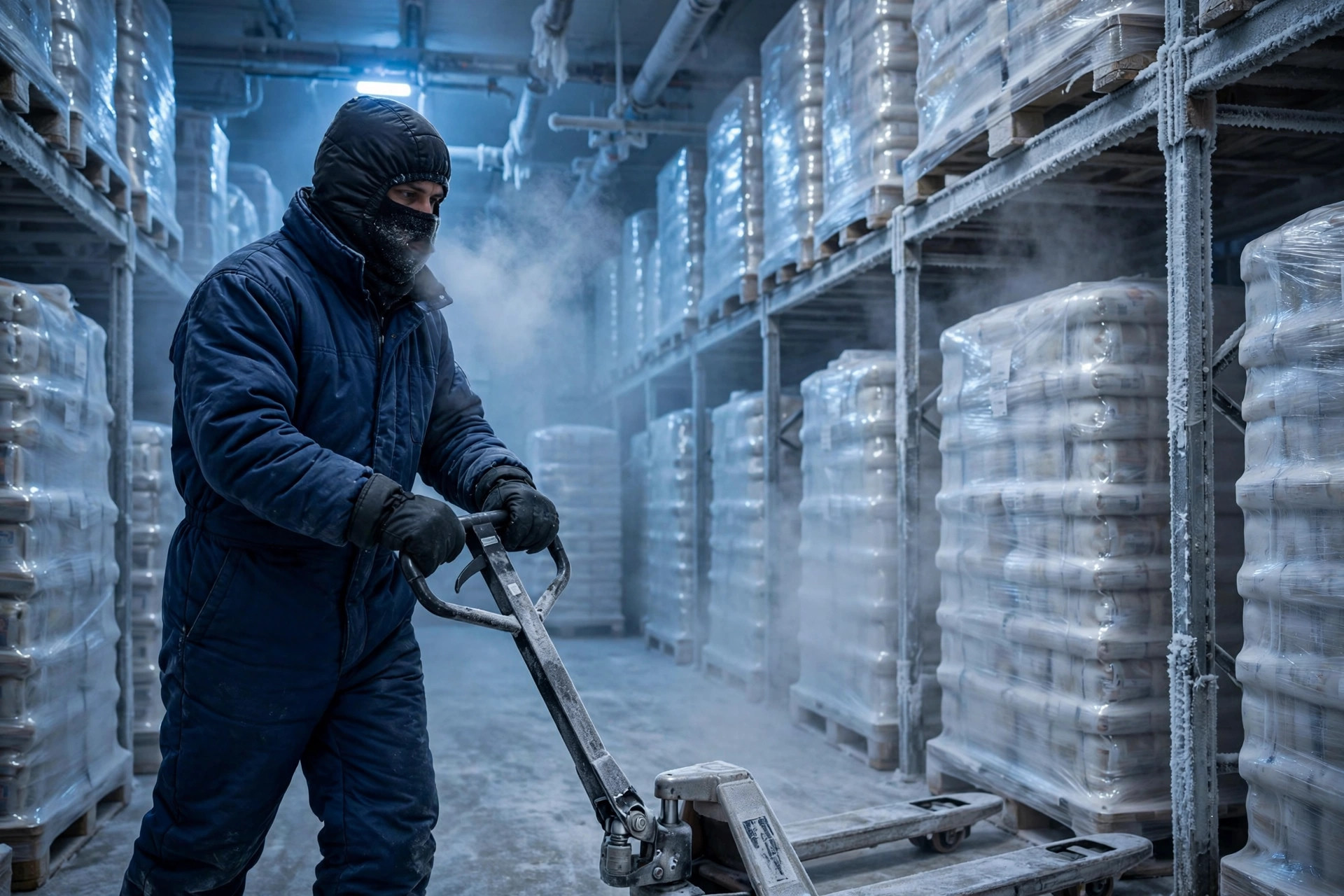
Ah Hui was a picker, four months in, a hard worker. That night in a -22°C freezer he worked two and a half hours straight — our rule said 90 minutes, but he saw the order queue and powered through. Numb fingertips, he ignored them. By the warming room, the finger was white, stiff, blistered.
ER visit. Three weeks off. Workers' comp, a few thousand in medical bills. The money wasn't the worst part — run a 200-person warehouse, and one safety failure drops morale across the whole floor.
After that HR asked: "What does OSHA actually require for freezers?" I dug around. Same sentence Google gave me: no specific standard. That made me angry — no standard, so when a worker gets frostbite, whose fault is it?
Folks, this article answers that once and for all. A freezer warehouse OSHA cold stress rules field guide — not for lawyers, for people who run freezers.
What OSHA's Cold Stress Rules Actually Say: No Temperature Standard, but the General Duty Clause
Bottom line: OSHA really has no "freezers must be X degrees, workers rest every Y minutes" standard. The supplier Q&As are right about that much.
But OSHA doesn't enforce through a cold-specific standard — it enforces through Section 5(a)(1) of the OSH Act, the General Duty Clause. Plain English: every employer must provide a workplace "free from recognized hazards." Frostbite and hypothermia are recognized hazards; OSHA publishes its own cold stress guidance on them. After an incident, the inspector won't ask for a standard number — four questions: Do you recognize this hazard? Written prevention plan? Training and rest rotations? Cold-weather PPE issued? Can't answer, and the citation goes under the General Duty Clause.
Here's the counterintuitive part: no temperature number from OSHA is exactly why "there's no standard" is no shield. The inspector cites OSHA's own cold stress guidance and NIOSH recommendations to prove it's a recognized industry hazard. You say "OSHA never said how long at -20°C," they answer "NIOSH did. ACGIH did. What did you do?" Get that, and everything follows.
(Our site ran a new-hire safety training piece earlier — general onboarding. This one is freezer cold stress only.)
How the Problem Surfaced: Three Versions of Our Rotation Schedule
After Ah Hui's injury, version one copied the ACGIH "no wind" column: -20°C freezer, out every 2 hours for 10 minutes. Veterans handled it. New hires had stiff hands at 90 minutes. Version two, I went strict — 60-minute rotations for everyone. The veterans revolted: "A tenth of our daily picks gone — who covers peak season?"
Honest truth about scheduling: two standards for two groups never works. Sixty minutes for new hires, 120 for veterans — supervisors can't track it, workers call it unfair. Version three, still in use, is tiered by temperature, same rule for everyone. Veterans grumbled, then went silent — the schedule is fixed but people aren't: anyone frozen can come out early. Nobody laughs at that here.

Our Freezer Warehouse OSHA Compliance Checklist: Four Lists We Actually Use
List 1: Temperature-Tiered Rest Rotation Schedule
Full disclosure: OSHA gives no hard "X degrees, Y minutes" rule. Below is our SOP, adapted from the ACGIH cold-exposure work/warm-up schedule and made more conservative — built for outdoor wind chill, and a freezer has no wind, so in theory we could go looser. High turnover means we stay conservative. When in doubt, check the latest OSHA and NIOSH guidance.
| Freezer temperature | Max continuous work | Warm-room break | Notes |
|---|---|---|---|
| Above -15°C (chill zone) | 2 hours | 10 minutes | Normal shift rhythm |
| -18°C to -23°C (standard freezer) | 90 minutes | 15 minutes, hot water | Our main freezers run -20°C — this tier |
| -23°C to -28°C (deep freeze) | 60 minutes | 15 minutes | Buddy system mandatory |
| Below -28°C (blast freeze) | 45 minutes | 15 minutes | Buddy system + timer reminder |
Field notes: the warming room must be genuinely warm — above 20°C — with hot water from insulated jugs, not a coffee machine (caffeine is a diuretic). Timer: the digital clock by the freezer door. Critical line: break time is paid time. Without that in writing, the schedule is scrap paper.
List 2: PPE Issue and Payment — In a Freezer, the Employer Pays for Cold Gear
The most misunderstood rule: cold-weather clothing is "staying warm," the employee's own business? Wrong. 29 CFR 1910.132(h): the employer pays for PPE. "Ordinary clothing worn solely for weather protection" is exempt — but OSHA carved out two exceptions, one of them exactly us: work in a freezer or other artificially temperature-controlled environment. -20°C isn't weather; it's a work environment you created. Insulated suits, gloves, freezer boots are PPE. Not one cent on the worker.
We fought this in early 2024 — HR suggested "employees bring part of their own gear," and a six-year veteran driver had already bought insulated boots out of pocket. I printed 1910.132(h) and put it on the table. Done. Now every new hire gets a full kit day one — insulated coveralls, freezer boots, double-layer gloves, balaclava and face cover. Returned at separation, exchanged when worn out, upgrades reimbursed with receipt. Remember: making freezer workers pay for cold-weather PPE is itself a violation. No frostbite required.
List 3: Training — 30 Minutes, Freezer Only
OSHA's cold stress guidance lists training separately. Our practice: a dedicated 30-minute session before any new hire works the freezer — separate from general onboarding. Full crew refresher every October. Attendance sheets filed — proof of action if the General Duty Clause comes knocking.
Thirty minutes, four topics: 1. Symptoms — frostbite in hands and feet (white, hard, numb), hypothermia in the head (shivering, slurred speech, confusion). 2. Dressing — three layers; two thin glove pairs rotated beat one thick sweat-soaked pair. 3. The rotation schedule on the freezer door. 4. Who to call — shout for your buddy; the buddy walks you out and reports up.
Veterans mentor new hires under a mandatory two-week buddy system. That's straight out of OSHA's guidance — watching each other for early signs.
List 4: Cold Stress Emergency Response Plan
One page on the warming room wall: warming room and first-aid kit locations (chemical hand warmers and a thermometer — OSHA's recommended setup); spot symptoms → get out → warming room → report up — frostbite: don't rub, no hot water; hypothermia: call 911; temperature logged twice daily — if refrigeration fails, that's your evidence trail.
We Ran the Numbers: The Productivity Cost of Rest Breaks Is Nothing
What everyone wants to know: how much throughput? We ran it — at -20°C, 90-minute rotations with 15-minute breaks cut daily picks per person by roughly a tenth.
The other side: Ah Hui's case — a few thousand in medical bills, three weeks off, finding and training a temp. A month of labor cost dwarfing the "tenth of productivity" — before workers' comp premium hikes, and before an OSHA inspection where one citation wipes out everything you saved and then some.
The trade-off is clear: rest rotations aren't a cost. They're insurance. A tenth of daily picks is certain, small, plannable. A frostbite incident is uncertain, large, unplannable. Anyone running a warehouse has to do this math.
A Reminder for Fellow Operators
Three things, if you run freezers too:
First, stop searching for "the OSHA freezer temperature standard." It doesn't exist. The General Duty Clause does — auditing your plans, records, and training. Paperwork right, inspection doesn't scare you.
Second, write the rotation schedule in temperature tiers, set it in stone, and pay for break time. Without that line, workers trade health for throughput — and you pay in the end.
Third, freezer PPE is on the company, full stop. 29 CFR 1910.132(h) says so. Making workers buy their own gear saves pennies and buries a landmine.
"Freezer warehouse OSHA cold stress rules" returns thin Q&As because the writers never worked a freezer. Compliance isn't on paper. It's at the freezer door at 3 AM — timer goes off, people come out, drink something hot, go back in. Do that right, and whether OSHA shows up or not, you can stand behind it.
By Chen Feng, Warehouse Operations Manager