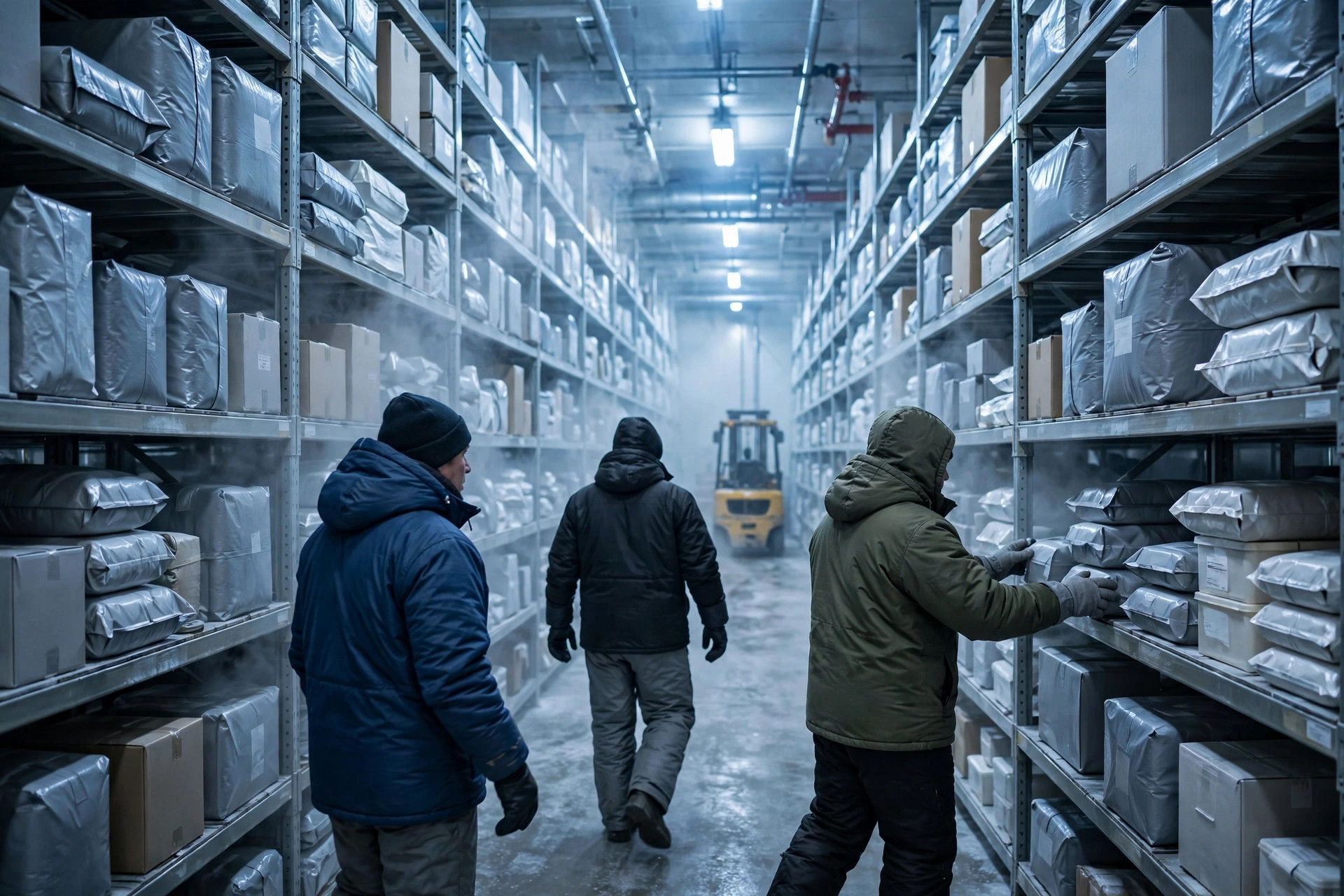
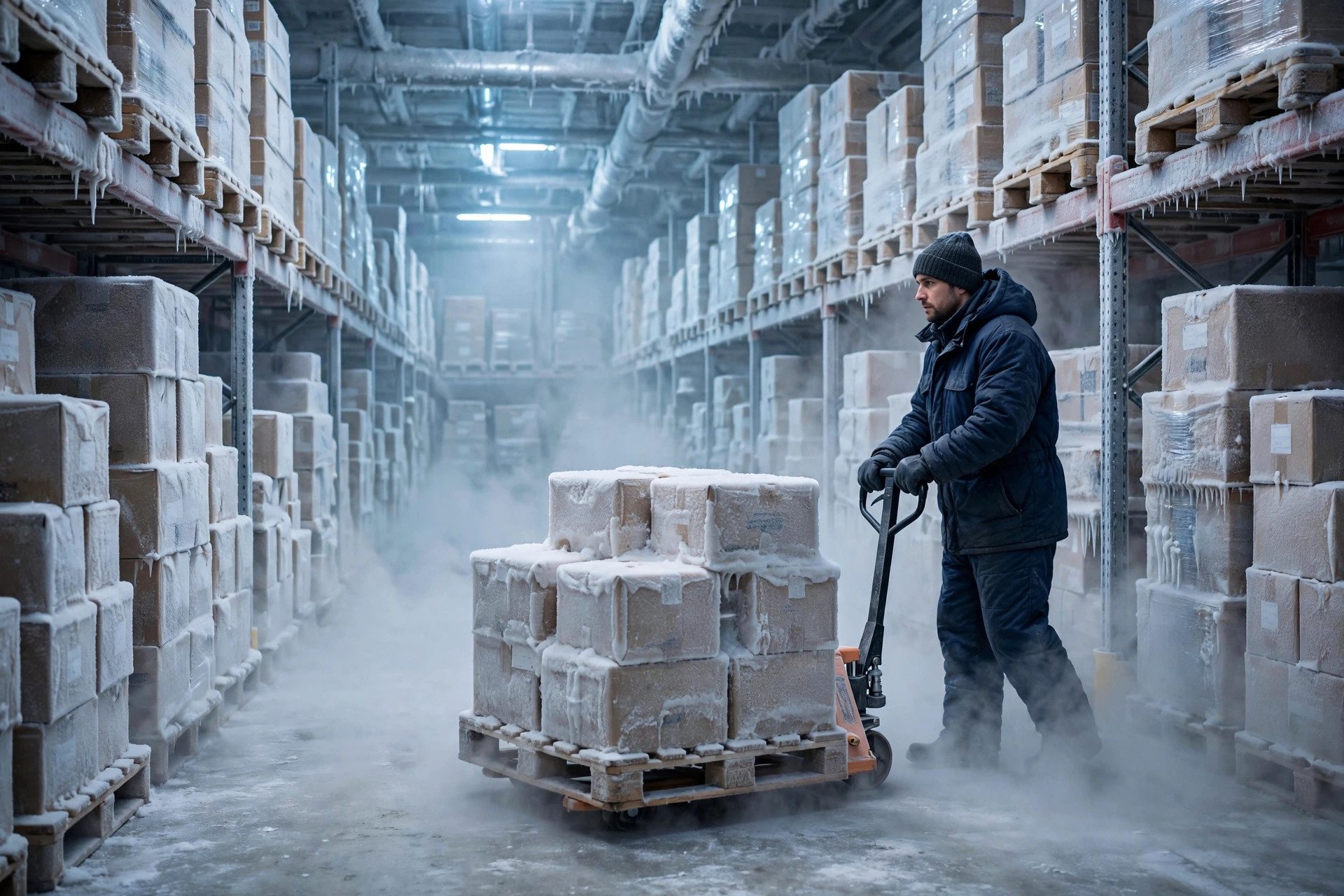
Think of a rack standing inside a freezer warehouse as a person permanently stationed on a seaside rock. A rack in an ambient warehouse gets damp at worst. A freezer rack goes through a daily freeze-thaw-freeze cycle: frost forms, melts into water during door openings and defrost cycles, and that water — often laced with salts from cleaning agents and food liquids — runs down the uprights and settles into welds, bolt holes, and base plates. I once inspected a freezer racking system less than four years old where the bottom of the uprights crumbled in my hand. The same brand's racks in an ambient warehouse were eight years old and still solid.
In cold storage, corrosion protection is eighty percent decided at selection time. There are three mainstream options: hot-dip galvanized, powder-coated (spray-painted), and stainless steel. Here is the full picture.
The mechanism: freezer corrosion is a different animal
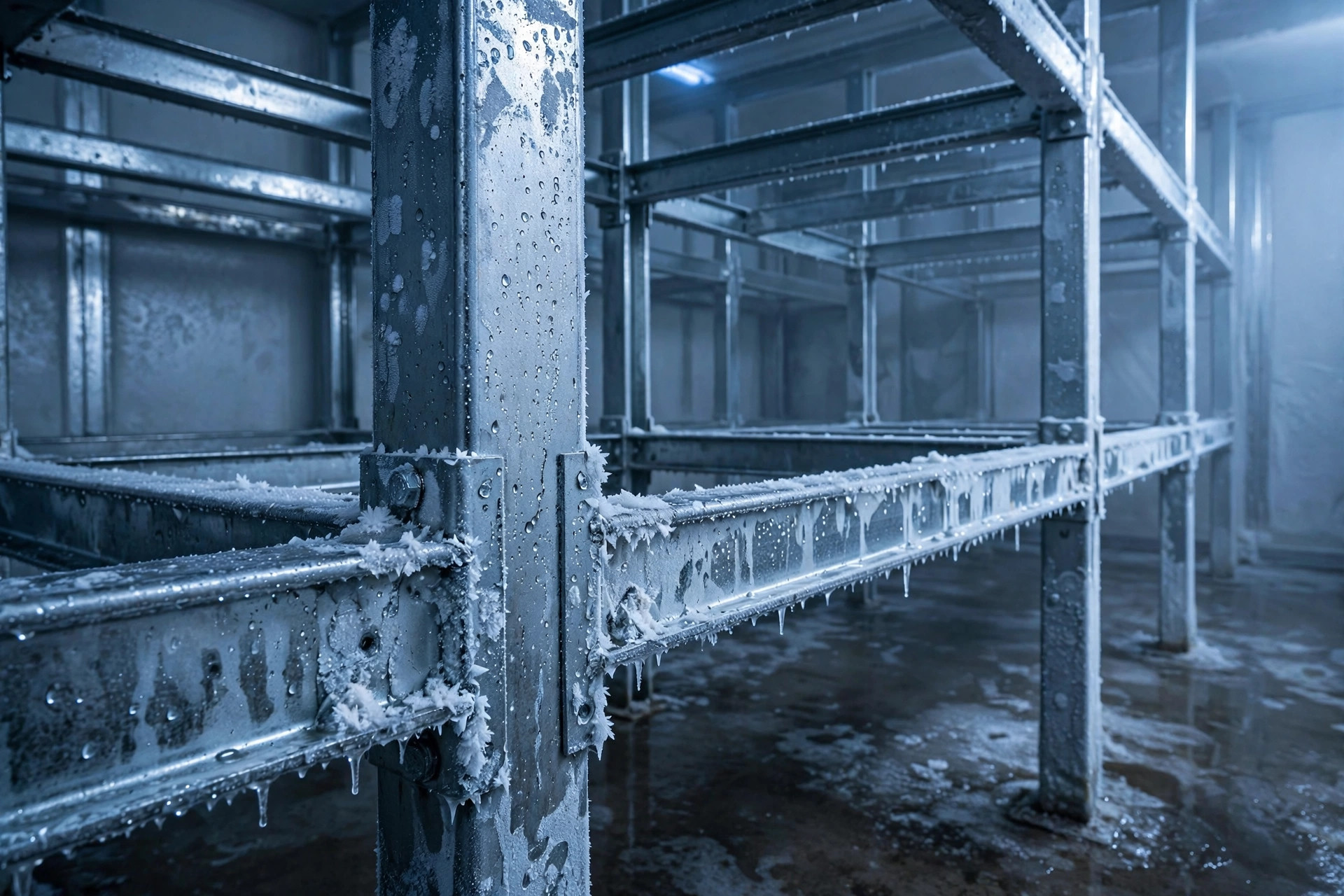
Ambient corrosion is slow atmospheric oxidation. Freezer corrosion is accelerated electrochemical attack: cold surfaces condense moisture into frost, defrost cycles turn it into standing water films, and chlorinated floor disinfectants add chloride ions — the catalyst for pitting corrosion. Galvanized coatings fear exactly this repeated wet-dry cycling. Under persistent moisture, zinc forms white rust (zinc corrosion products), which piles up, traps moisture against the coating, and accelerates localized attack.
Once you see this, the myth of "galvanized is fine" falls apart. Galvanizing protects against atmospheric corrosion, not against a freezer's daily bath. Selection needs hard boundary lines.
The selection boundary: three processes, one table
| Hot-dip galvanized | Powder-coated | Stainless (304/316) | |
|---|---|---|---|
| Protection principle | Zinc as sacrificial anode | Polymer coating as physical barrier | Inherently corrosion-resistant material |
| Weakness | Standing water films, chlorides | Pitting once coating is breached | 316 is expensive; 304 pits in high-chloride environments |
| Temperature fit | Marginally OK in chillers above 0°C | Below -25°C, verify coating adhesion at low temperature | All temperature ranges |
| Cost level | Baseline (1x) | Roughly 1.2–1.5x galvanized | Multiple times galvanized |
| Expected life (freezer) | Far shorter than ambient | Depends on coating integrity | Longest |
I draw the lines with three rules:
First, look at the temperature band. In 0–4°C chillers, galvanized with regular inspection can work. In -18°C freezers and below, galvanized life is cut in half or worse — go powder-coated or stainless. The colder it gets, the more frequent the frost-melt cycle, the more aggressive the corrosion.
Second, look for "water." Fresh meat, seafood, and produce leak fluids. Racks get pickled daily. Once a pallet chips the powder coating at one spot, rust tunnels inward from that point. Stainless wins in these scenarios simply because there is no coating to breach.
Third, look at chlorine. Warehouses mopped daily with chlorinated disinfectants can pit even 304 stainless. Either step up to 316 or accept the math of "galvanized plus frequent replacement."
The maintenance traps: installation is just the start
Right selection can still be ruined by bad installation and maintenance. The three traps I see most:
First, installation damage. A galvanized or powder-coated rack scraped by a forklift or pry bar during installation has a "corrosion window" opened. The fix is a touch-up kit (zinc-rich paint for galvanized) on site, repairing chips the same day. Many projects skip this step and start rotting from the scratch three years later.
Second, base plates and bolts. Upright feet standing in wash water are the fastest-rotting part of the whole system. Thicker base plates, Dacromet or stainless bolts — don't cheap out here. I have even seen PVC sleeves slipped over upright bottoms as "waterproof boots." Crude, but it works.
Third, defrost water drainage. In some freezers, defrost water runs straight down the walls, and the racks along the wall take the hit. Check your defrost drainage path — don't let your racks stand under a waterfall.
One more often-overlooked point: coating integrity testing. Powder-coated racks deserve an annual "pinhole test" — run a spark holiday detector along uprights and beams, and pinholes or micro-cracks under the coating will set it off. It sounds fussy, but a detector isn't expensive, and two people can sweep a mid-size freezer in half a day. Dab the found pinholes with matching touch-up paint at negligible cost. A seafood freezer I worked with ran pinhole detection plus touch-ups two years running; in year five, coating integrity was still above ninety percent on sampling. The identical racks in the neighboring warehouse, which skipped testing, started flaking off in sheets from the welds in year three.
Testing has a side benefit: it becomes your evidence when negotiating warranty claims with the rack supplier. If the coating fails at scale within the warranty period and you have annual test records, your claim stands on solid ground. Without records, you're stuck arguing "was it damaged during your installation" — unwinnable.
The final math: whether cold storage rack corrosion protection money is well spent comes down to one number — how many years you plan to use these racks. If you're relocating or reconfiguring within five years, galvanized is enough; save the money. For a ten-year-plus owned freezer, powder-coated or stainless wins on annualized cost. Corrosion doesn't negotiate. It only recognizes time and water.
By Da Liu, Automation Engineer