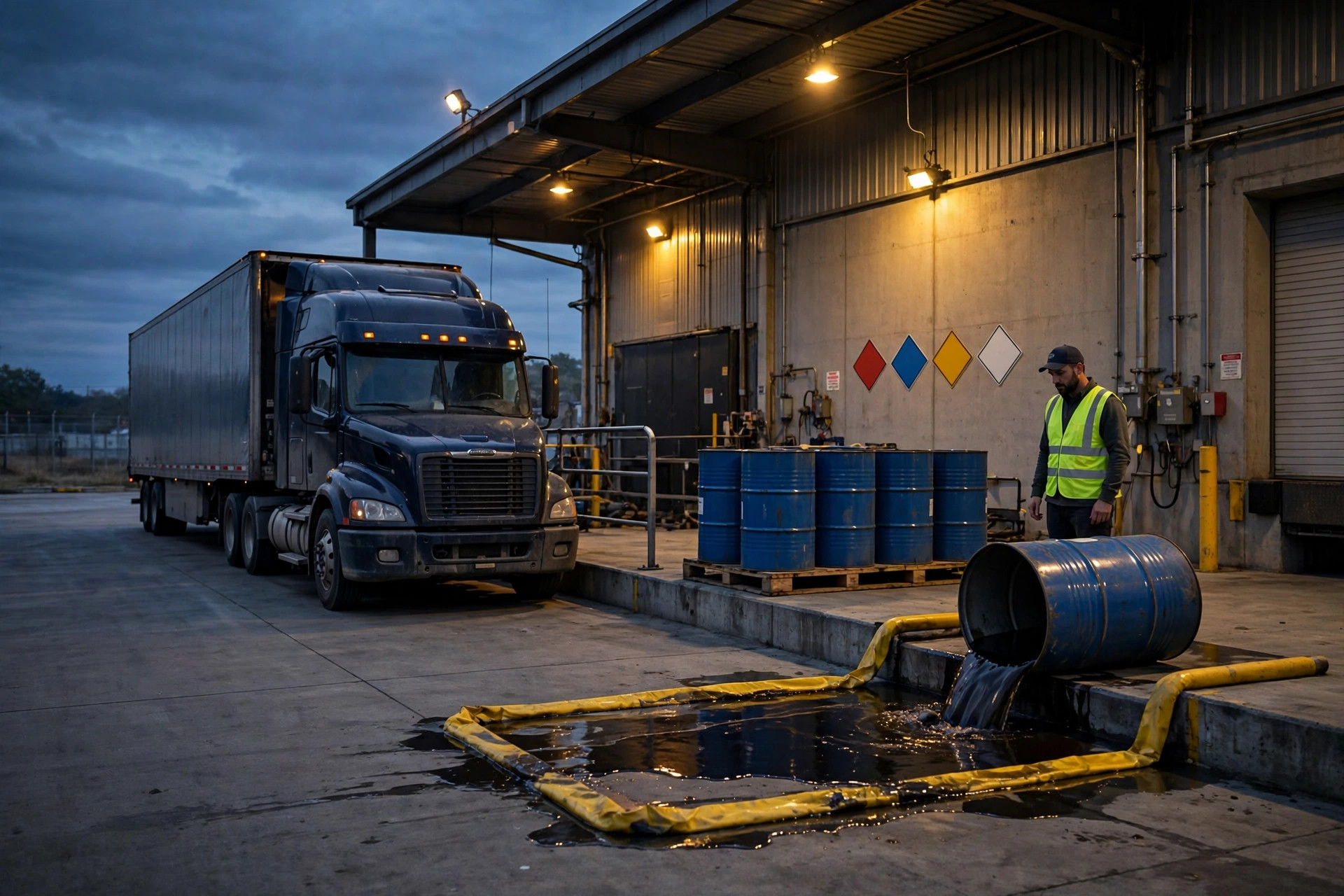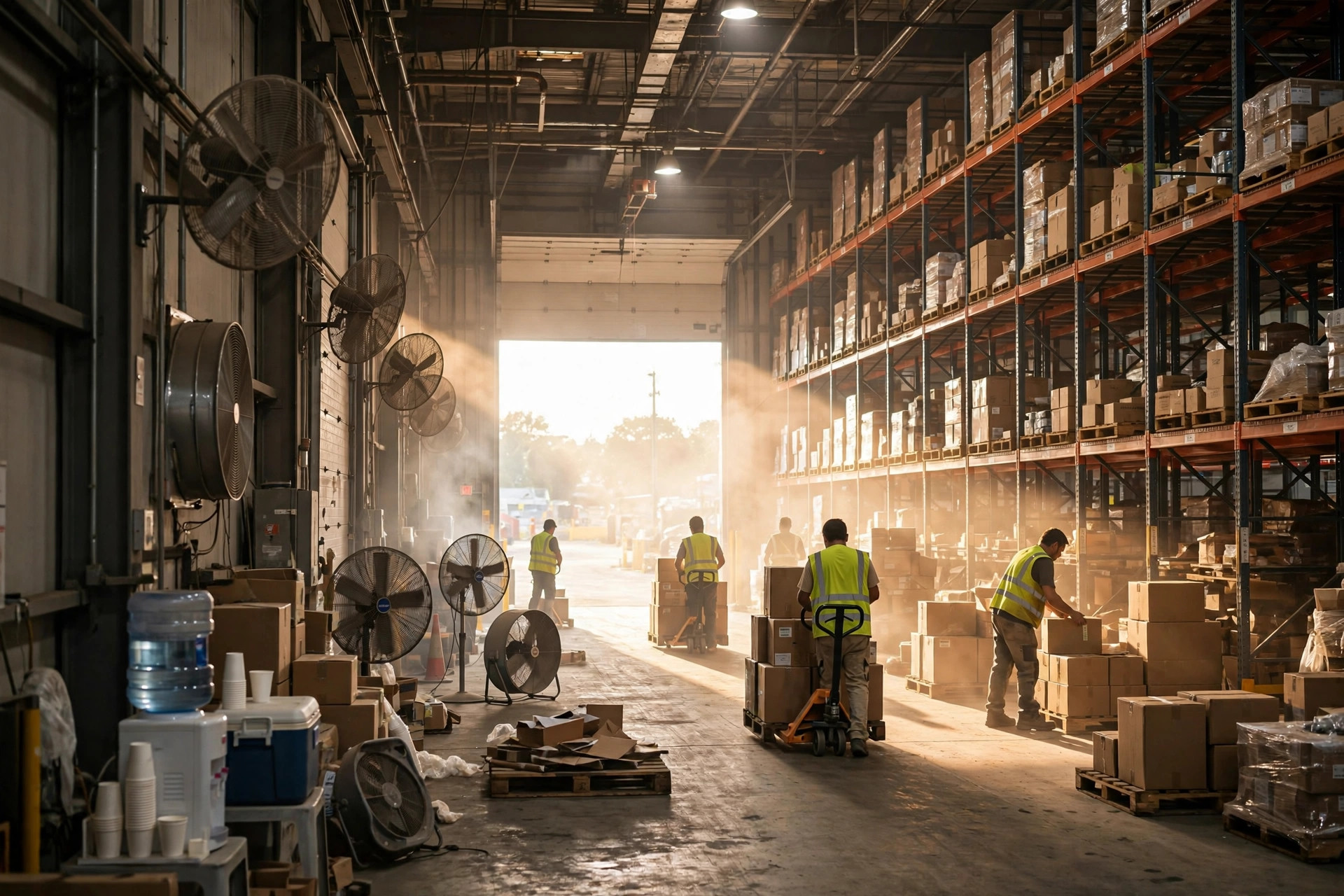
July 2026. Fontana: 104°F outside, 98°F inside, 106°F by the dock doors. A solid heat illness prevention plan is what gets you through afternoons like that. Leo — new guy, day four on the job — four hours into picking, face white as paper, legs shaking. Marcus, one of my veterans, grabbed him by the arm, sat him by the big fan, got two cups of water into him. Twenty minutes later he was back on his feet.
Listen, every warehouse manager has seen that scene. Here's what changed in 2026.
The federal heat rule still isn't final. It was proposed on August 30, 2024, hearings wrapped up last summer, the post-hearing comment period closed at the end of last October — and nobody will tell you when it lands. This July a House committee even voted to kill it outright, though that's not law. No final rule does not mean no enforcement. OSHA let the old Heat National Emphasis Program expire on April 8 and rolled out a new one on April 10, running straight through April 2031, covering 55 high-risk industries. Warehousing is on the list. Programmed heat inspections jumped from about 200 to roughly 2,400 a year. In 2024 alone, OSHA issued over $2 million in heat-related penalties nationwide.
Plain talk: a written heat illness prevention plan isn't optional anymore. If you wait until an inspector walks in to write one, you're already late.
The Federal Rule Isn't Final. The Heat Illness Prevention Plan Requirement Is Real Anyway
Federally, there's still no heat-specific standard. OSHA enforces heat with two tools. First, the General Duty Clause — Section 5(a)(1) of the OSH Act — which says you must keep the workplace free of recognized hazards, and heat counts. Second, the revised NEP that took effect April 10, 2026, which hands inspectors an actual checklist: water, rest, training, acclimatization, and a written plan. They walk in and work down the list.
California folks, you already know you're in the toughest state. Outdoor rule 8 CCR §3395 plus the indoor rule §3396 that took effect in 2024:
- Outdoor at 80°F and up: shade, cool water (at least one quart per employee per hour), cool-down rest whenever a worker asks;
- Outdoor at 95°F and up (agriculture, construction, landscaping, oil and gas, heavy-material transport): high-heat procedures kick in — dedicated observation, working communication;
- Indoor at 82°F (radiant heat or heat-retaining clothing) or 87°F (all other indoor work): cool-down areas below 82°F, temperature monitoring, training, a written indoor plan.
We're in California, so we run both the dock program and the indoor program. Texas and Florida folks — don't tune out. The NEP is national, and federal inspectors show up everywhere.
Penalties, so you can do your own math: 2026 brought no increase. A serious violation runs $16,550; willful or repeated runs $165,514. One serious citation buys a lot of cases of water.
Where Warehouses Actually Get Hurt: The First Two Weeks
August 2023, our building. San Bernardino County, five straight days over 100°F. Leo — yeah, the same Leo — day three on the job, unloading at the dock around noon. Forty minutes in, he went down. ER visit: heat exhaustion plus dehydration. We got lucky.
When we did the after-action, the problem wasn't how hot it was. It was that it was day three. OSHA's data is blunt about this: most heat fatalities happen in a worker's first few days. The body isn't adapted, the worker pushes hard to prove himself, and the first heat wave takes him out.
July 2025, a peer's building near Phoenix — this one stung worse. A six-year veteran, back from two weeks of vacation, day two on day shift, forty minutes unloading a trailer with no AC. Heat stroke. Ambulance. Two weeks off wipes out acclimatization completely.
So rule number one in our plan: anyone in their first 14 days, or returning after more than 7 days away, works the acclimatization schedule. Not a suggestion. A rule.
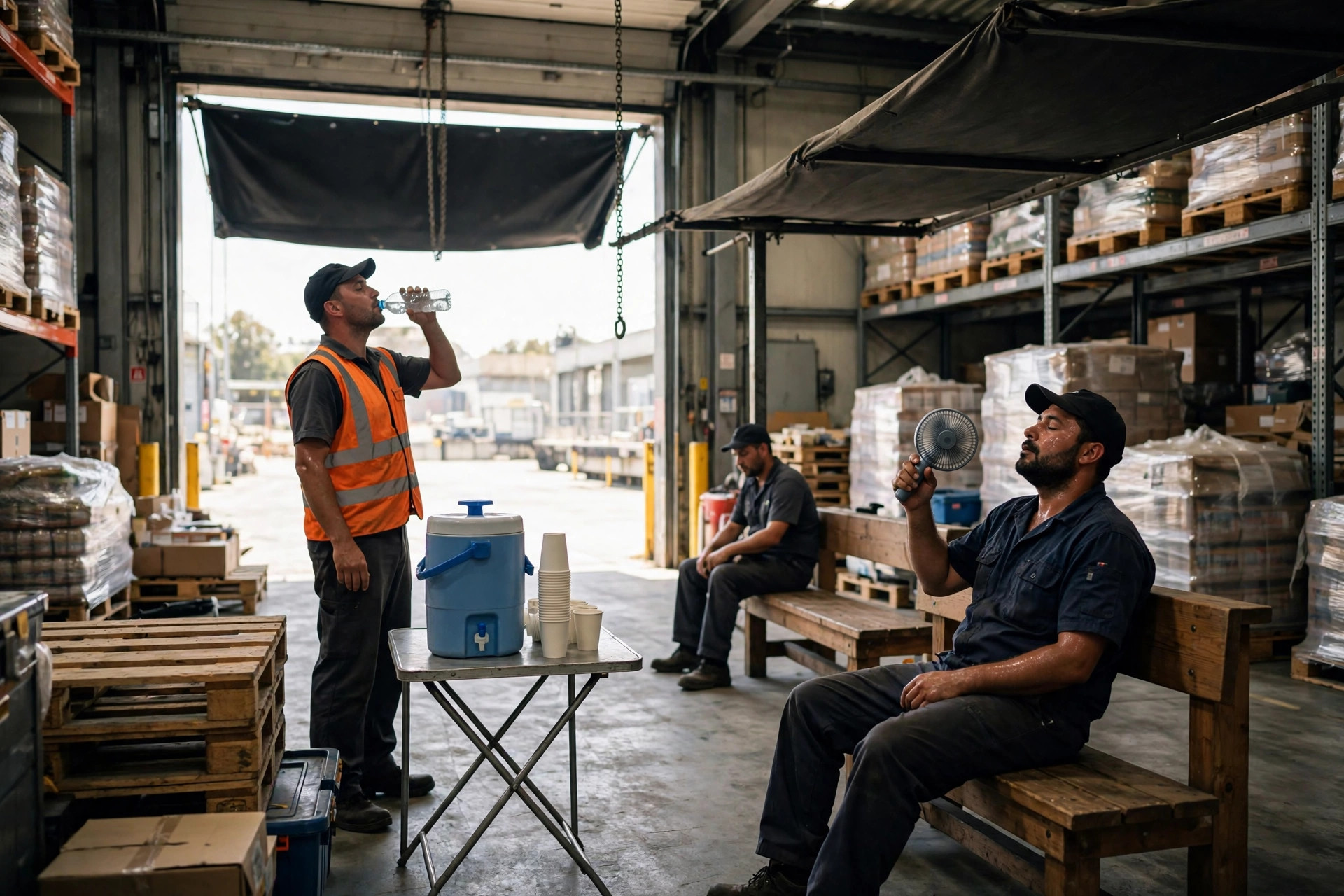
80, 90, 95: Three Temperature Lines, One Action Table
The proposed federal rule draws two lines: 80°F and 90°F heat index. California outdoor draws them at 80°F and 95°F; indoor at 82°F/87°F. Our approach: take the strictest of each, merge into one table, post it on the break-room wall, copy in every lead's hand.
| Trigger | Water & cooling | Rest | Watch | Records |
|---|---|---|---|---|
| Outdoor / heat index 80°F+ | ≥1 quart cool water per person per hour; water station within a 5-minute walk | Cool-down rest on request, any time | Lead walks the floor hourly | Daily temp log + water check |
| Heat index 90°F+ (proposed federal tier) | Same, plus iced water | Mandatory paid rest breaks, lead calls them | Buddy system, pairs watch each other | Symptom refresher training |
| Outdoor 95°F+ (CA high-heat) | Same | Same | Dedicated observer + radio check-ins | High-heat activation log |
| Indoor 82°F/87°F+ (CA indoor line) | Cool-down area held below 82°F | Same | Same | Indoor temp monitoring log |
Honest opinion: the real value of this table isn't passing inspections. It's that the lead doesn't have to think. Temperature hits the line, actions fire automatically. When an inspector asks a lead "what do you do at 90 degrees," the lead points at the table and recites it. That beats any binder.
The First Two Weeks: New-Hire Acclimatization Schedule
We locked this in after the 2023 incident, modeled on the federal proposal's 20-40-60-80-100 ramp:
| Day | Time in heat | Notes |
|---|---|---|
| Day 1 | 20% of normal shift | Shadow a veteran, never solo |
| Day 2 | 40% | Same |
| Day 3 | 60% | Can work solo, lead checks in extra |
| Day 4 | 80% | Lead asks twice, unprompted |
| Day 5 | 100% | Days 6–14: still ask "how are you feeling" daily |
Anyone returning after 7+ days away (sick leave, vacation) starts at day 3 and runs three days. Sounds fussy. The Phoenix veteran is why we do it.
Here's the counterintuitive part: the danger zone in acclimatization isn't "too little work" — it's "looks fine." Days 3 and 4 are when incidents spike. The worker feels good, the lead relaxes. Our rule: on days 3 and 4, the lead asks twice without being asked. Heat stroke can go from "a little dizzy" to on-the-ground in fifteen minutes.
What a Warehouse Heat Illness Prevention Plan Actually Looks Like
What OSHA wants in writing boils down to one sentence: written down, trained on, present on the floor. Ours is eight items, six printed pages — one copy on the break-room wall, one in the office:
- Owner: who's in charge of heat safety (our shift manager on duty), with a phone number;
- Temperature monitoring: who checks the forecast, when indoor temps get read, where the thermometers sit;
- Water: map of water stations, who checks supply each shift;
- Rest/cool-down areas: locations, shade and fan setup, temperature requirement for the cool-down zone;
- Acclimatization: the new-hire and returnee schedule above;
- Training: new-hire onboarding plus annual refresher — symptom recognition (heat cramps → heat exhaustion → heat stroke), how to report, emergency numbers;
- Emergency response: someone goes down — who calls 911, who meets the ambulance at the gate (our building is big; ambulances getting lost at the wrong dock door happens), cool the worker first — shade, water, wet towels, no alcohol;
- Records: temperature logs, training sign-ins, incident reports. When the inspector asks, you produce them on the spot.
California note: Cal/OSHA floated a draft revision in May 2025 (under AB 2234) that may eventually require handing every covered employee a copy of the full plan at hire, at training, and annually. Not final yet — but we already do it. It's coming; build the habit now.
One trade-off worth stating plainly: more fans is not always better. In a warehouse running 60%+ humidity, big fans blowing hot air at workers is just a giant hair dryer. Spend in this order: water and rest stations (nearly free — do it first) → shift scheduling around peak heat (free) → ventilation and dehumidification (moderate) → spot cooling or AC (expensive, last). Don't lead with AC — the inspector checks water, rest, training, and the plan, not your AC count.
A Note for Fellow Managers
Don't write the plan and lock it in a drawer. When OSHA walks in, the first question is "where's the plan," and the second question goes to your workers: "were you trained?" On paper, in their heads, on the floor — all three, or it doesn't count.
Here's how we run it: refresher training every April, full check of water stations, fans, and thermometers every May, and the moment a heat advisory drops, the action table fires in the leads' group chat. Not for the inspector — so nobody has another day like Leo's.
Heat doesn't wait. Write the plan first. And check the current requirements on OSHA's and Cal/OSHA's official sites — the details change, and the official policy is what counts.
By Chen Feng, Warehouse Operations Manager