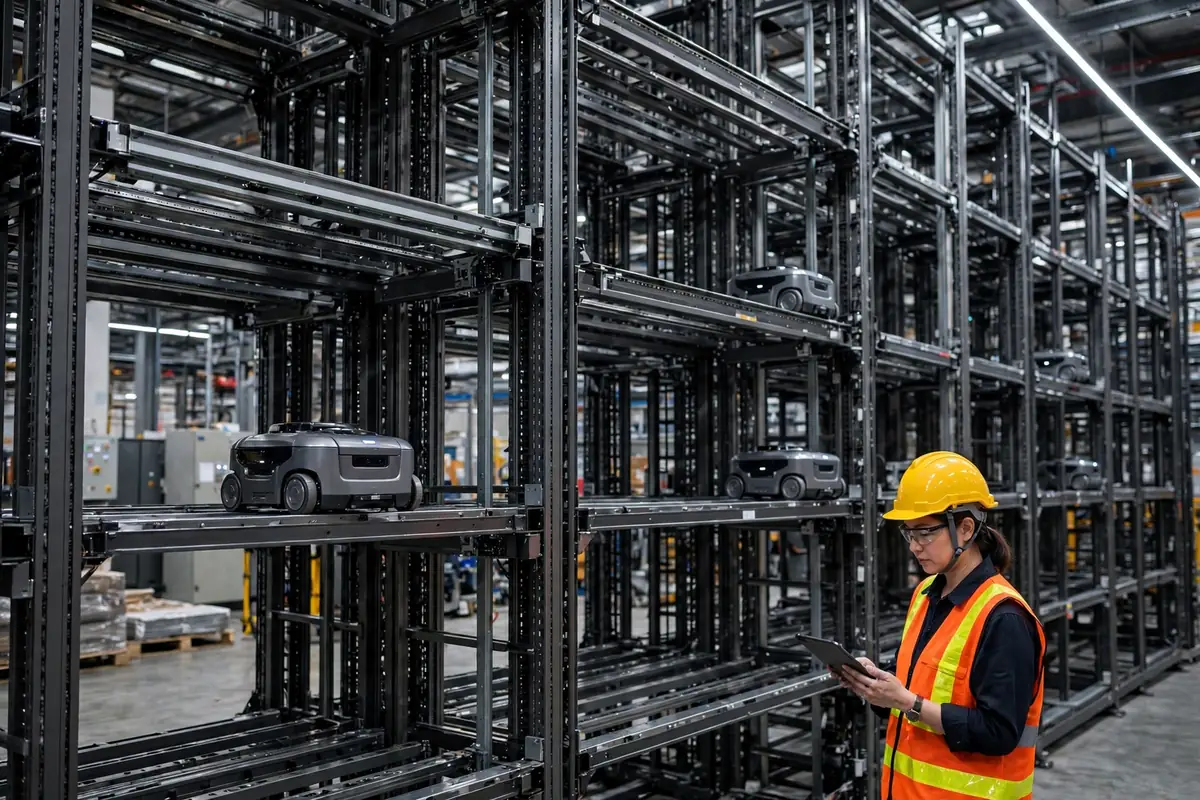
Let me say it plainly: four-way shuttle warehouse maintenance is what decides whether a dense storage system is still an asset in year three, or a problem with a service contract attached. On acceptance day everyone stares at throughput. Pallets per hour, cycle time in seconds, beautiful numbers, handshakes all around. But these systems rarely die on performance. They die in year two and year three, one shuttle at a time, one blocked lift at a time, until a warehouse manager tells me: Da Liu, if I had known, I would have bought two more forklifts.
Think of it like buying a car based only on its 0-to-60 time, never asking about service intervals or part lead times. A dense storage system breaking down puts a hand around the throat of your outbound operation.
Run the Math First: What four-way shuttle maintenance Is Actually Protecting
Start with the principle. A shuttle system is a series structure. No matter how many shuttles you own, every pallet rides a lift to reach its level and rides one back down. System availability is not the average of component availability, it is the product. Say the fleet holds 0.98, the lifts hold 0.97, and the rack, rails, and transfer points hold 0.99. Multiply: 0.98 × 0.97 × 0.99 ≈ 0.94. Sounds acceptable, until you convert it. Across an 8-hour shift, that is roughly half an hour a day when the system is not really in shape, and that assumes failures politely spread themselves out instead of clustering at the outbound peak, which they never do.
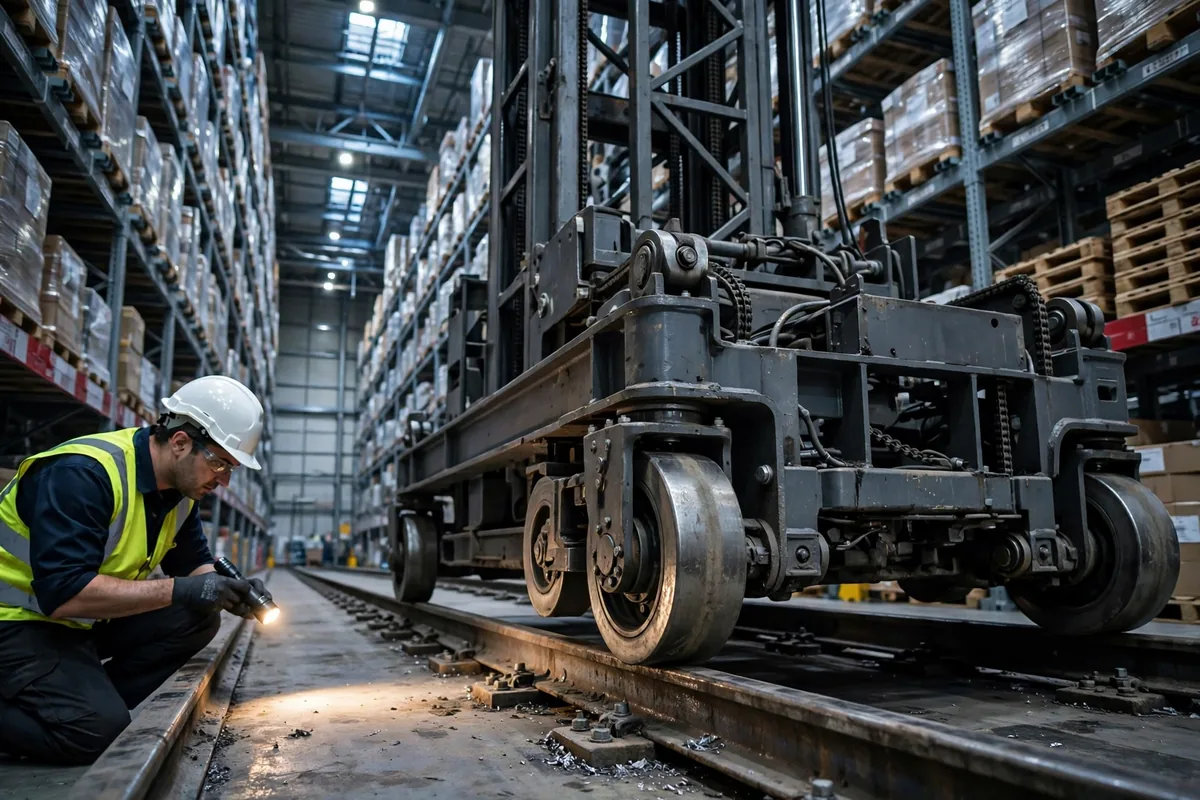
Here is the counterintuitive part, and I will defend it anywhere: the true single point of failure in a dense system is not the shuttle, it is the lift. Lose one shuttle and the scheduler redistributes its work. Throughput dips, the warehouse keeps moving. Lose one lift and every level it serves starves at once. So the maintenance budget order should be lifts first, rails second, shuttles third. Yet most spare parts cabinets I open are full of shuttle wheels and batteries, with not a single lift encoder, brake, belt, or rope in sight. The money got spent. It just got spent backwards.
In 2023 I worked a case at an auto parts warehouse in East China: 12 shuttles, 2 lifts, eighteen smooth months after go-live. One Monday morning a lift started drifting on positioning. The error was small, the system kept running, nobody stopped to look. By Wednesday the drift had compounded into a wrong-level delivery, a pallet jammed at the transfer point, and one whole aisle was blocked for most of the day. Root cause: a loose encoder coupling. Tighten it, recalibrate, about an hour of work. The failure was never the repair. It was that a soft fault, the kind that raises no alarm and stops nothing, got three days to grow into a hard one. Maintenance, done right, is mostly about catching faults while they are still soft.
The Lift and the Shuttle Are One System: shuttle and lift maintenance Cannot Be Split
The interplay between shuttles and lifts is something many teams only learn during an incident. A shuttle delivers a pallet to the transfer position, the lift takes it away, and between those two events there is waiting, alignment, and a signal handshake. When lift cycle time slips, shuttles queue on the level. Queuing is not free: the shuttle sits there burning battery, tasks pile up behind it, and the outbound sequence for that whole level scrambles. Run it the other way and it still hurts. When a shuttle's positioning accuracy drifts, every lift pickup spends extra seconds correcting, and a second or two per cycle, across hundreds of cycles a day, quietly evaporates into lost capacity that no single measurement catches, because every individual reading is technically within tolerance.
So inspect them as a pair. Pull the lift's cycle count, average cycle time, and failed handoff count onto the same timeline as the shuttle data. Whichever degraded first, the timestamps will tell you.
Failure modes, in my field experience, fall into a short list. Check in this order:
| Symptom | Check first | Do not touch yet |
|---|---|---|
| One shuttle keeps dropping offline, tasks time out | Battery curve, drive wheel wear, signal strength | Do not swap the main board first |
| A whole level's throughput falls off a cliff | Lift cycle time, failed handoff count | Do not order more shuttles |
| Pallets land on the wrong level or jam at transfer | Lift positioning accuracy, encoder, level parameters | Never let a shuttle force its way through |
| Shuttle runs loud, positioning drifts | Rail joints, steering wheels, rail deformation from floor settlement | Do not just recalibrate and skip the rails |
| Runtime after charging keeps shrinking | Battery internal resistance and cycle count, charging strategy | Do not replace the whole fleet's batteries first |
A second case, from an appliance warehouse in South China in 2024, makes the same point. Before peak season, throughput sagged and operations' first instinct was to buy two more shuttles. I pulled the data first: shuttle task intervals had stretched, but most of that stretch was empty waiting. Then the lift data: cycle time had crept up since commissioning, guides were under-lubricated and the brake clearance was off. We serviced the lift, throughput came back on its own, and the purchase order got withdrawn. Think first, calculate second, spend money last.
Spare Parts: Rank by Minutes of Downtime, Not by Price
My framework for spares has one rule: rank parts by how many minutes of downtime their failure buys you, not by unit price. Three tiers.
Tier one, line-stoppers: lift encoders, brakes, critical sensors, shuttle drive wheel sets and drive modules. Not always expensive, but one failure stops a whole section, and lead times are rarely short. These live on site, in quantities based on how many failures you can absorb during the longest replenishment window.
Tier two, degraders: batteries, charging contacts, communication modules. The system limps along without them at full strength, so they get swapped at the next planned stop, with one or two rotation sets on the shelf.
Tier three, long tail: covers, brackets, anything cosmetic. Order as needed. Stocking these is just renting shelf space to your own money.
One more trap deserves naming: part versions. Shuttle hardware iterates fast, and drive boards or battery specs can differ between production batches of the same model. A spare in the wrong version is worse than no spare, because someone will fit it, it will misbehave, and your troubleshooting just grew by two hours. Register hardware and firmware versions against each vehicle number when parts arrive. That ledger matters as much as the parts.
And a word on batteries, because this is where budgets go to die. When runtime shrinks, do not replace the fleet's batteries in one heroic purchase. Sample internal resistance and real cycle counts first. Very often the charging strategy is the culprit: packs stored at full charge for long stretches, or too many deep discharges, age a few units early while the rest are fine. A full fleet battery swap is the most expensive option on the table, which is exactly why it should be the last one you reach for.
When It Breaks: warehouse maintenance Troubleshooting Order Matters
Final piece, the troubleshooting order I drill into every junior engineer: outside before inside, single point before system, data before disassembly.
A shuttle alarms: check the rails for debris and joint steps first, then battery and signal, and only then suspect the vehicle itself. A level slows down: read the lift's cycle data, then the task distribution, and only then discuss adding vehicles. A pallet jams at the wrong level: stop the lift and check positioning, and never let a shuttle keep forcing the load. Every forced attempt scores the rails and the pallet, and secondary damage is how a one-hour fault becomes a one-day fault.
As for MTBF, the number printed in the vendor's brochure, enjoy it and move on. After six months, classify your own work orders by component and calculate your own mean time between failures. That is your system's real parameter set, from your dust, your temperature, your shift pattern. Set inspection intervals and spare quantities from those numbers.
Whether the money was well spent comes down to one figure: unplanned downtime as a share of total runtime, measured after the first year. Keep that number down and a four-way shuttle system is a genuine asset. Let it climb, and the prettiest acceptance report in the world is just a piece of paper.
By Da Liu, Automation Engineer