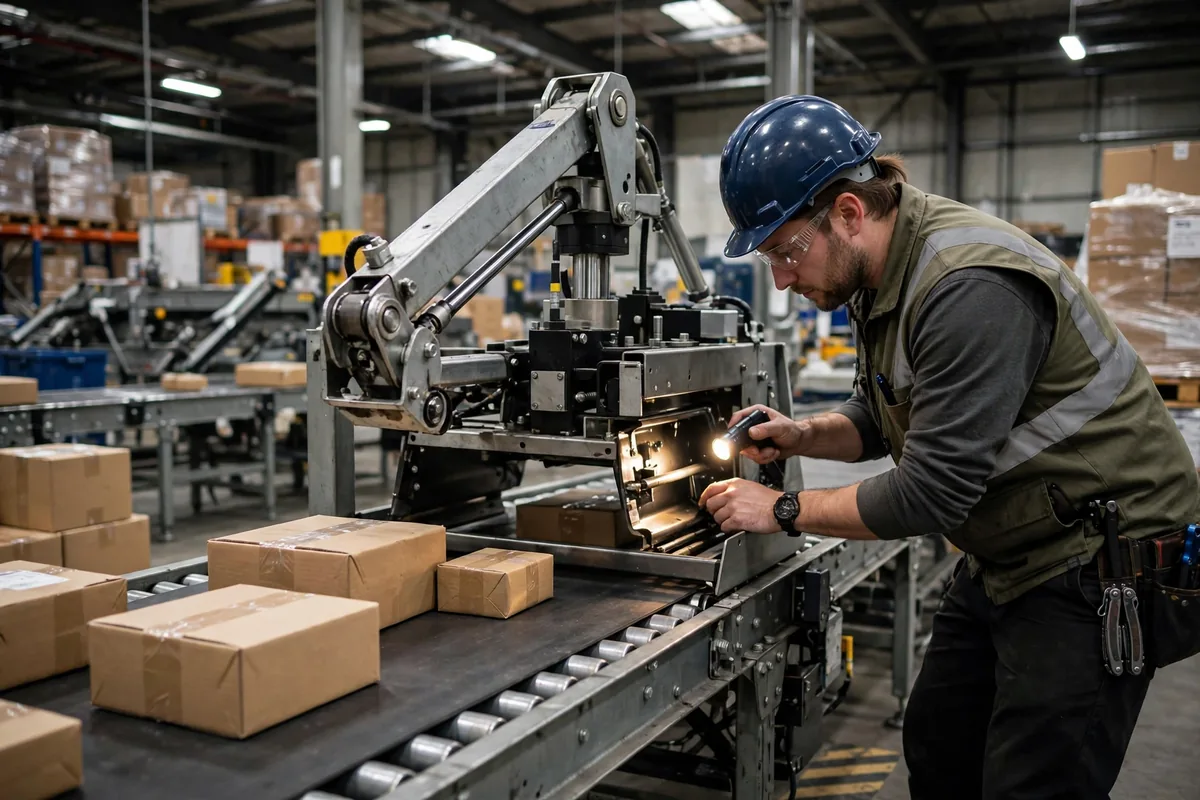
Let me be blunt: swing arm sorters are not fragile machines. What is fragile is the way most warehouses maintain them. Picture a tireless worker standing beside a conveyor, swinging an arm out every time a parcel passes. Parcel arrives, arm swings, parcel leaves sideways, arm retracts. The motion is simple, which means the failure points are predictable — and predictable failures that still stop your line are a maintenance failure, not a machine failure.
The principle takes one paragraph. Parcels travel on the main line. A photo-eye detects the right moment, a pneumatic cylinder or electric actuator drives the arm out fast, the parcel is pushed into its chute, and the arm retracts before the next parcel arrives. Throughput does not come from arm strength. It comes from timing: detection, actuation, and retraction landing in the right order, every cycle. Fire late and the parcel has passed the chute. Retract late and the next parcel hits the arm. Most faults on these machines are timing, speed, or incomplete retraction — not catastrophic breakage.
If you are still choosing equipment, that is a selection question, and I covered the dividing line in swing arm vs cross-belt sorter selection. This article starts after the purchase order: how to keep the machine running, and how to get it back fast when it stops.
The four failure modes of swing arm sorters I see over and over
First, inaccurate pushes. The parcel goes sideways, half-leaves the belt, or spins instead of diverting. Do not replace the arm first. Check three things: whether the detection eye is dirty, whether anything is limiting arm travel, and whether the parcel is simply too light. A very light polybag does not get pushed — it gets slapped. It spins or flies. That is not a fault; that is a parcel outside the machine's honest working range, and forcing it through is a fake requirement dressed up as an equipment problem.
Second, slowing actuation. The arm still works, but it extends and retracts like it is tired. On pneumatic units, check supply pressure stability, leaking fittings, and clogged exhaust mufflers before anything else. On electric units, listen for abnormal noise and feel for heat. Slowing is the most dangerous mode because it does not stop the line. It degrades into occasional collisions and rising missorts, and by the time the exception rate gets your attention, the machine has been slow for weeks.
Third, double-parcel collisions and jams. Gap between parcels collapses, the arm retracts into the second parcel, and everything wedges. Think of a queue where everyone stands too close: one stop and the whole line compresses. The root cause is usually upstream gap control, not the arm. Feed any sorter an uncontrolled stream and it will jam.
Fourth, diverting into a full chute. The chute is backed up, the arm keeps pushing, parcels pile and spill back onto the main line. That is a full-chute detection and interlock failure. Frankly, some integrators deliver this interlock sloppily and nobody tests it at acceptance. Test it on day one.
Two cases from my own work. During peak season in 2022, at an e-commerce warehouse in eastern China, one line produced far more exceptions on nights than days, according to the shift logs we kept. Two days of chasing it ended at the air supply: when other equipment drew air at night, pressure sagged, arm speed dropped, and missorts climbed. A receiver tank and a cleaned-up dedicated air run fixed it. Not one sorter component was replaced. The second case, in 2024 at a site in southern China, was a loosening arm mount. Every cycle shifted the angle a fraction. After a week the push bias was visible to the naked eye — and the crew had spent that week adding people at the chute to rescue parcels, convinced the parcels were the problem. Torque and thread-locking fixed it in about half an hour.
Spare parts and recovery for swing arm sorters: what to touch first
When the line stops, random disassembly is the enemy. Here is the recovery order we post at the machine.
Step one: read the alarm and recent cycle history, and decide whether you have one bad unit or a line-level problem. Several units faulting together means check air, power, and upstream feed first — not individual arms.
Step two: clear the jam safely. Power down as your site procedure requires, remove trapped parcels, and swing the arm by hand. Feel for rough travel and look for debris at the pivot and chute entry. A surprising share of 'failures' end here, with a cleared jam and a wiped photo-eye.
Step three: dry-cycle the unit empty. No parcels. Listen, watch the speed, confirm full retraction. If it cycles badly empty, chase the actuator and detection. If it cycles cleanly empty but fails under load, your problem is parcel spacing or detection timing, not the arm.
On spares, my position is simple: overstock the cheap wear parts, never gamble that an expensive part will not fail at peak. As an experience-based recommendation, keep at minimum detection photo-eyes, arm wear pads, air fittings and common tubing, and fastener hardware on site. Exact part numbers must come from your own manufacturer's list — never copy another site's list blindly.
| Part group | Why it goes first | Cost of not having it (experience estimate) |
|---|---|---|
| Detection photo-eyes | Dirt and aging are the top nuisance cause; swap is fast | False reads, whole-line slowdown while you troubleshoot |
| Arm wear pads | Friction consumable, wears every shift | Slipping, skewed pushes, more parcel damage |
| Air tubing and fittings | Leaks directly slow actuation | Cycle rate drops exactly when peak needs it most |
| Actuator-related parts | Rare failure, total stop when it happens | Waiting on shipment while the unit sits dead |
Run the math with your own numbers. Downtime loss is roughly your parcels per hour multiplied by stopped hours, plus the labor you pull into manual sorting — that is an assumption-based formula, so plug in your real rate instead of borrowing anyone else's. A full set of wear spares normally costs far less than one peak-season day down; the orders of magnitude are not close. A low-rate site outside peak can rationally stock only the high-frequency items and accept manufacturer expedited shipping on the rest. Spares strategy follows your rate and your peak pressure. There is no universal list.
Daily maintenance stays deliberately boring: wipe the eyes and clear debris every shift, hand-cycle a few units and check fasteners weekly, and review exception records monthly to find the one repeat-offender unit. Repeat offenders almost always have a specific cause — mounting angle, an awkward infeed direction — and fixing that cause once beats a crew cleaning up after it forever.
Whether the maintenance money is well spent comes down to one number: unplanned downtime minutes per month on that line. If that number is falling, your routine works. If it is not moving, you are performing maintenance, not doing it.
By Da Liu, Automation Engineer