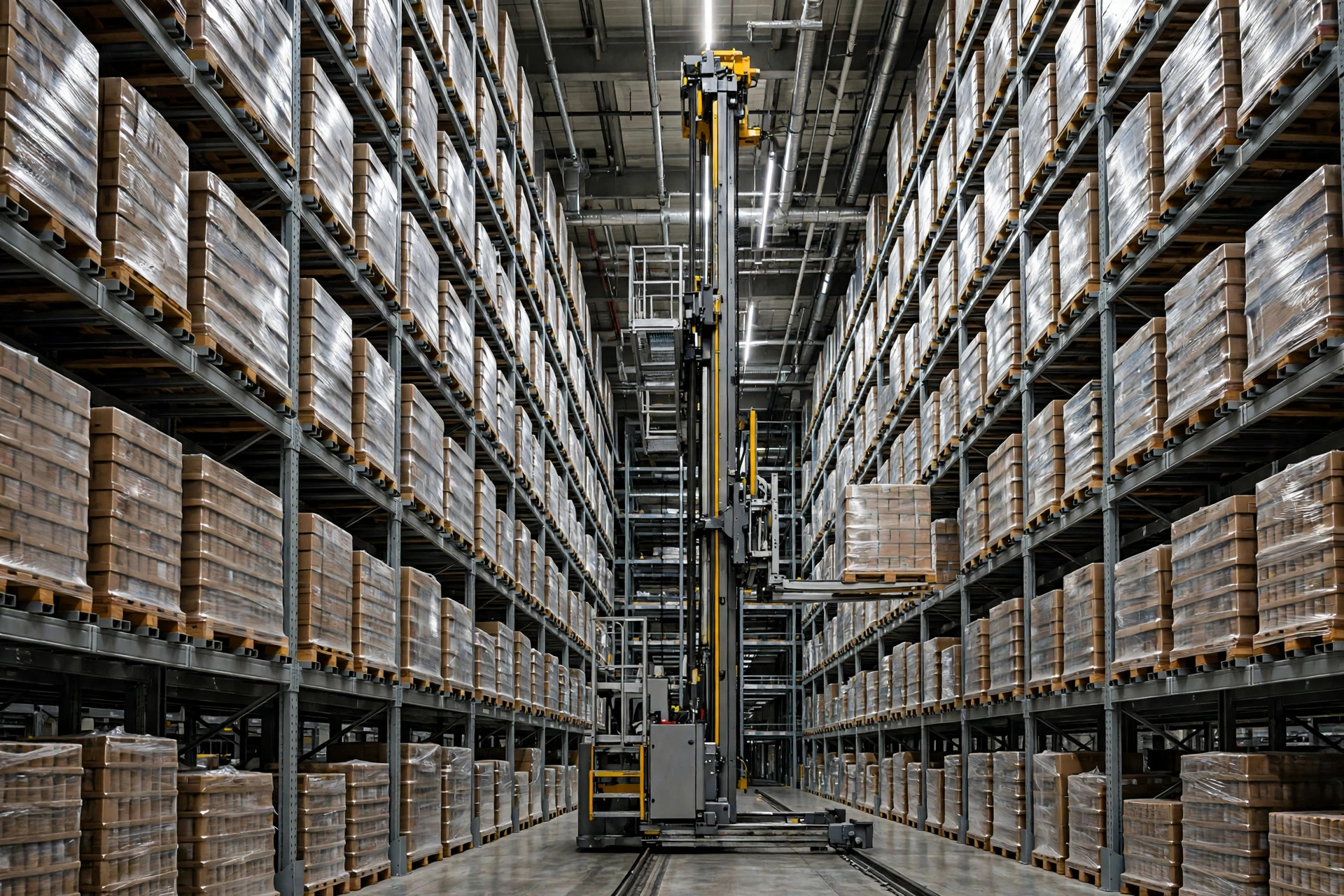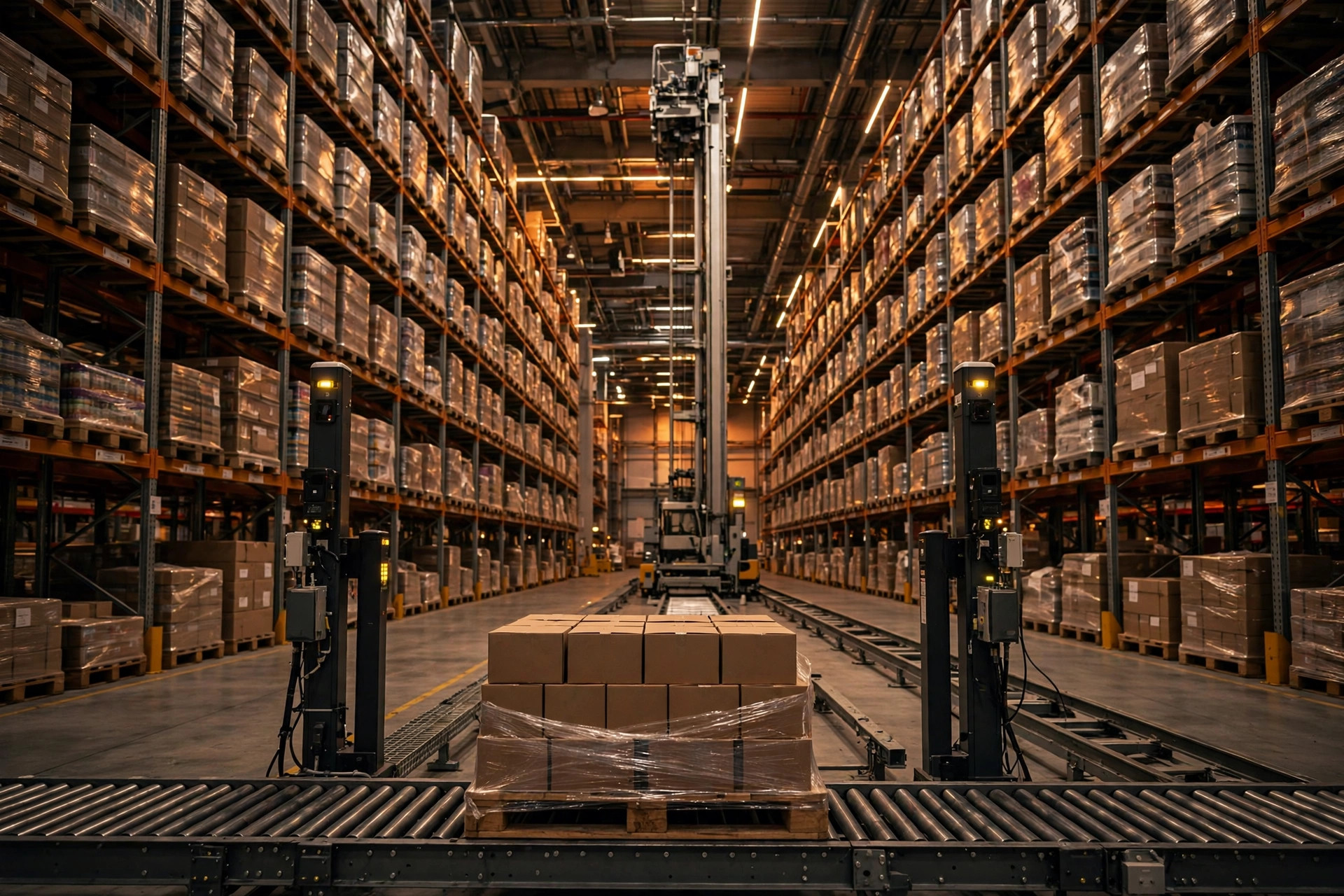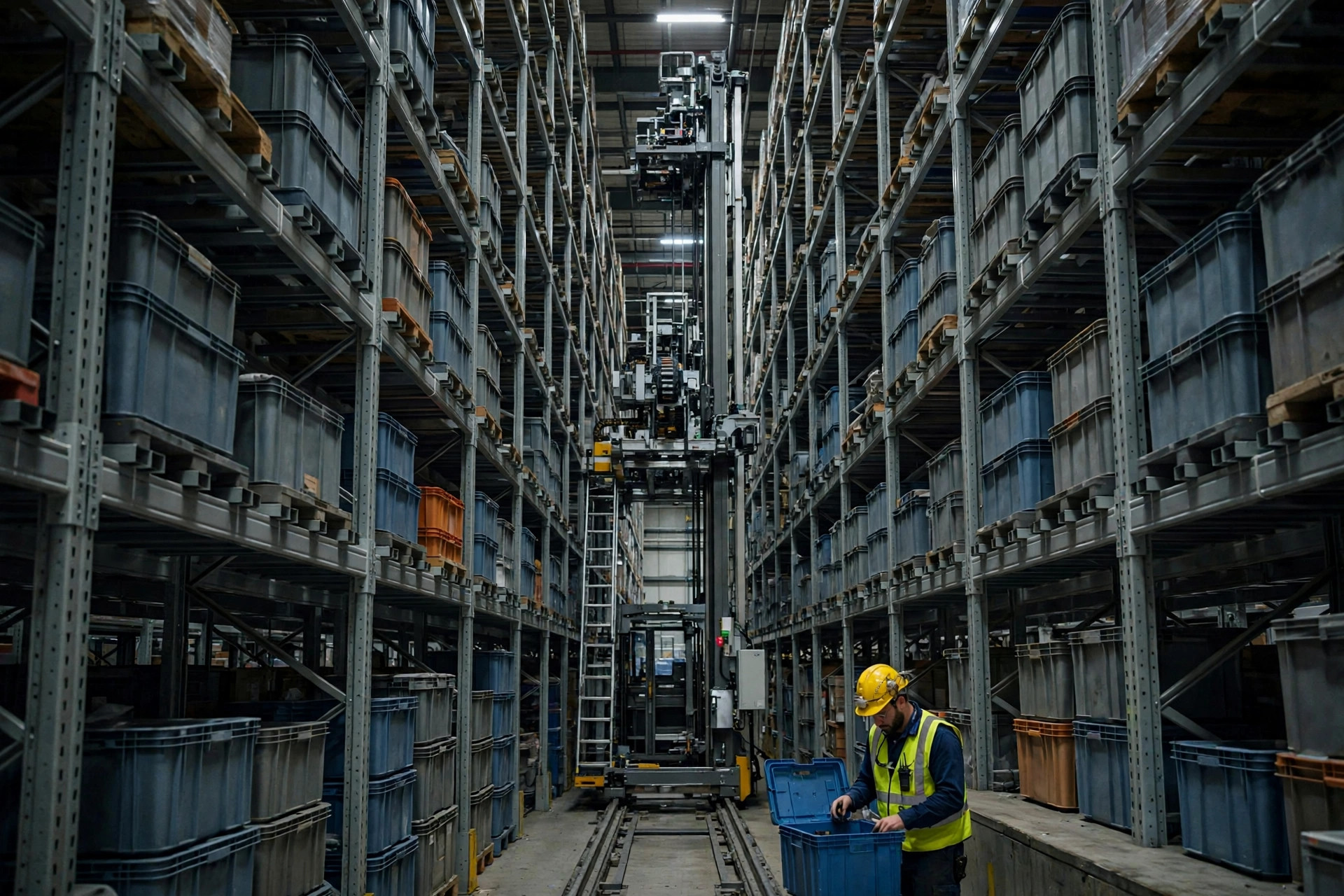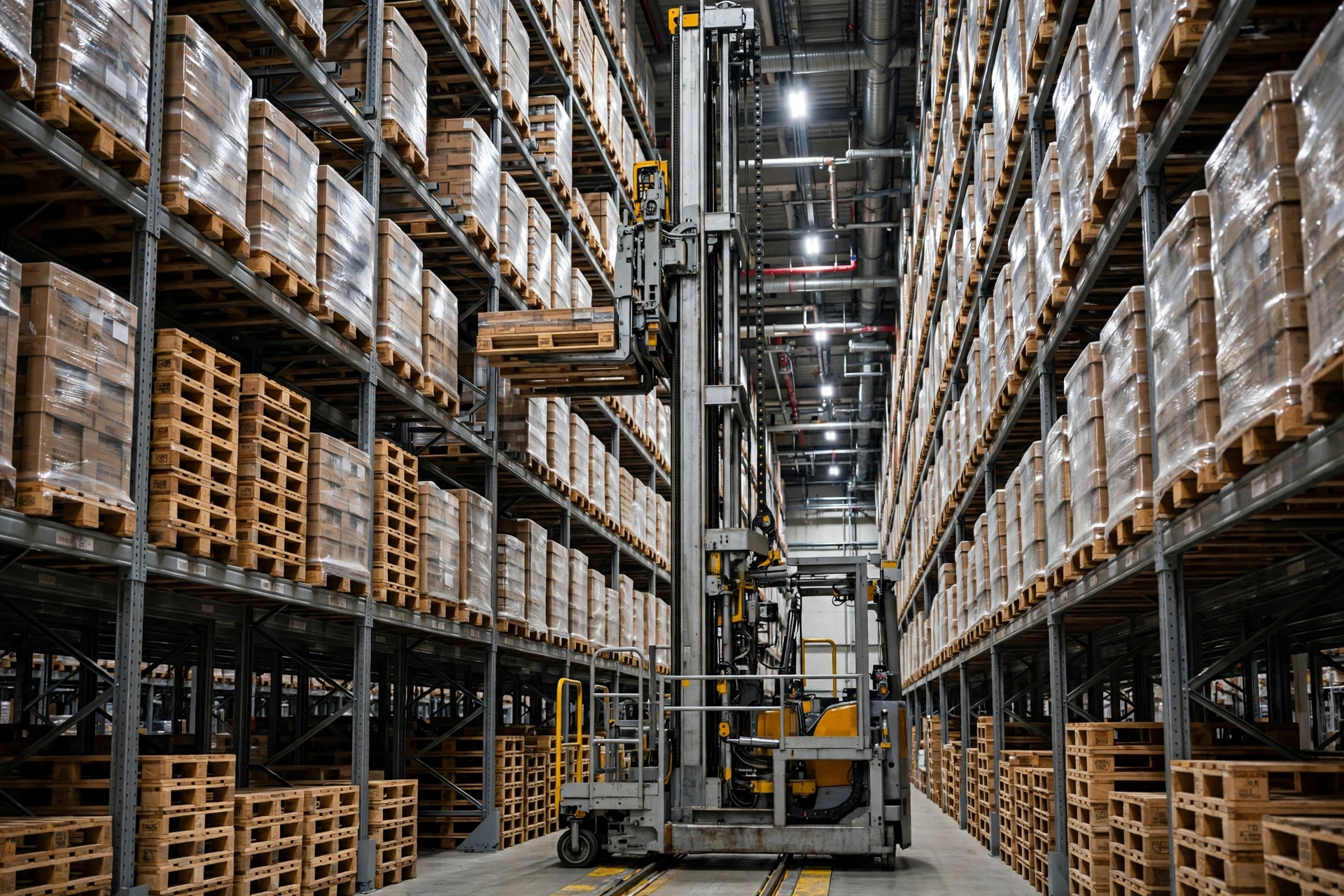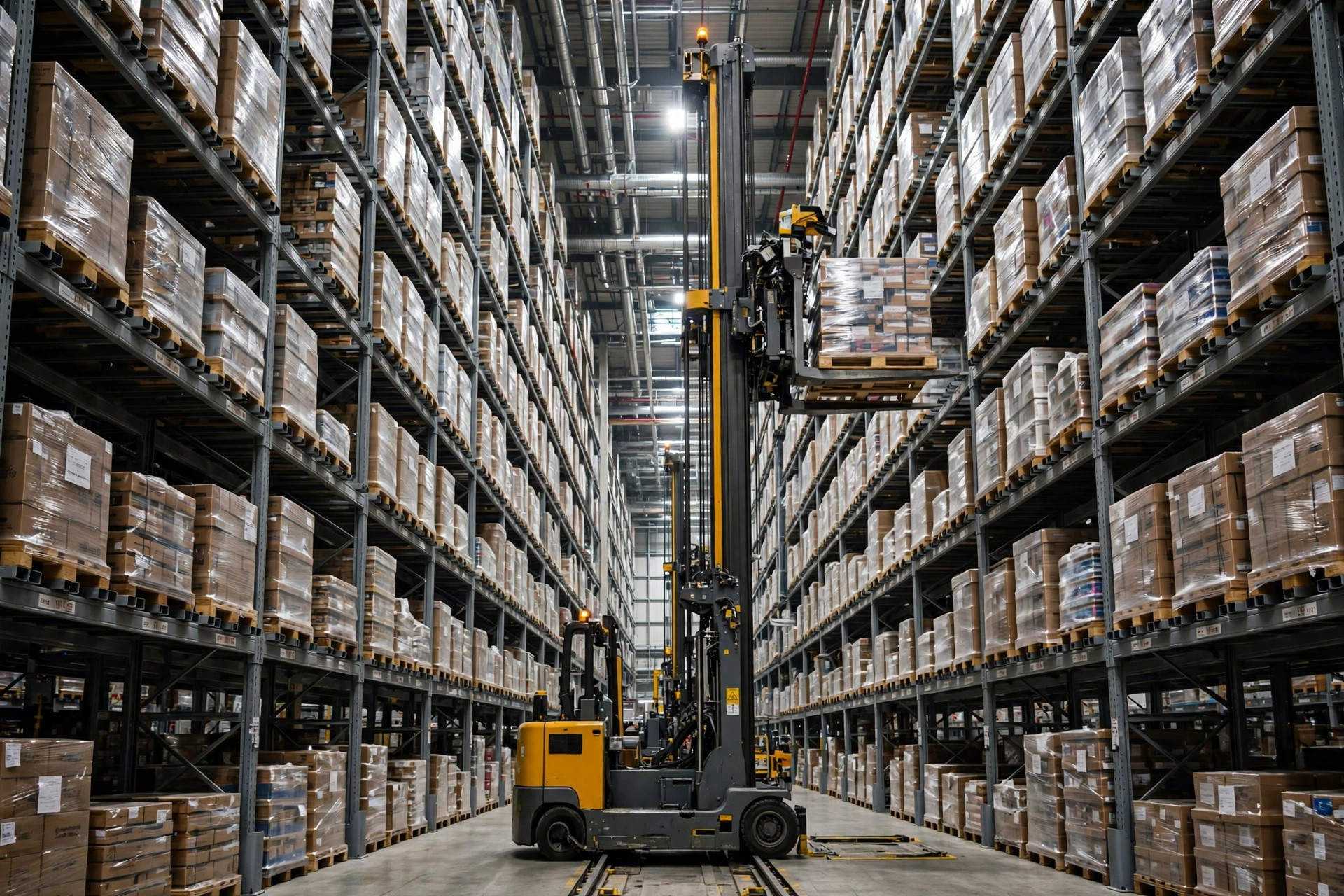
Bottom line up front: there is no better technology here — only the right fit for your building. Clear height above 25 meters, concentrated SKUs, steady in-and-out flow? Go with the stacker crane. Under 20 meters of clear height, thousands of SKUs, spiky order profiles? The four-way shuttle wins. One sentence captures the whole difference: a stacker crane is one strongman owning an entire aisle — tall, fast, but doing one job at a time; a four-way shuttle is a swarm of ants, several carts per level running in every direction, riding an elevator (the lift) whenever they need to change floors. Keep that picture in your head. Every selection rule below grows out of it.
Where Each System Bottlenecks: Stacker Crane vs. Four-Way Shuttle
The two systems bottleneck in completely different places, and that is what decides the selection.
The stacker crane's bottleneck is itself. One aisle, one crane. These machines reach 40 meters — DAMBACH's MONO series is rated up to 40 m with 4-ton loads — moving horizontally and vertically in a single combined motion. A typical pallet crane delivers roughly 40 to 60 combined cycles per hour per aisle. Read that again: per aisle, not per building. Longer aisles and taller racks don't change it; more throughput means more aisles. Stacker cranes are a vertical game. Height is home turf.
The four-way shuttle's bottleneck is the lift. Carts run on rack rails in four directions — roughly 1 to 2 m/s empty and 0.6 to 1.2 m/s loaded, per vendor spec sheets — each rated around 1.5 tons per pallet. One cart loses to one crane, but shuttles win on numbers: put several carts on each level, add more when peak season hits. The catch is that a cart can only work its own level. Every floor change rides the lift, and there are only one or two lifts serving the whole system. I've seen this exact failure three times: the proposal says "sufficient carts," then peak season arrives and there's a queue at the lift at 2 a.m. while carts sit idle on their levels.
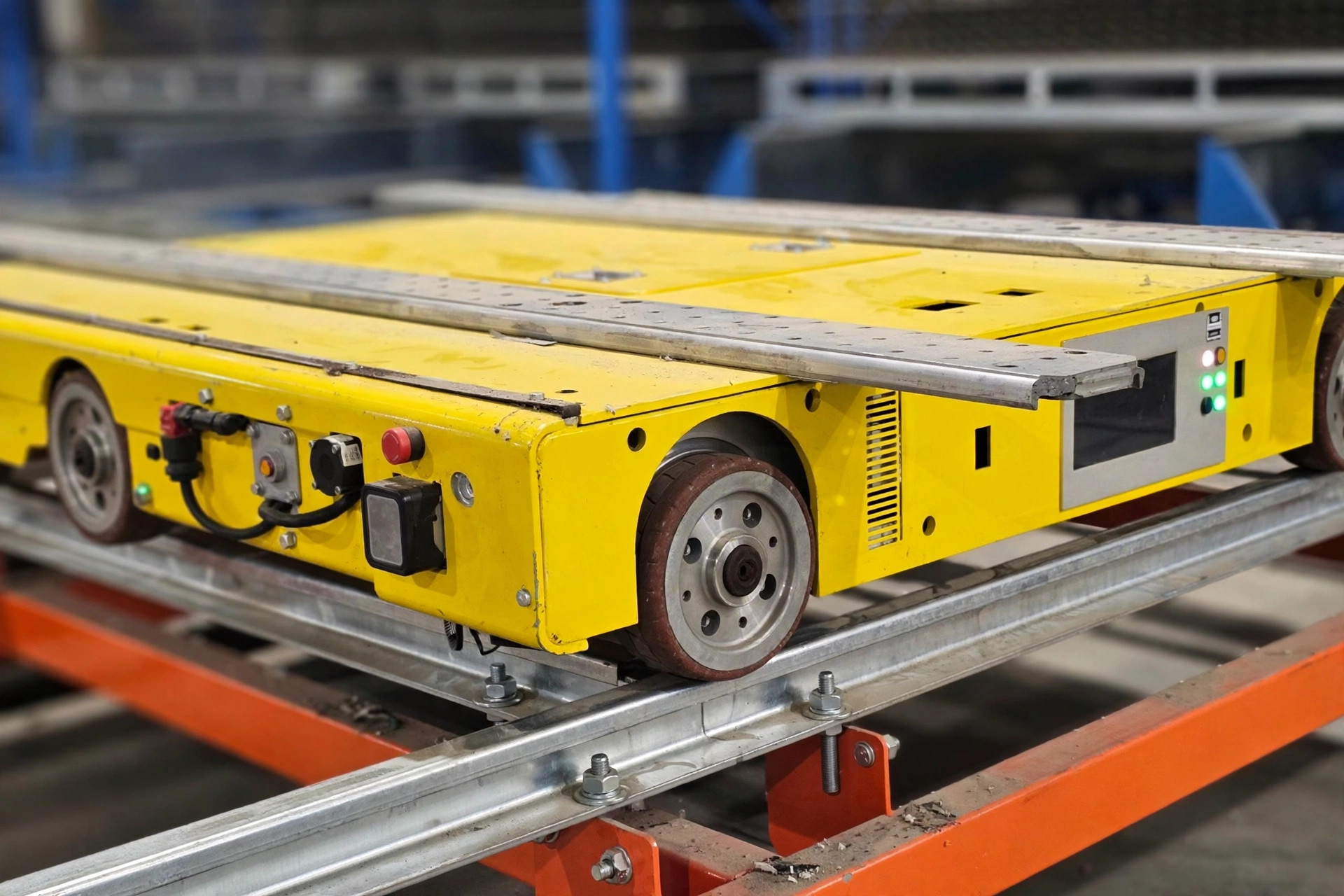
In 2023, a cold-chain food distributor in Ontario, California ran an 18-meter-high freezer: 12,000 pallet positions, 800-plus SKUs, daily replenishment to grocery chains. They went with four-way shuttles — two carts per level, two lifts. The simulation report looked beautiful; average throughput checked out. Then the first Thanksgiving peak hit: outbound needed 220 pallets per hour at peak, each lift was theoretically rated at 60 pallets per hour, two lifts meant 120. The queue started at 2 a.m. and never cleared. The fix was a third lift plus moving hot SKUs down to lower levels. That project taught me something I now repeat at every design review: in a shuttle project, check the lift count first and the cart count second. Never reverse the order.
In 2021, a 3PL outside Chicago leased a building with 32 meters of clear height and installed a six-aisle stacker crane system. During commissioning, the cranes shuddered and threw positioning alarms. Root cause: floor flatness. High-bay cranes are specified against standards like Germany's DIN 18202 — a standard industrial slab doesn't cut it. Three weeks of floor grinding followed. The client's words: "If I'd known the civil works needed rework, I'd have signed the equipment contract two months later." In crane projects, civil works go first and the equipment contract goes last. That's the rule.
Five-Step Selection Checklist: Shuttle or Crane?
- Height first. Under roughly 20 meters of clear height, the shuttle is at home — vendors and industry comparisons consistently place four-way shuttles below the 20-meter line. Above 25 meters is crane territory; at that height you can't economically stack enough carts and lift capacity.
- SKU and order profile. Thousands of SKUs, fragmented orders, sharp peaks — take the shuttle, with its swarm flexibility. Concentrated SKUs, full-pallet moves, steady rhythm — take the crane.
- Peak-hour pallet flow. Run the peak-hour numbers: if peak flow exceeds about 70% of one lift's capacity, a shuttle design needs another lift or a different route. The lift is a hard bottleneck; adding carts won't help.
- Building shape. Shuttles don't care about columns or irregular footprints. Cranes need long, regular aisles — don't force one into an irregular building.
- Growth outlook. Pallet positions growing more than 50% in three years — take the shuttle; just add carts. Stable footprint — take the crane.
Running the Numbers: Crane vs. Shuttle Comparison
| Dimension | Stacker crane | Four-way shuttle |
|---|---|---|
| One-line principle | One machine owns one aisle, horizontal plus vertical in one motion | Multiple carts per level run flat; floor changes ride the lift |
| Height range | Up to 40 m — the high-bay champion | Generally below 20 m |
| Throughput behavior | Capped per aisle (typically 40–60 combined cycles/hour); more throughput means more aisles | Cart count scales flexibly, but the lift is a hard bottleneck |
| SKU fit | Concentrated SKUs, full-pallet moves | High SKU counts, fragmented orders |
| Expansion | Hard to change once the layout is set | Add carts, add a lift |
| Single point of failure | One crane down means one aisle down | One cart down, the others cover; but a lift failure hits the whole level |
| Cost structure | Priced per aisle, expensive per machine | Cheap per cart but many of them, plus lifts and rack rails |
| Civil works | Extreme floor-flatness demands, in-rack sprinklers, heavy foundation loads | High rail-precision demands, charging area must be planned |
| Maintenance | Centralized; one machine down hurts | Many carts but cheap each; lithium batteries run about three years on one charge per day at 1,000-plus cycles |
| Typical use | High-bay raw-material stores, manufacturing line-side, 3PL full-pallet storage | Cold chain, food, e-commerce, high-SKU distribution centers |
How to frame TCO: equipment plus racking plus civil works plus WCS software plus five years of spares. What clients always forget are the civil works and the software — floor remediation and sprinklers for cranes, WCS scheduling for shuttles. Those two line items routinely run to 20 or 30 percent of total investment. Vendor claims like "30% lower cost per pallet position" are marketing; get real quotes.
Two counterintuitive takes. First, "shuttles are faster" is an illusion: cart versus crane, the crane wins — shuttles win by fielding a team. Second, cranes look expensive, but above 30 meters their cost per pallet position can actually come out lower. Height dilutes a crane's cost and punishes a shuttle, which needs carts on every level and lifts that can't keep up. Ask "which costs more" without naming a height and you're asking a meaningless question.
Go-Live Night Checklist
- Was the lift count sized to average flow or peak flow? I've seen this mistake three times. Size to the peak hour and keep 30% headroom.
- Pallet quality: shuttles are brutal on pallets — damaged, warped, or open-bottom pallets jam carts, and vendor specs say so explicitly. Screen the entire pallet pool before go-live.
- Floor-flatness survey in hand? For crane projects, don't trust "looks flat." Get laser survey data.
- Fire protection: in-rack sprinklers installed? In the US, NFPA 13 requires them for high-piled storage; your local authority having jurisdiction governs the details. Retrofitting sprinklers after the racks are up is the kind of bill that makes CFOs go quiet.
- Clear height re-verified? Sprinkler pipes, lights, and cable trays eat headroom the rack drawings never show.
- WCS stress-tested? A shuttle system is a multi-cart coordination problem — the scheduling software is its soul. Make the integrator run your peak profile through simulation; paper numbers don't count.
- Cold storage: charging area planned? Carts must stay inside the freezer while batteries charge outside — vendor operating specs require it. Reserve the charging room early.
- Spares: keep one or two complete shuttle carts on the shelf; critical wear parts for cranes. Don't wait for a breakdown to place the order.
Before your next selection meeting, put three numbers on the table: total pallet positions, SKU count, and peak-hour in/out pallets. Without those three numbers, any "shuttle versus crane" debate is theater. With them, the answer picks itself.
By Lin Xiao, WMS Implementation Consultant