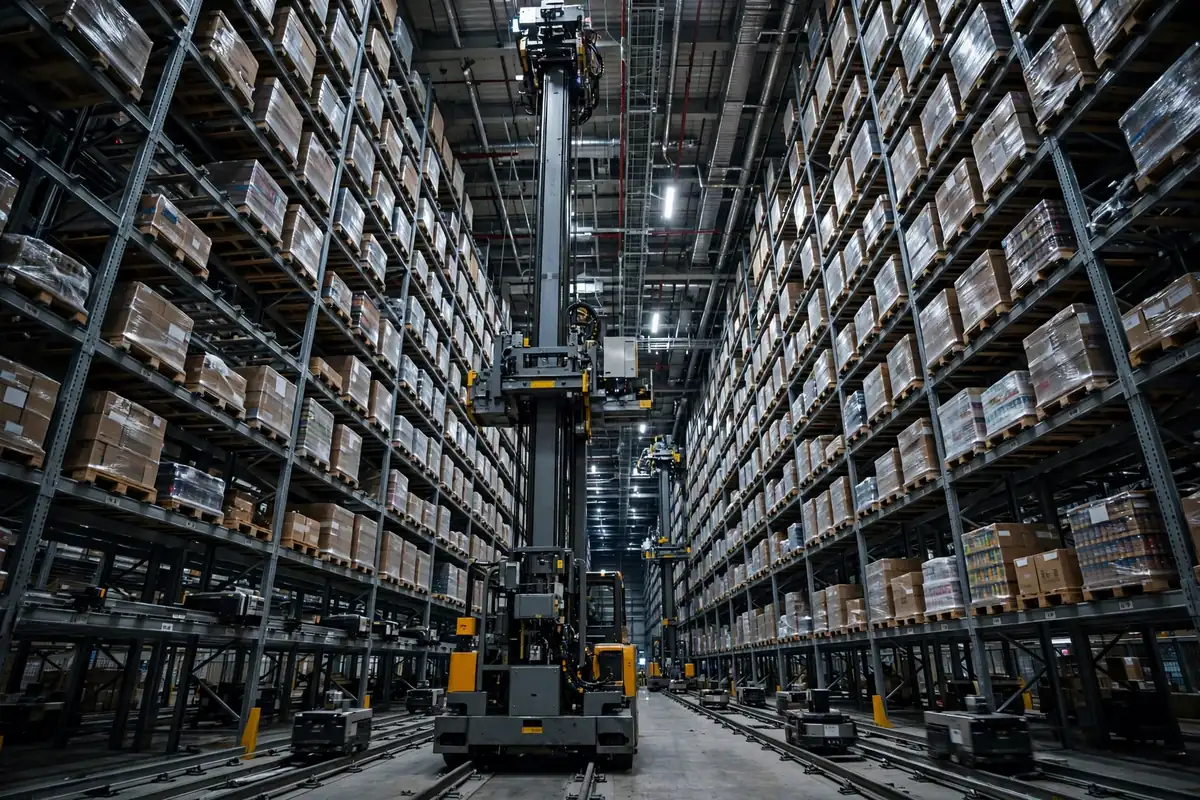
Last autumn I sat in on a four-way shuttle vs stacker crane design review at an auto parts warehouse in eastern China. Twenty-four meters tall, racking already going up, and the owner asked the one question nobody in the room wanted to answer: in a four-way shuttle vs stacker crane warehouse, which one do we buy? Two integrators argued for two hours. Nobody would commit. So I asked the owner for three numbers: daily pallet throughput, SKU count, and how many times bigger peak season was than a normal week. He knew none of them. Meeting over.
That is why this article exists: the answer is not in a spec sheet. It is in your business numbers.
One Is an Elevator, the Other Is a Taxi Fleet
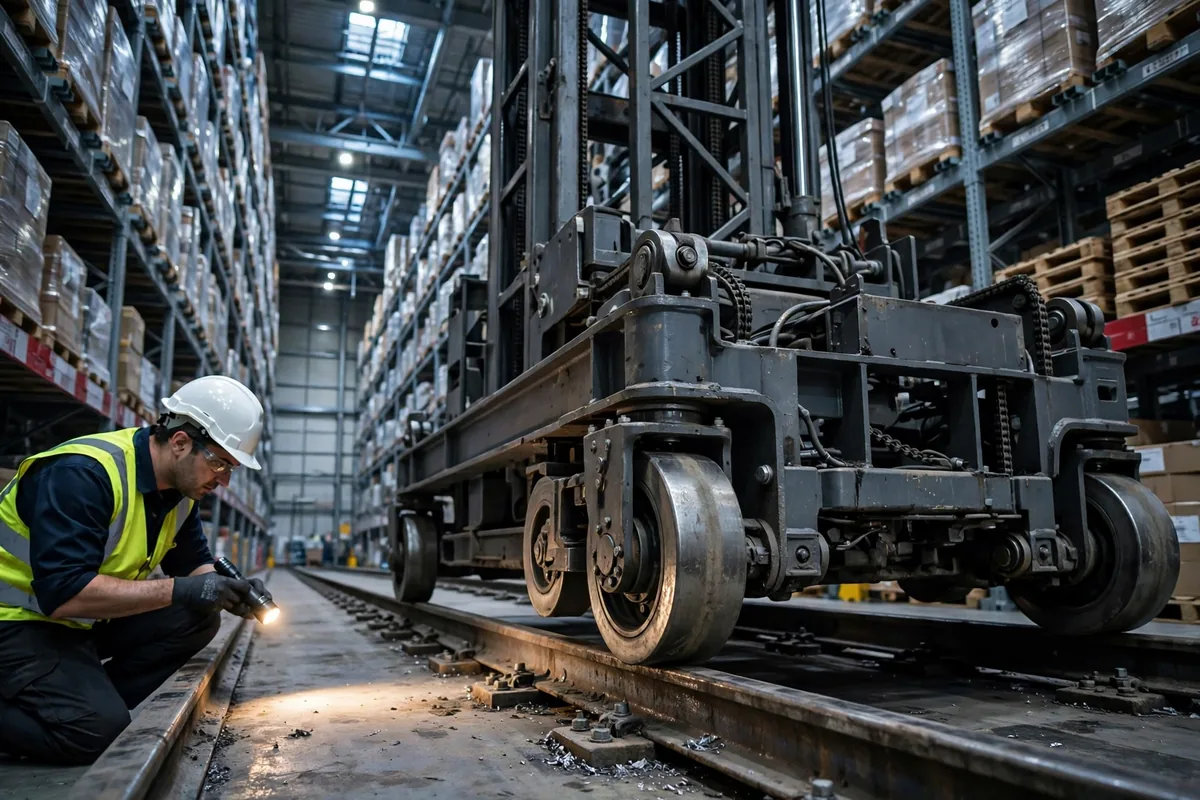
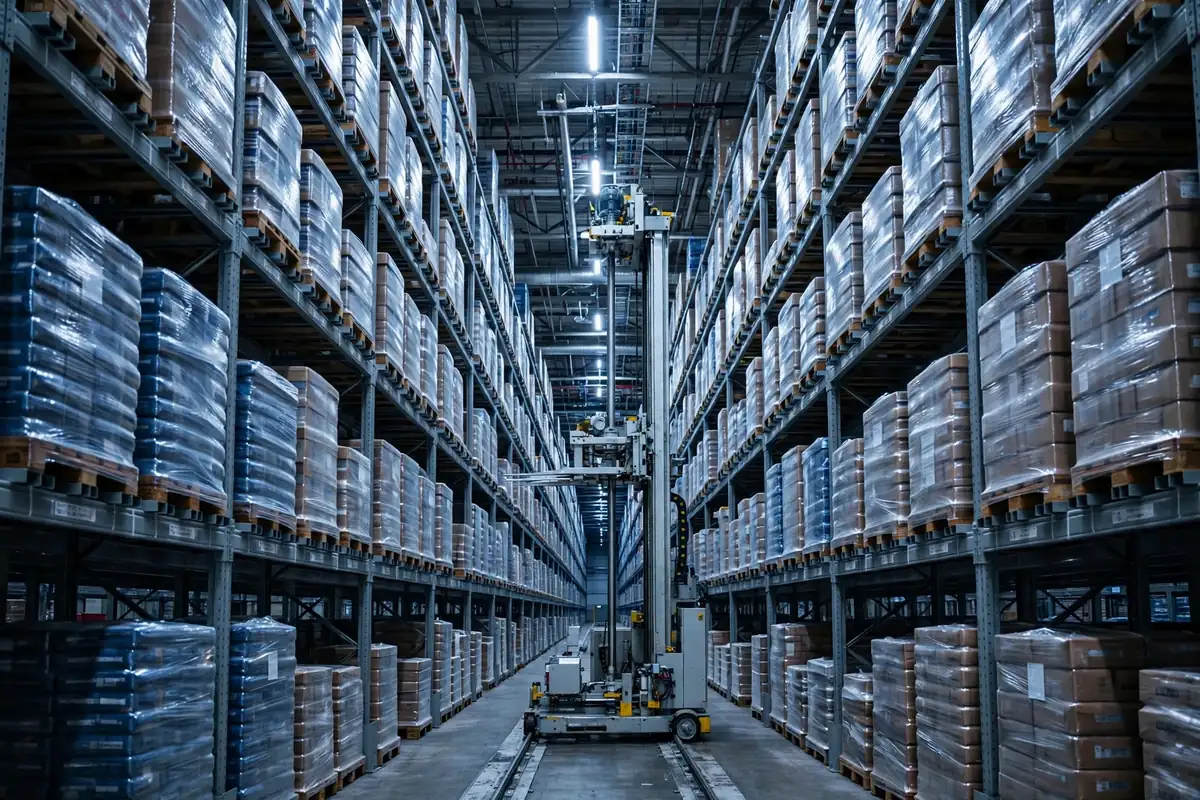
Think of a stacker crane as a dedicated elevator with telescopic forks, living in one aisle. It runs up and down, left and right, picks a pallet, and drops it at the aisle entrance. Simple structure, fixed path — and the aisle entrance is the bottleneck, one machine's cycle time the aisle's ceiling.
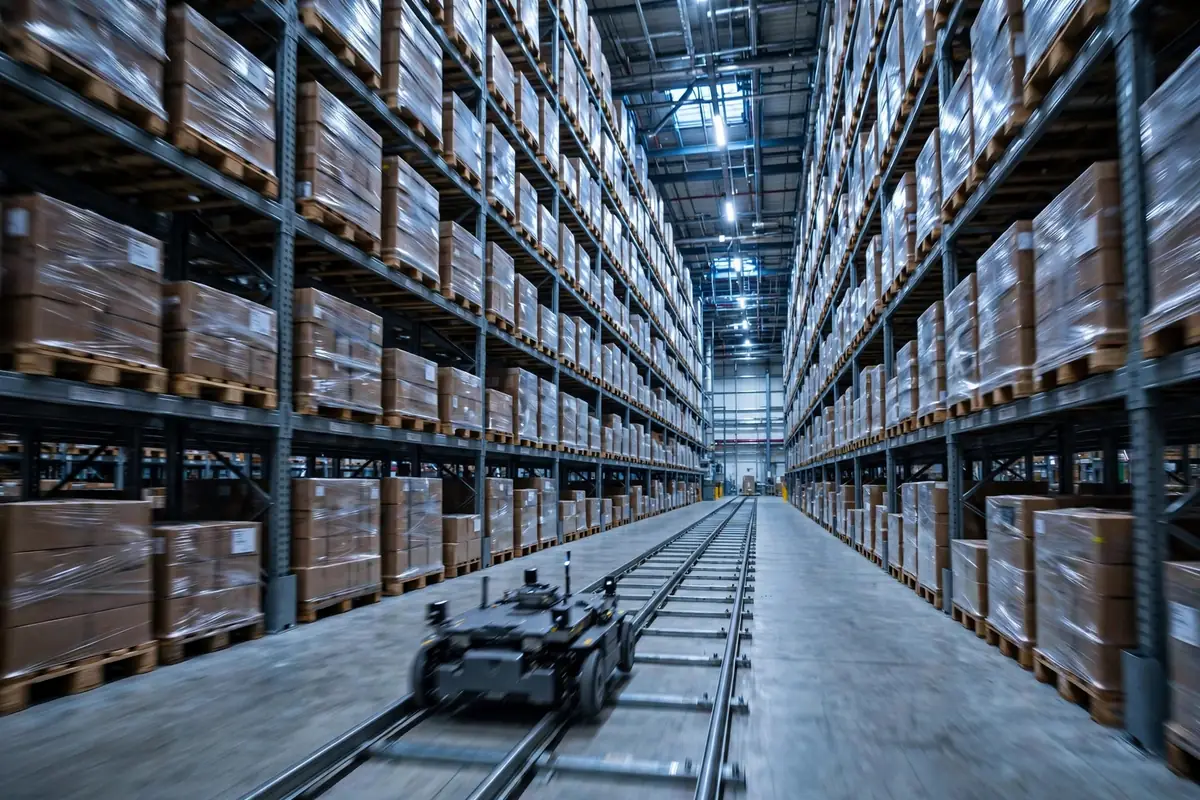
A four-way shuttle system is a different animal: a fleet of small vehicles that change direction and change levels inside the racking grid, with lifts moving them between floors. You add throughput by adding vehicles, and jobs spread across the fleet. But the system gets complicated — scheduling, lifts, charging, avoidance — and if any one link underperforms, the whole network slows down.
Here is the part most sales decks will never tell you: a four-way shuttle is not an upgraded stacker crane, and a stacker crane is not obsolete technology. There is no generational relationship between them, only a fit relationship. I have seen projects that paid shuttle money and got stacker-crane throughput, because the business never needed multi-vehicle flexibility. They paid for the word "advanced."
Four-Way Shuttle vs Stacker Crane: Three Lines That Decide It
I draw the line with three tests.
First, throughput. A stacker crane's per-aisle capacity is bounded by its cycle time. One crane, one aisle, a fixed number of pallets per hour. If your peak demand fits inside that capacity, a crane is enough. But if your peak runs at three or four times normal volume and stays there for hours, adding crane capacity means adding aisles — more racking, more building work — and that gets expensive fast. Adding shuttle capacity means adding vehicles. So: big, sustained peaks favor shuttles; flat, predictable flow favors cranes.
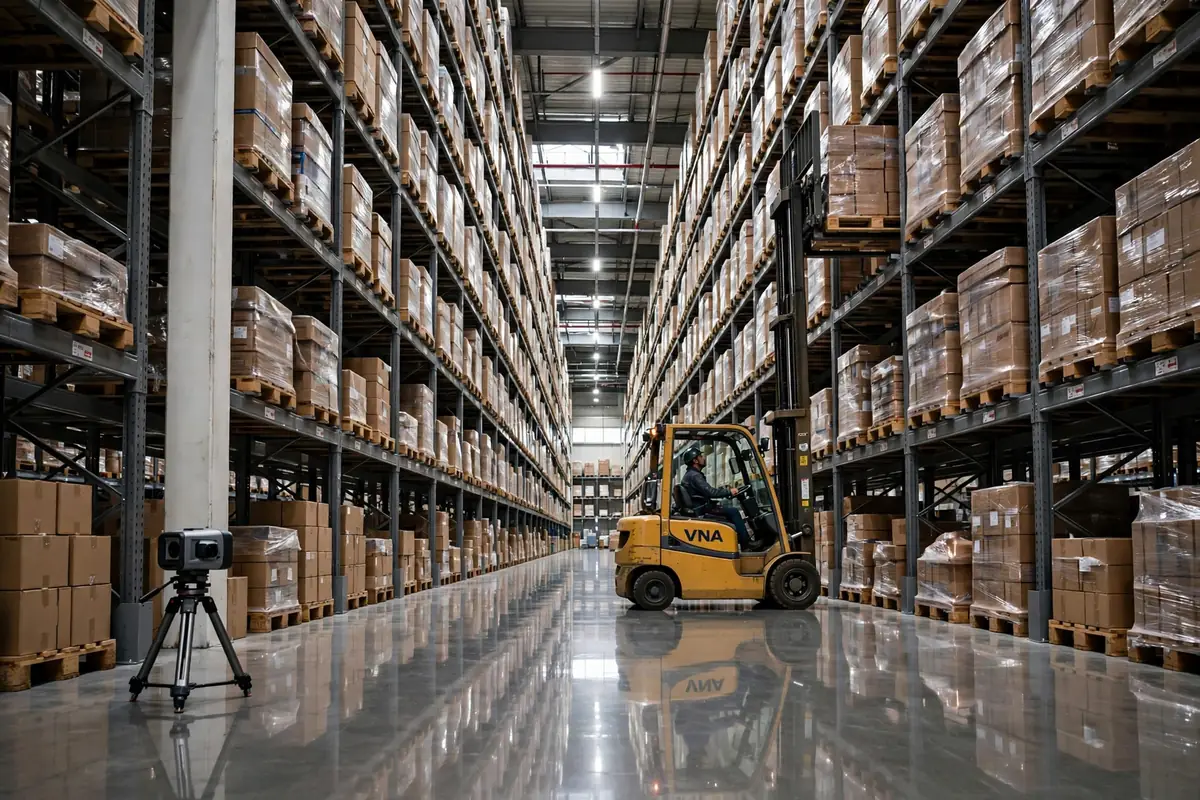
The second line is density. Shuttle racking can be packed tighter: small vehicles travel inside the rack on multiple levels and aisles get narrower, so space utilization is usually higher. But that density has a price: higher installation precision, less error tolerance, harder reconfiguration. Crane racking gives up a few points of utilization, but the structure is simpler and easier to change. If land is expensive and your ceiling is at the fire-code limit, the shuttle's density is worth real money. If land is cheap, paying millions for a few extra points of utilization is not.
The third line is SKU structure. Few SKUs, large batches, fast turnover: a stacker crane loves that, built as it is for full-pallet moves on fixed paths. Many SKUs, small batches, high order frequency: shuttles do better, because many vehicles can pick for many orders at once. I reviewed a cosmetics warehouse with more than ten thousand SKUs and thousands of orders a day, averaging under two pallets per order, where the crane proposal had queues at the aisle entrances stretching into the next day.
If your operation crosses two of the three lines, start talking shuttles. Cross one, run the numbers first. Cross none, stay with cranes and stop shopping for excitement.
Run the Money: Four-Way Shuttle vs Stacker Crane on a Worked Example
Cost comparisons need an anchor. The worked example below is a hypothetical scenario built from common cases, not a real project's quotation — its job is to show where the two options spend money differently.
Take a hypothetical 8,000-pallet high-bay warehouse moving 1,200 pallets a day, peaking at 2.5 times normal volume, with around 3,000 SKUs. A crane setup means four aisles and four cranes: lower upfront cost and lower maintenance per machine, but expansion means adding aisles at high marginal cost. A shuttle setup means roughly forty vehicles plus lifts: usually higher total cost, with batteries, wheels, and drives as consumables — but expansion is just adding vehicles.
| Stacker crane | Four-way shuttle | |
|---|---|---|
| Upfront investment | Relatively lower | Usually higher |
| How you expand | Add an aisle, expensive | Add vehicles, more flexible |
| Peak elasticity | Weak, aisle entrance is the bottleneck | Strong, many vehicles in parallel |
| Maintenance points | Few, one machine per aisle | Many: vehicles, lifts, charging |
| Single-point failure | One aisle stops | One vehicle fails, others reroute |
| Space utilization | Relatively lower | Usually higher |
The real question is whether your business will change in the next three years. If SKU counts, order profiles, and peak multiples are all moving fast, the shuttle's flexibility is worth the premium. If the business is stable, the crane's lower price is real money saved. The most expensive mistake in equipment selection is not overpaying. It is paying full price for flexibility you never use.
The Maintenance Traps Nobody Puts in the Proposal
Vendor proposals always end with beautiful MTBF and uptime figures. What decides whether you sleep at night is maintenance.
Crane maintenance is straightforward and brutal: rails, chains, forks, and motors are heavy-duty parts, and when one fails, the aisle stops for half a day. So ask the vendor one question: when a single crane fails, is there a backup path for that aisle? Many proposals never mention it, and you only discover the answer when the aisle is locked shut.
Shuttle maintenance is sneakier. The vehicles themselves are not expensive. The system is. The lift is the throat of the whole network: if it stops, every vehicle on that level is stranded. If the charging strategy is wrong, half your fleet queues for charge during peak season and throughput falls off a cliff. Scheduling has edge cases too: a surge on one level can jam the floor. None of that shows up on a parameter sheet.
One more trap: spare parts. Crane parts are relatively generic, but shuttle vehicles are often vendor-customized, and batteries, drive boards, and wheel sets may only come from one supplier. Get the spare-parts list and lead times into the contract before you sign.
Early last year, a 3C accessories warehouse in southern China went live with a shuttle system. Three smooth months, then one big promotion tripled outbound volume and everything surfaced at once: lift queues, charging queues, vehicles running empty on a few levels. The root cause was the WMS wave strategy: order allocation ignored floor balance, so all the hot SKUs sat on two levels. The equipment was fine; the strategy was wrong.
Is the money worth it? Look at one number.
Back to that auto parts warehouse. The owner eventually brought the three numbers: under 800 pallets a day, around two thousand SKUs, peak under twice normal volume. Zero of the three lines crossed. My recommendation was stacker cranes, and to spend the savings on better WMS slotting and the conveyor lines at the aisle entrances. He took it, and the project has run steadily since.
So here is my conclusion: no standard answer, only an arithmetic problem. Work out your peak multiple, your SKU structure, and how much your business will change in three years. Is the money worth it? Look at one number: your cost per pallet moved at peak volume. Whichever option is lower is the right one. Everything else is a vendor slide deck.
By Da Liu, Automation Engineer