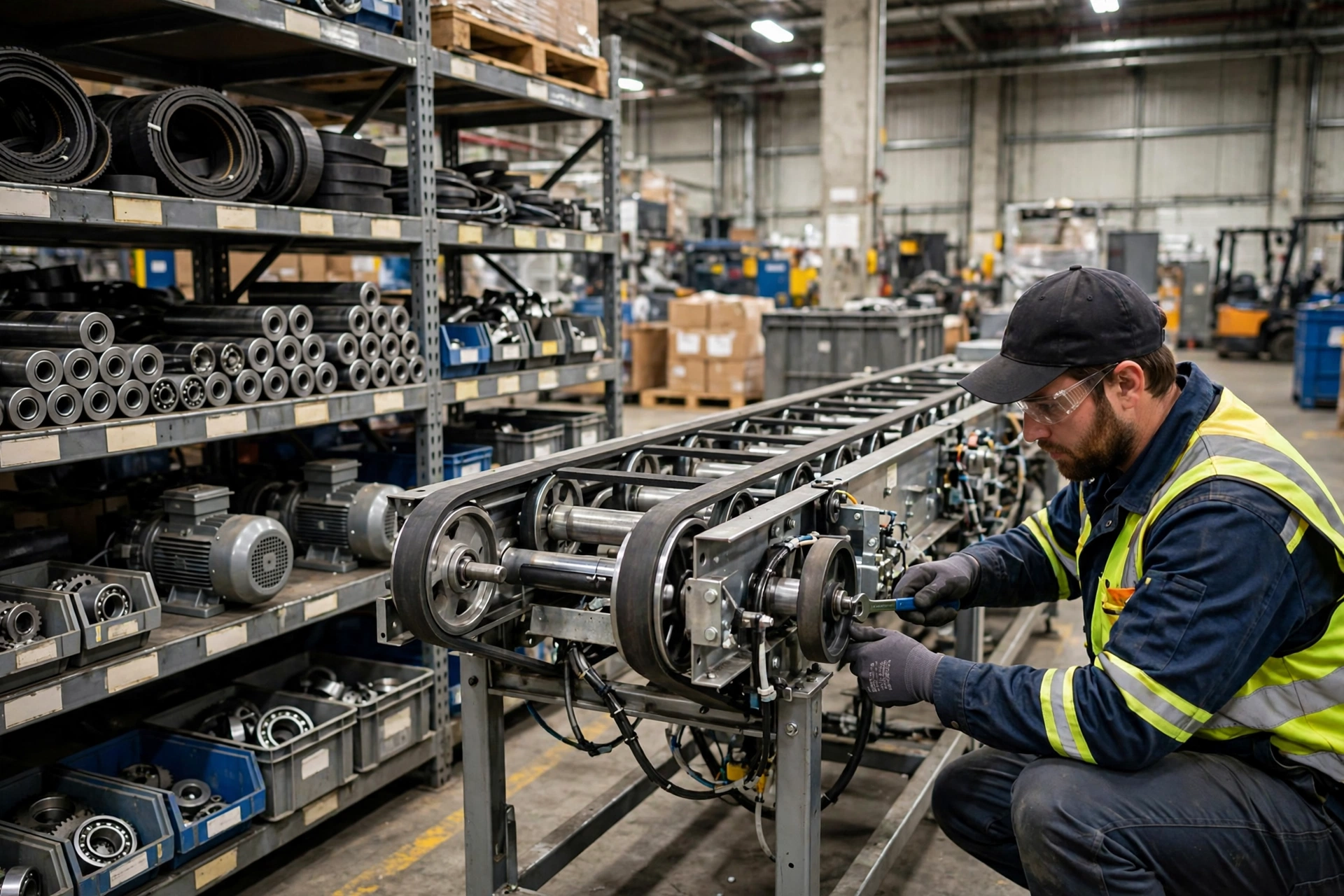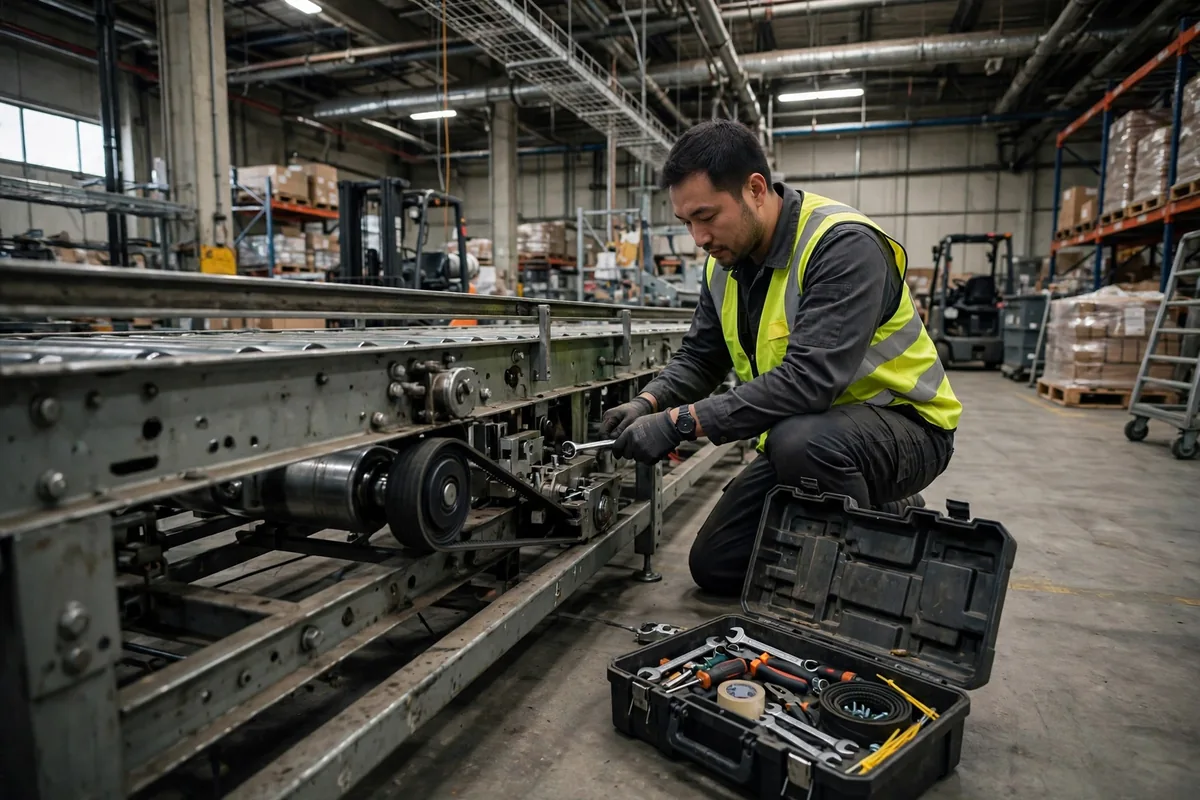
Talking about four-way shuttle maintenance is like buying a car. The salesperson will talk about acceleration all day, and nobody will mention what tires cost, how often you replace the battery, or when the transmission fluid is due. A four-way shuttle is the same. In selection meetings everyone talks about speed, cycle time, and pallets per hour. Have you done the math on running it? This article is about four-way shuttle maintenance: which parts wear out, how often to change them, how to schedule service windows without stopping production, and what an hour of downtime actually costs.
First, the principle, in one sentence. A four-way shuttle is a small vehicle that runs back and forth and side to side on rails inside the racking, driven by its wheels, located by the rails, powered by a battery, and told what to do over a wireless link. You can think of it as a valet that parks itself in a multi-story garage, except it's looking for pallets, not cars. Four subsystems. If any one of them fails, the whole aisle stops.
Wear Parts in Four-Way Shuttle Maintenance: Wheels, Rails, Batteries, and Comms
Wheels first. In four-way shuttle maintenance, the wheels are the most frequently replaced part, and it's not close. Drive wheels and guide wheels grind against steel rail all day. The polyurethane tread wears thin, the wheel slips, positioning drifts, and then it hits a limit switch and throws a fault. Our rule of thumb, as an illustrative example: one shuttle running a full 16 hours a day will wear its drive-wheel tread to the replacement line in roughly 8 to 12 months. Guide wheels last a little longer, say 12 to 18 months. Treat those as illustrative — check your own manufacturer's manual, because tread compounds differ between brands. The check is crude but it works: measure tread thickness with a caliper once a week and replace at the manufacturer's lower limit. Don't wait for the steel core to show — by then the rail is damaged too, and rail repair costs several times what a wheel costs.
Rails come second. The rail itself rarely breaks. What fails is the rail joint and the fixing bolts. In a warehouse with big temperature swings, steel rail expands and contracts, and joints slowly drift out of alignment. Past 2 millimeters of misalignment (illustrative figure — check the manufacturer's tolerance table), the shuttle jolts every time it crosses the joint, and every jolt shortens wheel life. Our practice is to spot-check joints monthly with a level and a feeler gauge, focusing on aisle ends and the zones with the biggest temperature swing. Loose bolts are sneakier — listen for them while the shuttle runs; a strange noise means stop and check.
Batteries are third. A lithium battery pack hates two things: sitting at full charge for long periods, and heat. During peak season, when shuttles run back-to-back with deep charge and discharge cycles, capacity fades fastest. As an illustrative example: a pack rated for 3,000 cycles, at 1.5 full cycles a day, should theoretically last five or six years. In practice, once capacity drops below about 80% — usually around year three — it belongs on the replacement plan. Treat the 80% as my illustration, not a spec. And don't judge a battery by voltage. Judge it by runtime. A shuttle that used to run 8 hours a shift and now calls for a recharge after 6 hours needs a new pack. Don't push it. The price of pushing it is a shuttle dying mid-aisle and blocking everything behind it.
Comms modules come fourth, and they're the easiest to blame. A shuttle loses a task or the control system can't find it — six or seven times out of ten, everyone suspects comms first, and half the time it turns out to be a loose antenna, the other half a new metal obstruction in the aisle. The module itself rarely fails. The connectors and antennas fail. Every service starts with antenna fastening and connector oxidation, then firmware version, and only then the module hardware. Get the order wrong and you spend money on the wrong thing.
Here's the whole list as one table to pin on the maintenance room wall. Cycles below are illustrative examples — use your manufacturer's manual for the real numbers:
| Component | What to check | Replacement / overhaul cycle (illustrative) | Cost of waiting |
|---|---|---|---|
| Drive wheel tread | Tread thickness, slipping | 8–12 months | Bad positioning, limit hits, rail damage |
| Guide wheels | Wear, unusual noise | 12–18 months | Drift, vibration, positioning errors |
| Rail joints / bolts | Misalignment, looseness | Monthly spot check | Shorter wheel life, jolts, faults |
| Lithium battery pack | Runtime, capacity | Plan replacement around year 3 | Dies mid-aisle, blocks the aisle |
| Antenna / comms connectors | Fastening, oxidation | Quarterly check | Lost tasks, control system can't find the shuttle |
Service Windows: How to Schedule Them Without Stopping Production
The service window is where four-way shuttle maintenance gets genuinely hard. The equipment has to stop, but the freight can't. Get the window wrong and the maintenance gets done, production gets hurt anyway, and you've gained nothing. Here's the counterintuitive part: a window isn't better when it's longer. It's better when it lines up with the valleys in the aisle's task curve — pull four weeks of task volume from the control system, find the quietest half-day in the week and the quietest two or three hours in the day, and where those two low points overlap is the real window. Night looks quiet, but it's often the peak for replenishment and cross-docking.
Picture this, as an illustrative scenario: a facility with 12 four-way shuttles and 6 aisles measures its windows before peak and finds task volume between 2 and 4 a.m. is only 30% of peak. The maintenance crew puts battery equalization and wheel checks in that window, stopping only one aisle at a time while the other five run a little harder to cover. Volume is unaffected. Stop three aisles at once for a "thorough service" and the morning peak will punish you for it.
Then there's the spares trade-off: hold too few and the wait for parts takes longer than the repair; hold too many and capital sits on a shelf while the boss asks questions. Our dividing line is downtime cost — what a drive wheel costs, how many days the part takes to arrive, and what those days of degraded aisles cost. Hold plenty of common parts, few specialized ones, and put expensive major items on vendor consignment instead of carrying them yourself.
And a shot at a fake need: some vendors sell a "predictive maintenance platform" with sensors that claim to predict a wheel failure a month ahead. Sounds great. In practice? How worn a wheel is — a caliper tells you in ten seconds. How much battery runtime has dropped — the control system already has the data. Before you spend serious money on a platform, get the weekly manual inspection done properly. A warehouse that hasn't made its inspection checklist stick will only turn "data nobody looks at" into "a dashboard nobody looks at." Look at one number: three months after the platform goes live, has fault downtime fallen? If not, it's a fake need.
Downtime Costs: Do the Math First, Then Talk Maintenance Budget
Finally, the money. If downtime cost isn't calculated, the maintenance budget never gets approved, and when it does get approved it always feels expensive.
The calculation has three parts, all illustrative — swap in your own warehouse's real numbers before you use them. One is the direct loss: pallets not moved per hour, times margin or late penalty per pallet. Two is the knock-on loss: the pick area waiting for stock, shipments missing cut-off, and overtime labor. Three is the hidden loss: customer complaints and orders rerouted to another warehouse — the hardest to calculate and the easiest to ignore.
An illustrative scenario: a facility with 6 aisles, one aisle moving 40 pallets an hour. One hour down means 40 pallets not moved. At a combined cost of 15 per delayed pallet (illustrative figure, covering overtime and rerouting), the direct plus knock-on loss is about 600. Add four pickers waiting an hour at 25 an hour each, another 100. One aisle down for one hour costs roughly 700 on paper — before counting what the customer thinks. Now run the same math for a planned service: two hours, scheduled in a window, other aisles covering — the pallets actually lost may be less than half the unplanned figure. That's the difference between planned downtime and a breakdown: one is controlled, the other isn't.
So work the budget backwards: a year of breakdown downtime, and what it takes to halve it. If the investment is smaller than the loss it prevents, spend it. And the one number to end on: hours lost to faults last year, times cost per hour — that's this year's maintenance budget ceiling. Lower than the quote, you're in decent shape. Far higher, the money is overdue.
By Da Liu, Automation Engineer