It was 2 a.m. on a November night, peak season — the kind of shift where forklift tip-over prevention is the last thing on a tired driver's mind, and exactly when it matters most.
I was in the office working on the next day's shift schedule when a crash shook the building — then the dull thud of pallets hitting concrete, then shouting.
I ran out to aisle B: a forklift on its side, pallets burst open across the lane, Xiao Li the driver sitting on the floor, pale, hands shaking.
Honestly, my legs went weak too. The mast had landed half a meter from a rack upright — half a meter the other way and we'd be telling a very different story.
At the morning meeting, my boss asked: bad luck, or did we miss something?
I went through the footage frame by frame. Not overloaded. Forks weren't high. Floor was flat. Then one frame told the story: he took the aisle corner too fast and too sharp. The truck rocked once — and went over.
Folks, I've run warehouses for years — crews up to 200 people — and I've seen tip-overs more than once. Nine times out of ten it isn't the truck; it's the center of gravity leaving the triangle. Here's how I explain it to my own drivers: the four causes behind most forklift tip-overs, and the tip-over prevention checklist my crew actually follows.
Forklift Tip-Over Prevention Starts with the Stability Triangle
OSHA's standard, 29 CFR 1910.178, has an appendix on stability that comes down to one idea: the stability triangle.
Every certified driver learns it in training — and nine out of ten forget it the day after the test. So I changed how I teach it:
Picture the forklift as a three-legged stool: two front legs are the front wheels, one back leg is the pivot point at the center of the rear steer axle. Connect the three and you get a triangle — the truck's "safe zone."
Keep the combined center of gravity inside that triangle and you're fine. The moment it's thrown outside — over you go.
Two plain-English rules from the spirit of OSHA's appendix: the higher the load, the smaller the safe zone; the sharper the turn and the harder the brake, the harder the center of gravity gets thrown around.
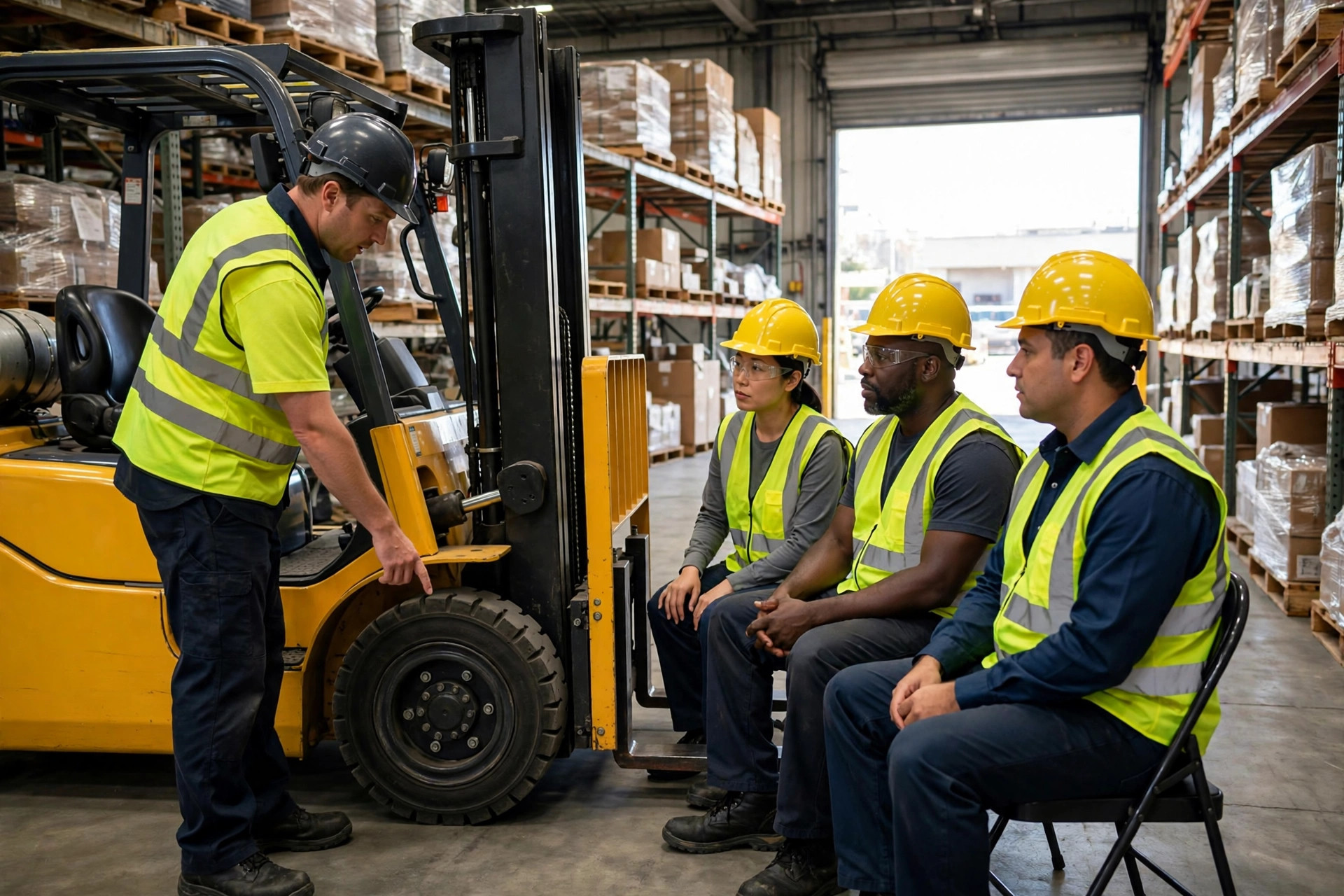
Training new hires I point at a real truck: no math needed — slow down for turns, keep it low. Keep the center of gravity inside the triangle and the truck won't surprise you.
The 4 Causes of Forklift Tip-Overs
Cause 1: Too fast, turning too sharp
This is the number one killer in every tip-over I've investigated. Li's was textbook: night shift, rushing, took the corner too hot — the center of gravity swung right out of the triangle. OSHA sets no hard speed limit, only that you must be able to stop safely, so every warehouse sets its own. Ours: walking speed in the aisles, slow down and horn before every turn.
Our veteran Biao pushed back: "Eight years, never tipped once." I made him safety observer for a week at that corner instead of arguing. Three days later: "Feng, I take it back." Some lessons land better from the sidelines.
Cause 2: Traveling with the load too high
Higher forks, higher center of gravity, smaller safe zone. OSHA's appendix warns: forward tilt at height is one of the most dangerous moves — it shoves the center of gravity toward the triangle's edge.
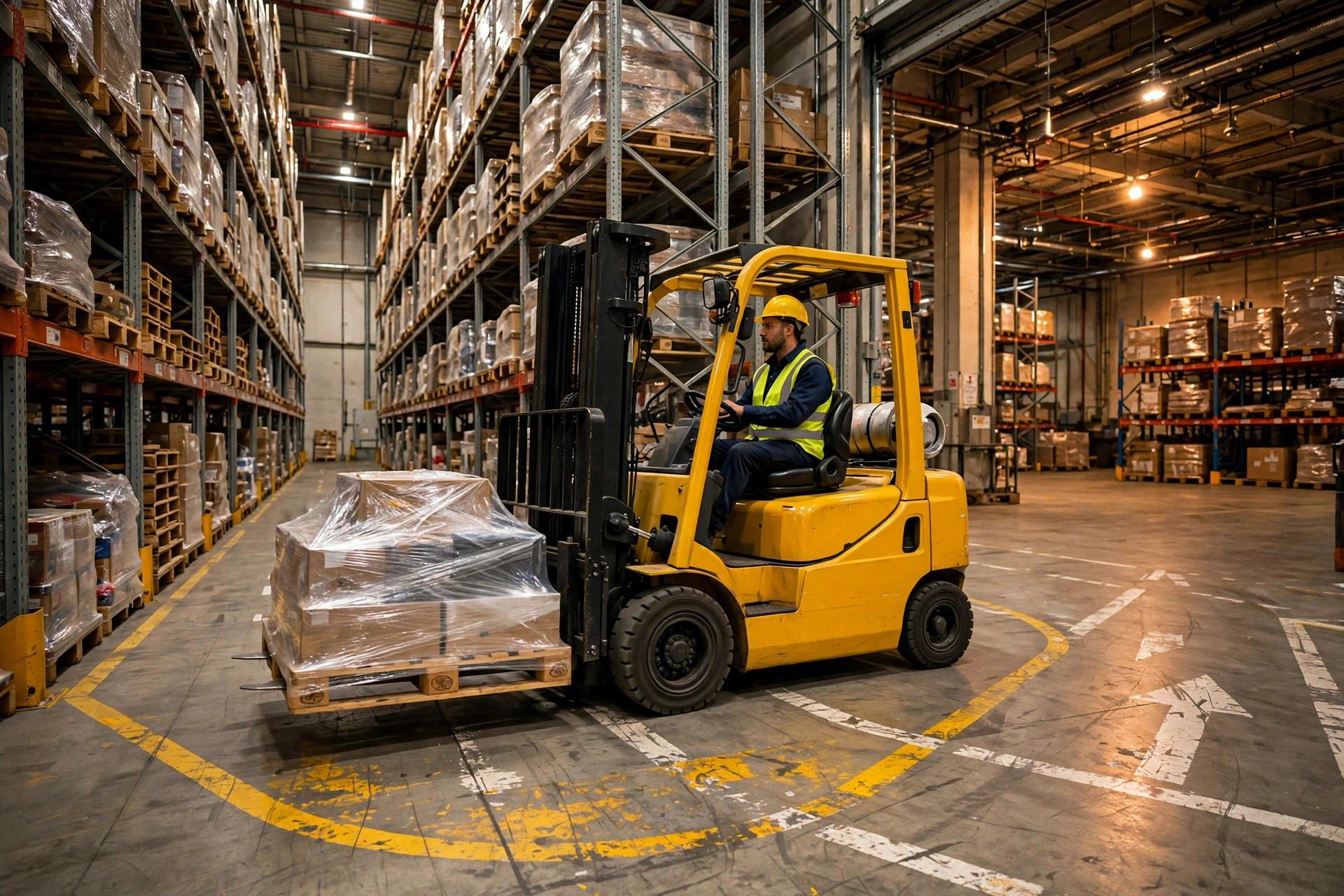
Our rule: forks 6 to 8 inches off the floor, just enough to clear the ground. Get caught cruising with forks three feet up and you're off the truck for half a day of retraining.
Cause 3: The load center creeps forward (the sneaky one)
This one scares me most, because it looks like you're not overloaded. OSHA's appendix is explicit: trucks rated 30,000 pounds and under are rated at a 24-inch load center — the distance from the fork face to the load's center of gravity.
The appendix gives the example I use in every training session: a truck rated 3,000 pounds at a 24-inch load center has a maximum allowable load moment of 72,000 inch-pounds (3,000 × 24). Carry freight 60 inches long and the load center becomes 30 inches — the same truck can now handle only 2,400 pounds (72,000 ÷ 30).
The load doesn't look overweight — but the center of gravity moved 6 inches forward and real capacity dropped 20 percent. This "invisible overload" is undetectable by feel. Read the data plate, do the math.
| Load length | Load center | Real capacity of a 3,000-lb truck |
|---|---|---|
| 48 in (standard pallet) | 24 in | 3,000 lb |
| 60 in | 30 in | 2,400 lb |
| 72 in | 36 in | 2,000 lb |
Our iron rule: load overhanging the forks or a visibly forward center of gravity — bigger truck or two trips. Never "give it a try." One try can cost you the whole truck.
Cause 4: The ground and the pallet let you down
Dock edges, ramps, potholes in the yard, a pallet with a cracked corner — any of these can shift the center of gravity in a split second.
Two rainy seasons ago, a pallet corner gave way under the forks at the dock. The whole load lurched sideways — the driver set it down fast, nobody hurt, but the whole warehouse broke into a cold sweat. Since then our pre-shift check has one more line: look at the pallet before you pick it. Cracked pallets don't go on the truck.
Three Things That Surprised Even My Veterans
The longer I do this, the more "common sense" turns out wrong:
Empty trucks tip over too. Plenty of drivers think only loaded trucks are dangerous. Wrong. Empty, the center of gravity sits near the rear axle pivot — one fast sharp turn will lay it on its side. We tipped an empty truck the year before last — driver rushing to clock out, spun around in the parking lot. Nobody hurt, but the truck was in the shop for two weeks.
More counterweight doesn't always mean more stable. OSHA's appendix says it outright: adding counterweight shifts the center of gravity rearward and reduces lateral stability. Heavier isn't automatically safer.
If it tips, do NOT jump. This is the one that saves lives. Drivers who jump usually get pinned by their own truck — among the most common causes of death in forklift accidents. The OSHA-taught procedure: stay in the seat, grip the wheel hard, brace your feet, lean away from the fall. Every new hire drills this on day one. It feels silly in training — until the truck is going over.
Our Tip-Over Prevention Checklist
Here's the checklist on every steering wheel in my warehouse:
- Five minutes before every shift, walk around the truck: tires, forks, mast chains, brakes, horn, lights — and eyeball the pallets, cracked ones don't go on the truck. One thing off, the truck stays parked.
- Travel with forks 6–8 inches off the floor, slow down and horn before every turn and aisle entry. Never travel with a raised load tilted forward.
- On ramps: loaded going uphill, drive forward; going downhill, back down — keep the load on the uphill side.
- Read the data plate, respect the load center. Loads longer than 48 inches get calculated before they get lifted — no "give it a try."
- Water or oil on the floor gets cleaned before anyone drives over it.
- If it tips, there's exactly one right move: don't jump. Hold the wheel, lean away.
The first three months, the drivers complained we were slower. So I did the math with them: ten extra minutes a day per driver, twenty drivers — 200 minutes a day. Now price one tip-over: two weeks in the shop, damaged freight, the insurance hit, the investigation, the downtime, the morale crater. You don't need a spreadsheet to know which side costs more.
And the number that keeps me up at night: roughly a hundred U.S. workers die in forklift-related accidents each year (check OSHA's site for the latest figures), tip-overs among the leading causes. Every one is somebody's warehouse, somebody's family.
A Note to Fellow Warehouse Managers
A ten-year driver and a one-year driver differ in exactly one thing — and it isn't skill. It's respect for the machine. The most dangerous drivers I've known were the skilled ones: fast, confident, willing to "give it a try."
We name a "Steadiest Driver" every month — not the fastest, the one with zero violations.
If you run a warehouse too, here's my ask: at tomorrow's morning meeting, take five minutes and teach the stability triangle again, the three-legged-stool version. Don't wait for the crash to teach the lesson.
By Chen Feng, Warehouse Operations Manager