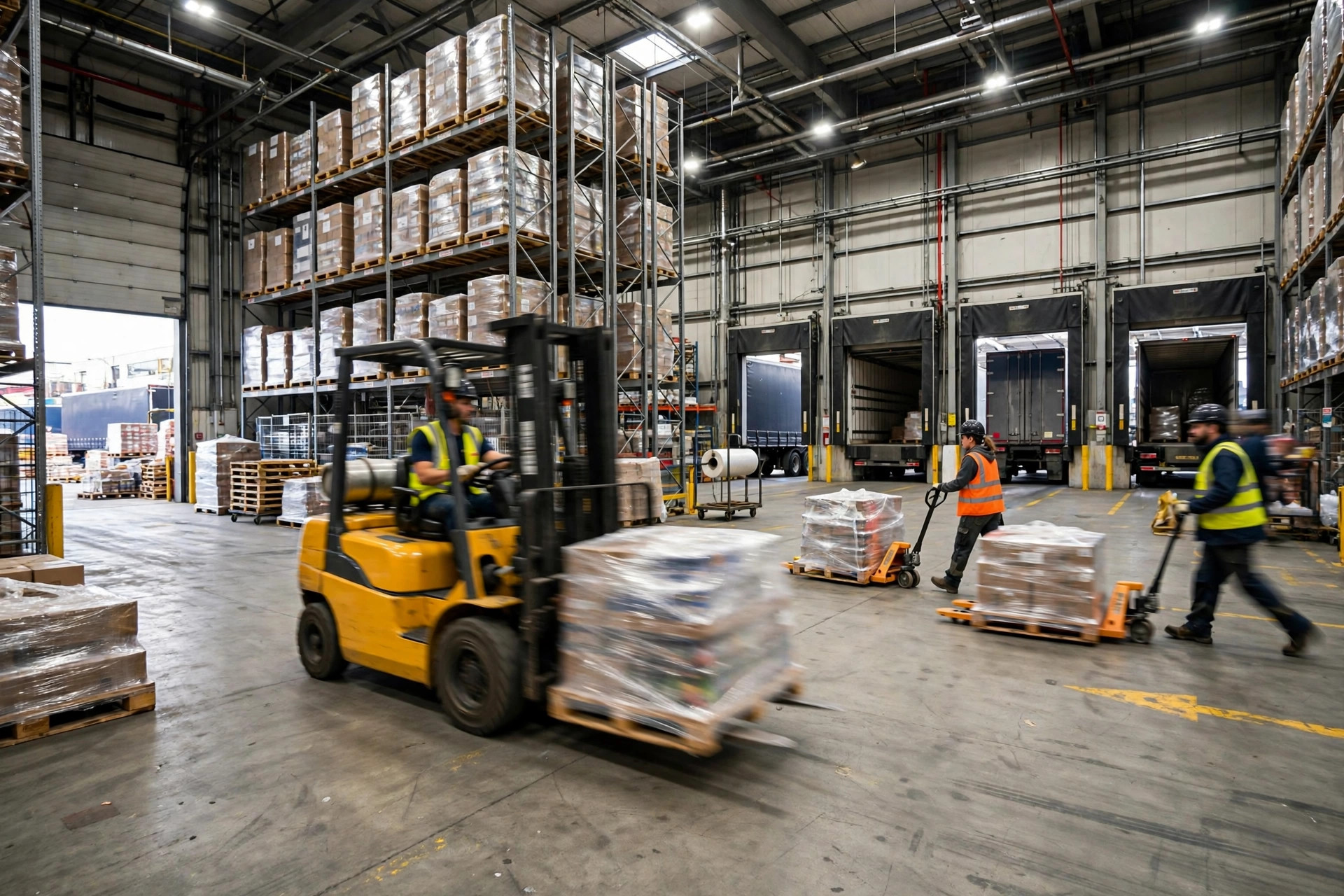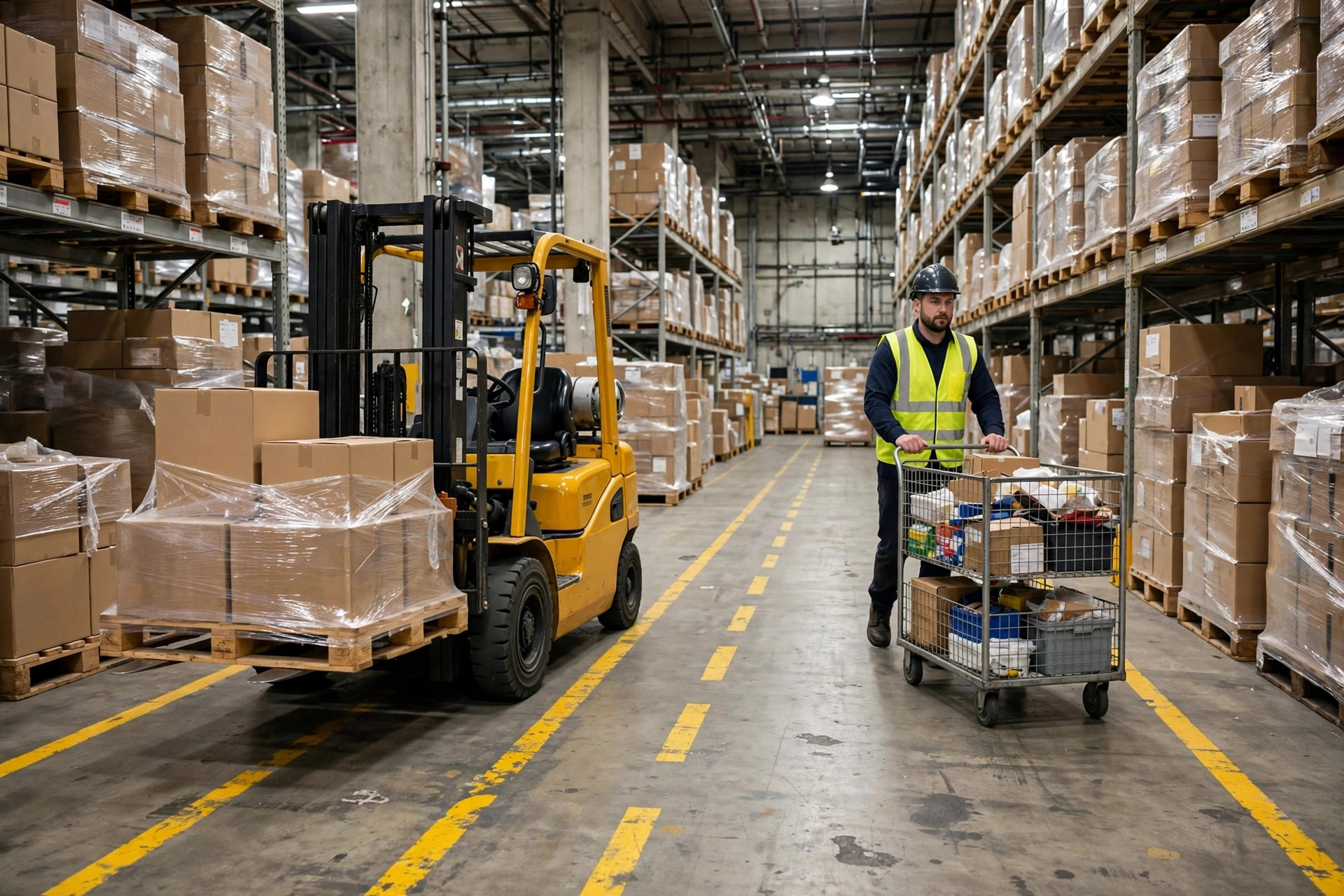
Fall 2023. I was reviewing traffic flow at a 3PL warehouse in the American Midwest when the site manager pulled up the camera footage: in the past month, forklifts and pickers had 11 near misses in the main aisle — eleven incident reports, one actual scrape, and half a pick line down for four hours. My verdict up front: mixed forklift-pedestrian traffic is never fixed by telling drivers to "slow down." It's a layout problem, not a discipline problem.
Why Forklifts and People Collide: It's Math, Not Manners
Think of a single-lane road with no traffic lights, shared by cars and pedestrians. When something goes wrong, don't blame the driver's skill — blame the road, which was never designed right.
The numbers: a forklift at 7 mph needs about 16 feet to stop in an emergency; at 9 mph, stopping distance stretches past 21 feet. That's an unloaded truck on a clean, flat floor — add a full load or a wet patch and it only gets worse. A picker walks roughly 2.5 to 3 mph, and going from "I see the forklift" to "I'm out of the way" takes at least two to three seconds. In two seconds, a forklift at 7 mph covers 20 feet. Sixteen feet of braking against 20 feet of reaction travel — the math says they meet.
OSHA estimates forklifts cause about 85 fatalities and 34,900 serious injuries in the US each year, with pedestrians struck or run over accounting for roughly one in ten fatal accidents. That's structural risk, not bad luck.
And here's the number most people ignore: conflict points. Think of them as solder joints on a circuit board — more joints, higher odds of a cold one. Three four-way intersections on a two-way main aisle make six conflict points; add eight spots where pickers cut across to reach the opposite rack, and one building casually holds a dozen-plus. Each is a roll of the dice: "the driver didn't see" times "the picker wasn't looking." Risk multiplies here, it doesn't add.
The Midwest manager's first instinct was "more training." I had him count conflict points on the floor plan instead: fourteen. He went quiet. Training can't fix arithmetic — fourteen conflict points turn even a 0.05% per-encounter risk into a monthly incident report, given hundreds of daily encounters.
Trick One: Time-Sharing — A Class Schedule for Forklifts and Pickers
This is time-division multiplexing from industrial Ethernet: one shared medium, everyone takes turns, nobody collides. Separation on the time axis.
Three moves, executed ruthlessly. First, stagger replenishment windows against picking windows. A replenishing forklift is at its most dangerous — elevated pallet, blocked sightlines, constant reversing. Fix the windows, e.g. 10:00–11:30 and 15:00–16:30 daily: pickers use perimeter aisles while trucks own the main aisle; outside the windows, trucks stay out of the pick zone. Second, one-way circulation. Two-way aisles mean head-on encounters and frozen pickers; a one-way loop means everyone looks one way. Stolen from parking garages — crude, works. Third, sound and light: horn before blind corners, warning lights at intersections. OSHA already expects it; don't treat it as decoration.
Before the 2024 Double 11 peak, an e-commerce fulfillment center in South China ran exactly this play. Its main aisle was a daily battleground: trucks couldn't get in to replenish, pickers waited for stock, seven or eight near misses a month. After time-sharing, near misses dropped to zero and replenishment on-time rate rose from the low eighties to above 95%. The kicker: pickers' units per hour went up too — no more stopping to yield, no more broken flow.
The honest math: time-sharing costs roughly 10% of forklift utilization. What it buys: one scrape means half a day of downtime plus investigation — direct and hidden costs that dwarf a year of "wasted" window hours. And if someone gets hit, it's not about money anymore.
The cutoff is clear: one main aisle, light traffic (under ~20 passes/hour), zero budget — time-sharing is the highest-ROI start. If traffic is too heavy to fit windows in, move to trick two.
Trick Two: Zoning — Paint the Line Between the Picking Aisle and the Truck Lane
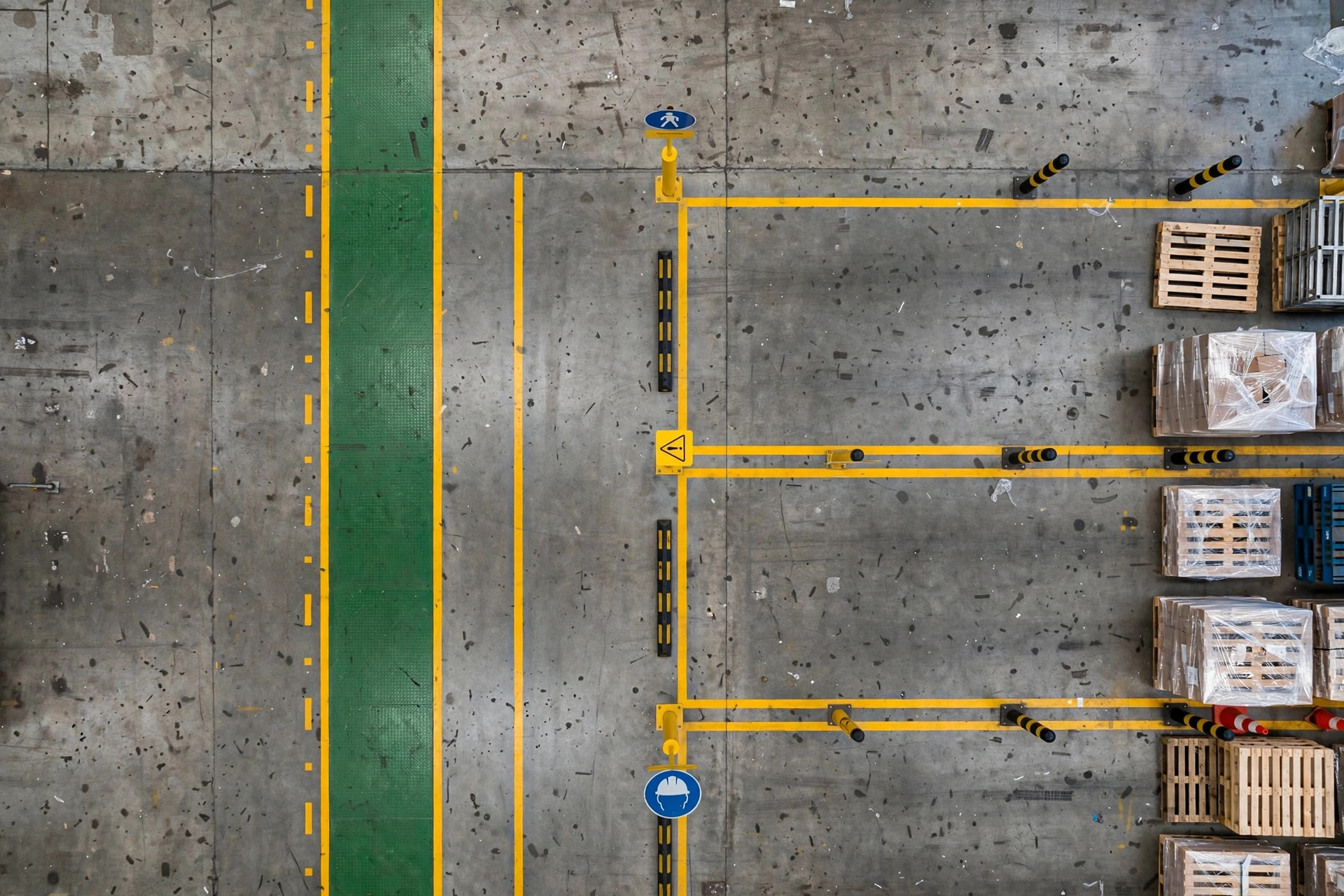
Time-sharing separates in time; zoning separates in space. The four-piece kit: marked pedestrian walkways (yellow line, picker-only lane, wide enough for two to pass); convex mirrors at rack corners so drivers and pickers see each other early; blue spot lights projecting ahead of the truck so the light arrives before the steel does; marked crossings with "forklifts yield" signs where crossing is unavoidable — the rule written in stone: trucks yield.
The kit costs a few thousand yuan and a weekend. Don't scoff — after the Midwest 3PL painted lines and hung mirrors, near misses fell from eleven a month to under two. Fell to, not eliminated: paint solves "can be seen," not "won't look." That's why time-sharing and zoning work best together.
When is time-sharing enough, and when is zoning mandatory? My decision framework:
| Time-sharing | Zoning (paint + signage) | Physical barriers | |
|---|---|---|---|
| One-time cost | ~Zero | A few thousand in materials | Per meter, a few hundred/meter |
| Forklift efficiency hit | ~10% utilization loss | Almost none | Almost none |
| Suitable traffic | Under ~20 passes/hour | Medium | Heavy or accident history |
| Maintenance | Discipline; weekly checks | Repaint quarterly | Nearly none |
| In one line | Start here when broke | Mandatory with budget | After an incident, don't cheap out |
Three inputs decide: daily forklift passes, aisle width, near-miss history. Light traffic, clean record — start with time-sharing. Medium traffic or 2+ near misses a month — zoning goes in. Had a scrape or an injury — straight to guardrails, no hesitation. Barriers look pricey until you price one accident, which runs an order of magnitude higher.
Don't Rush to Buy "Smart Collision Avoidance": A Rant Against Pseudo-Needs
Someone always asks: UWB tracking, forklift radar, proximity alarms — doesn't that solve it once and for all? Blunt answer: textbook pseudo-need — using equipment to fix a management problem.
I've watched plants spend a small fortune on "smart collision avoidance." Alarms screaming all day, drivers unplugging them within months; UWB tags handed out, half ending up in a drawer because pickers hate wearing them. The tech isn't broken — but with no traffic design, sensors just add a louder horn to chaos.
It's buying a bigger pump for a leaky boat instead of patching the hole. Sensors and radar are the last line of defense, not the first. Time-sharing and zoning turn "will meet" into "never meet"; smart devices only shout after they've met. Don't reverse the order.
When is smart gear worth it? After time-sharing and zoning are fully in place, near misses still won't drop, and one or two blind intersections remain — then proximity alarms earn their keep as gap-fillers. Buying the smart system first is a stupidity tax.
The Maintenance Trap: Lines Painted, Nobody Follows Them in Three Months
Low-tech fixes don't die in design — they die in maintenance. Three traps: paint wear (forklifts grind the yellow off in months; nobody repaints equals never painted — put repainting on the quarterly checklist, same day as truck servicing); discipline erosion ("just this one truck" during peak season collapses the whole schedule — pair windows with mobile barriers at pick-zone entrances; barriers beat willpower); double standards (punish pickers for jaywalking but never drivers for speeding, and the rule dies — in reviews, don't ask "whose fault," ask "which step changes").
My checklist: weekly, spot-check two intersections — paint legibility, mirror alignment. Monthly, tally near misses — more than two triggers a review. Quarterly, repaint and test lights and horns. Write it into the SOP and the fix survives past month three.
Whether the money is worth it comes down to one number: how many vehicle-pedestrian conflict points does your warehouse have?
Tonight, grab a floor plan and count every spot where forklift routes cross picker paths. Over ten — time-sharing and zoning go in now. Over two near misses a month — barriers go on the calendar. Had even one scrape — stop nickel-and-diming and install the guardrails.
One counterintuitive parting shot: wider aisles aren't safer. Wide aisles make drivers unconsciously speed up, stretching stopping distance from 16 feet to 21-plus. Plenty of incidents happen on the widest main aisle in the building — the wider the road, the bigger the courage, and physics doesn't care about your feelings.
Spend five minutes in tomorrow's standup reviewing last month's near misses. No equipment to buy, no drawings needed — start by counting conflict points. In traffic flow, low-tech done right beats any smart system.
By Da Liu, Automation Engineer