
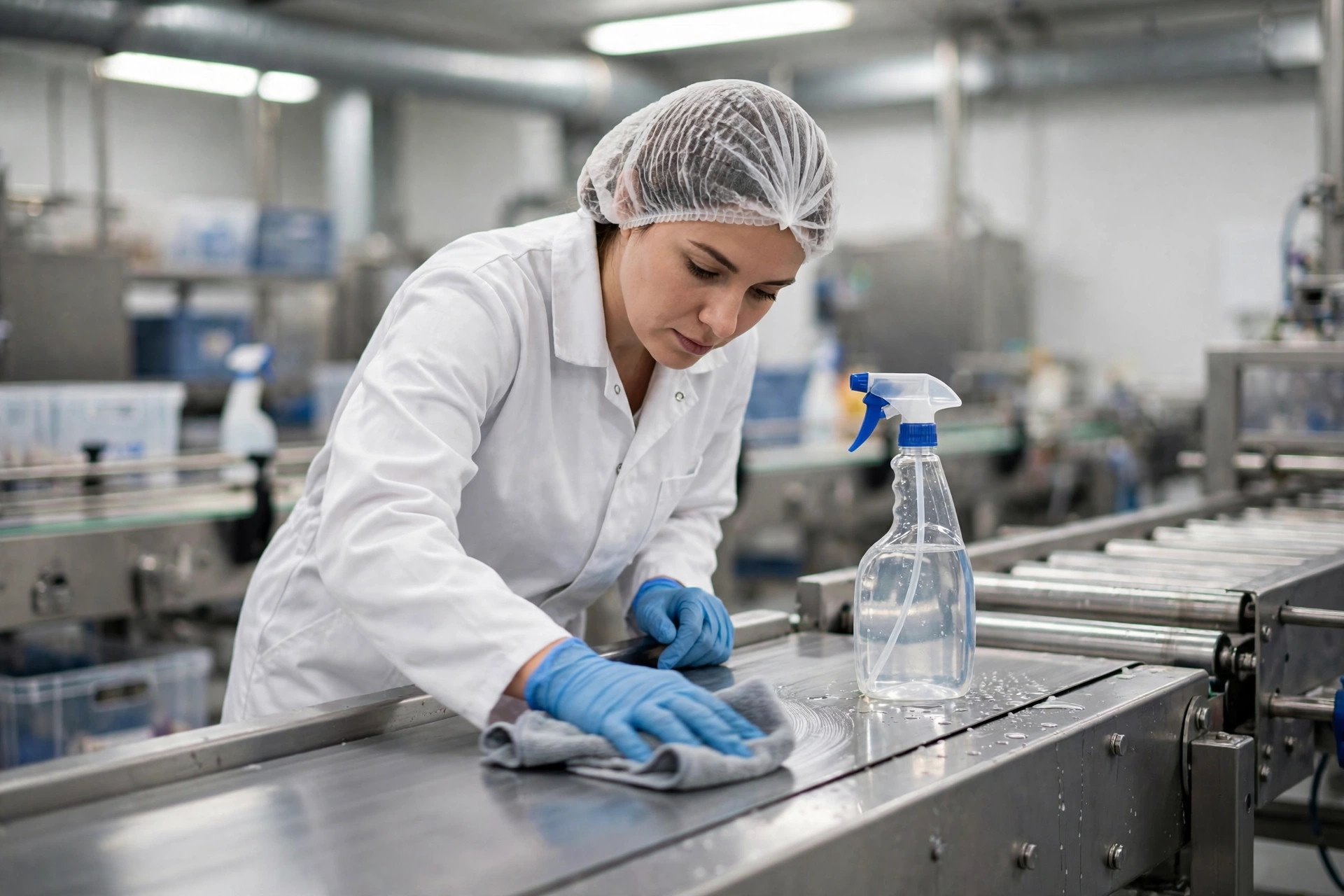
I used to think cleaning a conveyor belt meant wiping it down and hosing it off. Then on September 17, 2025, a third-party auditor sent by one of our food clients walked into my 3,000-square-meter warehouse, ran a swab along the seam of a belt curve — right in front of me — and said: "This fails."
My face went green. That belt got wiped daily. How could it fail? Turns out we'd been cleaning all the visible surfaces and missing every sanitation dead zone. The big players' automated wash lines? We can't afford that kind of money. But do the scrappy stuff right, and you pass audits all the same.
Our predicament: wiped daily, still failed
We started handling food clients in 2024 — dry goods storage and pick-and-pack: baking ingredients, meal powder, nuts. Clients require an annual audit. Our first audit in 2024 dinged us for water stains on the floor. We fixed the floors, got cocky — and in 2025 got hit where we weren't looking: the conveyors.
The auditor's exact words are burned into my brain: "The belt surface looks clean, but the seam joints and the curve guide channels test positive." Translation: bacterial counts over the limit. He gave us 30 days. Miss it, and the client moves 400-plus pallets to another 3PL — nearly a quarter of our food business. Lose that, and I'd work two months for free.
I was floored. The crew wiped those belts twice daily. So I spent an afternoon crouched by the conveyor, and the answer was humiliating: we only cleaned the top half — everywhere hands could reach and eyes could see. The residue lived where they couldn't.
Food warehouse conveyor belt cleaning dead zones: the 5 spots that sink you
After the auditor's "education," I went over our three light-duty belt conveyors with a flashlight. The dead zones were identical on all three, and I'd bet money your warehouse has the same ones:
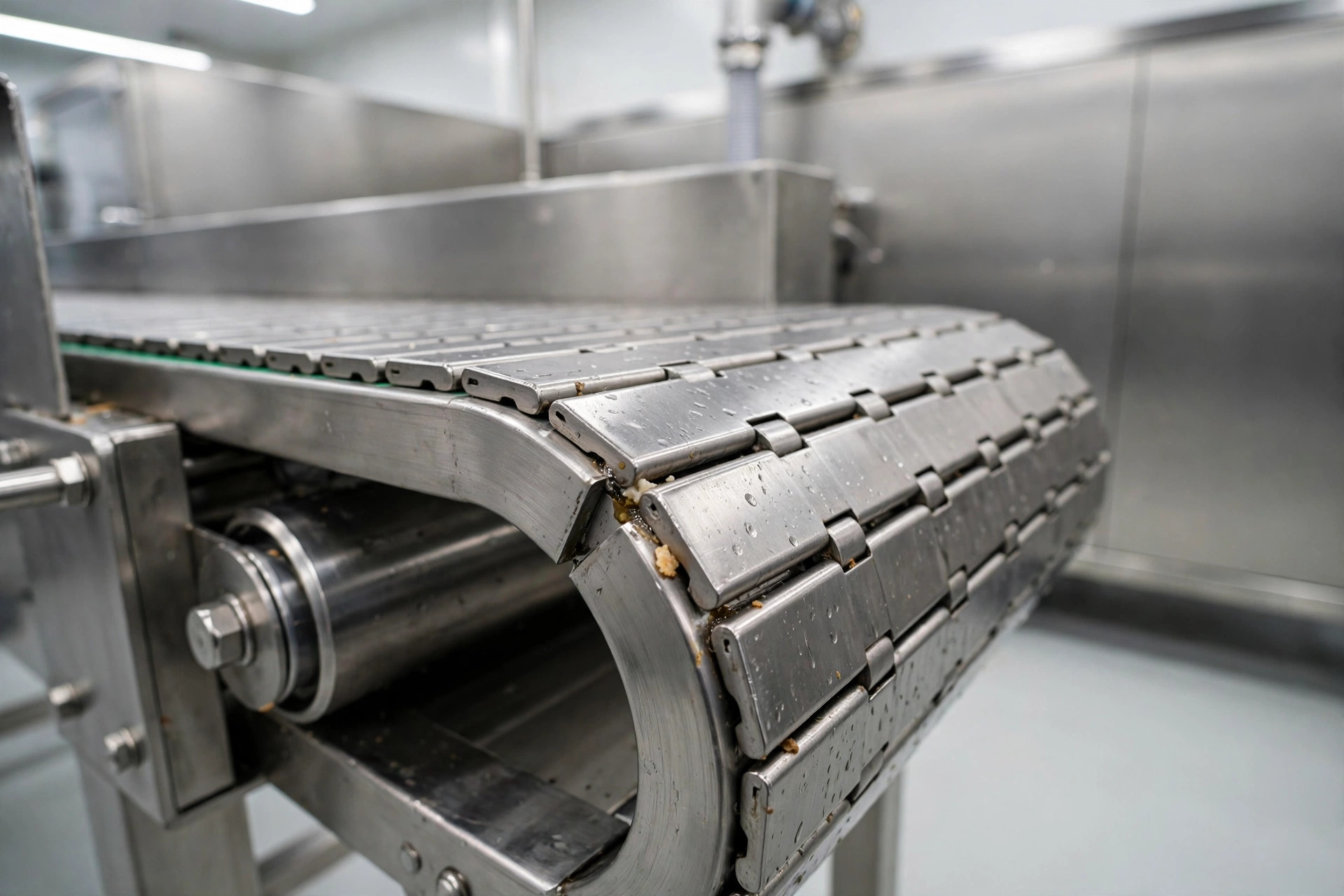
1. Seam joints and splice steps. The splice leaves a tiny step. Powdered product packs in there; our rags glided right over it. This is where the auditor's swab came back positive.
2. Curve-section guide wheels and channels. Under the curve, the belt runs through an arched channel where grease and powder bake into a black ring. I pried off a fingernail-sized chunk with a screwdriver — imagine how long that had been building up.
3. Roller ends and bearing housings. A gap between each roller end and the frame collects falling dust until it compacts. We dug nearly half a jin (about 250 grams) of dough-like crud out of one.
4. The underside of hoppers and drop chutes. The chute takes a beating all day, and nobody looks at its backside. Flour plus moisture caked and started growing mold there. I lifted the guard plate and nearly threw up.
5. Bolt heads and frame welds. Uneven stainless welds and hex bolt sockets collect packed powder. Rags don't touch these — you need a brush.
Once we taped this list of five to the wall, our cleaning actually started. Fun fact the auditor shared: roughly eight out of ten small warehouses fail on these exact spots. Big plants have automated wash systems blasting everything daily. Small warehouses rely on hands — and the moment hands get lazy, you fail.
Conveyor belt cleaning frequency: our small-warehouse shift schedule
The big-plant standard is a full wash at the end of every shift, and in warm production areas (meat processing, for example) some add a mid-shift wash too. I read in an industry tech article that once production areas go above 40°F (about 4°C), microbes multiply much faster, and specialists recommend adding that mid-shift cleaning. We're a dry-goods warehouse at room temperature — copying the big-plant frequency with our headcount was impossible.
| Frequency | Action | Time | Who |
|---|---|---|---|
| Mid-shift (lunch break) | Dry-sweep belt surface + wipe seam steps | 10 min | Shift worker |
| End of shift | Dry sweep → wet wipe belt → brush the 5 dead zones → sanitizer wipe → dwell | 25–30 min | Shift worker |
| Every Friday | Remove detachable guides/guards, deep-clean roller gaps and guide channels | 1 hour | Me, leading the crew |
| Monthly | Half-day full stop: brush every frame weld and bolt head, inspect belt wear | Half day | Everyone |
The non-negotiable: those 30 minutes at end of shift happen every day, logged on the handover sheet, signed by the shift lead. We used to clean "when there's time," which meant never. And let the sanitizer sit for the full contact time on the label — rinse it off immediately and you've done nothing.
On sanitizer concentration, I did my homework: chlorine-based sanitizers typically run 50–100 ppm, quats around 200 ppm — always follow your product's label. Stronger is not better. Over-concentration corrodes equipment and can leave residue. Test strips cost almost nothing: mix it, test it, done in seconds.
Here's the counterintuitive one: higher water pressure is not better. I used to think blasting everything with a pressure washer was the ultimate clean. Then a food-grade belt manufacturer's cleaning guide warned: excessive pressure atomizes water, and microbes ride the mist into the air — contaminating nearby equipment and the belt you just sanitized. They recommend hot-water rinsing at 120–140°F (about 49–60°C), never above 185°F (about 85°C), since extreme heat denatures protein and bakes it onto the belt. No thermometer in our little warehouse? "Hot but bearable" lands roughly in that range. Crude, but better than blasting blind.
No-downtime cleaning in practice: the 10-minute shift change is gold
Our biggest fear is stopping the line. The food line ships 200–300 cartons a day; stop the belt during the day and picking backs up behind it. So our strategy is: big cleans after hours, small cleans in the cracks — zero daytime stoppage.
Our three-piece scrappy toolkit costs less than a couple hundred RMB (a few dozen dollars) total, and the effect was immediate:
First, the two-rag rotation. One rag in use, one soaking in sanitizer. During the 10-minute lunch break, the shift worker grabs the soaked rag and wipes the seam steps and chute undersides — belt keeps running, worker walks alongside. We used to use one rag all day; it got dirtier with every wipe and nobody noticed.
Second, the toothbrush method. Cheap hard-bristle toothbrushes for bolt-head hex sockets and frame welds. At the re-audit, the auditor saw our box of toothbrushes, paused, then laughed — big plants use specialty crevice brushes costing as much as our whole box, with about the same result.
Third, the three-minute wipe during changeovers. Our line switches categories 2–3 times a day. The belt runs empty to clear product — those 3 minutes are when a worker dry-brushes powder out of the seams. Skip this and nut fragments end up in meal powder; an allergen complaint is far worse than a failed audit.
One more trick: the cleaning log sheet. One A4 page — date, shift, items done, signature — taped next to each conveyor. Auditors love this: it proves a system, not a panic cleanup. At our first audit we had no records, and the auditor wrote "cleaning management absent." This time he photographed our log as a positive example.
Doing the math: what the scrappy approach actually saves
Someone will ask: why not just buy an automated belt washer, or hire a professional cleaning company? Let's do small-warehouse math.
A professional food-equipment cleaning company charges per visit what we'd pay in electricity for several months — and they come once or twice a month at most, leaving you to handle the other 28 days of daily cleaning yourself. Money spent, dead zones still growing. An automated wash line? The kind of CIP system big plants run costs more than several years of rent on our 3,000-square-meter warehouse. Not happening.
Our scrappy costs: rags, toothbrushes, brushes, food-grade cleaner, test strips — consumables run a couple hundred RMB a month. Labor is 30 minutes per shift, folded into work the crew already did before clocking out. In the 30-day correction window, this got all three conveyors compliant. Re-audit passed first try. Four hundred pallets saved.
The trade-off, honestly stated: scrappy gets you to "compliant," not to a big plant's automated-line ceiling. Our strategy is scrappy methods to hold the baseline, save up for equipment to raise the ceiling later. Every yuan in a small warehouse has to land where it counts, and for conveyor belt cleaning, diligence beats dollars.
4 tips for fellow small warehouses
- Flashlight the dead zones before buying anything. Map your conveyor's five dead spots first, photograph them. Everything starts here.
- Frequency beats intensity. Thirty unfailing minutes a day beats one heroic monthly deep-clean. Skip a day, microbes grow a day.
- Follow the sanitizer label; don't skip test strips. Too weak means unsanitized; too strong damages equipment and risks residue. Pocket change — the best investment in the toolkit.
- The log sheet is your get-out-of-jail card. Auditors believe in systems and evidence, not "trust me, I wipe it daily." One sheet of paper can save hundreds of pallets of business.
One last honest word: food warehouse conveyor belt cleaning isn't about equipment — it's about giving a damn. We can't afford the big plants' automated wash lines, but we have something they don't: an owner who personally brushes bolt heads with a toothbrush. As the auditor left, he said: "At your scale, reaching this level — that's rare."
Small warehouses have their own way of surviving. Short on money, make it up in hustle; short on equipment, make it up in care. Lock down the dead zones, hold the frequency, keep the records — and a small warehouse can nail food conveyor belt cleaning just as well.
By Xiao Ma, Small Warehouse Owner





