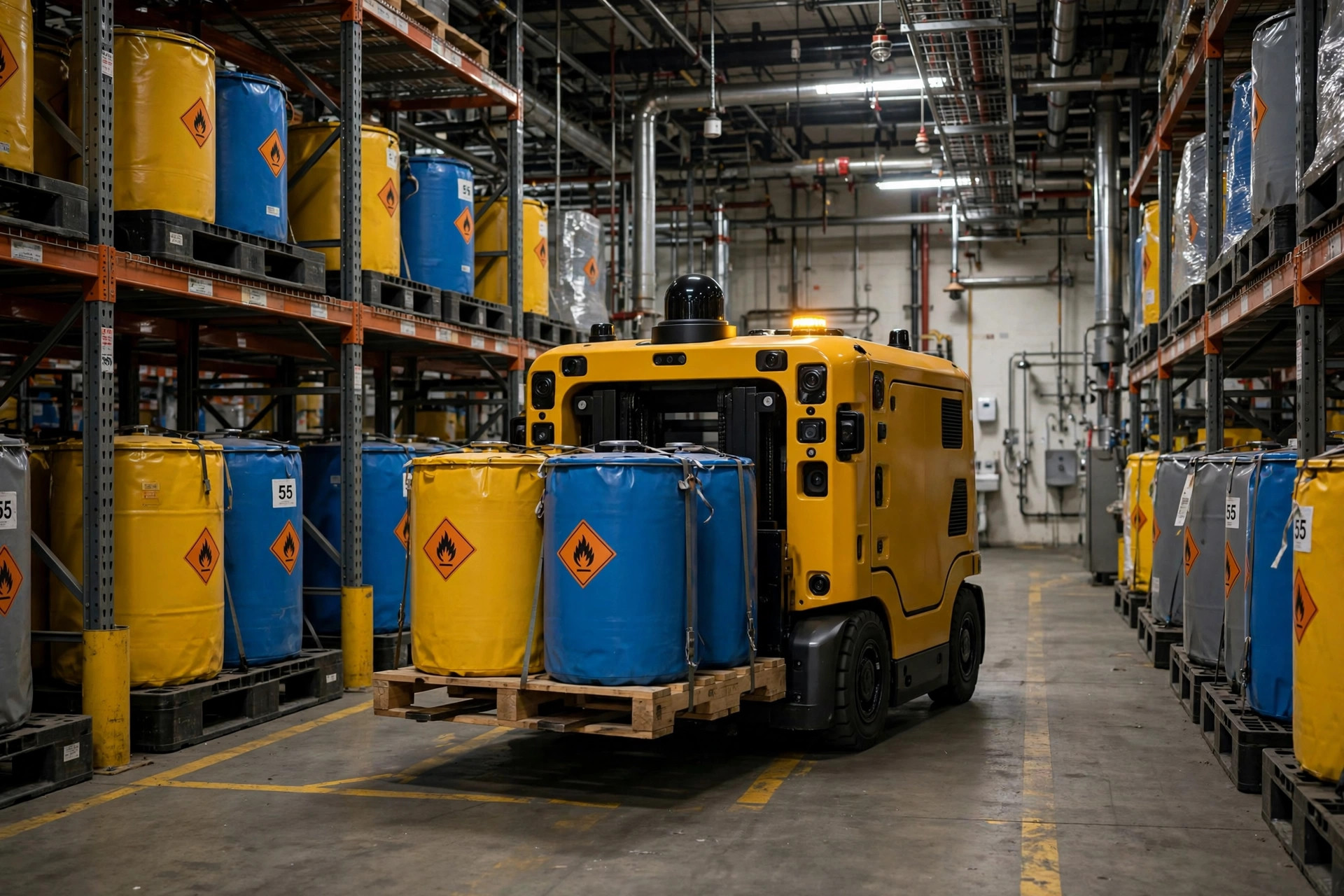
Early in 2024, a lithium battery plant in Zhejiang asked me to review a proposal: 14 explosion-proof AGVs for the cathode workshop, 1.2-ton payload. I checked the explosion-proof AGV certification requirements against their actual area classification, then the quote — full-vehicle flameproof, ATEX Category 2, priced at several times a standard AGV — and called back: half this money is wasted. Their solvent zone was classified Zone 2, which never needed a flameproof vehicle. The vendor wasn't lying; they just specced one grade higher than necessary. Like buying an umbrella and being handed a diving suit.
Most automation engineers meeting explosion-proof AGV certification requirements for the first time picture the same thing: thicker housing, boxed-in motor, done. Wrong. Explosion protection isn't about surviving a blast — it's about never providing the ignition. Explosions need fuel, oxygen, and ignition; in a chemical warehouse the first two are a given. Solvent vapor in the air is normal. The only thing you can kill is the ignition source. Count them on one AGV: motor arcing, contactor sparks, hydrogen from charging lead-acid batteries, brake friction sparks, tire static, even RF energy from the navigation lidar. Explosion-proof design means eliminating that list, item by item.
There are three schools of elimination — think of them as three kinds of diving suit. Ex d, flameproof, is the hard-shell suit: ignition inside can't get out. Ex i, intrinsic safety, cuts it at the root: circuit energy too low to ignite gas — like lighting gasoline with an unstruck match. Ex nA, non-sparking, means "no sparks in normal operation": cheapest, but only good for Zone 2. Take it into Zone 1 and you're swimming naked.
The second concept is area classification. Gas atmospheres split into Zone 0, 1, and 2; dust into Zone 20, 21, and 22. Zone 1, by the industry's working definition: an explosive gas atmosphere present roughly 10 to 1,000 hours per year under normal operation. ATEX equipment Categories 1, 2, and 3 map to Zones 0, 1, and 2. The selection line sits right here: your zone decides your equipment category, and buying one category higher is money down the drain.
ATEX vs IECEx vs UL: Where the Certification Requirements Diverge
Selling explosion-proof AGVs overseas means three systems. Short version: ATEX is EU law, IECEx is the international passport, UL is the US ticket. All three build on the IEC 60079 family, but the rules differ completely.
| Aspect | ATEX | IECEx | UL (North America) |
|---|---|---|---|
| Nature | EU Directive 2014/34/EU — mandatory in the EU | International voluntary scheme, adopted as mandatory in many countries | Mandatory under NEC (NFPA 70) and OSHA |
| Coverage | European Union | Worldwide; the more recognized credential in places like Australia | US, Canada |
| Standards | EN 60079 series | IEC 60079 series | UL 583, UL 913 (intrinsic safety) |
| Issued by | EU Notified Bodies | IECEx-recognized bodies and labs | NRTLs such as UL, FM |
| Certificate | EU type-examination certificate | Online CoC, verifiable on IECEx website, with ExTR and ExQAR reports | UL Listed mark |
| Factory audit | Quality assessment for Category 1/2 | Mandatory ongoing audits | Follow-up inspections |
| Time and cost | Per the certification body's latest requirements | Per the certification body's latest requirements | Per the certification body's latest requirements |
The last row is blank on purpose: the same vehicle through different notified bodies can see timelines and quotes differ twofold. Anyone promising "certified in three months, fixed price" is reading a broker's script.
Here's the counter-intuitive part: an ATEX certificate doesn't get you into the United States. The US uses Class/Division, not Zones. Class I Division 1 roughly matches Zone 0/1, but the certification path is entirely separate. OSHA is explicit: in Class I Division 1 gas atmospheres, only industrial trucks designated EX may be used (the EX type under UL 583). Bid a US chemical plant with an ATEX certificate and the safety officer asks one question: UL Listed? If not, you redo the evaluation through UL or FM — ATEX reports serve as technical reference only. Like renting a car in the US on a Chinese license: your skill transfers, but they want the locally recognized document.
IECEx is the most portable of the three. Its online CoC is verifiable by anyone, its ExTR test reports are accepted by many national schemes — cutting repeat testing — and factories undergo ongoing quality audits (ExQAR). For the Middle East, Southeast Asia, and Australia, IECEx is usually the best-value starting point. I've seen manufacturers certify ATEX for Europe, then get asked for IECEx when the project moved to the Middle East — two test rounds costing enough for two more AGVs.
The Real Fork in Explosion-Proof AGV Certification: Whole Vehicle vs Components
This is the priciest decision in explosion-proof AGV certification requirements, and the one vendors least like to explain. Two roads. Whole-vehicle certification: the body type-tests the complete AGV, reviews your technical file and quality system, and the certificate carries the vehicle model number. Expensive and slow — but the owner's safety review passes first time and liability is clean. Certified components plus self-assessment: motors, terminal boxes, batteries all carry their own explosion-proof certificates, while you write the vehicle-level documentation yourself. ATEX allows internal production control for Category 3 (Zone 2) equipment, so in theory no notified body is needed. Sounds great? Every dollar saved becomes your own legal liability. With no vehicle model on any certificate, you — not a certification body — must prove the design complied if anything goes wrong.
The line is crisp: Zone 1 and up (ATEX Category 2) — forget self-assessment, certify the whole vehicle; that's a red line. Zone 2 — the component route is viable, but only if your documentation survives scrutiny. Most AGV makers' electrical integration records can't support a credible explosion-protection assessment.
A 2023 solvent-warehouse project at a Jiangsu chemical plant is the textbook good case. Toluene storage, Zone 1, six forklift-type explosion-proof AGVs, 1.5-ton payload, 1.2 m/s. The park's tender accepted only whole-vehicle certificates, so the vendor went straight for dual IECEx plus ATEX and passed first time. Why dual? Next stop was the Middle East, where customers verify the IECEx certificate online themselves — minimum trust cost. Dual certification shares most testing, so doing both at once beats two separate rounds. Certification cost doesn't scale with the number of certificates — it scales with testing workload.
The Maintenance Traps Nobody Puts in the Quote
Blunt time. Most projects spend 90% of the budget on vehicles and certificates, leaving crumbs for maintenance training. My conclusion: over a flameproof AGV's life, maintenance quietly costs more than certification — all of it hidden traps.
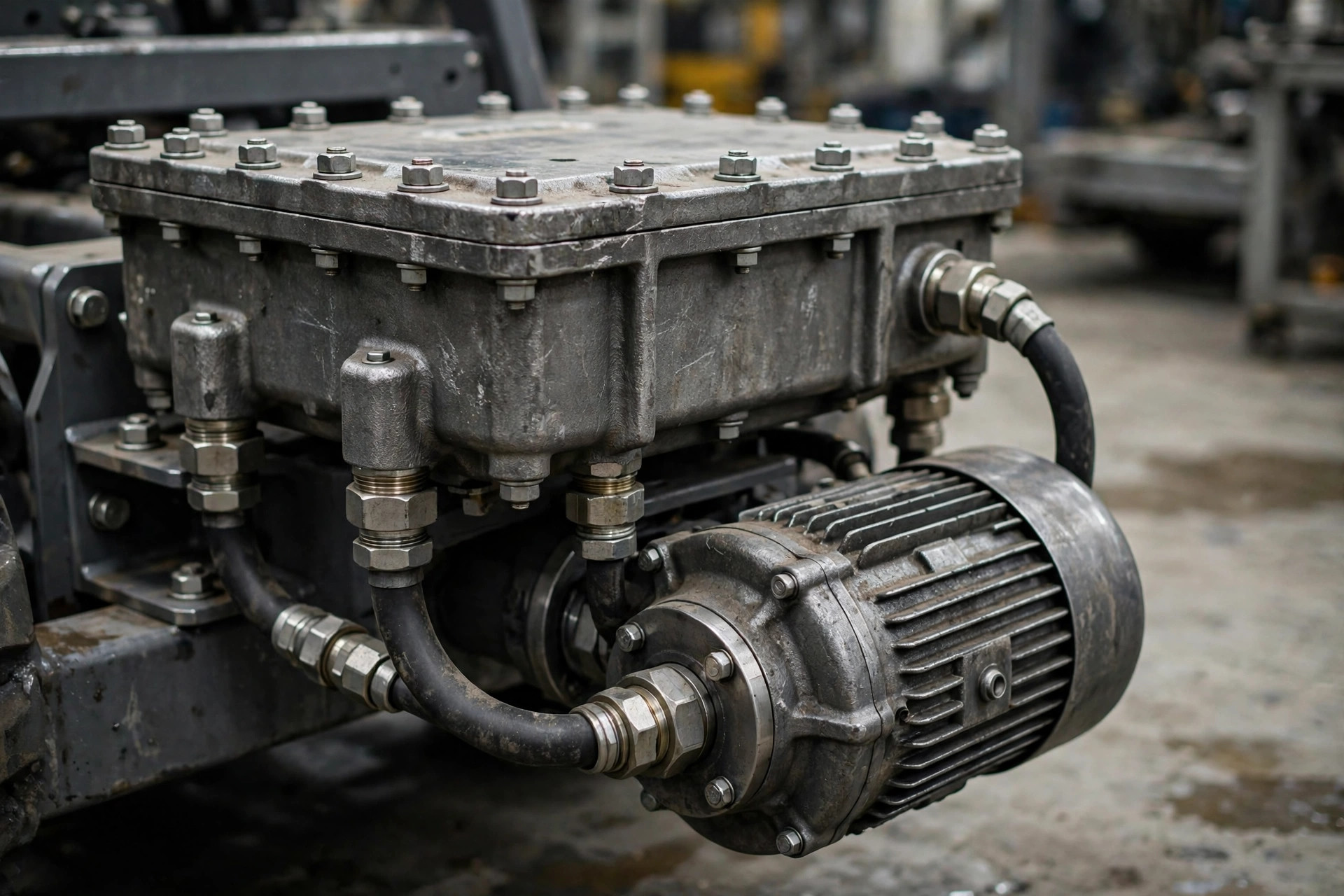
Trap one: opening a flameproof enclosure. An Ex d housing doesn't open on a whim: power off, move to a safe area, unbolt in sequence — and the flameproof joints tolerate zero nicks, with bolt grades and torques specified. A tech swaps in ordinary bolts, or files a nicked joint smooth — the certificate voids instantly. From that moment, it's an ordinary AGV driving a hazardous zone.
Trap two: batteries. Lead-acid charging releases hydrogen, so charging happens in safe areas — iron rule. Lithium releases no hydrogen, but thermal runaway packs more energy, and a flameproof battery compartment is a different design from a standard one. Charging strategy and swap procedures go into the manual before purchase, not as questions afterward.
Trap three: static. Tires must conduct static; the grounding drag chain needs regular wear checks. The most overlooked ignition source — and inspectors' favorite checklist item. A six-figure explosion-proof AGV can be shut down over a worn-out grounding chain worth pocket change. Absurd, but real.
Trap four: spares. One uncertified spare part voids the whole-vehicle certificate. Motor failed and you bolt on a "looks identical" standard motor? In Zone 1, that's operating without a license. Spares must be original certified parts — lead time and premium disclosed to the owner up front.
Now the math. An explosion-proof AGV costs several times a standard one (go by actual quotes), and certification, special maintenance, and spares keep burning cash. Whether it's worth it comes down to one number: the labor cost of one human entry into the hazardous zone, times entries per year, versus the AGV's annualized cost plus maintenance. If positive, the certificates are worth every cent — you're not buying a vehicle, you're buying a ticket keeping people out of the zone. That ticket's value equals what one entry used to cost: protective suits, gas detection, two-person supervision, permits. If you can't compute it, or it's negative, don't buy — optimize the manual process instead. Buying an explosion-proof AGV was never a technology question. It's arithmetic. Get it wrong, and a drawer of ATEX, IECEx, and UL certificates is just tuition paid.
By Da Liu, Automation Engineer