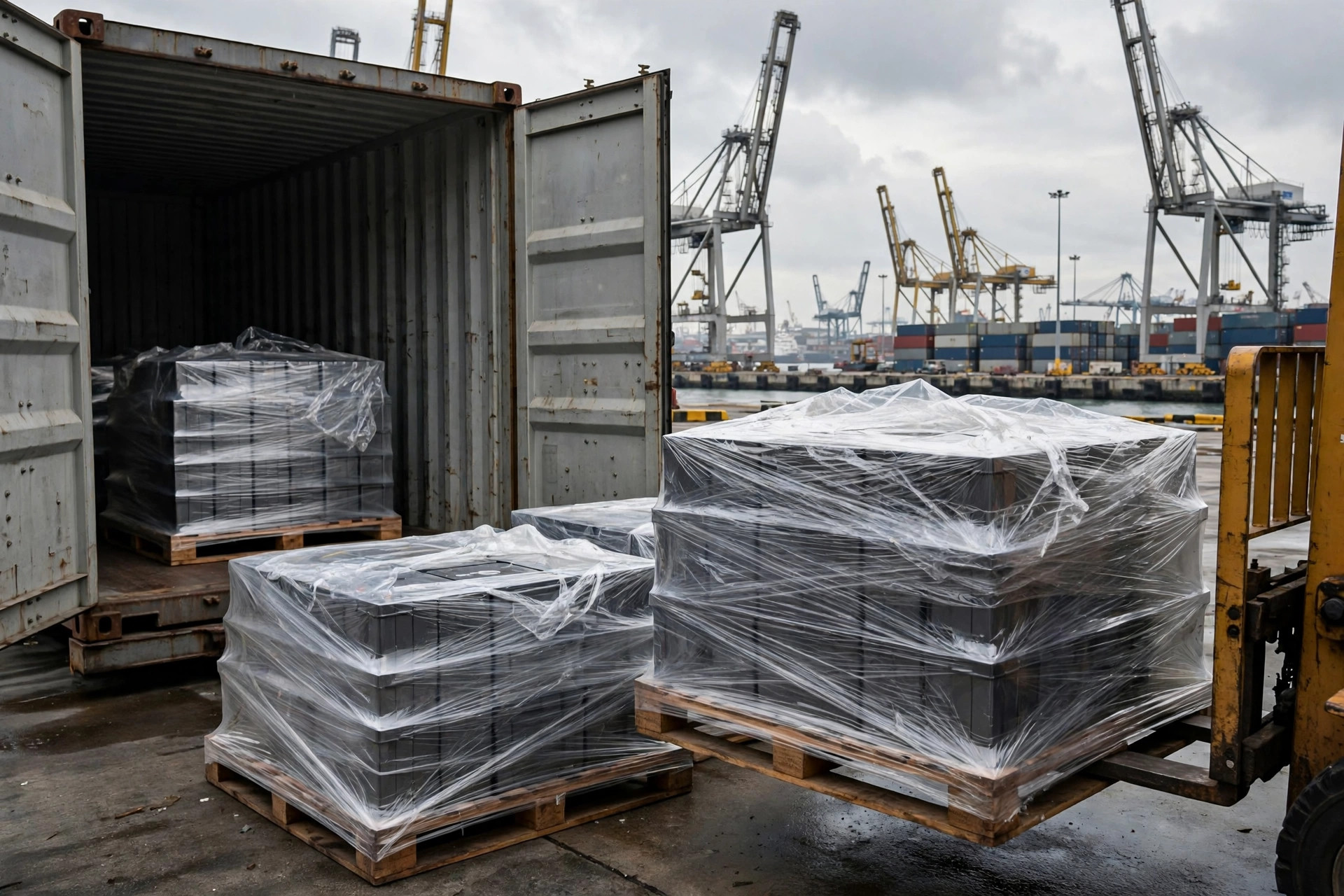
This autumn, a commercial energy-storage battery exporter in Zhejiang received an email from its German customer with a 40-item questionnaire attached: What is the carbon footprint per kilowatt-hour? Which smelter supplied the cathode material? When will the battery passport data interface be ready? The sales team forwarded it to compliance, which discovered that not a single question could be answered with the existing CE certificate. That is how the EU battery regulation (Regulation (EU) 2023/1542) actually reaches lithium exporters: it does not inspect your cargo, it inspects your data chain.
EU Battery Regulation and Lithium Export: Read the Timeline Before Planning
The regulation entered into force on 17 August 2023 and has applied generally since 18 February 2024, with obligations phasing in by battery category. The milestones that matter for exporters:
| Milestone | Content | Nature |
|---|---|---|
| 17 Aug 2023 | Regulation enters into force | Done |
| 18 Feb 2024 | General application begins | Done |
| 18 Feb 2027 | Battery passport mandatory: EV batteries, LMT batteries, industrial batteries above 2 kWh, each carrying a QR code | Hard date, unconditional |
| 18 Aug 2027 | Supply chain due diligence takes effect (cobalt, lithium, nickel, natural graphite traceability) | Postponed from 2025 |
| Carbon footprint declaration | Nominal date 18 Feb 2025 for EV batteries, but conditional: applies 12 months after the carbon-footprint methodology delegated act enters into force | The delegated act had not been adopted as of mid-2026, so enforcement necessarily falls later than the nominal date |
| Maximum carbon footprint thresholds | Nominal 18 Feb 2028 for EV, 18 Feb 2029 for industrial, equally conditional | Threshold values not yet published |
The most common misreading in the trade press is quoting the nominal dates without the conditions. The entire carbon-footprint track starts not from the regulation's text but from the European Commission's delegated acts — no act, no clock, and the nominal dates become decorative. The one unconditional hard date is the battery passport on 18 February 2027. For any milestone you cannot pin down, the EU's Official Journal is the only source that counts.
Why did Brussels design a dual track of product plus data? Two logics converge. The first is industrial policy: Europe's domestic battery capacity started late and cannot win on cost alone, so carbon-footprint and traceability requirements turn full-chain data capability into a market-access condition — precisely the weak point of European assemblers and the strong point of leading Chinese manufacturers. The second is the circular economy: the battery passport is a cradle-to-grave file for every battery, serving recycling, second-life use, and extended producer responsibility. Once you see these two logics, it becomes clear why the regulation audits systems, not samples.
Case One: "One File per Cell" in Zhejiang
In early 2026, the Zhejiang company above — exporting on the order of tens of MWh of commercial storage to the EU annually — was told by its German customer that the next purchase order would require carbon-footprint data, or the order would move elsewhere. An internal review found the cell plant's own production data complete, but carbon-emission factors for upstream cathode material, graphite, and separators largely missing. Suppliers quoted prices, not carbon numbers.
The response came in three steps. First, carbon-data clauses went into supplier contracts: from mid-2026, cathode, anode, and electrolyte suppliers had to ship third-party-verified emission factors with their goods, or face replacement. Second, a data-platform project stitched together the material and energy data scattered across ERP, MES, and spreadsheets, aggregating cradle-to-gate footprints by battery model, with the goal of completing the first model's full accounting before the end of 2026. Third, carbon-footprint sampling was embedded into the factory acceptance-test workflow — lab batch records feed the carbon file directly, avoiding the cost of running a parallel data track just for compliance.
The company's compliance lead put the first-year investment in the low millions of yuan, including headcount and systems. The striking part of his accounting: testing fees were the small line. The big line was backfilling historical data and negotiating with suppliers one by one. His blunt assessment: carbon accounting itself is not hard; getting upstream suppliers to hand over data is. And the earlier you start, the more cooperative they are — after 2027 everyone has to disclose, so early movers negotiate from strength.
Case Two: Order Migration at a Guangdong E-Bike Battery Maker
A second company in Guangdong ships tens of thousands of e-bike (LMT-category) battery packs to the EU each year through three or four mid-sized European importers. In the second half of 2026, two importers sent revised purchase agreements with a new clause: suppliers must provide smelter-level traceability for cobalt, lithium, nickel, and graphite, and accept annual audits.
The clause traces back to the due-diligence obligation taking effect on 18 August 2027. Legally, the importer — not the Chinese factory — answers to EU authorities. But importers will inevitably push the evidentiary burden upstream, and mid-sized importers cannot afford their own compliance teams. Their rational move is to buy only from large manufacturers that can deliver a complete traceability package.
The Guangdong company's math was unsentimental: building a dedicated traceability system for tens of thousands of packs a year would amortize into most of the per-pack margin, while doing nothing risked losing the existing customer base after 2027. Their trade-off: consolidate the EU LMT business to a single large importer (riding on that importer's system) and redirect freed capacity to the Middle East and Southeast Asia, where growth is accelerating and no battery-passport-style data barrier exists. That is not surrender; it is resource reallocation after running the numbers.
Where the Money Goes: A Lithium Export Compliance Cost Breakdown
Across interviews with several exporters, the cost structure looks roughly like this (order-of-magnitude estimates; individual cases vary widely — confirm with your service providers):
| Cost item | Content | Scale |
|---|---|---|
| Carbon-footprint accounting (per model) | Cradle-to-gate accounting under the regulatory methodology, third-party verified | From tens of thousands of yuan per model |
| Data-system retrofit | Connecting ERP/MES/data platforms to aggregate material and energy data by model | Hundreds of thousands to low millions of yuan |
| Battery passport integration | QR codes, data interfaces, passport data hosting | Market still forming in 2026; get quotes |
| Due-diligence system | Supply-chain traceability, risk assessment, annual audits | From hundreds of thousands of yuan per year |
| EU authorised representative | The EU-based accountable entity the regulation requires | Annual retainer; get quotes |
Note the shape of this table: testing fees are a minor line; data infrastructure and headcount dominate. Compliance cost is heavily fixed-cost in nature — the larger your EU volume, the easier it amortizes. For lithium export businesses running on thin margins and fragmented shipments, this fixed-cost profile is the decisive fact: small lots suffer most.
A Counterintuitive Read
Most people file the battery regulation as "another CE mark." But CE tests a sample; this regulation audits a system. And under a systems barrier, the first companies shut out are usually not the technically weakest — they are the ones with the weakest data infrastructure.
The deeper counterintuition: Chinese manufacturers hold a structural advantage in traceability. The dominant cost of carbon footprints and due diligence is chain fragmentation — data has to be assembled across many independent firms. European assemblers run globally pieced-together supply chains, long and brittle. China's leading battery makers sit on the world's most complete industrial chain, where data availability is inherently higher. The EU battery regulation may be the first regime to convert "full industrial chain" from a cost advantage into a compliance advantage. Companies that won orders on price over the past decade and companies that won on supply-chain integration are about to diverge.
A decision framework for three exporter profiles. Profile one: industrial, EV, or LMT batteries with the EU as a core market — start carbon-data infrastructure now, aim to complete the first model's full accounting before end-2026; the February 2027 passport is a hard date that cannot wait. Profile two: portable batteries as the main line — the passport does not cover them for now (check the official position), so focus on labelling, collection obligations, and importers' EPR registration demands. Profile three: small-lot, fragmented shipments — first calculate how the fixed compliance cost erodes per-container margin; below the threshold, shrink the exposure or pivot markets rather than letting one market drag down the whole P&L.
Closing: Three Questions Without Standard Answers
The evidence is on the table; the judgment is yours. But three questions deserve an answer from every exporter before the end of 2026. First, the carbon-footprint delegated acts are long overdue — could the February 2027 passport slip with them, and should your investment pacing change if it does? Second, when every major Chinese manufacturer can produce a polished carbon footprint, where does competition return — price, or lower carbon? Third, if your importer asks you next year to sign joint liability on due-diligence clauses, do you sign, or walk away?
By Dr. Chen, Supply Chain Researcher