
Early this year, a forklift manufacturer in Jiangsu province, exporting roughly 4,000 electric forklifts a year, sat down with its German distributor to negotiate a 2027 supply framework. Buried in the contract annexes were two terms the sales director had never seen before: a battery passport, and a carbon footprint declaration. The distributor's purchasing head put it bluntly — without these two items, the 2027 shipments would not make it into their warehouse. The sales director's first instinct was to find an agent who could "issue" a battery passport for a fee, only to learn that it is not a paper certificate at all, but a digital data package attached to every single battery.
This is not an isolated episode. Under Regulation (EU) 2023/1542, published in July 2023 to replace the old Battery Directive 2006/66/EC, the European Union is rewriting the rules of market access. The lithium batteries inside forklifts, AMRs, and shuttle vehicles fall under the "industrial battery" category — specifically the above-2 kWh tier, which happens to be the most strictly regulated one. For any equipment maker still selling into Europe, two gates now stand in the way: the battery passport, and the carbon footprint.
Gate One: The Battery Passport — A Digital ID for Every Battery
The battery passport is, in essence, a mandatory digital identity card for each battery. The regulation requires a QR-code data carrier on the battery, linking to a digital record that carries the battery's carbon footprint figures, material composition, share of recycled content, supply-chain due diligence information, performance and durability parameters, and maintenance and end-of-life guidance.
According to the regulation's timetable, from 18 February 2027, traction batteries, industrial batteries above 2 kWh, and light-means-of-transport batteries placed on the EU market must all carry a battery passport. For warehouse equipment manufacturers, that means every lithium forklift battery rolling off the line needs a unique identifier, a scannable code, and data traceable down to the raw-material level. If the bill of materials in your ERP cannot even be reconciled with supplier batches, you will stumble at the very first step.
Gate Two: The Carbon Footprint — A Three-Stage Escalation
If the battery passport is the ID card, the carbon footprint is the medical exam — and the exam keeps getting stricter. The regulation is designed as a three-stage escalation. First comes mandatory declaration: the full life-cycle carbon footprint must be calculated separately for each battery model and each manufacturing plant, then verified by an EU notified body. Next come performance classes, ranking batteries publicly by carbon intensity. Finally, maximum thresholds arrive, and products above the line are barred from the market.
This mechanism starts with EV traction batteries, with industrial batteries following behind; the exact phase-in dates for industrial batteries should be confirmed against the official EU text and subsequent delegated acts. The direction, however, is unambiguous: carbon costs are being internalized into product market-access conditions. It is the same logic as the EU's Carbon Border Adjustment Mechanism, whose definitive phase began on 1 January 2026 — except CBAM covers bulk commodities like steel and cement, while the battery regulation governs the product itself.
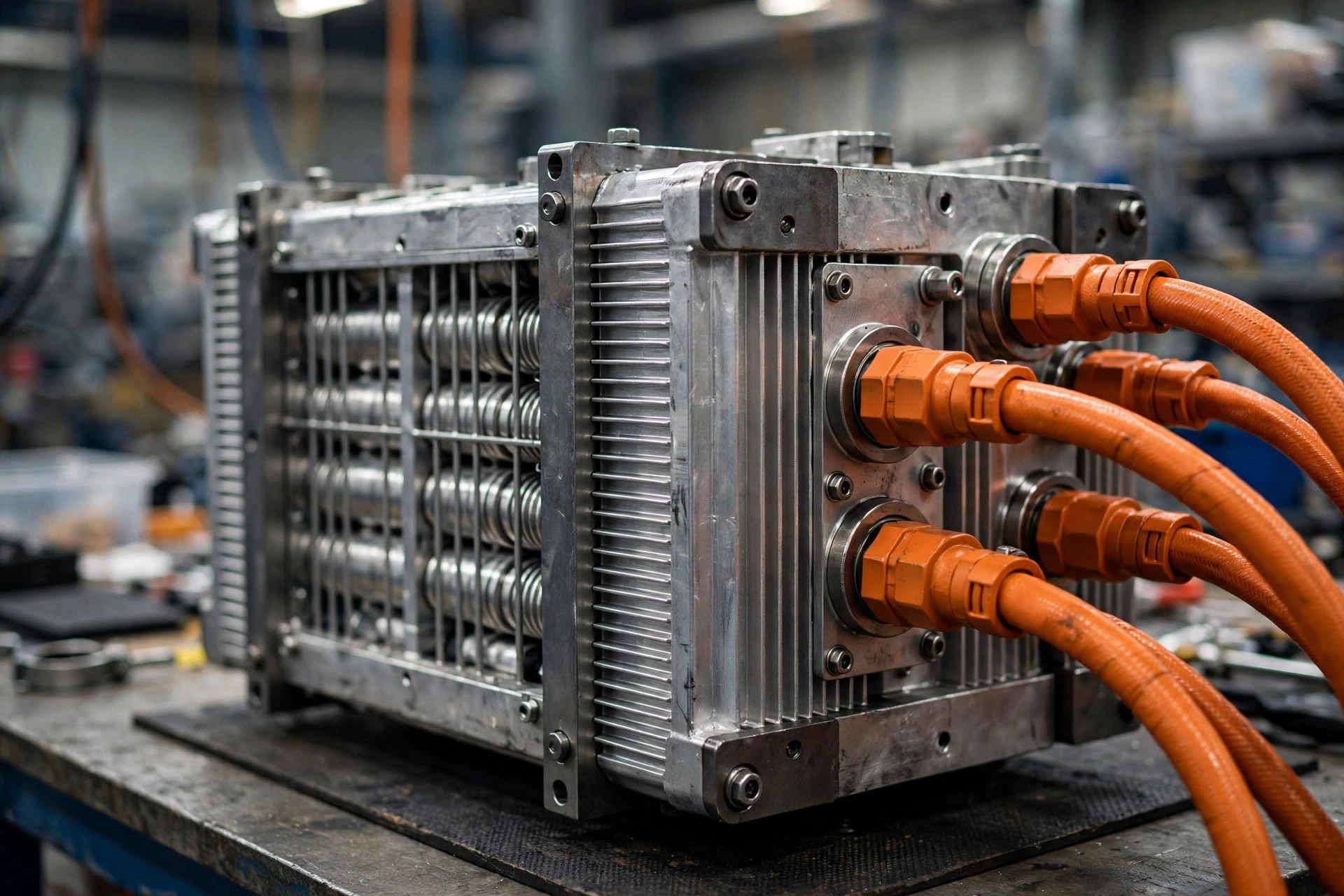
A Guangdong-based company that builds lithium battery packs for forklifts commissioned a third-party life-cycle carbon assessment in 2025, hoping to get an early read on its exposure. The surprise was where the data gap turned out to be. Their own plant was fine — electricity and water consumption were metered by process step. The black hole was upstream: the cell supplier refused to share carbon data for the cathode material, citing trade secrets. After three months of deadlock, the pack maker switched to a more cooperative cell supplier. Procurement costs rose by about 3%, but they secured a complete data chain from raw materials to the factory gate. Their compliance lead put it plainly: calculating a carbon footprint is not hard; getting the supply chain to talk is.
Where the Money Goes: A First-Year Compliance Cost Estimate
A clear accounting of costs is the precondition for deciding when to act. Below is a first-year compliance-readiness estimate for a mid-sized equipment maker exporting 3,000–5,000 units a year to Europe:
| Item | Scope | Cost range (USD) |
|---|---|---|
| Carbon footprint assessment + notified-body verification | Per battery model × plant, each combination | $30,000–$80,000 per combination |
| Battery passport data system | ERP data pipeline, QR labeling, data hosting | $50,000–$150,000 |
| Supply-chain due diligence program | Origin screening for cobalt, lithium, nickel, natural graphite, etc. | $20,000–$60,000 |
| Extended producer responsibility (EPR) registration | Country-by-country registration with compliance agents | $3,000–$8,000 per country per year |
| Internal staffing | 1–2 dedicated staff over 18 months | $80,000–$150,000 |
| Total | Approx. $150,000–$400,000 |
Note the structure: fees paid to testing and verification bodies account for only about a third. The bulk of the spending sits in internal data governance and system integration.
The Counterintuitive Part: The Most Expensive Item Isn't Testing — It's Data
This is where most companies misjudge the regulation on first contact. Instinctively, budgets get pointed at "which body to hire for certification, and what they quote" — as if this were a one-time exam to pass. But the battery passport and carbon footprint requirements are, at their core, the EU demanding that companies build and operate a standing data infrastructure: bills of materials accurate to the batch, continuously refreshed supplier data, sub-metered plant energy consumption, and per-battery records retrievable by a scan. Certification is merely the stamp applied after that infrastructure exists.
That creates a genuine trade-off: act now, or wait until every implementing detail is settled? Waiting avoids wrong turns, but data collection has no shortcut — a carbon footprint assessment needs at least twelve months of continuous production data as its baseline, and supplier coordination takes repeated rounds of grinding. That time cannot be compressed. My read is to split the work: start data collection now (low sunk cost, and irreversible preparation), and stage the system integration and formal verification. An 18-month countdown looks roughly like this: the first three months for a data inventory (BOM accuracy, supplier list, plant energy metering); months three through nine to launch the carbon assessment and build the due diligence process; months nine through fifteen to connect the battery-passport data pipeline and roll out QR labeling; the final three months for notified-body verification and EPR registration across member states.
When the Basis of Competition Shifts from Price to Data
Zooming out, the most interesting thing about the battery passport may not be compliance itself, but the competitive dimension it could reshape. Once the carbon footprint and material origins of every battery are a scan away, competition in the European market will gradually shift from "whose battery is cheaper" to "whose data is credible." Chinese manufacturers hold a natural advantage in supply-chain depth — but will data capability become the new moat? And once carbon thresholds land, will they force a fresh reshuffling of battery chemistries — repricing, say, the relative advantage of lithium iron phosphate over ternary routes? The answers will not arrive until after 2027. What is already certain is that the companies with their data house in order earliest will hold the most leverage in that repricing.
By Dr. Chen, Supply Chain Researcher