A few weeks ago I walked through a cross-dock in Southern California where the owner pointed at three forklifts sitting by the dock doors and asked me a blunt question: these machines never lift anything higher than knee level all year — did we buy the wrong equipment? I told him not to sell anything yet. In the electric pallet jack vs forklift warehouse debate, the right answer is never about which machine is "better." It is about whether your freight ever needs to leave the ground. If all you do is ground-level moves, the answer may surprise you.
Electric Pallet Jack vs Forklift: Start With the Principle, Not the Size
Most people think an electric pallet jack is just a small forklift. It is not. That is like comparing an electric scooter to a pickup truck — the difference is not size, it is what the machine is built to do.
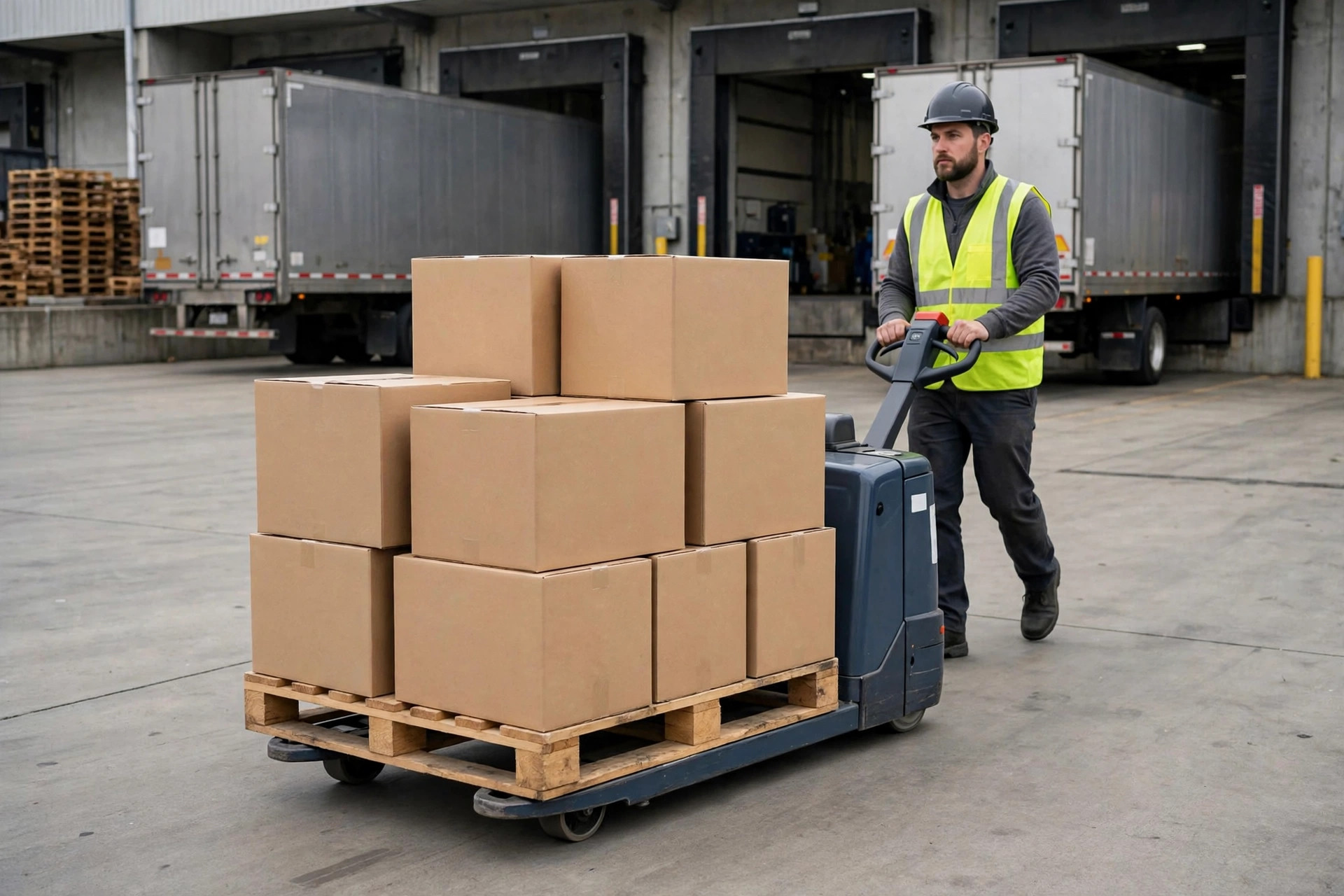
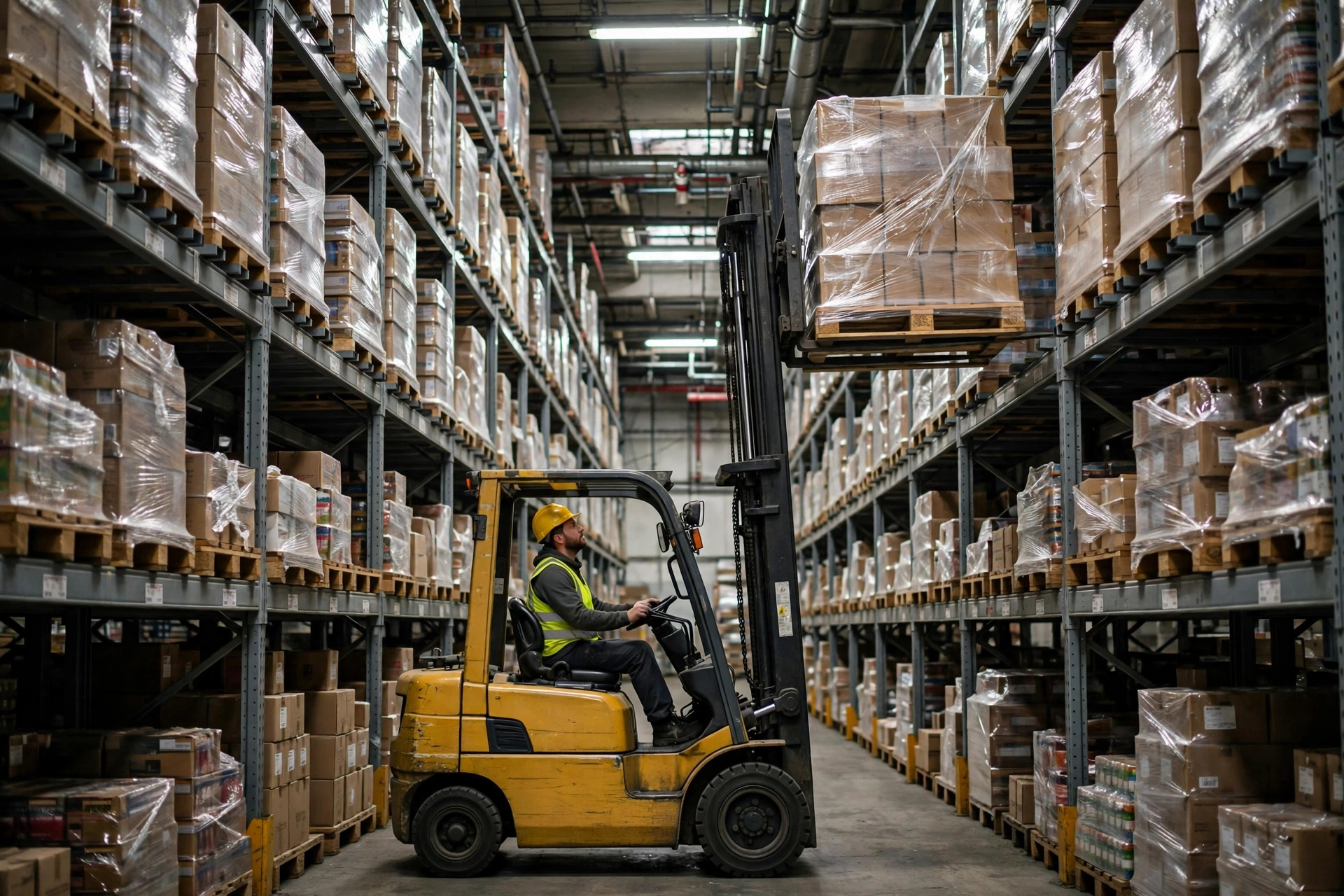
You can think of it this way: an electric pallet jack is a pallet that walks on its own. Its forks lift a pallet just a few inches off the floor, exactly enough to drag it along. A forklift is an arm that lifts. Its mast can carry a full pallet up to multi-level racking. One solves horizontal movement. The other solves vertical movement.
That distinction drives everything. Ground-level work — unloading trucks, moving freight from dock to staging, cross-docking, short hauls between production and the warehouse — is all horizontal. The freight never needs to rise more than a hand's width off the floor. Using a forklift for that is like using a crane to carry parcels: it works, but every dollar you paid for lifting capacity sits idle.
Flip it around, and the limit is just as hard. The moment any step in your process requires putting freight onto racking, stacking it, or pulling it down from height, the pallet jack is out. Its forks physically cannot reach that high. That is not a performance gap. The machine simply was not built with that function.
The Comparison: Six Dimensions That Decide Electric Pallet Jack vs Forklift
| Dimension | Electric Pallet Jack | Forklift |
|---|---|---|
| Lift height | A few inches off the floor, just enough to travel | Reaches multi-level racking; check manufacturer specs for exact figures |
| Load capacity | Covers a standard pallet load in typical use; check manufacturer specs | Wider range, with heavy-duty models well above that; check manufacturer specs |
| Speed and turning | Short body, tight turning radius, nimble in narrow dock areas | Longer body, wider turning radius, needs wider aisles |
| Purchase and maintenance cost | Usually clearly lower, simpler structure, fewer service points | Usually higher, with mast, hydraulics, and tires adding maintenance items |
| Operator qualification | Training requirements are generally simpler, but training is still required under local rules | Typically requires formal training and certification under local rules; check your local regulations |
| Safety risk | Concentrated on run-over injuries and blind spots while traveling | Adds falling loads from height and tip-over risk, so controls must be stricter |
Look at that table and notice what matters most: the first row. Lift height is a can-it-do-the-job line. Everything below it is about how well and how cheaply the job gets done. Get the first row wrong and the rest of the math is meaningless.
Two Real Warehouses: One Got It Right, One Nearly Got It Wrong
First, the one that got it right. A fast-moving consumer goods cross-dock, tens of thousands of square feet, where freight comes out of inbound containers, gets sorted, and leaves on outbound trucks the same day without ever touching a rack. They used to run two forklifts. They switched to electric pallet jacks plus one forklift kept as backup. The change did not show up as a dramatic line item. It showed up on the floor: in the tight dock area, a pallet jack turns in one move where a forklift needed two reverses; the end-of-shift inspection list got much shorter; and new hires got up to speed noticeably faster. Their logic was simple: if the freight never leaves the ground, stop paying for lifting capacity.
Now the one that nearly got it wrong. A small auto parts warehouse. The owner saw the price tag on pallet jacks and wanted to replace every forklift and tear out the racking for floor stacking. I walked the floor and found three levels of racking, with slow-moving parts stored on the second and third levels. Floor stacking would have meant renting more space, and once we ran the rent numbers, the equipment savings vanished and then some. The final setup kept one forklift dedicated to putaway and picking from racking, with pallet jacks handling all ground-level moves. The owner later told me he was glad he had not sold the forklift. The most dangerous thing about a false requirement is how much it looks like saving money.
Both stories point to the same rule: whether a pallet jack can replace a forklift does not depend on the equipment. It depends on whether your process contains a "put it up on a rack" step.
The Dividing Line: Three Cases, Find Yours
Case one: a pallet jack is fully enough. Every step is ground-level, freight goes from unloading to loading without ever leaving the floor, and staging is floor-stacked or single-layer pallets. Warehouses like this can run electric pallet jacks as their main fleet and keep zero forklifts. Cross-docks, fast-turn sortation centers, and floor-stacked raw material stores mostly fall here.
Case two: you must have a forklift. Any step requires putaway, stacking, high-level picking, or multi-level racking in staging. Then the forklift is not a question of whether to buy, but how many and how big. Pallet jacks can assist, but they cannot replace the core function.
Case three: run both, which is the most common answer. Warehouses with heavy ground-level volume use pallet jacks as the workhorses for volume, while forklifts handle only putaway and retrieval. There is no universal ratio. Look at one number instead: what share of the pallets you move each day actually need to be put away or picked from racking? If that share is low, one forklift is enough. If it is high, you need more. The ratio comes from your process, not from the price list.
The Maintenance Traps: Think About These Three Before You Buy
The first trap with pallet jacks is the battery. The battery is the core wear item, and bad charging habits — leaving it depleted, storing it flat — kill range faster than most people expect. Before you buy, set a charging routine: who charges it, for how long, and who deals with a depleted unit. Without a routine, even good equipment will not hold up.
The second trap is the wheels. Load rollers and drive wheels run on concrete all day, and pits, metal shavings, and stretch wrap on the floor wear them faster than expected. A worn wheel makes the jack drift, so the operator has to fight it the whole trip. That is tiring, and it ends with clipped rack legs.
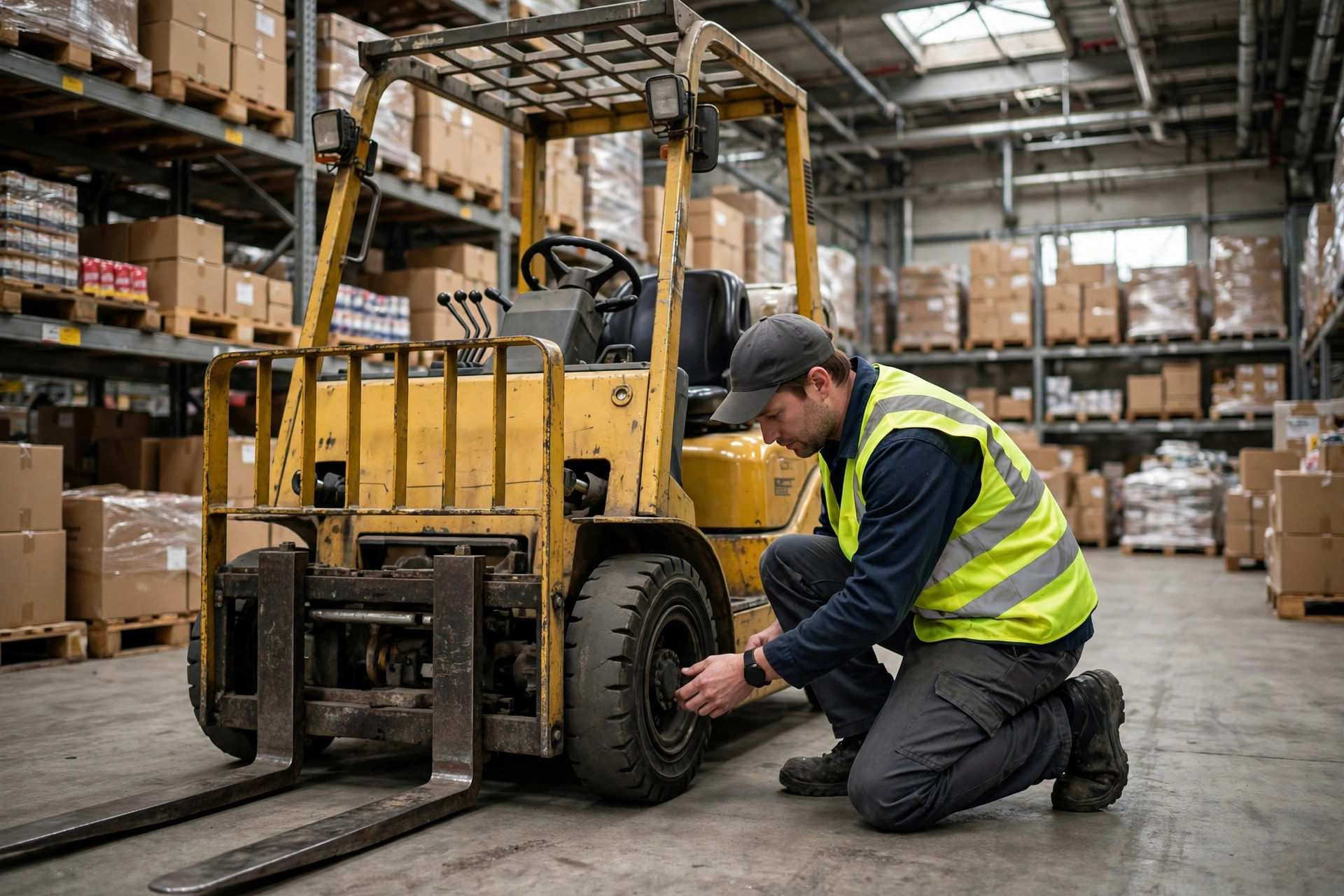
The third trap is assuming there is nothing to maintain. A simple structure does not mean zero maintenance. Hydraulic oil, chains, brakes, the emergency stop button — skip the checks and the failure will show up at the worst possible moment, in the middle of your busiest unloading window. Forklifts, ironically, rarely run completely unmaintained, because their training and inspection regimes force regular checks. Pallet jacks most often die from "it is so simple, nobody looks after it."
One more thing people miss: aisles. A tight turning radius does not mean aisles can shrink without limit. The dock area still needs safe travel and turning clearance, and pedestrian walkways must stay separated. You shrink the equipment but not the layout, and the efficiency gain never shows up.
Is the Money Worth It? Look at This One Number
After all of that, the dividing line comes down to one sentence: out of all the pallets you move in a day, how many genuinely need to be lifted more than about a meter? If that number is zero, a pallet jack can replace a forklift. If it is above zero, the forklift stays, and the pallet jack can only be its partner.
The next time someone tells you "pallet jacks are cheap, let's replace all the forklifts," ask them for that number. If they cannot answer it, their proposal was not calculated. It was a feeling.
By Da Liu, Automation Engineer