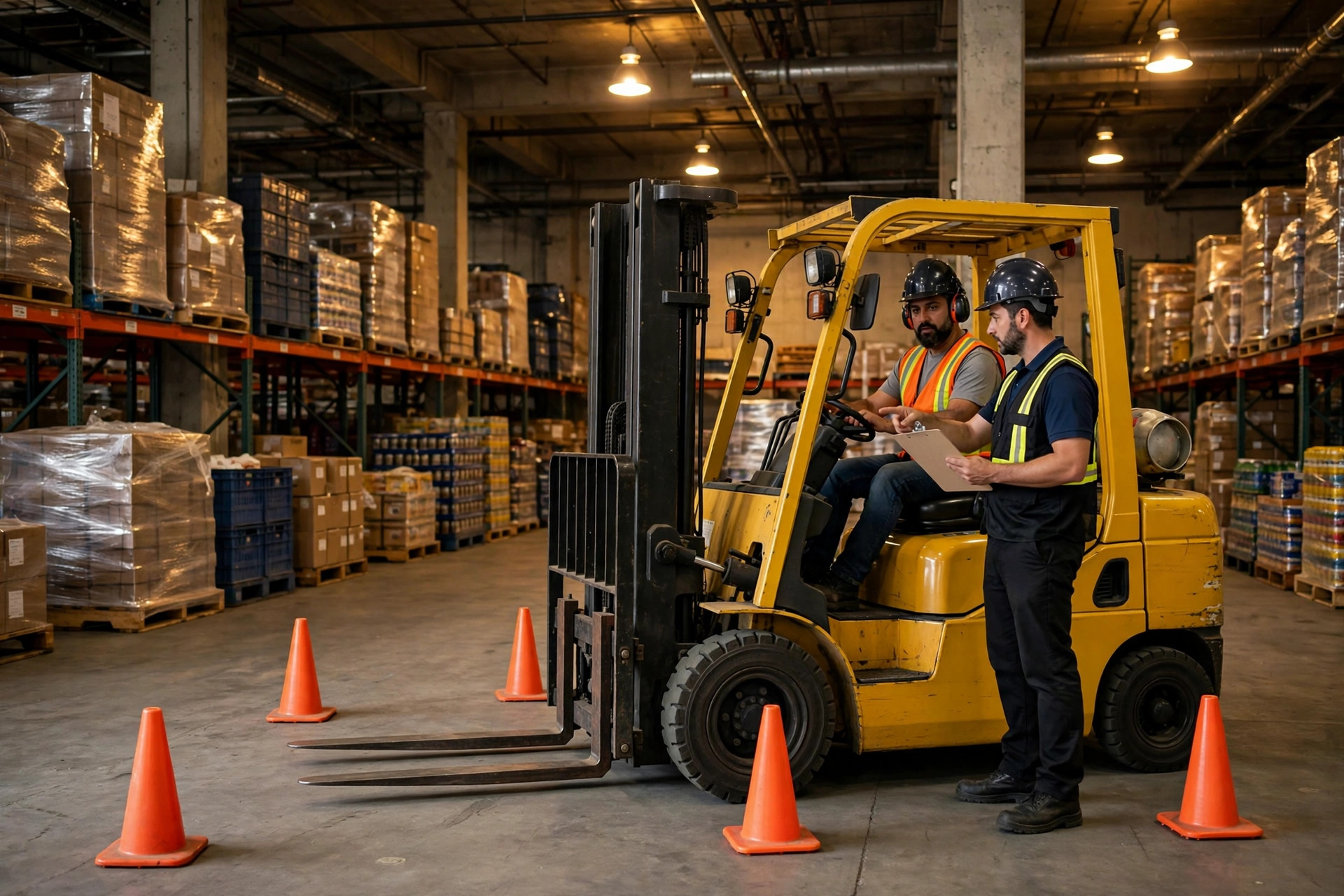
Full disclosure first: our warehouse runs three forklifts and has zero full-time safety staff. When I first read the forklift pre-shift inspection OSHA requirements, my head hurt — pages of items, as if each forklift needed its own private doctor. We run a 3,000-square-foot warehouse. Drivers clock in at 7 a.m. and freight starts moving at 7:30. Ask a driver to spend half an hour on an inspection and he'll hand in his resignation.
But there's no dodging this one. Back in the fall of 2023, at our little warehouse in Ontario, a cracked link on the mast chain of our electric forklift went unnoticed. Mid-lift, with a pallet of goods weighing close to 800 kilos in the air, the chain jumped and the load shook like a washing machine on spin cycle — three meters up. Thank god nobody was underneath. The repair bill came to over $600, and we lost half a day of work. That's when it clicked for me: the pre-shift inspection isn't for OSHA. It's for staying alive.
What OSHA's forklift pre-shift inspection requirements actually say
Here's the hard requirement, plain and simple: OSHA standard 1910.178(q)(7) says powered industrial trucks must be examined before being placed in service each day — and taken out of service if the examination shows any condition that could affect safety. Running trucks 24 hours around the clock? Then they get examined after every shift. No negotiating the frequency: daily, every shift, before every use.
As for what to check, OSHA's daily checklist covers: tires, horn, lights, brakes, steering, hydraulics, forks, mast and chains, gauges, fire extinguisher, seat belt, fluid leaks, overhead guard, load backrest, and the backup alarm. Quick side note: OSHA sorts industrial trucks into seven types, Type I through Type VII — electric, internal combustion, rough-terrain, the whole family. The fine print varies by type, so check the latest standards on OSHA's official site. This article is about the inspection itself.
My hot take: the forklift pre-shift inspection checklist shouldn't be long
Counterintuitive opinion, and I'll say it first: longer checklists are worse.
I've seen a buddy in a warehouse-owners group build a 40-plus-item inspection form — two printed pages. His drivers did it for three days, then "forgot" about it forever. A checklist nobody finishes is the same as no checklist. We went the opposite direction: picked the 15 items that actually save lives from the OSHA list, printed them on one sheet, and taped it to every forklift's steering wheel. Five minutes a day. Check, sign, go.
We've been running this sheet for almost two years. Take it, print it, use it:
| # | Check | How (30-second version) | If it fails |
|---|---|---|---|
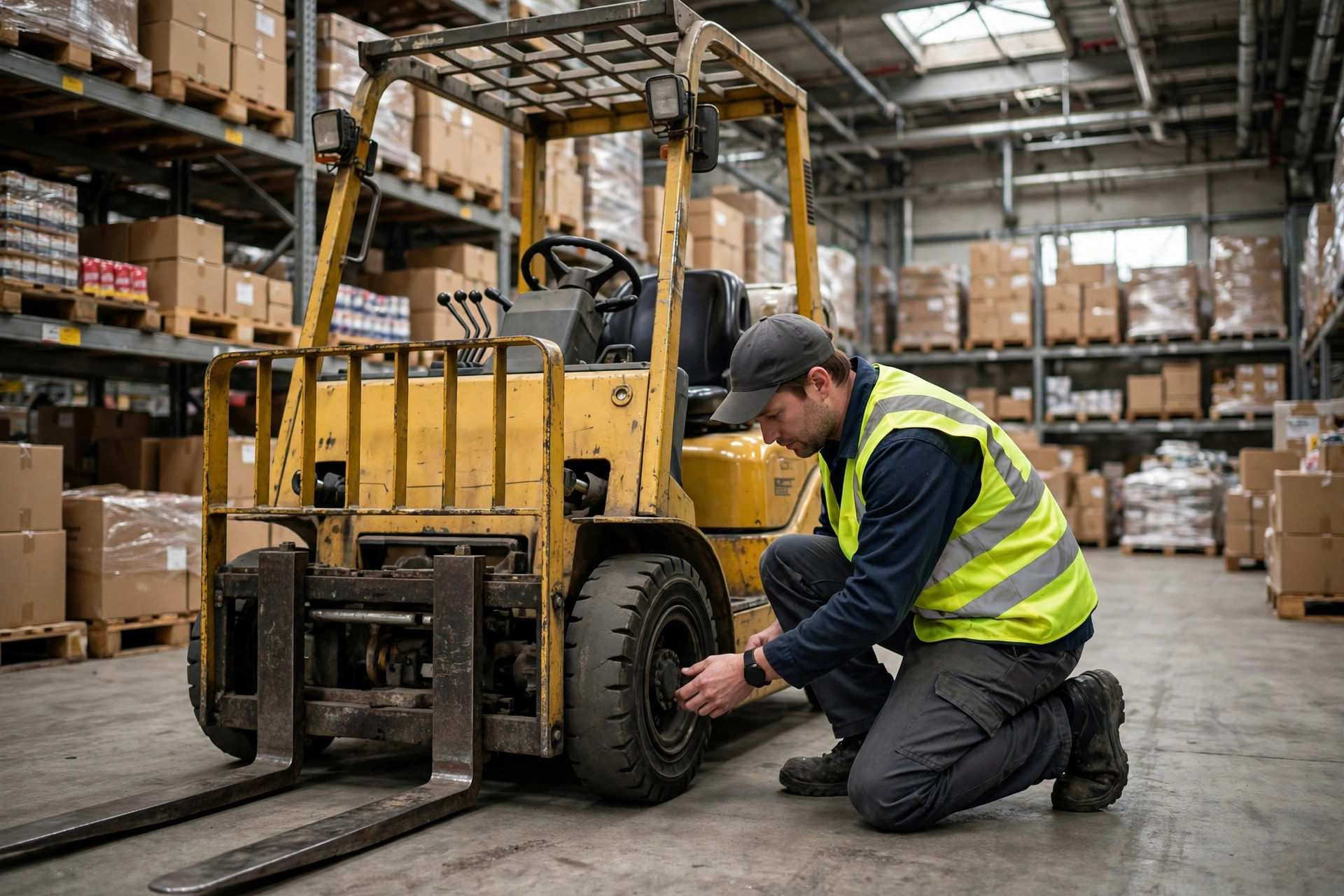
| 1 | Tires | Walk around: flat, bulges, loose lug nuts? | Bulge or badly flat → park it, call the shop |
| 2 | Forks | Heel and tip: cracks, bends? | Any crack → park it. A broken fork kills. |
| 3 | Mast + chains | Raise and lower twice, listen for noise, check chain tension | Grinding or sticking → park it |
| 4 | Foot brake | Drive two meters, slam it, see if it stops | Doesn't stop → parked. Non-negotiable. |
| 5 | Parking brake | On a slope (or in gear on flat ground), set it, see if it rolls | Rolls → parked |
| 6 | Steering | Full lock both ways, feel for heaviness or noise | Binding or noise → report for repair |
| 7 | Horn | Press it | Dead → fix before it leaves the dock |
| 8 | Lights | Headlights, beacon, check they light up | Out → note it, replace same day |
| 9 | Hydraulic lines | Fittings and cylinders: any seepage? | Seeping → wipe and watch; dripping → parked |
| 10 | Gauges | Battery/fuel level, hour meter — write the numbers down | Battery too low → charge before work |
| 11 | Seat belt | Pull it out, check retraction and locking | Broken → replace same day |
| 12 | Fire extinguisher | Present, gauge in green, pin in place | Missing/expired → replace same day |
| 13 | Overhead guard | Bent, cracked welds? | Deformed → parked for repair |
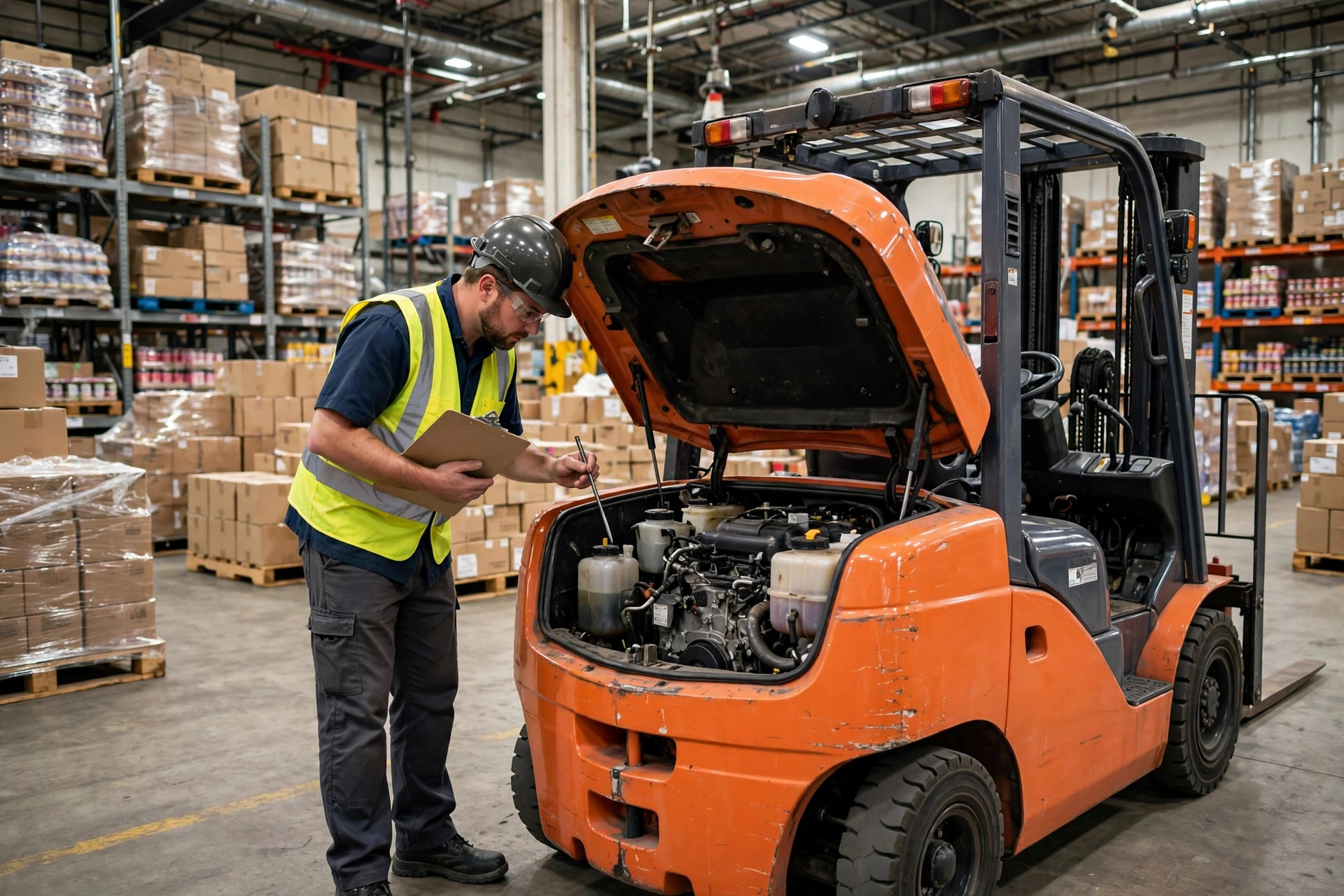
| 14 | Leaks under the truck | Glance underneath: oil spots, puddles? | Found → trace the source; can't find it → parked |
| 15 | Backup alarm + mirrors | Reverse gear: alarm sounds? Mirrors aimed right? | Silent → fix same day |
The whole logic fits in one line: if the box says "parked," that truck doesn't move today. Brakes, forks, chains, steering — a failure there is exactly what OSHA means by "a condition adversely affecting safety." Horns and lights? Fix them the same day.
How a small warehouse keeps the forklift pre-shift inspection alive
Having the sheet is the easy part. Getting drivers to actually do it every morning — that's the real job. Four drivers including me. Three field tricks:
First, the keys live next to the checklist. Sign the sheet, take the keys. Drive without signing? Caught once and you buy the whole warehouse bubble tea. Caught twice and you're first on the weekend overtime list. Forget speeches about safety culture — build the mechanism.
Second, file the sheets monthly. In March 2024, an OSHA inspector walked into a buddy's warehouse across town. First question out of his mouth: "Show me your daily inspection records." My buddy had none. I won't quote his fine — let's just say it was enough to cover his drivers' bonuses for half a year, in his words. Records are proof. Ours go into a binder every month, locked in the file cabinet.
Third, pay drivers for catching problems. Last November, our driver Xiao Zhao spotted a hairline crack at the heel of a fork during his inspection. Reported it. New forks cost us over $400. I handed him a $200 red envelope on the spot — compared to what a snapped fork dropping a pallet would cost, that $200 was the best money I've ever spent. Drivers went from "going through the motions" to "hunting for problems." The inspection quality changed completely.
Honestly? Big-company safety programs — dedicated safety officers, electronic inspection apps, QR-code signoffs — we can't afford that stuff. But one sheet of paper, one pen, five minutes: same result. Since we started this in late 2023, zero forklift incidents, and the drivers sleep better at night too.
One last note: this 15-item sheet is tuned for our electric counterbalance trucks (Type I). If you run internal-combustion or rough-terrain trucks (Types IV through VII), you'll want engine oil, coolant, and exhaust on the list. Check OSHA's official site for the latest standard for your type — don't copy mine blindly.
Small warehouses have their own way of surviving — compliance isn't about how much money you spend. It's about whether you spend those five minutes every day.
By Xiao Ma, Small Warehouse Owner