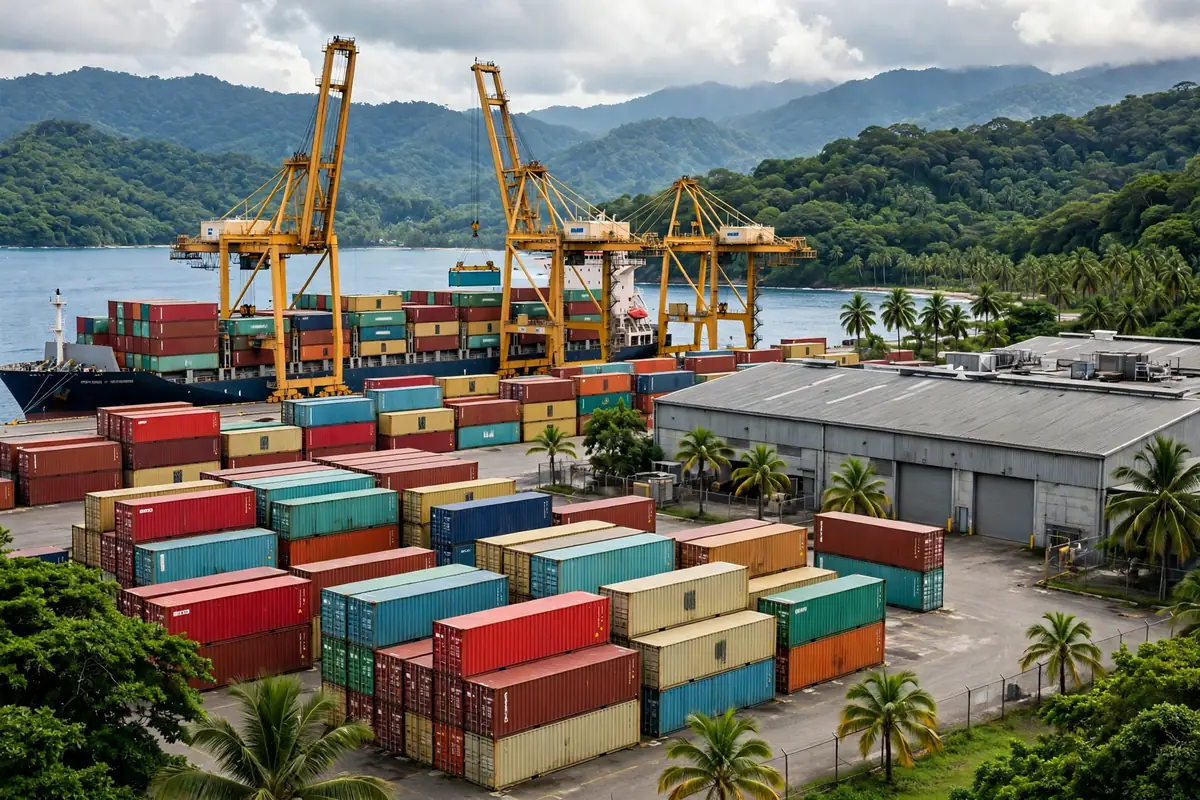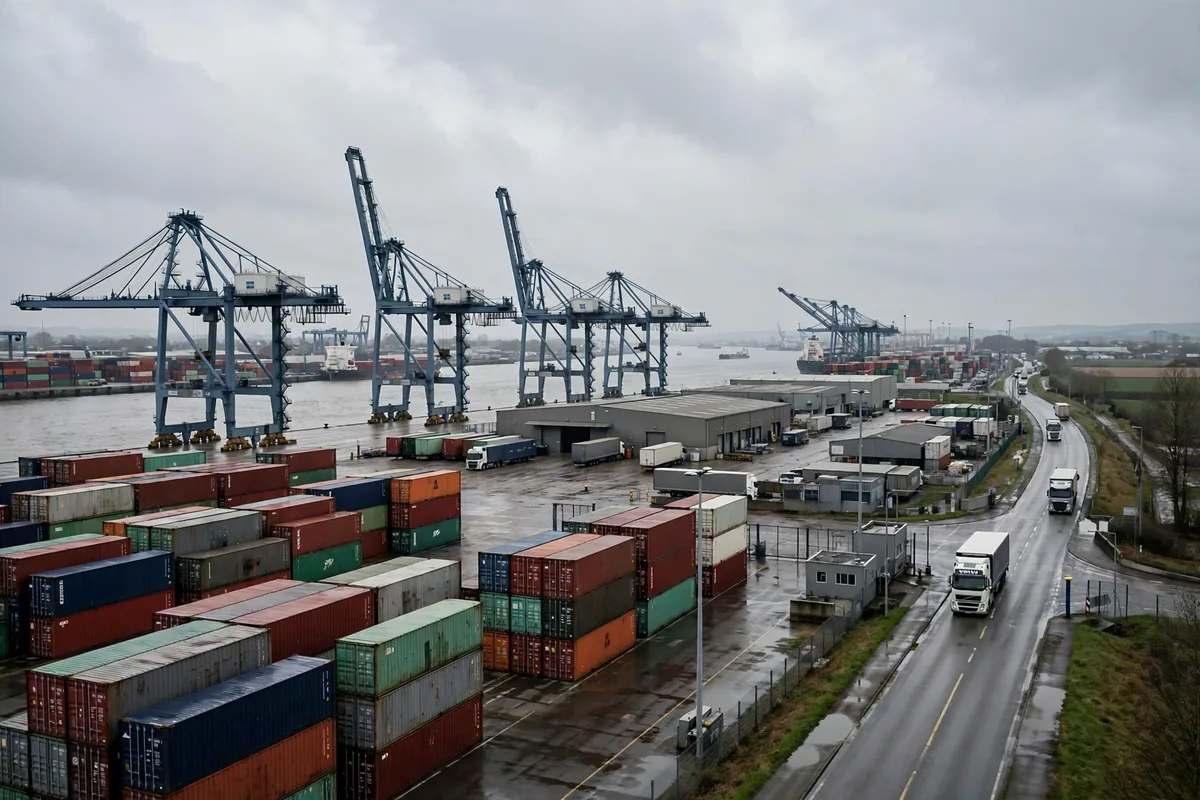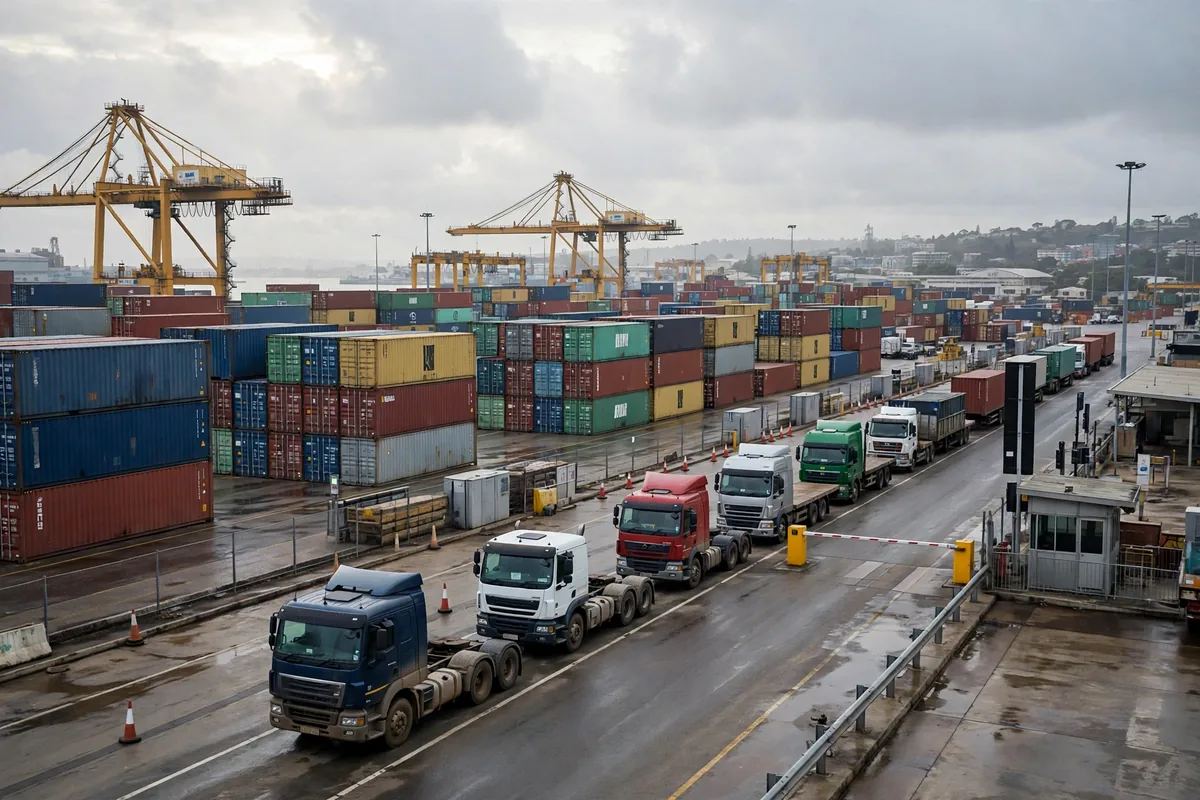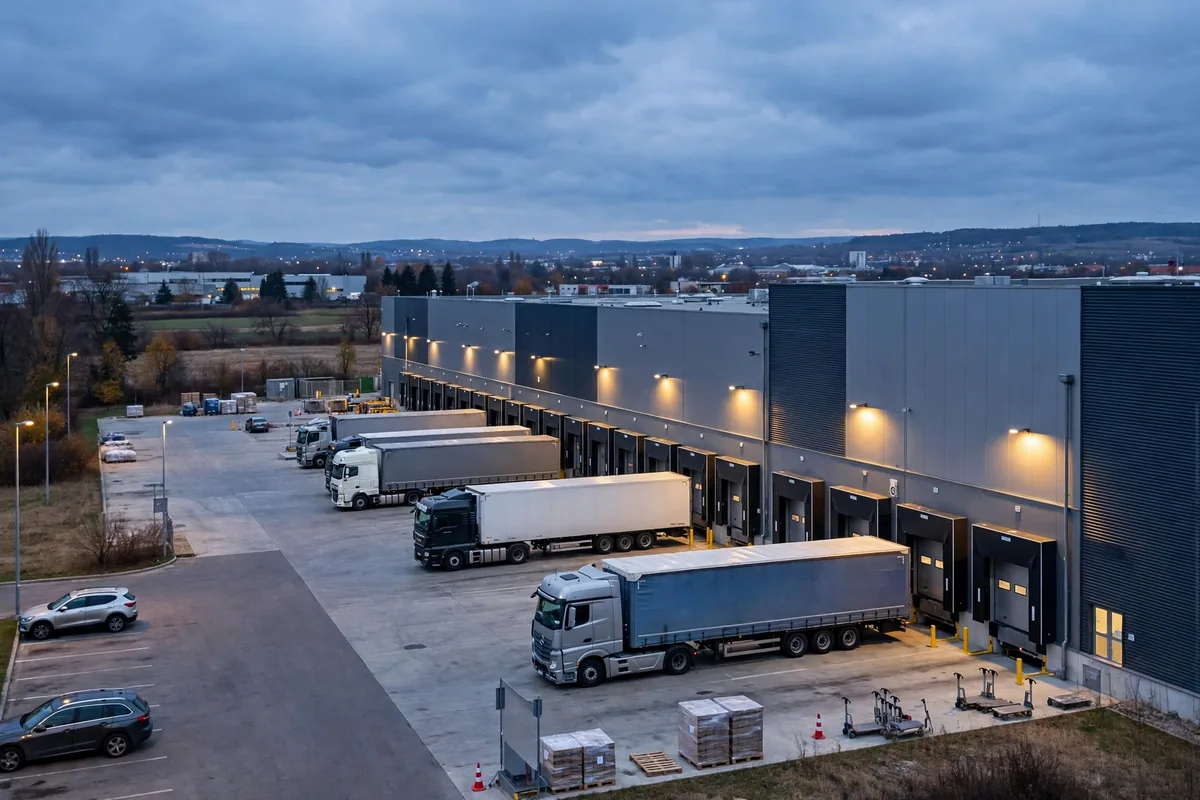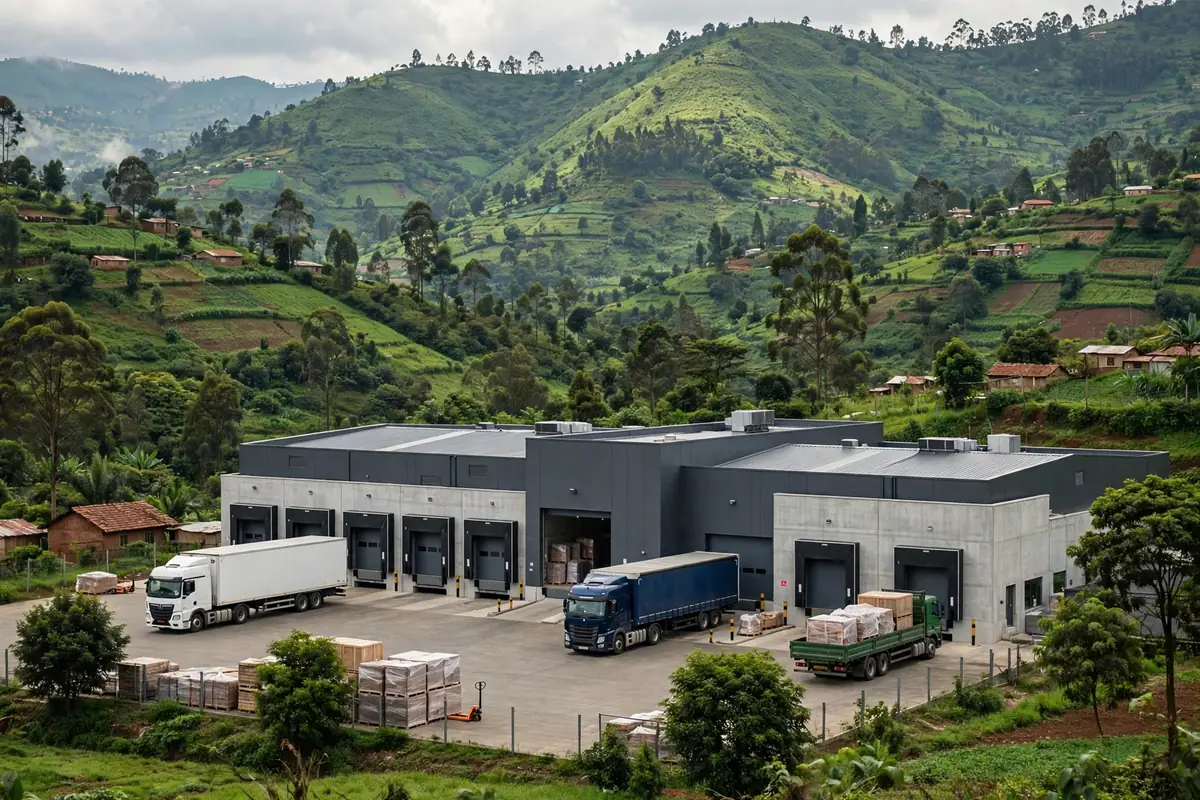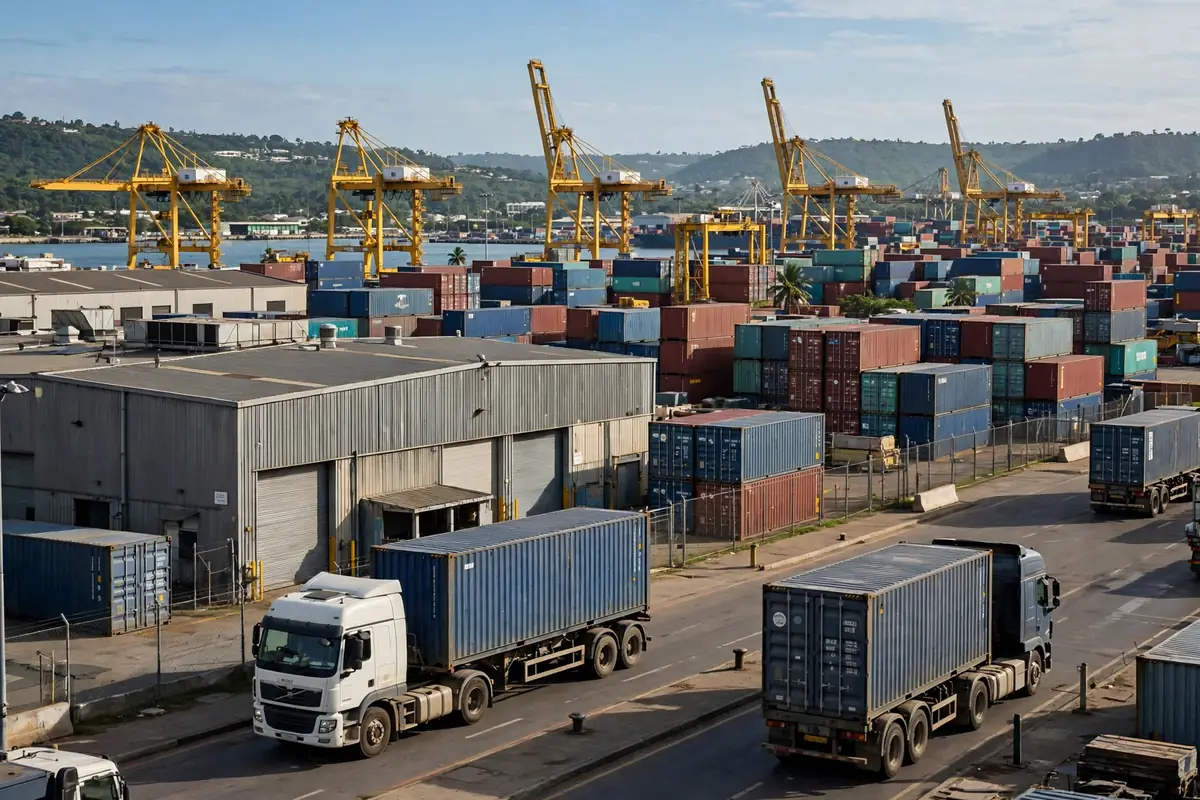
The question at the heart of durban south africa port warehouse logistics appears simple: when cargo lands in Durban, should it be warehoused near the port or moved inland toward Johannesburg as quickly as possible? According to long-standing industry observation, the structure behind the question is less simple. Durban handles a large share of South Africa's seaborne trade, while Gauteng concentrates much of the country's consumer demand, manufacturing, and distribution activity. Goods enter from the southeast coast; demand sits on the inland plateau. Warehousing, in this context, is a corridor decision disguised as a real-estate decision.
The geography deserves attention. The road distance between Durban and Johannesburg is in the region of five to six hundred kilometres, served principally by the N3 corridor through Pietermaritzburg, the Mooi River area, and Van Reenen's Pass. The route climbs from sea level to the highveld. Gradient, weather, and traffic therefore shape reliability in ways that a map does not reveal. Researchers who model this lane as a fixed transit time tend to underestimate its variance, and variance, rather than average speed, is what distribution systems actually feel.
What demand patterns reveal about durban south africa port warehouse logistics
A first pattern can be observed in retail distribution. Some shippers serving national chains have historically placed their first warehouse near the Durban port area or in nearby industrial zones such as Pinetown. The logic is operational: containers can be collected promptly after clearance, de-stuffed, and held close to the point where documentation or inspection problems are easiest to resolve. The difficulty emerges when the final demand is concentrated in Gauteng. In that case almost every fast-moving unit must still travel the full N3 corridor, and the time saved at the port is repaid, with interest, in line-haul scheduling and in the exposure of store replenishment to corridor disruption.
Other shippers adopt the inverse structure: a light Durban node and a heavier Johannesburg node. Durban performs short dwell, sorting, and exception handling. Cleared fast-moving cargo moves inland in full loads and is distributed from warehouses around Johannesburg toward Pretoria and surrounding towns. Inland rent and labour are not necessarily lower. What improves is control over the final leg, because the distance between stock and demand has been shortened. This comparison should be read as an on-the-ground operational observation rather than a universal rule; product velocity and order profile can reverse the conclusion for a given shipper.
A second pattern concerns project and building-material cargo. For equipment and materials whose final site or delivery sequence may change, moving everything inland early creates a different risk: expensive repositioning. Shippers in this segment often retain stronger port-side holding capacity in Durban and release cargo inland only against confirmed delivery schedules. The logic of consumer goods — be as close to demand as possible — is therefore inverted. For project cargo, the premium is on being close to uncertainty, not close to the customer. Applying a single warehousing formula to both categories is a recurring early error in this market.
A decision framework for durban south africa port warehouse logistics
The following framework is intended to separate the variables rather than to prescribe an answer:
| Decision dimension | Favours Durban port-side warehousing | Favours Johannesburg warehousing |
|---|---|---|
| Cargo destination | Dispersed, including KwaZulu-Natal demand | Concentrated in Gauteng and nearby provinces |
| Velocity | Slow-moving, requiring holding and phased release | Fast-moving, requiring frequent replenishment |
| Exception profile | Frequent clearance or inspection exceptions | Stable documentation, few exceptions |
| Transport organisation | Containers need breaking and re-sorting after landing | Stable full-load corridor movements are feasible |
| Risk concern | Costly inland repositioning if plans change | Corridor disruption passing directly into store stock-outs |
Read through this framework, a counterintuitive conclusion becomes clearer. A lower port-side handling or storage rate does not necessarily produce a lower total cost. If cargo is destined for Gauteng in any case, an additional dwell and an additional handling cycle in Durban may simply transfer cost from the warehousing line to transport and stock-out lines. Conversely, a Johannesburg warehouse that appears heavier and more expensive can, in peak periods, prove more stable because corridor variance is absorbed before it reaches the store network. Comparisons based only on cost per square metre or per pallet will systematically misread this corridor.
Corridor risk belongs inside the same analysis. Congestion in holiday and peak freight periods, weather effects on mountain sections, and temporary disruption after incidents are variables operators on the N3 repeatedly describe. They do not make the corridor unreliable. They mean that service promises require a buffer, and that the location of the buffer is itself a design choice: earlier dispatch from Durban, safety stock in Gauteng, or longer ordering lead times at stores. A distribution system designed without an explicit buffer converts every corridor fluctuation into a customer-facing failure.
The emerging trend, observable across larger shippers, is to reject the binary framing altogether. Durban and Johannesburg are assigned different jobs: Durban for landing, exceptions, and slow stock; Gauteng for velocity and final response. The cost of this dual-node model is real — inventory is split, replenishment discipline must be explicit, and reconciliation becomes harder. For shippers whose volumes are still small or whose destination mix is still unstable, forcing a dual-node structure prematurely can amplify inventory pressure rather than reduce risk.
Inventory visibility deserves separate mention. In post-season reviews described by operating teams, the most common failure in a dual-node model is not transport at all. It is information. The Durban site believes a load has departed, the Gauteng site believes it has not yet arrived, and stores continue to promise delivery dates based on stale stock. The remedy is unglamorous but effective: every corridor departure needs a clear in-transit status, every receipt needs to be visible to both ends, and an unexpected dwell needs to be reported before the store asks. Without that basic synchronisation, the theoretical benefit of two nodes is consumed in execution. Single-node systems face the same weakness, but with fewer handovers it surfaces more slowly and is easier to forgive.
Seasonality further complicates any fixed answer. Back-to-school periods, year-end holidays, and promotional cycles change both Gauteng demand peaks and the tightness of corridor capacity. Cargo that can sensibly dwell in Durban in a quiet month may need to move inland earlier in a peak month, while fast cargo that normally justifies a direct inland movement may, in a quiet period, be better consolidated briefly in Durban to avoid half-empty loads. Mature operators therefore review the split monthly rather than treating an annual decision as permanent. That discipline itself has a cost in data and attention, which is why smaller shippers may be better served by making one node work reliably first, and only then adding the second.
The more productive question, therefore, may not be which warehouse is cheaper. It may be which uncertainty your cargo is paying for on this corridor. If the dominant uncertainty is clearance and project timing, the answer leans toward Durban. If it is replenishment frequency and store availability, the answer leans toward Johannesburg. As volume structure and corridor capacity evolve over the coming quarters, the balance between those two answers is likely to keep shifting — and that shifting, rather than any fixed verdict, is what planners should be monitoring.
By Dr. Chen, Supply Chain Researcher