When companies evaluate Antwerp Belgium warehouse logistics, a recurring pattern deserves attention: the site decision is often made by comparing distances on a map, yet the costs that emerge six months later rarely come from those distances. They come from how cargo dwells, is handled, and is redistributed between quay, warehouse, and inland destinations. Antwerp should be assessed as a distribution system, not a port with warehouses nearby.
The Node Position of Antwerp Belgium Warehouse Logistics
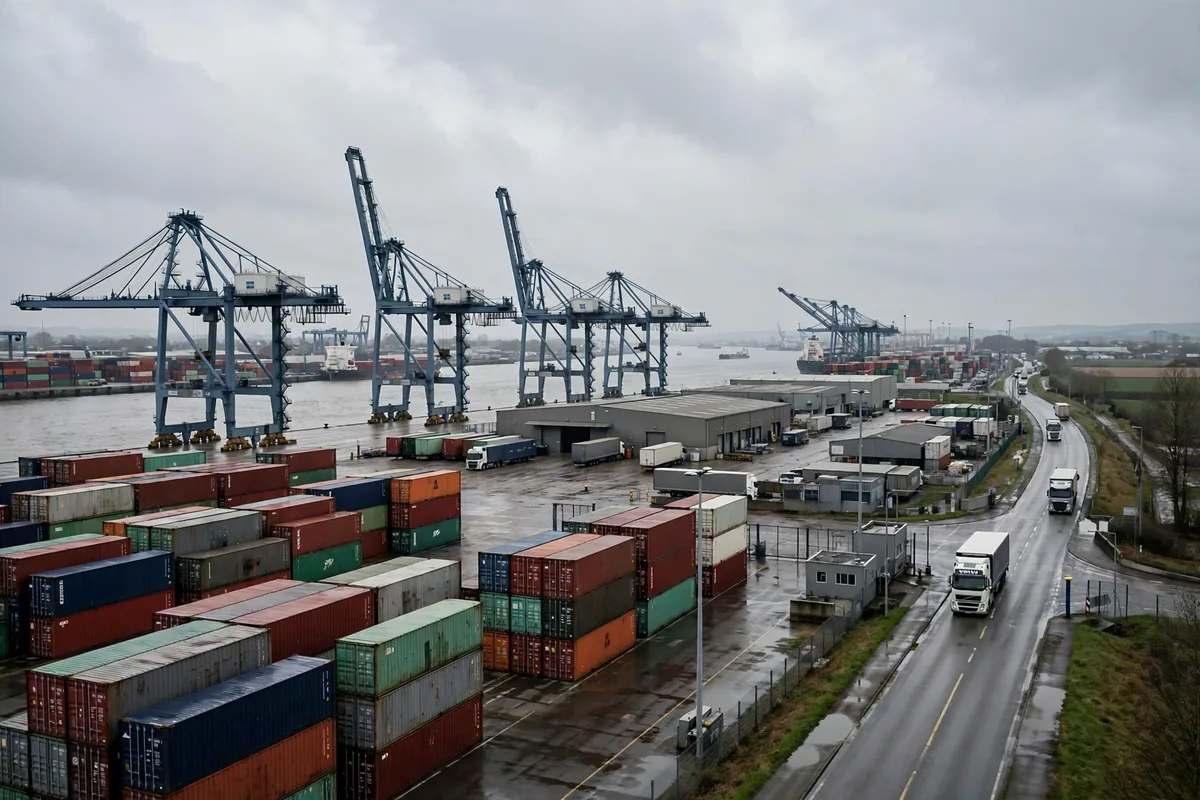
Geographically, Antwerp sits on the lower Scheldt, with its port and logistics zones extending along the river. From this position, road, rail, and inland waterway connections reach across Belgium and extend north into the southern Netherlands, east toward Germany's Ruhr region, and south into northern France. Antwerp therefore performs two roles at once: it is a maritime import gateway and an inland distribution node for northwestern Europe.
According to port and regional logistics research, Belgium's compact geography makes this overlap unusually powerful. Within a single day's round trip by road, a warehouse in the Antwerp area can serve Belgium's main cities as well as substantial demand in the southern Netherlands and the western edge of Germany. Density, therefore, is the first variable to understand. Port infrastructure, a major chemical cluster, logistics parks, and consumer markets coexist within a relatively small space, so cargo can complete its first redistribution without long empty or low-utilisation legs.
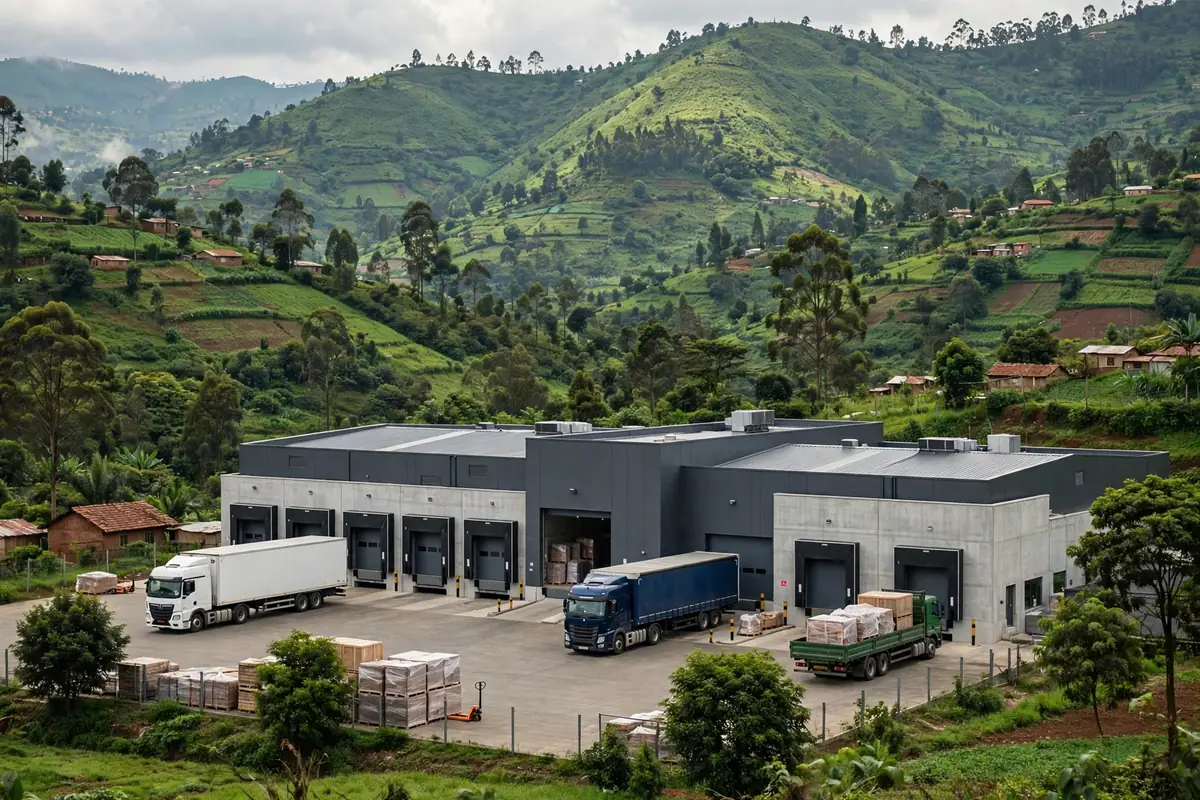
Density also creates constraint. Land near the port is tight, and large single-storey footprints are scarce in the immediate port area. The economics follow predictably. Cargo that turns quickly and needs devanning, labelling, and rapid onward movement can justify a portside location. Cargo that needs deep storage, slow picking, and long dwell usually cannot, because the shipper ends up paying for proximity to the quay that the operation no longer uses after the first handling step.
Portside Warehouses vs Inland Warehouses: A Comparison Framework
The second question is the choice between portside warehousing and inland warehousing, mainly in the directions of Ghent to the west and Brussels to the south. Ghent tends to absorb port overflow and manufacturing-related flows, while the Brussels direction offers a more balanced position for distribution across central Belgium and onward to the south and east. Neither option is superior in itself; each performs differently depending on cargo rhythm.
| Dimension | Portside (Antwerp port area) | Inland (Ghent / Brussels direction) |
|---|---|---|
| Core strength | Fast devanning and transfer, frequent in-and-out flows | More storage space, room for sorting and value-added work |
| Best suited to | Fast-turn cargo needing port-area services | Slower-turn cargo needing a large working footprint |
| Main risk | Tight land supply, limited expansion flexibility | An extra inland leg that must be managed for lead time |
| Decision test | Is port dwell short enough to justify proximity? | Are destinations dispersed enough to reward a central site? |
To make the framework calculable, consider the following explicitly hypothetical illustration. The figures are index numbers invented for method demonstration only; they are not actual port charges, rents, or transport rates. Suppose an importer handles twenty containers a month. Under Option A, everything is devanned and distributed from a portside warehouse, with an assumed warehousing cost index of 120 and an inland delivery index of 100. Under Option B, operations move inland, the warehousing index falls to 100, the delivery index rises to 110, and an inland transfer adds an index of 15 per container. Warehousing alone suggests a saving of 400 index units a month under Option B, but once transfer and delivery increases of 350 units are included, the net saving shrinks to 50. At sixty containers a month, the fixed coordination cost of the transfer is spread more thinly and the inland advantage grows; at ten containers, the portside option may be simpler and cheaper. Location, in short, is a function of scale, not a fixed preference.
A documented pattern from field interviews illustrates the point. In the autumn of 2023, a consumer electronics accessories company based in eastern China moved its European import warehouse from the Antwerp port area toward Ghent after its inventory depth had grown substantially within a year and its portside site could no longer hold the required stock profile. The operating model became full-container devanning at the inland site, with weekly distribution to customers in Belgium and the southern Netherlands. In its internal review, the company emphasised not rent but fewer stock-outs and emergency transfers, because the larger site allowed fast-moving and slow-moving stock to be stored separately. Relocation gains, in other words, often appear first in operational order, and only later in the cost table.
Chemicals and Consumer Goods Follow Different Distribution Logics
The third layer is cargo type, and here Antwerp Belgium warehouse logistics splits into two distinct logics. Antwerp hosts one of Europe's major chemical clusters, and the port area has developed warehousing, tank storage, and specialist services adapted to chemical products. For this cargo, compliance and safety are discussed before price: storage segregation, operator qualifications, and emergency arrangements determine whether a warehouse is eligible at all, and only then do distance and cost enter the comparison. Chemical flows also tend to be planned in batches, with more predictable volumes, so the warehouse is valued mainly for stability and traceability.
Consumer goods behave almost in reverse. In 2024, an importer of household goods supplying e-commerce and retail channels in western Europe placed its peak-season stock in an inland warehouse in the Brussels direction, because its destinations were spread across Belgium, northern France, and western Germany and outbound waves could be grouped by destination without a second sorting step. Across three peak months, the variable that governed delivery performance in its operating records was the alignment between order cut-off times and linehaul departures, not the distance back to the port. For consumer goods, distribution performance is built from wave planning, labour flexibility, and returns handling, and a warehouse a few dozen kilometres further inland can outperform a portside site if its order organisation is better.
This leads to a counter-intuitive judgement: within the Antwerp system, the warehouse closest to the port is frequently not the most efficient distribution warehouse. For consumer goods requiring deep storage and multi-destination wave picking, the portside advantage decays quickly once customs clearance and devanning are complete; what remains depends on internal organisation and the linehaul network. For chemicals, by contrast, proximity decays slowly, because the specialist services the cargo depends on are themselves concentrated around the port. The right first question is therefore not how far a warehouse is from the quay, but where the cargo's critical handling steps actually take place.
When Antwerp Makes More Sense Than Rotterdam: A Decision Sequence
The final question is the one shippers ask most directly: Antwerp or Rotterdam? Both ports sit in the Rhine-Scheldt delta and serve heavily overlapping hinterlands, so any claim that one dominates the other in general terms lacks a basis. A more defensible approach is to test four conditions in sequence. First, cargo type: chemicals and related products often find a deeper base of adapted warehousing and services in Antwerp because of its cluster, while general consumer goods can work through either port and require further comparison. Second, destination gravity: if a shipper's customers concentrate in Belgium, northern France, and western Germany, Antwerp's inland connections are usually more balanced; if the gravity sits clearly in the Netherlands and northern Germany, the calculation should be redone rather than assumed. Third, operating model: cargo needing devanning, labelling, inspection, and rapid re-distribution depends more heavily on port-area service density, whereas full containers moving directly to an inland warehouse are less sensitive to the port itself. Fourth, redundancy: some companies deliberately route through both ports to reduce exposure to congestion or schedule disruption at a single gateway, in which case Antwerp functions as one pole of a portfolio rather than as a replacement.
The decision sequence is then practical: screen by cargo type, measure total inland travel against destination gravity, verify the availability of the post-port services the operation requires, and only then compare quotations from specific warehouses and carriers. Reversing the sequence — comparing prices first and constructing the justification afterwards — reliably produces the option that looks cheapest on paper and generates additional transfers and waiting time in execution.
The broader trend is that competition among northwestern European ports is shifting from throughput alone toward the coordination of port, warehousing, and inland networks. As that shift continues, the useful question about Antwerp Belgium warehouse logistics may move away from which single warehouse to choose and toward how a network spanning portside and inland sites should be organised — and whether a configuration that is optimal for today's volumes, product mix, and destination pattern will still hold when all three have changed two years from now.
By Dr. Chen, Supply Chain Researcher