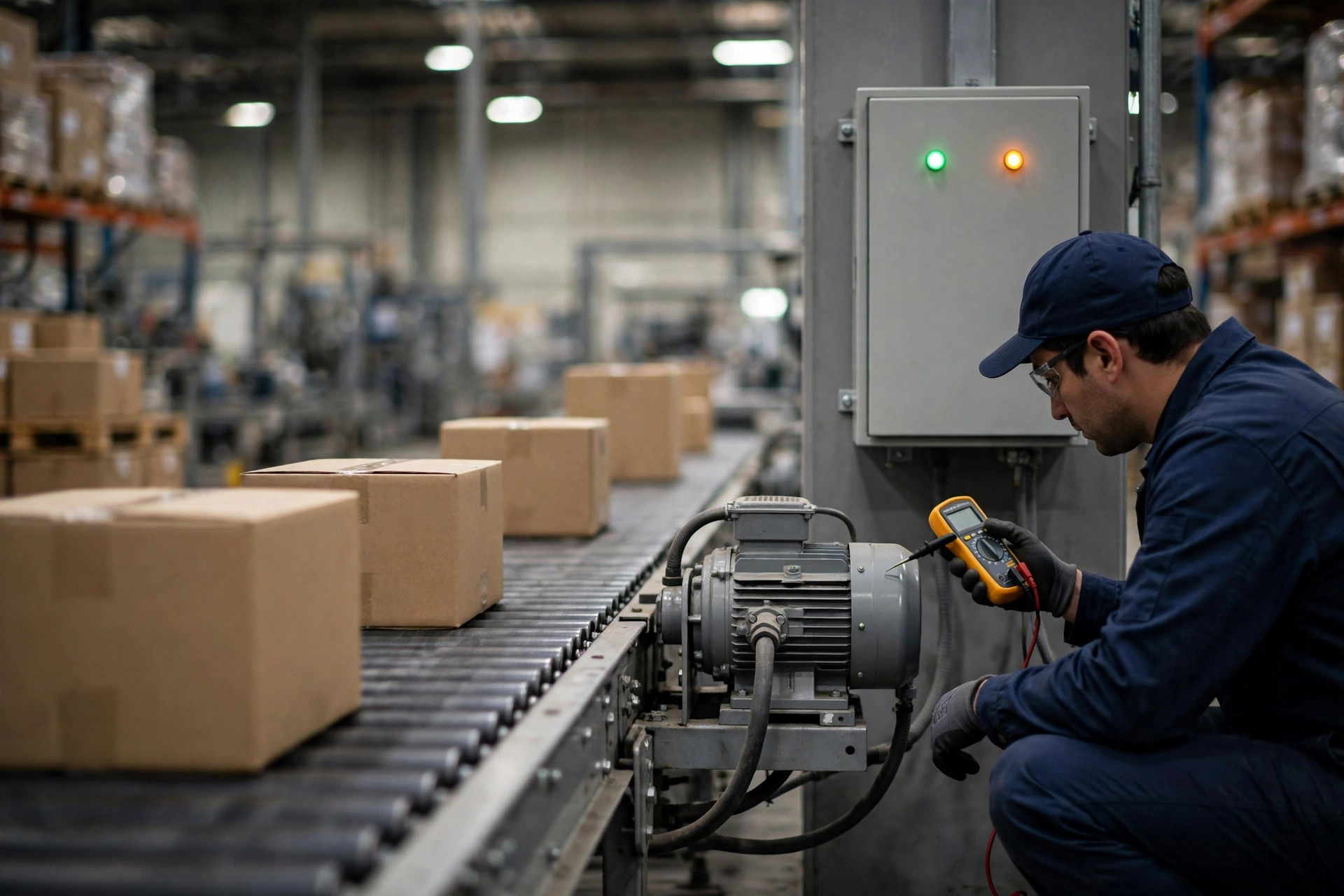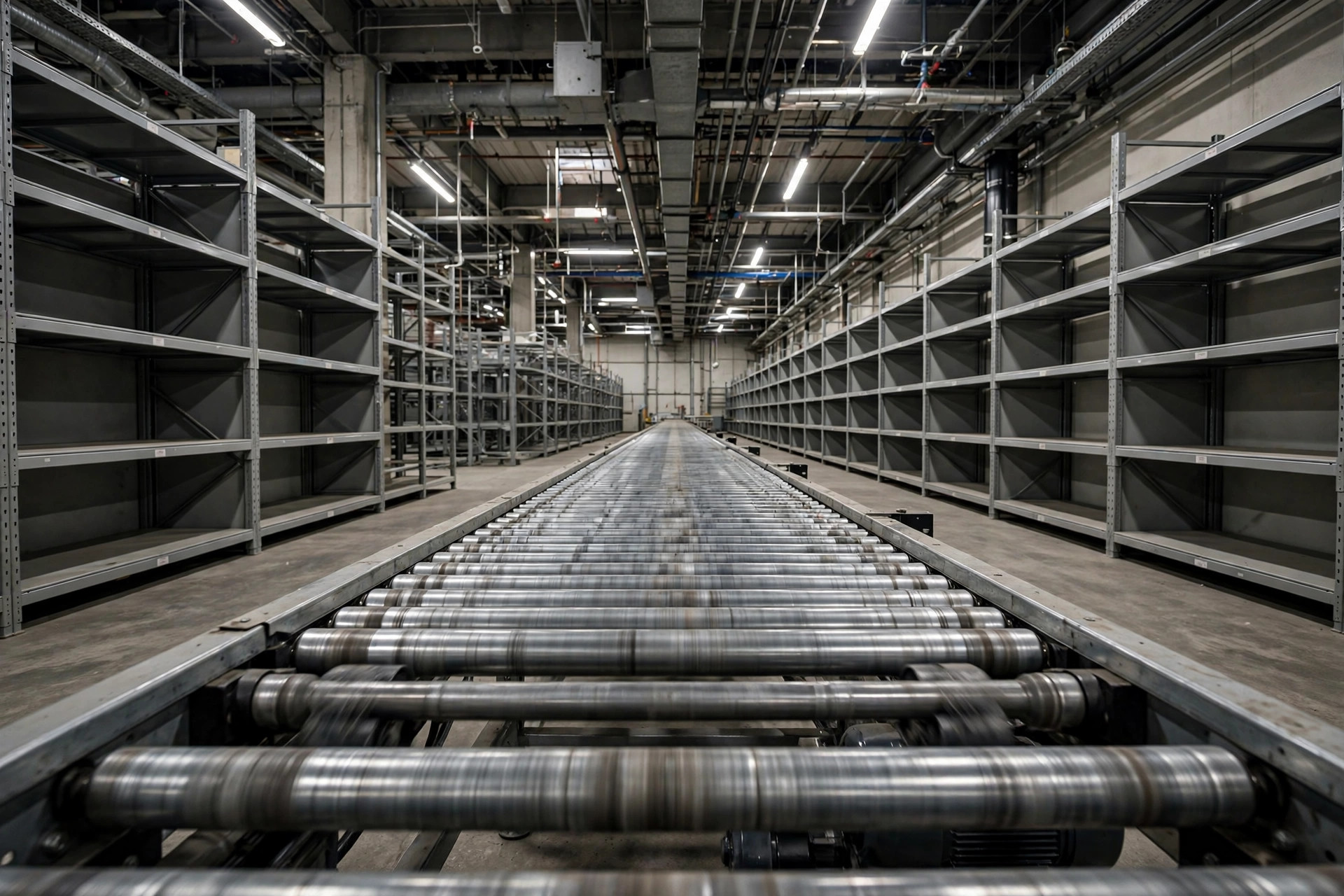
Walk into any small warehouse at lunchtime and you'll see it: the conveyor running full speed at 50 Hz, moving absolutely nothing. That's like driving to the corner store with the gas pedal welded to the floor.
A variable frequency drive (VFD) is, in one sentence, a gas pedal for your motor. Think of it this way: an induction motor's speed is n = 60f(1-s)/p. The pole count is fixed, slip barely moves, so line frequency is the only throttle you've got. Direct-on-line starting welds that throttle at 50 Hz. A VFD lets you ease off whenever you want — and that changes everything about how the line behaves.
What a VFD Actually Protects
Here's what most people miss: a VFD is a motor bodyguard first and an energy saver second.
An induction motor pulls 5–7 times its rated current at direct start — that's just how these motors are built (check any manufacturer's datasheet). A conveyor that starts and stops a dozen times a day takes a dozen current punches to the contactors, windings, and belt splices. A VFD's soft start holds inrush to roughly 1.5× rated, so the motor gets helped to its feet instead of kicked upright. You can hear the difference: no more of that violent belt jerk on every start.
It also brings overload, phase-loss, and over/under-voltage protection built in. In 2021 I was doing a walkthrough at a 3PL warehouse in Guangdong: a carton jammed a roller on a sortation line with no VFD, the motor sat stalled through the whole lunch break, and the windings cooked. Two days to rewind the motor, plus the downtime. With a VFD, overload protection trips in seconds. That alone has paid for plenty of drives I've installed.
Which Conveyor Lines Deserve One: Three Dividing Lines
Time for some straight talk: not every conveyor deserves a VFD. Some integrators spec one on every line — they're selling hardware, not saving you money. Three lines decide whether yours is worth it:
1. The power line. Talk VFDs at 1.5 kW per motor and up. A 0.75 kW motor burns a few hundred dollars of electricity a year at best; the drive never pays for itself. Treat the exact cutoff as the manufacturer's selection guide — this is field-rule magnitude.
2. The hours line. Ten-plus operating hours a day. A line that runs two hours for inbound unloading won't save enough to matter, no matter how efficient the drive is.
3. The duty line. Any one of these tips it: ① you need speed control — manual induct feeding at uneven takt, so line speed has to follow the people; ② long light-load or no-load stretches — e-commerce peaks by day and idles at night, so the line can slow down; ③ frequent starts and stops — the inrush savings and the reduced mechanical shock are real money.
Miss all three and a VFD is a vanity purchase. The payback math stretches past a decade. Don't pay the stupidity tax.
Conveyor Savings Math: Do It Yourself — Don't Trust a Percentage
First, kill a popular myth: people copy the fan/pump "affinity law" — drop speed 20%, power drops 49% (cubic) — onto conveyors. Wrong. A conveyor is a constant-torque load: power = torque × angular velocity, torque roughly fixed, so power tracks speed nearly linearly. Slow down 20%, power drops about 20%, not 49%. Any proposal quoting cubic-law savings on a belt line belongs in the bin.
Here's the honest formula (yours to keep):
Annual kWh saved ≈ total motor kW × (1 − average speed ratio) × annual hours × derating factor (0.8–0.9, covering load factor and efficiency losses)
Worked example — all numbers assumed, plug in your own: a pack-out line with four 2.2 kW motors (8.8 kW total), VFDs holding them at 70% speed on average, 16 hours a day, 300 days a year: 8.8 × 0.3 × 16 × 300 × 0.9 ≈ 11,400 kWh. At typical industrial rates that's on the order of several thousand dollars a year. A 2.2 kW drive costs in the low hundreds, so four of them pay back in months. That's why I call it the smartest retrofit a small warehouse can make.
Real case: in 2023, an e-commerce fulfillment warehouse in Zhejiang ran twelve 3 kW motors on its main sortation loop, 24/7. Between peak waves and overnight lulls they dropped line speed to 60%. Power bills fell — and so did wear: roller and belt replacement parts dropped by roughly a third year over year (their own maintenance records), and the line's MTBF visibly improved with the softer mechanical shock. The energy savings got the budget approved; the maintenance savings were the real prize.
Three VFD Maintenance Traps, Each Paid For in Cash
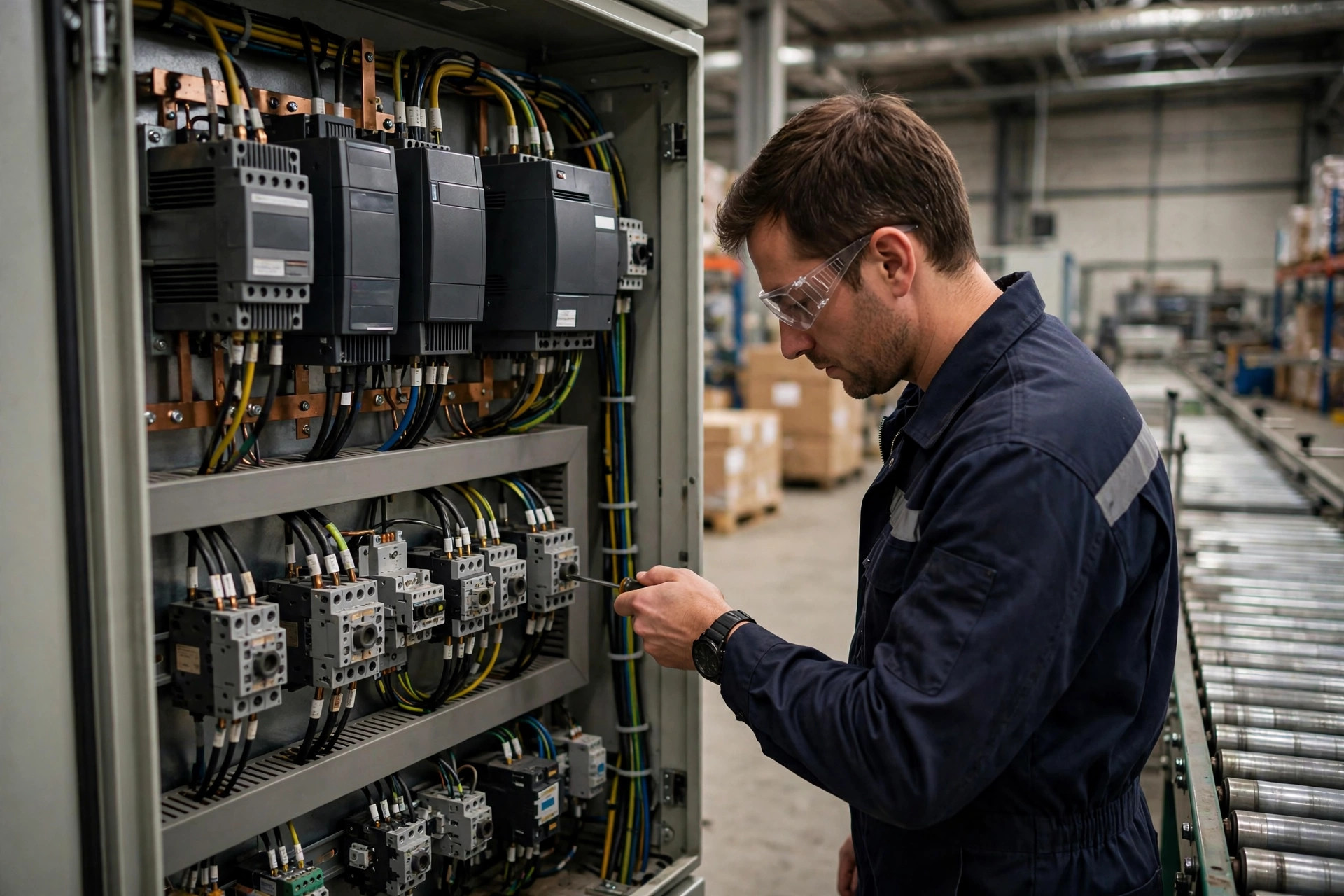
Trap 1: harmonics. A VFD is a harmonic source. One or two, nobody notices. A dozen drives on the same bus and harmonic currents heat the neutral conductor and trip your capacitor bank alarms. Fix: line reactors or filters on the drive inputs, sized per the manufacturer's manual. Don't wait until the capacitor cans bulge to remember this.
Trap 2: low-speed cooling. The most overlooked one. Standard induction motors are self-cooled — the fan sits on the shaft, so at 30 Hz the fan spins at 60% while a constant-torque load keeps making full heat. Winding temperature climbs, insulation ages faster. For sustained low-speed constant-torque duty, monitor motor temperature or add an independently powered forced-cooling fan. Put it on the inspection sheet, not in someone's head.
Trap 3: parameters get "adjusted." A well-meaning tech bumps the max frequency from 50 to 60 Hz to "make the line faster," or cuts accel time to 0.5 seconds for "snappier starts" — and the motor and mechanics die young. That cooked motor in Guangdong in 2021? The postmortem found the night shift had raised the limit to 60 Hz. Commissioning-day rule: lock the parameters, back up the parameter sheet, seal the cabinet. Then leave.
So Is It Worth It? One Number Decides
Payback (years) = total VFD investment ÷ annual electricity savings (add avoided parts and repairs — the number only gets prettier).
Under 2 years: install with your eyes closed. Two to three: worth a serious conversation. Over three: do other retrofits first and let the VFD wait its turn. Motors don't lie — run the numbers before you spend, and you'll never lose.
By Da Liu, Automation Engineer