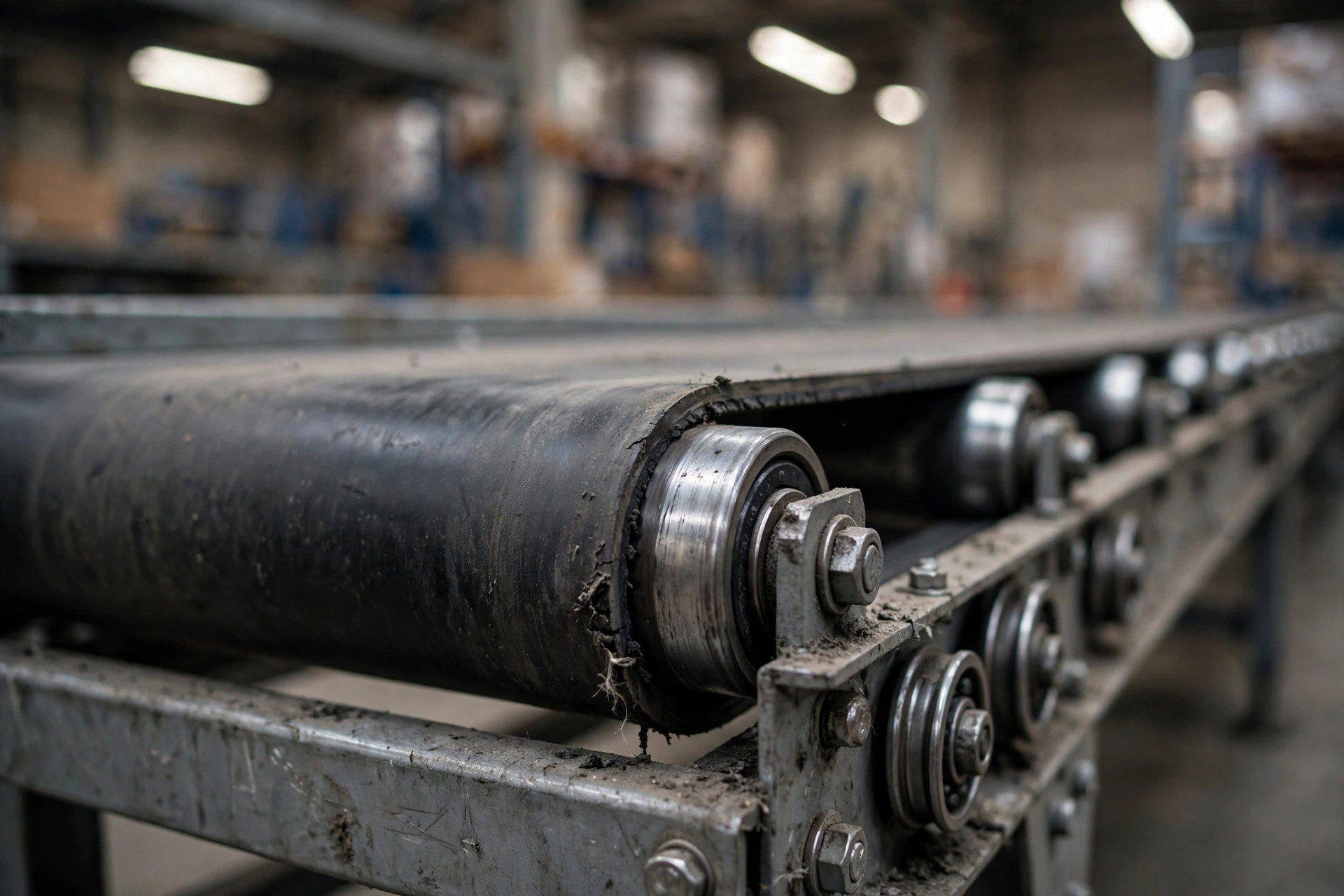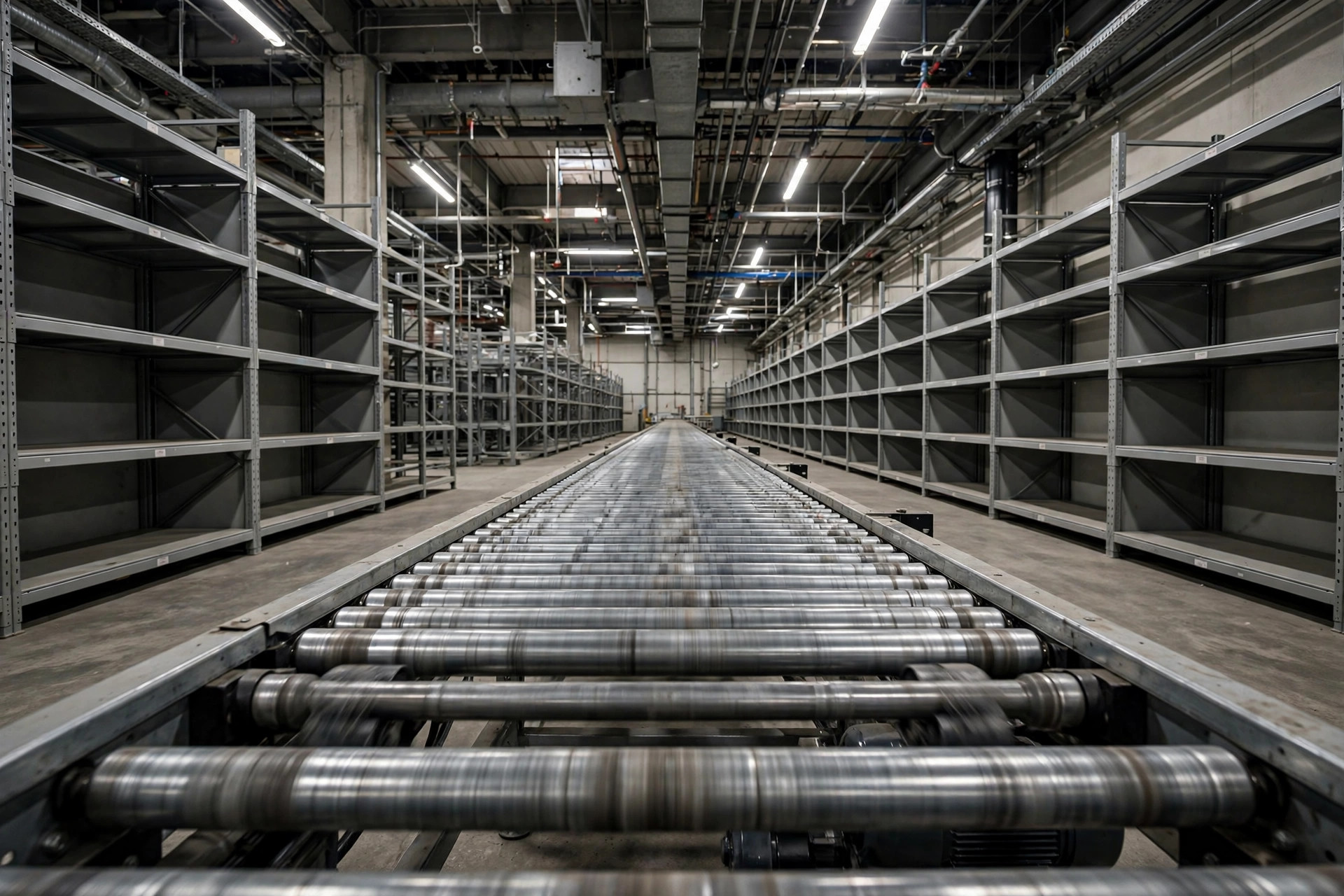
Last month I walked into a 3PL warehouse in Ontario — 120,000 square feet, with an 80-meter roller conveyor running between receiving and putaway. It was 3 PM. Not a single carton on the line. The rollers were spinning anyway. I asked the floor supervisor, and he said: "We never stop it. Stopping and restarting hurts the motor."
I clamped a meter on it right there: 2.1 amps on no load, roughly 1.2 kW of real power draw. That line idles at least 8 hours a day. Over a year, that's the better part of a thousand dollars in electricity — for one drive section. It's like leaving your car idling in the garage all night to "save the starter motor."
Do the math on idle running before deciding it's "just a few kilowatt-hours"
Nobody thinks idle conveyors cost much, because nobody does the arithmetic. Here's a formula any warehouse can use:
A conveyor running empty only fights bearing friction and belt losses, so it draws roughly 30% to 50% of its rated power. A typical 20–30 meter roller section uses a 2.2–4 kW drive motor, which means 1–1.6 kW disappearing into thin air while it spins with nothing on it.
| Line item | Value (estimate) |
|---|---|
| Motor rated power | 4 kW |
| Actual idle draw | ~1.2 kW (30% of rated) |
| Idle hours per day | 8 |
| Operating days per year | 300 |
| Annual idle consumption | ~2,880 kWh |
| Industrial electricity rate | $0.15–$0.25/kWh (check your local rate) |
| Annual idle cost | ~$430–$720 per drive section |
And that's per drive section. A long line often has two or three of them, and a mid-size warehouse runs three to five lines. Two or three thousand dollars a year, gone, without anyone noticing. But electricity is the smaller half of the bill. The bigger half is wear.
Early in 2024, an apparel returns warehouse in Fontana called me in. Their 60-meter belt line saw sporadic inbound during the day and almost nothing at night — but it ran 24/7. In one year they replaced more than 40 sets of idler rollers and one full belt. Every failed bearing had run dry. An empty belt doesn't tension evenly; the sections that tracked off-center chewed their own edges raw. Parts alone ran about $9,000, plus two half-day shutdowns. Next to that, the few hundred dollars of electricity barely registers. Wear is the real line item.
The three scenarios where conveyors idle the most
Idle time isn't evenly distributed. Three scenarios do most of the damage:
Sporadic receiving. Trucks arrive in waves. One gets unloaded, the next hasn't backed in yet, and the 20–40 minute gaps in between add up. This is the most common pattern in smaller warehouses — easily 5 to 8 idle hours a day.
Shift changes and meal breaks. Two-shift operations lose a fixed 1.5–2 hours a day to handoffs and meals. Nobody thinks those two hours are worth walking over to hit the stop button.
The "it hurts the motor" mindset. This one does the most damage. A lot of veteran techs grew up in the across-the-line starter era, when inrush current hit 6–7 times rated and frequent starts genuinely punished motors. But soft starts via VFD are standard now — inrush is held under 1.5x for a few seconds. Think of it this way: back when you crank-started an engine by hand, you had reason to fear stalling. Now that it's push-button start, idling all night is pure waste.
Three fixes — and don't let anyone sell you an "AI energy platform" for this
I'll be blunt about pseudo-needs: some vendors will pitch you an "AI energy optimization platform" for tens of thousands of dollars to solve this. You don't need it. Three fixes, in order of cost:
Fix one: photo-eye zone control. Put a pair of photoelectric sensors at each zone's entry. A zone only runs when product arrives, and shuts down 30 seconds after the last carton clears. A sensor pair costs tens of dollars; a full zone retrofit lands in the hundreds including labor. This is the best ROI in the building — in sporadic-flow applications it kills 70%+ of idle time.
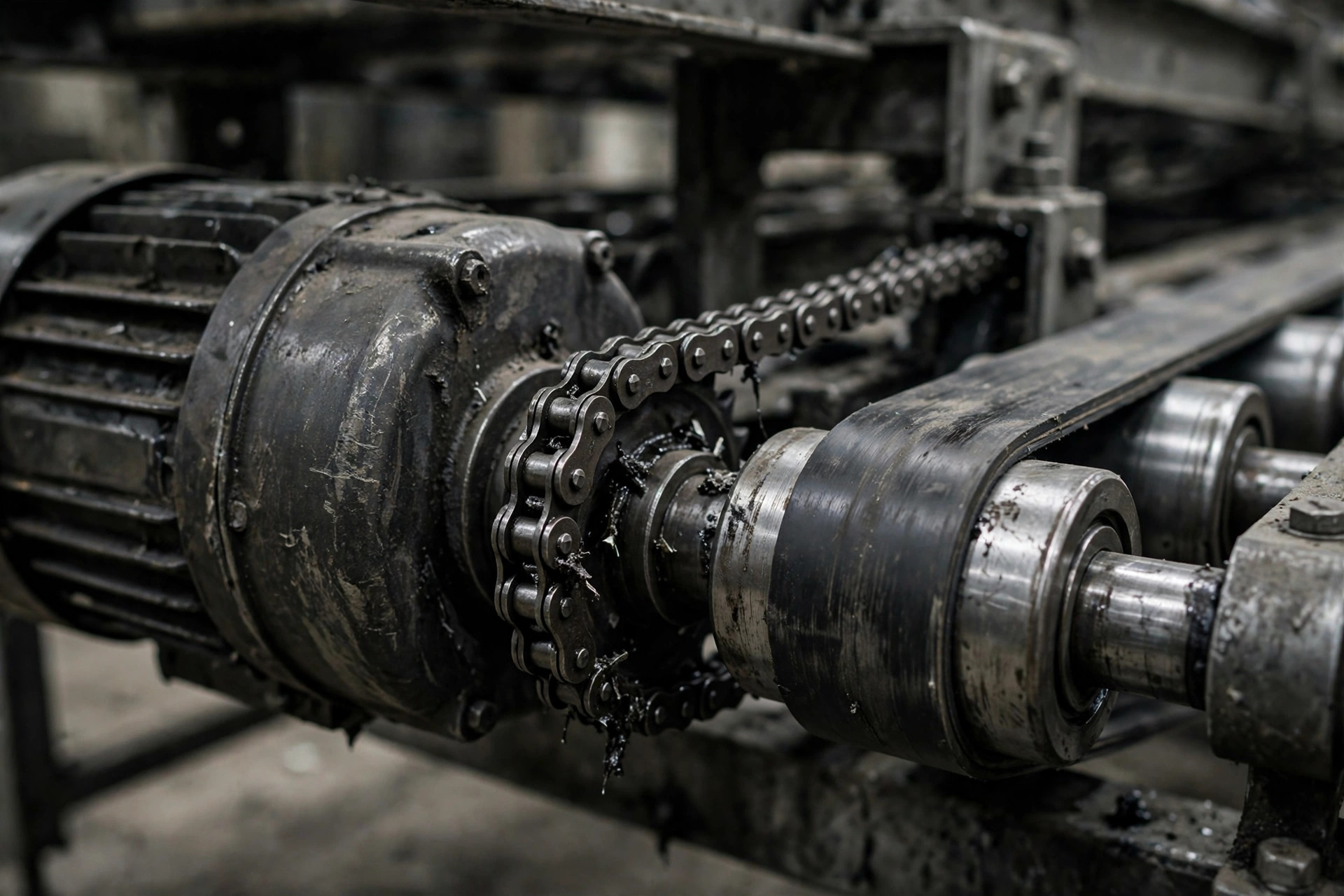
Fix two: VFD creep speed. For operations that dislike frequent starts (noise, belt shudder), program a standby speed — 10–15% when empty, drawing a fraction of the power, ramping up automatically when product arrives. A 4 kW drive costs a few hundred dollars and takes half a day to retrofit.
Fix three: a timer schedule, costing zero. Before spending anything, add two lines of PLC logic: auto-stop during shift changes and meals, auto-warm-up five minutes before shift start. This alone recovers about 2 idle hours a day in many warehouses.
Here's the dividing line: if gaps between incoming product regularly exceed 5 minutes, zone control pays for itself. If you're running continuous parcel-sorter flow where product basically never stops, don't bother — there's barely any idle time to recover, and the retrofit never pays back.
The counterintuitive part: start-up shock vs. continuous wear — which is worse?
The core objection to stopping a line is always "frequent starts damage equipment." That was true in 2005. In 2026, it's wrong.
Start-up stress is a one-time, seconds-long event: once a soft starter tames the current spike, the mechanical hit lands on the coupling and gearbox teeth, and the damage per start is tiny. Idle wear is continuous and measured in hours: every extra hour of spinning consumes an hour of bearing fatigue life; every extra meter of belt travel is a meter of friction. Ten thousand starts cause less cumulative damage than three thousand hours of empty running. It's like refusing to turn off a light because you're afraid of burning out the bulb with switching — the bulb does lose a little switching life, but the power bill and lumen depreciation eat that savings many times over.
And modern conveyor idler bearings are rated by running hours, not by start cycles. Every hour of idle spinning burns their life budget in exchange for nothing but noise and a utility bill.
So stop agonizing over whether stopping hurts the motor. Walk to your electrical room, or clamp a meter on the line, multiply the no-load current by your daily idle hours — whether this money is well spent comes down to one number: the annual idle cost per conveyor section (electricity plus amortized wear). If it's over $500, a few hundred dollars of zone control is a no-brainer. Below that? Then your product flow probably never stops anyway — congratulations, idle running isn't your problem.
By Da Liu, Automation Engineer