Conclusion first: when a sortation line starts mis-sorting, jamming, or "losing" cartons, the root cause is the photoeyes about eight times out of ten. This is a field guide to conveyor photoeye sensor placement — where the sensors go, how far apart, how high — written by a WMS implementation consultant who got dragged onto the warehouse floor one too many times. My edge as a software person looking at hardware: check the signal before you blame the equipment. It saves you a week.
Story One: A 0.7% Mis-Sort Rate, Caused by a Photoeye 800mm from the Merge
September 2024, a 3PL outside Guangzhou pushing 40,000 cartons a day. Their mis-sort rate was stuck at 0.7% and the ops director was getting crushed by customer complaints. By the time I arrived, they had already replaced the scan guns and rewritten their wave strategy. Neither helped.
I made them put the WMS sortation log next to the PLC photoeye signal log. Every mis-sort involved two small cartons entering the sorter back to back. On the floor, the reason was obvious: the gap photoeye at the induction sat only 800mm from the merge point. Two 600mm cartons arriving together looked like one long carton to the sensor. The sorter computed one divert window, and the second carton got kicked to the wrong chute.
The fix was one line of arithmetic: spacing = longest carton + minimum gap + margin. We moved the photoeye to 1,600mm. A week later the mis-sort rate was 0.08%. I have seen this exact failure three times. Every time, the sensors were installed "close enough" — and in conveyor photoeye sensor placement, a spacing error is the most common and most expensive mistake.
Story Two: The Night Black Poly Mailers Turned Invisible
The night before Singles' Day 2023, an e-commerce fulfillment center in eastern China started missing black matte poly mailers. Diffuse-mode photoeyes barely register dark surfaces — the bags ghosted straight through, the cartons behind them piled up, and the line jammed. At 2 a.m., the entire building was clearing the jam by hand.
The fix: swap the critical positions to through-beam sensors, which don't care about color. Since then, my standard commissioning test is 50 runs of the darkest bag and 50 runs of the shiniest reflective carton. Skip that hundred-carton test before peak season and you are flying blind.
Why Placement Decides Sortation Quality: The Software View
Here's the chain: WMS decides where the carton goes, the PLC decides when to divert, and the photoeyes tell the PLC where the carton is. If the photoeye signal is off by one position, the sort is off by one order. So my troubleshooting order is always: signals first, PLC logic second, WMS strategy last. Reverse that order and you can burn a week finding nothing — which is exactly what happened in Story One.
Four Steps to Place Photoeyes Right
Step 1: Work Spacing Backwards from Your Longest Carton
Formula: photoeye spacing ≥ longest carton length + minimum follow gap + margin (200–300mm).
Why: the sensor pair must be able to see "one carton ended, the next began." Space them closer than your longest carton and a long box blocks two pairs at once — the PLC reads it as one over-length carton or two cartons glued together. Both readings are wrong.
Worked example: longest carton 1,200mm, required follow gap 300mm, margin 250mm → spacing at least 1,750mm. Go measure yours. If it's short, move the sensor. Don't debate it.
Step 2: Set Height for Your Shortest Carton
The beam has to hit your flattest package. Mount the photoeye too high and flats and envelopes slide underneath undetected — the sensor might as well not exist.
Two options: drop the sensor close to the belt surface (watch out for belt frame interference), or run high/low dual photoeyes — high for normal cartons, low dedicated to flats. Which one? Look at your mix: if flats are more than 20% of volume, go dual. Don't cheap out on this.
Step 3: Pick the Right Type and Align It Like You Mean It
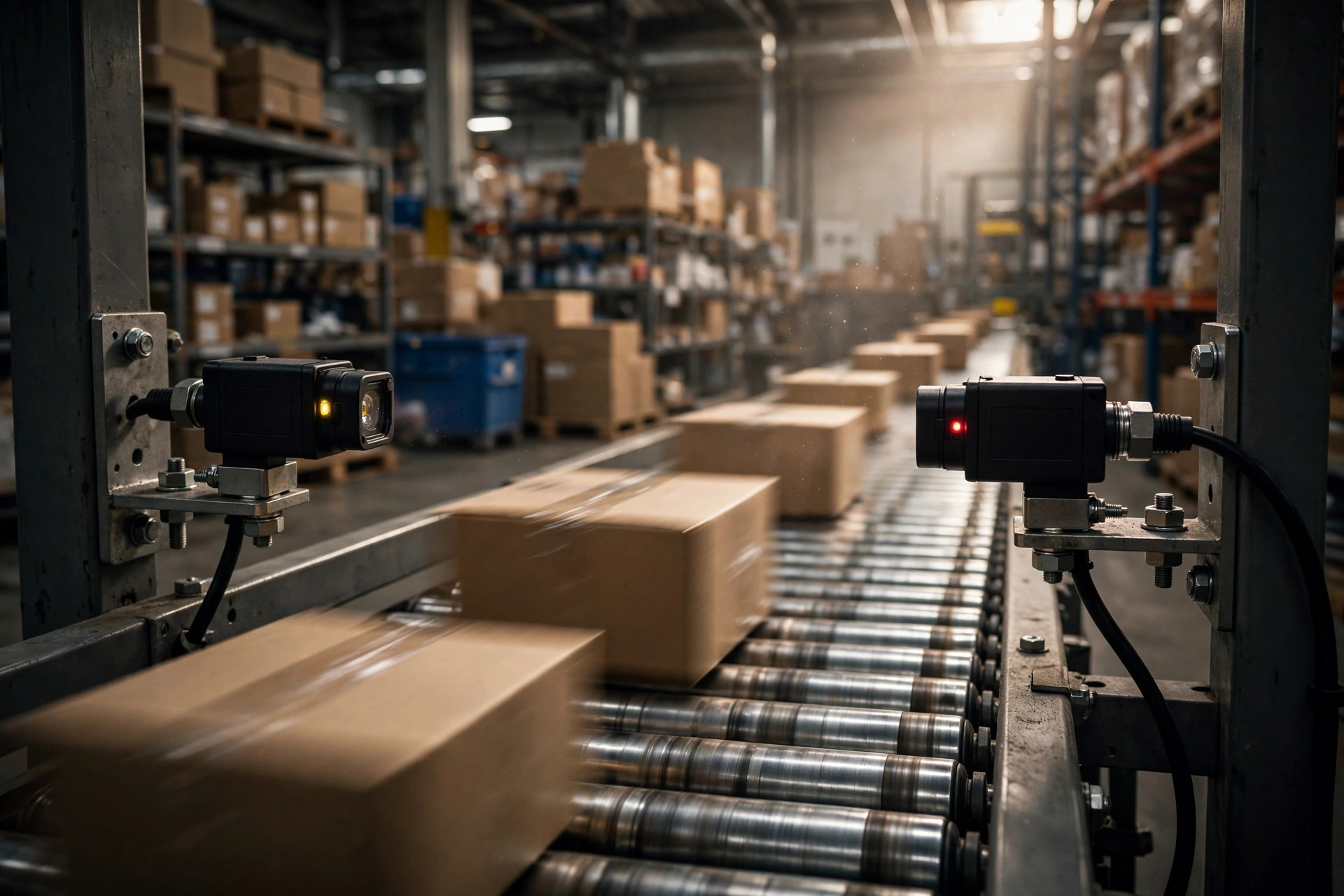
- Through-beam: emitter and receiver on opposite sides. Most reliable, color-blind, best for long distances. Downside: you install and align both sides.
- Retroreflective: sensor on one side, reflector on the other. Easier install — but the reflector hates dust. Three months without cleaning and the false alarms start. I've seen this one three times too.
- Diffuse: one side only, cheapest. Afraid of dark colors and shiny surfaces. Keep it away from any position where accuracy matters.
Alignment is manual labor: through-beam pairs must face each other dead-on, and conveyor vibration knocks them off. Use anti-vibration brackets with locking hardware. I once saw a sensor zip-tied to plain angle iron — a month of vibration tilted it 5 degrees, the signal went intermittent, and it took two days to find a loose bracket.
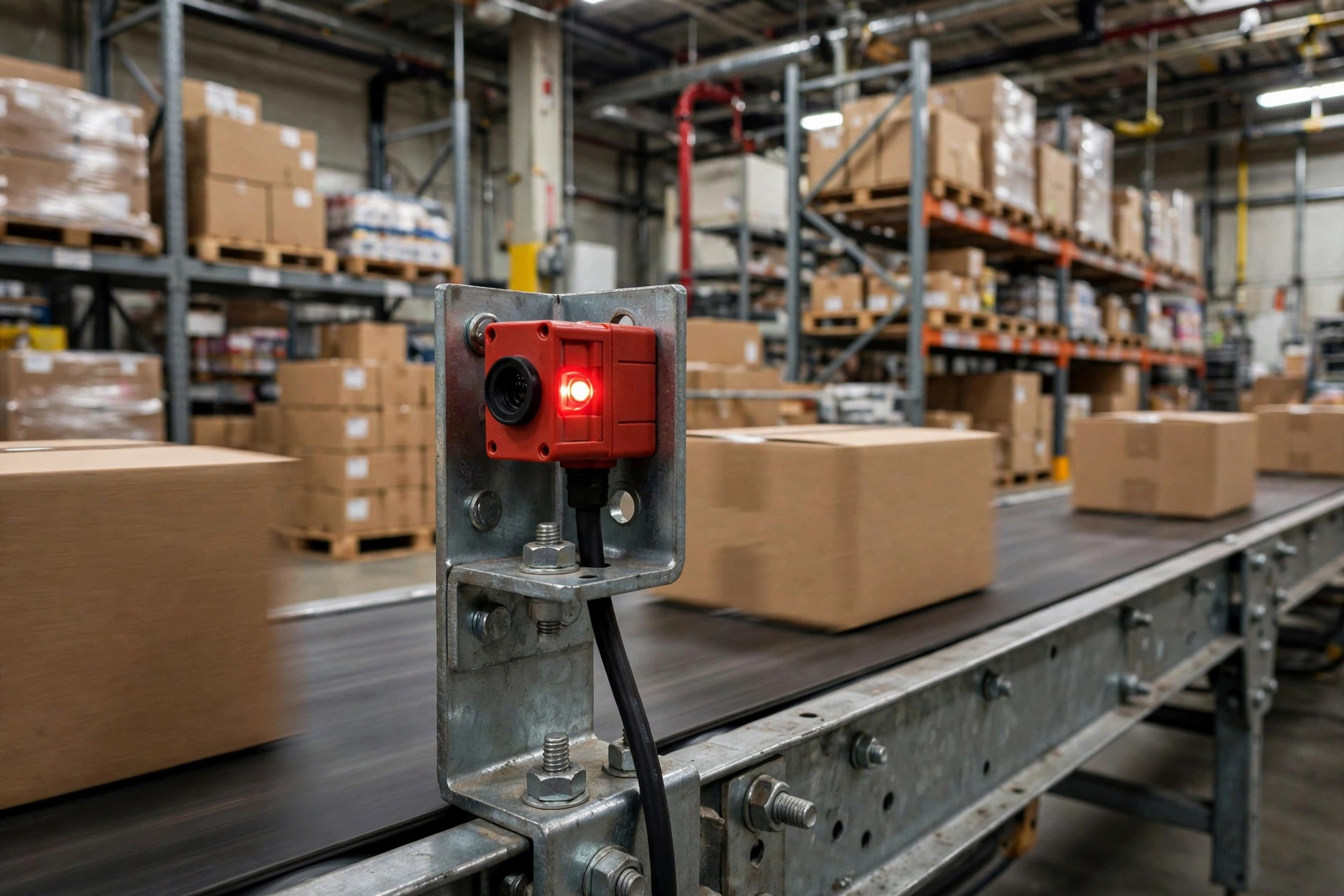
Step 4: The Three Induction Signals Have to Agree
A sorter induction typically runs three photoeyes, each with its own job:
- Gap photoeye: enforces carton-to-carton spacing; holds upstream belt if the gap is short.
- Jam photoeye: blockage alarm — carton dwelling past the timeout stops the line.
- Window photoeye: tells the PLC "carton nose arrived," starting the divert-window timer.
The software person's job: align all three signals between PLC and WMS — signal names, polarity (normally open vs. normally closed), and debounce time — in one mapping table. Mismatched signal names turn every future troubleshooting session into a disaster. On my go-live night checklist there is always this item: block each photoeye by hand and confirm the PLC indicator and the WMS monitoring screen change together. If they don't agree, you don't go live.
One more word on debounce time, the parameter software people always forget. Photoeye signals have chatter — a carton edge wobbles and the PLC sees two or three "carton arrived" pulses. A 30–80ms debounce filters most of it; set it too long and you eat the real signal from small cartons. How to tune: run your shortest carton at top speed, watch the signal, and shrink the debounce until it gets unstable, then back off a notch. Re-verify every time your carton mix changes. Don't set it once and forget it.
Troubleshooting Table: Match Your Symptom
| Symptom | Check first | Most likely cause |
|---|---|---|
| Small cartons read as one long carton | Measure gap photoeye distance to merge | Spacing shorter than longest carton — recalculate per Step 1 and move it back |
| Black/dark packages missed | Sensor type at that position | Diffuse mode can't see dark surfaces — switch to through-beam |
| False alarms with no carton present | Clean reflector, wiggle bracket, look for direct sunlight | Dusty reflector / loose bracket / ambient light interference — clean, tighten, add a sunshade |
| Divert window off, wrong chute | Window photoeye position vs. PLC distance parameter | Sensor moved but PLC distance parameter never updated |
| Intermittent, no pattern | Cable connectors | Loose or wet connector dropping signal under vibration |
Counterintuitive Take: More Photoeyes Is Not Better
The instinct is to add sensors for safety. Wrong. Every added pair is another false-trigger source, another reflector to clean, another 3 a.m. alarm. My rule: fully align the signals you already have between PLC and WMS before buying more hardware. A cheap photoeye in the right position beats an expensive one in the wrong position. Good conveyor photoeye sensor placement is arithmetic and discipline, not hardware stacking.
Go-Live Night Checklist (Steal This)
- Run 30 each of your longest, shortest, darkest, and shiniest cartons. Watch for misses and false triggers.
- Block every photoeye by hand; confirm PLC indicators and WMS screens change in sync.
- Shake every bracket; verify through-beam alignment holds; re-torque the lock nuts.
- Wipe every reflector and photograph it — compare again in three months.
- Write down each photoeye's position, height, and spacing; tape it inside the electrical cabinet door so the next troubleshooting session doesn't start with a tape measure.
Photoeyes are small things, but they're the only eyes your WMS has on the physical world. Blind eyes, wasted brain. Next time sortation goes wrong, don't upgrade the software first — walk the line and look at the photoeyes. Odds are, the answer is right there.
By Lin Xiao, WMS Implementation Consultant