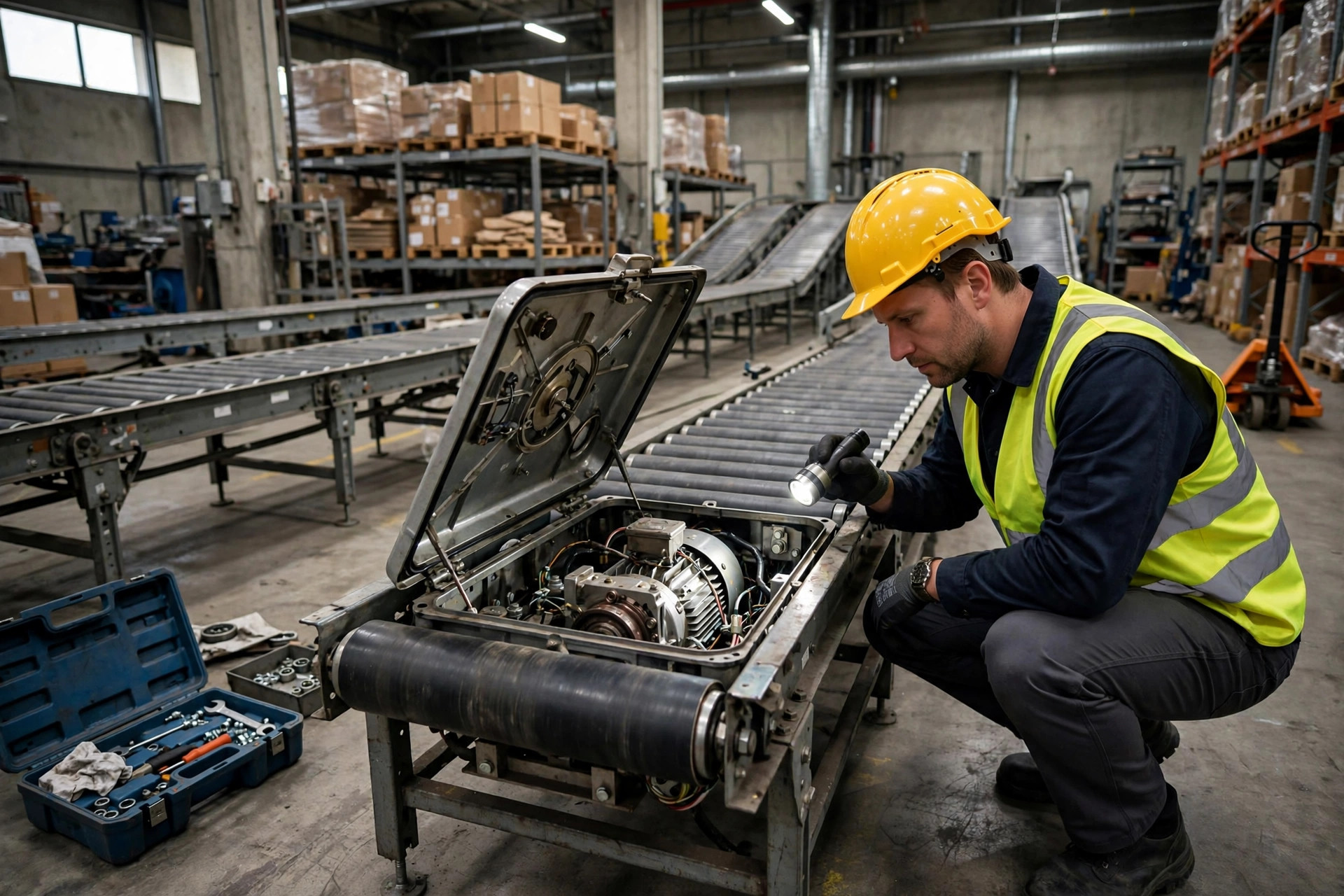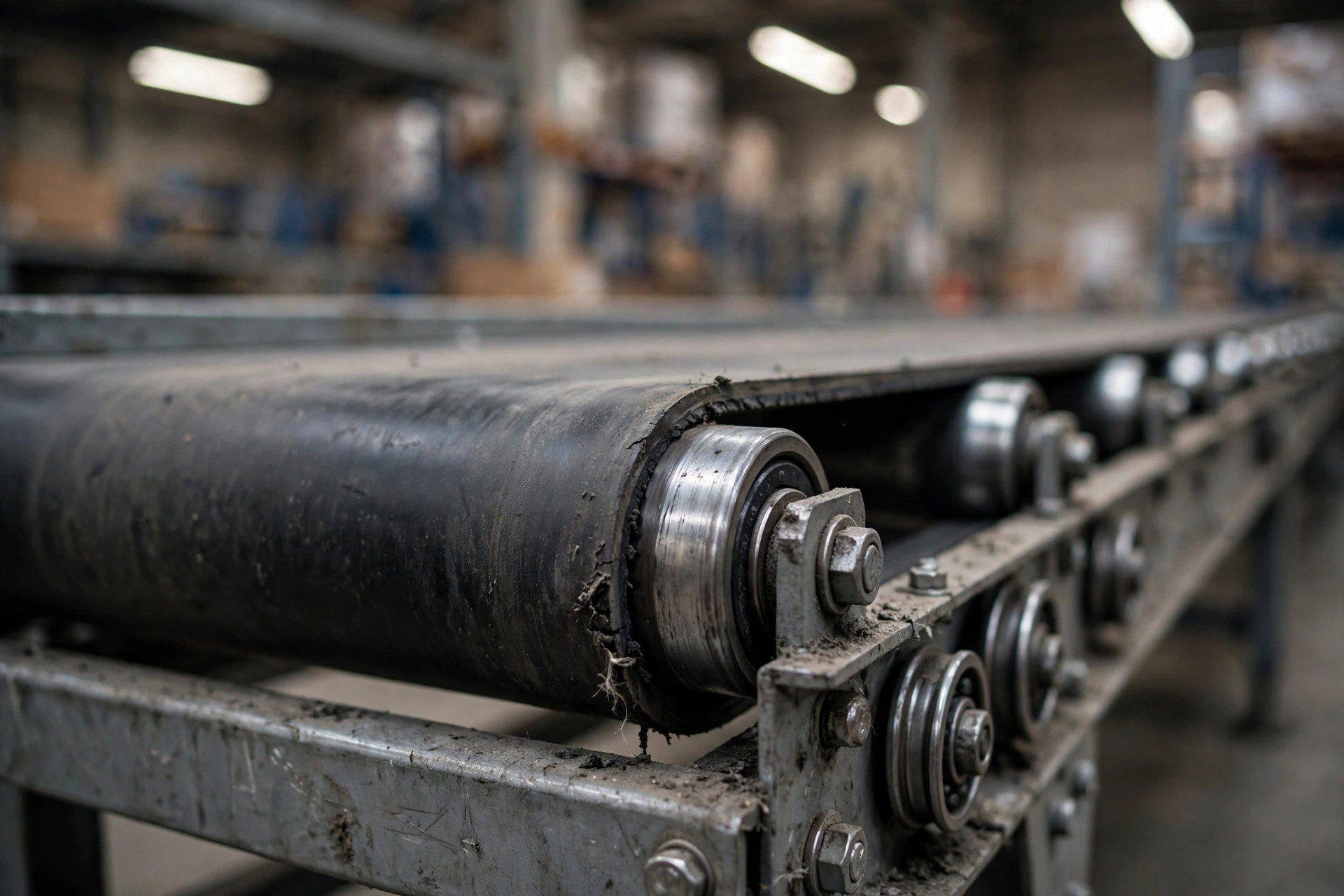
In October 2023 I was walking a 3PL in the Inland Empire on a quarterly check. They had a 130-foot straight belt conveyor whose belt had been drifting left for years — the left frame rail polished into a shiny groove. Monthly service visits, two weeks of peace each time, then drift again. Three years, two replacement belts. I told the manager straight: this is not a belt problem, it is an installation problem.
First, understand why a belt only ever drifts to one side
A belt has no natural talent for running straight. Think of it as an extremely honest employee — it leans toward whichever side has more friction.
The physics is simple: both ends of a roller turn at the same surface speed, but if the roller axis is off square with the belt centerline by even a fraction of a degree, the belt will slide steadily sideways, like a car tire with bad toe alignment. The bigger the angle, the faster the drift.
So belt misalignment is never a sudden failure. It is a geometry problem. Fix the geometry, fix the drift.
Cause 1: Rollers or idlers mounted out of square
The most common cause I see — more than half of all drift cases. Especially on frames that took a forklift hit, or lines where the installer skipped the leveling step to save time.
The analogy: it is like a bicycle wheel mounted crooked in the fork. You ride hands-free and it steers itself into the ditch. Same with a conveyor — an idler frame off by a degree or two, and over a hundred feet of travel the belt walks inches off center.
What it looks like: it drifts even with no load, the whole line drifts the same direction, and it gets worse toward discharge. Stand at the tail and watch the belt edge slide over at a steady diagonal.
Which bolt to turn: the idler support brackets. Loosen the mounting bolts, nudge the idler frame slightly — the rule that trips everyone up: move the leading end of the idler in the direction the belt is drifting. Get it backwards and you make it worse. Snug it down, run ten minutes, judge — one idler set at a time.
True story: that Inland Empire site had a 20-foot frame section a forklift shoved three years earlier. We chalked the belt edge; one revolution later it had walked nearly three inches. Re-leveled that section and the belt has not drifted since. Every monthly adjustment had been on the take-up screws — never the actual problem.
Cause 2: Uneven take-up tension
Most belt conveyors have a screw take-up at the tail, one screw per side. The physics is tug-of-war: the tighter side of the belt sees more friction, so the belt drifts toward the tight side.
What it looks like: check the two take-up screws — if the exposed threads differ by more than a few millimeters, that is your drift. Spring take-ups can do the same thing when one spring fatigues with age.
Which bolt to turn: tighten the loose side half a turn, back off the tight side half a turn — keep total tension constant. Most people just crank the loose side; the belt ends up overtensioned, motor amps climb, and the bearings pay for it. After adjusting, run it empty for five minutes and watch the belt sit centered on the tail pulley.
The contrarian take: tighter is not better. I have lost count of the sites where the response to drift was to tighten everything in sight. A belt only needs enough tension to transmit drive friction without slipping. The test is simple: if it does not slip on a fully loaded start, it is tight enough. Anything beyond that just eats bearings and belts.
Cause 3: Off-center loading, or a bad belt splice
The first two are geometry diseases. This one is a load disease and a splice disease.
Off-center loading is like carrying a shoulder pole with one heavy end — it slides toward the heavy side. If the feed point drops product consistently off to one side, asymmetric loading will drift the belt sooner or later. In the field: product keeps falling off one side, or the load visibly piles to one side of the belt.
Bad splice: if a vulcanized splice is not flat, or a mechanical splice went on crooked, every revolution the splice thumps over a roller and kicks the belt sideways. Stand at one spot and watch the belt edge: if it wobbles side to side with a period exactly equal to one belt revolution, the splice is your culprit.
Early 2024, a food distributor called about a sortation line where the belt kicked right every so often, then came back. I counted revolutions for ten minutes: one kick per revolution. One side of the vulcanized splice was nearly 2 mm thicker. Re-did the splice, problem gone. No idler adjustment would ever have fixed it — the disease was in the belt itself.
Belt misalignment: three causes, one cheat sheet
| Symptom | Idlers out of square | Uneven take-up | Loading / splice |
|---|---|---|---|
| Drifts with no load? | Yes | Yes | Splice: yes; loading: no |
| Drift direction | Whole line, same direction | Usually near the tail | Periodic wobble, or follows the load |
| Gets worse or steady? | Worse toward discharge | Parks against the frame rail | One kick per revolution, like clockwork |
| How long does a fix last? | Permanent, if you found it | Permanent, if you found it | Idler tweaks will not help — fix splice/feed point |
| First place to look | Idler brackets, frame | Tail screw marks | The splice, the feed point |
Field checklist: where to look first
Do not start turning bolts the moment you walk up. Run this sequence and you will have it localized in about half an hour:
- Stop the conveyor. Lockout/tagout. A belt conveyor will take your hand off — stay alive first, fix second.
- Run it empty 3-5 minutes. Stand at the tail: which way does it drift? Whole line or one section?
- Note the direction, then compare the two take-up screw positions. Big difference — even that out first.
- Walk the line. Look for frame or idler damage, especially where forklifts pass.
- Find the belt splice. Watch the edge there — does it wobble on a one-revolution period?
- Check the feed point: is product landing off-center?
- Adjust one variable at a time. Run ten minutes before judging the result.
- Still drifting? Stop adjusting and read the trade-off below.
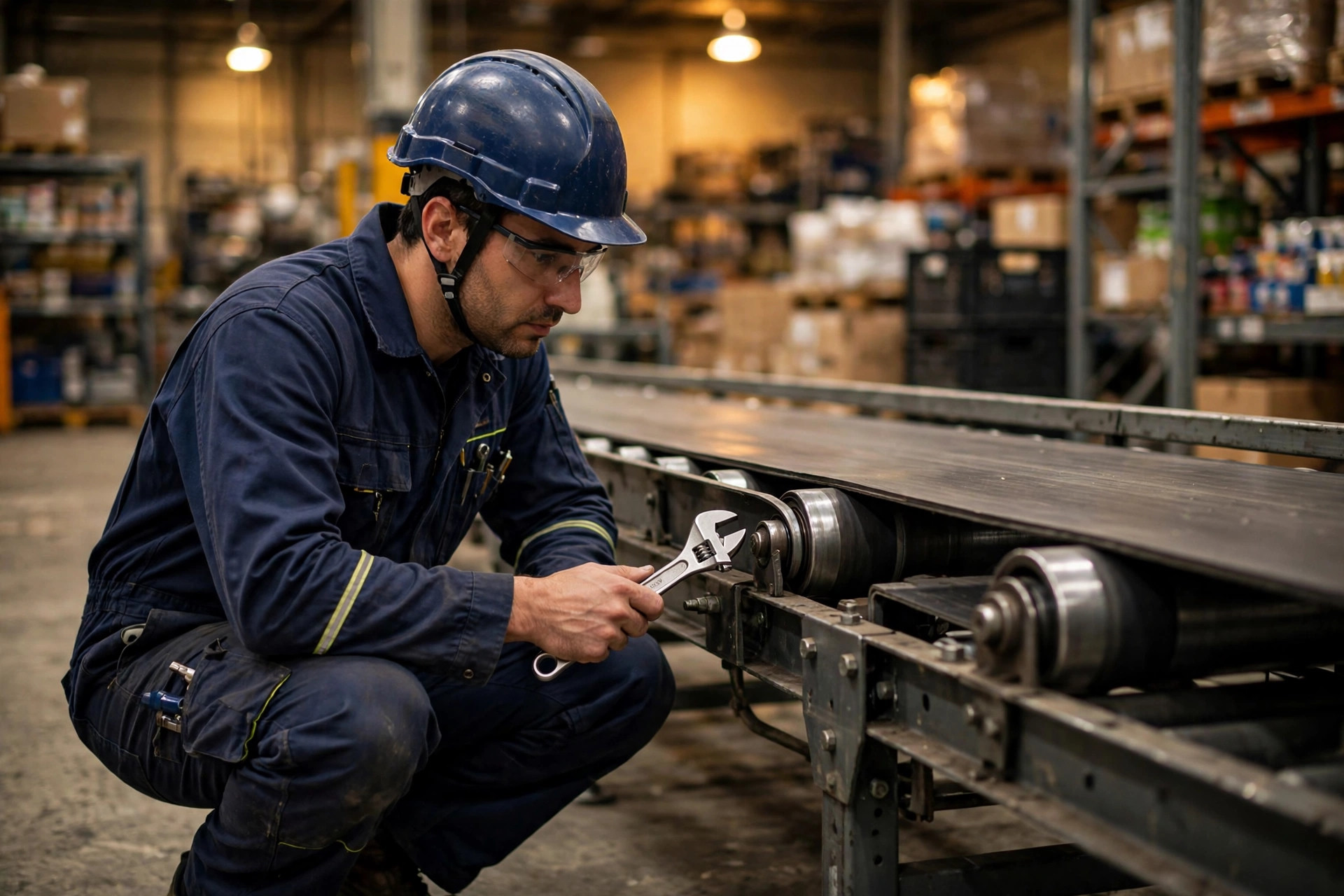
The trade-off: keep adjusting, replace the belt, or call the vendor
Three options, pick honestly:
Keep adjusting it yourself: cheapest — just labor. But if you have run the checklist and it still drifts, the root cause is not geometry anymore. It is the belt (splice, carcass damage) or a bent frame. More adjusting is just expensive reassurance.
Replace the belt or re-do the splice: a bad splice is an order of magnitude cheaper to re-vulcanize than a full belt replacement. But if the belt edge is frayed and thinned from a year of rubbing, the belt is done — a new splice is throwing money away. Rule of thumb: edge wear past about 5% of belt width, or a year of rubbing, means replace the whole belt.
Call the vendor or integrator: when do you admit defeat? Bent frames, bent pulley shafts, a whole line installed out of level — jobs that need a laser alignment kit and real tooling. You will pay for it, but it is done once, done right.
One sacred cow: automatic belt trainers. Vendors sell them as a cure for drift. My take is blunt — if the three causes above are not ruled out, a trainer is painkillers, not surgery. Get installation and tension right first, then decide on the gadget. Reverse the order and you are buying reassurance.
Is it worth the money? One number decides
Add up last year's drift-related stops — how many, how long each — multiply by the line's hourly throughput value, and compare against the cost of one proper fix.
The proper fix usually costs a fraction of the unplanned downtime. That Inland Empire site spent three years, two belts, and monthly stoppages — enough to re-install and re-level the whole line twice over. A drifting belt is never a small problem. It is the most expensive way equipment can tell you the foundation was never right.
By Da Liu, Automation Engineer