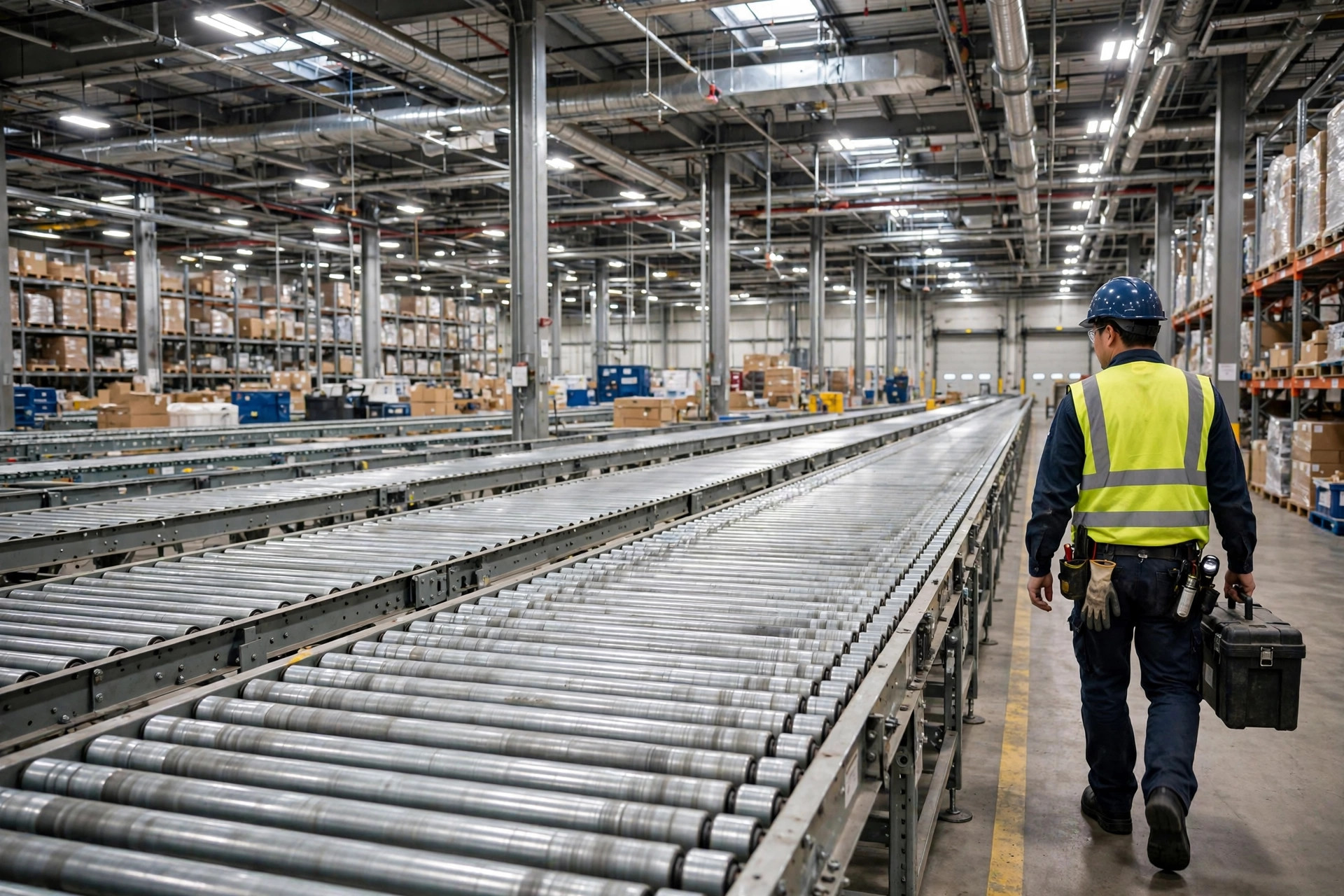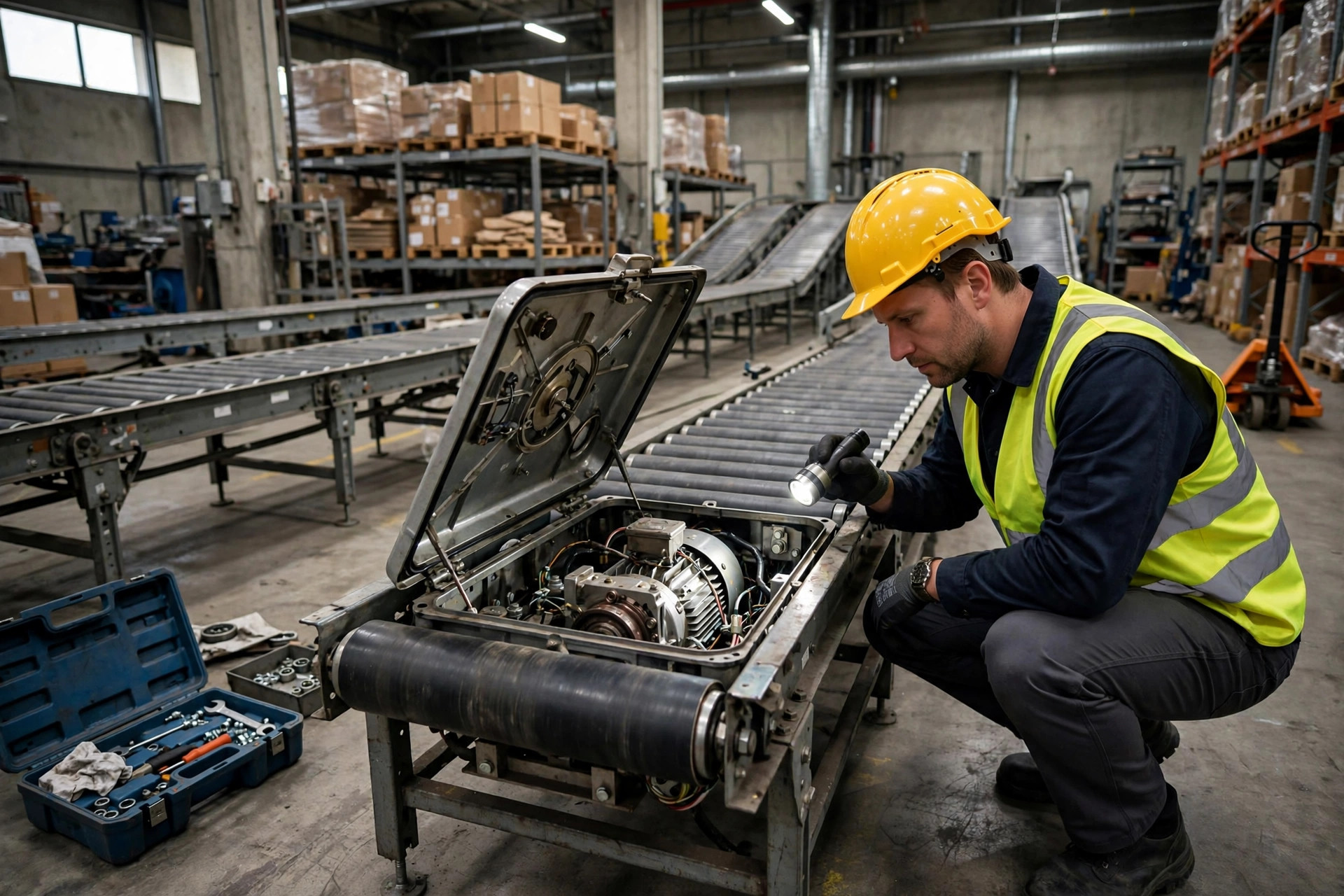
Last October, the owner of a 3PL distribution center in Guangzhou called me, voice shaking: the main conveyor line's drive motor had burned out, no spare in stock, and the supplier needed three days to deliver — right before peak-season inbound. It's like blowing your engine on the highway and finding out there's no spare tire in the trunk.
That incident brought back an old question I get every year: what should warehouse conveyor maintenance cost, really? Nine out of ten warehouse owners budget for parts and labor, then spend the whole year "over budget." The truly expensive line item is the one nobody dares to budget: downtime. You can at least see the repair bill. Downtime burns money invisibly — there's not even a line for it on the P&L.
The principle: warehouse conveyor maintenance cost is only ever three numbers
Any conveyor system's annual maintenance cost breaks into three parts. Think of it like owning a car: parts are the oil filters, labor is the shop's hourly rate, and downtime is the taxi fares plus lost workdays while your car sits dead. The first two are the bills you can see. The third is the one you can't — and it's usually the biggest.
The formula, up front: Annual maintenance cost = spare parts + maintenance labor (incl. service contracts) + downtime losses
For downtime I always use this framework: downtime hours × hourly throughput value of that line + re-routing fees for missed cutoffs + idle labor cost. Hourly throughput value = line speed × units per hour × average unit value. Plug in your own warehouse's numbers, not someone else's.
Those three line items added up are the complete picture. Leave any one out and the budget lies to you.
Line item one: spare parts — where the money actually goes
Conveyor spare parts have a personality: it's always the same few things that fail. Belts, rollers, and bearings are the big three consumables — they eat the bulk of the annual parts budget (exact share varies; check your service provider's latest quote). Drive motors and gearboxes fail far less often, but when they do, the expedited purchase of a single unit can make your eyes water.
The dividing line for spare-parts strategy is exactly one question: if this part fails, can you fix it the same day?
For standard items like motors and gearboxes, my iron rule is: keep one of each on the shelf. It doesn't tie up much capital, but it compresses a failure's downtime from three days to three hours. Stock belts, rollers, and bearings at safety levels matched to consumption rate. Don't apply "zero inventory" thinking to spares — the few dollars you save on inventory get wiped out by a single line stoppage, with interest.
One more trap: spares that don't match your aging system. A conveyor that's been running eight years, the manufacturer has moved two generations on — the roller you rush-ordered arrives with a shaft 2mm off and won't fit. Money wasted. Write "spare-parts compatibility verification" into your service contract, or keep your own spares ledger (part number, spec, substitutes). Don't wait until you're desperate to dig out the drawings.
Line item two: labor — your own electrician or an outsourced contract
This dividing line is equally clean: is your total conveyor length over 500 meters, or do you have more than five single points of failure?
Neither: train your own electrician or mechanic, run a weekly preventive checklist — belt tracking, roller noise, motor temperature. The annual labor increment is small and response is fast. I've seen 3,000-square-meter warehouses hit 99%+ uptime with one veteran technician and an infrared thermometer.
Either: stop toughing it out and sign a preventive maintenance contract. Per industry market reports, a preventive maintenance contract typically runs 8–12% of the original system value per year. Sounds painful? Read the next section before you decide.
Here's the counterintuitive part: you're not buying "repairs" with a maintenance contract — you're buying "not breaking down." A decent service provider visits a dozen times a year, replacing bearings that haven't failed yet but are about to, re-tracking belts that drifted a few millimeters. With in-house staff, the pattern is usually "fix it when it breaks" — and one breakdown's downtime loss covers half a year of contract fees. It's the difference between an annual physical and an ER visit: one ER trip costs as much as ten years of checkups.
Line item three: downtime — the priciest slice of warehouse conveyor maintenance cost
November 2024, a 3PL hub in eastern China doing 30,000 parcels a day. I happened to be on site for a project and logged the full timeline: the main line's drive motor burned out at 2 PM on a Tuesday, the spare arrived Friday, and they jury-rigged a motor off a branch line — the main line lost roughly 9 hours cumulatively (estimate). Direct hit: about 4,000 parcels missed the daily cutoff (estimate) and got re-routed via express couriers at several yuan more per parcel — the re-routing alone cost tens of thousands of yuan. Indirect hit: 60+ sorters standing idle, night shift forced into overtime. Add it up, and one incident burned enough money to pay for two years of a maintenance contract.
Contrast that with a pharma warehouse in southern China: 800 meters of conveyor, signed a preventive contract at 10% of system value in 2024, and logged 1.2 hours of unplanned downtime for the whole year — versus 26 hours in 2023 when they did their own repairs (figures from project records). The contract fee looked like "extra" spending. It was the cheapest money they spent all year.
There's a multiplier people forget: the peak-season factor. One hour of downtime in the slow season costs X; one hour the week before peak costs 5X. Budget downtime losses at peak-season rates, not slow-season ones — don't comfort yourself with the cheap number.
The dividing line: is an 8–12% contract actually expensive?
| Model | Fits | Annual cost level | Unplanned downtime | Risk |
|---|---|---|---|---|
| Reactive (fix when broken) | Short lines, few single points of failure | Parts + ad-hoc labor, lowest | Highest | One big incident wipes out a year's savings |
| In-house preventive | Mid-size DCs with dedicated mechanics | Labor + parts, medium | Medium | Depends on the veteran tech — knowledge walks out the door with him |
| Outsourced preventive contract | Long lines, many failure points, can't afford to stop | 8–12% of system value/yr (market-report basis) | Lowest | Read the contract terms; lock in response SLAs |
One sentence for the dividing line: the moment your warehouse "can't afford to stop," stop asking whether 8–12% is expensive. A hub moving tens of thousands of parcels a day loses more in one stopped hour than the whole annual contract. A small warehouse doing a few hundred parcels a day should stock the critical spares, keep the checklist habit, and spend where it counts.
The maintenance traps: three I've stepped in, plus one pseudo-demand
- Replacing the belt without re-tensioning. A new belt installed with a tracking drift shreds one edge within a week — money thrown away. Belt replacement must include tensioner calibration. It's basic work, but rushed contractors skip it. Check it at acceptance.
- Not logging MTBF data. Which roller fails twice in six months, which motor runs three years without a hiccup — if it's all in someone's head, your spares stocking is guesswork. Log failure time, location, and repair duration in a spreadsheet; three months in, you'll see the pattern. It's also your leverage when negotiating with service providers.
- The checklist that dies in month two. Plenty of warehouses fill out the inspection sheet religiously in month one and are just ticking boxes by month three. My fix: keep it under 10 items, each checkable in a minute, posted on the electrical cabinet door, photo sent to the group chat when done. A checklist that becomes theater is worse than no checklist.
And one shot at a pseudo-demand: some vendors now lead with vibration sensors plus AI prediction. Sounds impressive. My blunt take — a warehouse that can't keep a weekly checklist alive for three months has no business talking about predictive maintenance. Get the basics of prevention right first, push uptime past 99.5%, then talk. Buying AI before the foundation is solid is burning money on theater.
So is the money worth it? It comes down to one number: annual unplanned downtime hours × hourly downtime loss ÷ total annual maintenance spend. Above 3, the spend is working — keep going. Below 1, the money went out but downtime didn't come down — change the service provider or upgrade from reactive to preventive. Between 1 and 3, tighten the spares strategy and the inspection cadence.
Conveyor maintenance is that concrete: no mystique, just three line items. Run the numbers, and you'll have your own answer on what warehouse conveyor maintenance cost should be.
By Da Liu, Automation Engineer