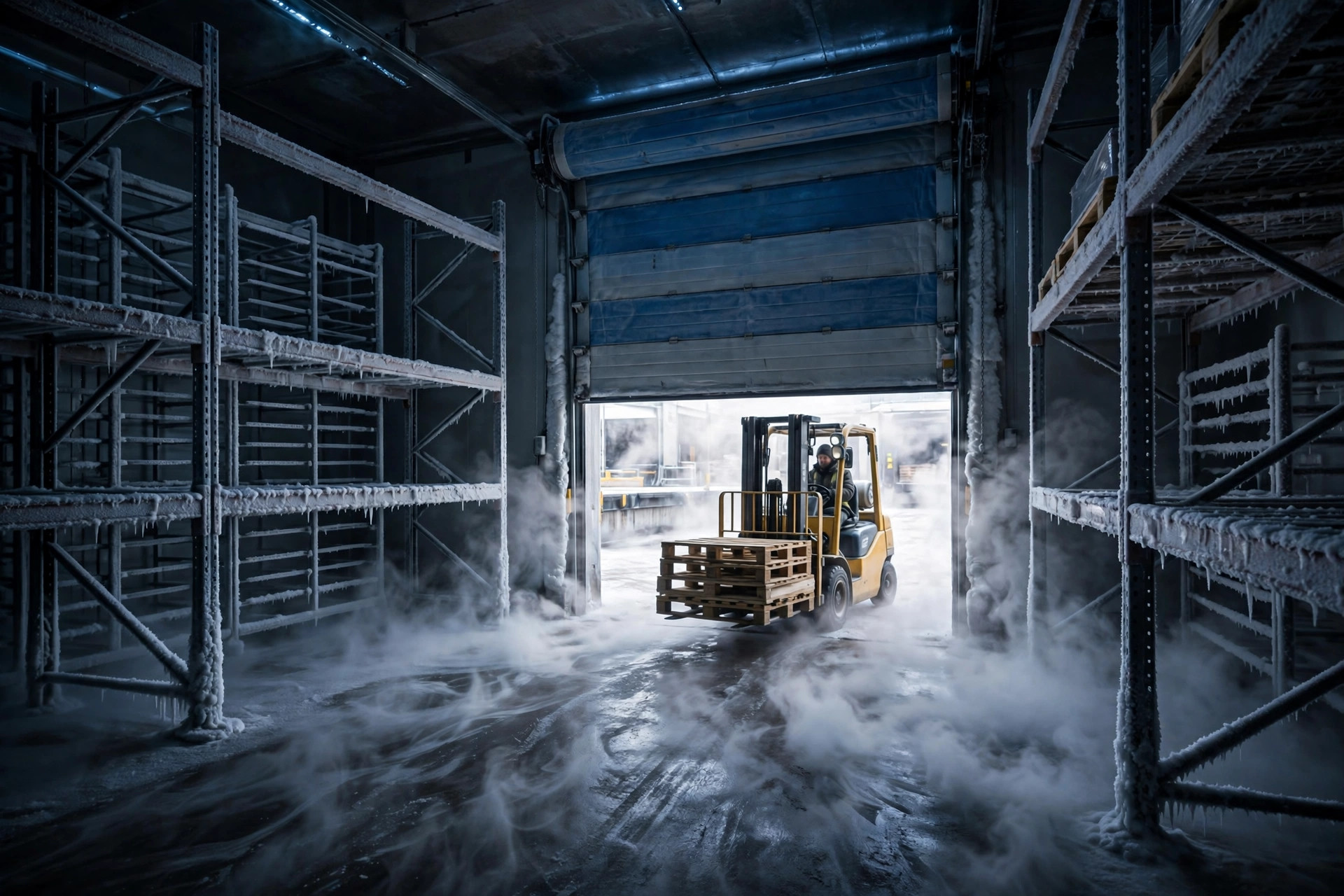
The phone rang at 4:30 in the morning, a week before Thanksgiving last year. It was my buddy Lao Chen, who runs a cold storage warehouse out in Fresno. "Feng, you gotta come look at this. My power bill keeps climbing, and there's a sheet of ice at the dock door — the forklifts are sliding."
I drove over at daybreak. Sure enough: one standard insulated sliding door at the dock, opening and closing hundreds of times a day during peak season. Frost caked on the door track, a puddle frozen solid on the floor. The night-shift guys told me one open-close cycle takes almost half a minute, so when they're in a rush they just leave the door wide open and run forklifts straight through. "We're gonna open it again anyway — why bother closing it." Folks, that's exactly where the money burns.
Here's the thing about cold storage: the enemy isn't an undersized compressor. It's the door. Every time it opens, cold air pours out and warm air rushes in, and the compressor has to work overtime. Moisture comes in with it, the evaporator ices up, and defrosting costs you another chunk of electricity. So today we're settling it: high-speed doors vs air curtains for cold storage energy savings. I've put all three options through their paces, so you don't have to.
Slow Doors Hurt Where It Counts: The Power Bill
I'll be honest — I used to run ambient warehouses, so cold storage doors were new territory for me. What got me serious was a 2024 visit to a food processing plant in Ohio: a 20,000-square-foot freezer running at -5°F while summer outside hit 95°F. They already had a high-speed insulated roll-up door. Should've been fine, right? Except with hundreds of cycles a day, the room temperature still swung 8 degrees, ice built up at the doorway, the floor turned slick, and the refrigeration system ran flat-out all day.
Then they mounted a 12-foot-wide air curtain above the doorway, interlocked with the high-speed door: the curtain ramps to full speed before the door opens and keeps blowing for one second after it closes. That one change cut the temperature swing from 8°F down to under 2°F. Energy and maintenance savings ran into the thousands of dollars per month, and the whole thing paid for itself in about a year. This was covered by Modern Materials Handling — real numbers, real plant.
That trip sent me down the rabbit hole: high-speed door, air curtain, or plain insulated door — which one actually saves energy? You can't trust the sales brochures. You have to run the numbers.
All Three Doors Cost Me Tuition
First, the plain insulated door. Cheap — about ten grand installed, door and all. When it's closed, the insulation is genuinely good. The problem is speed: a full cycle takes tens of seconds. During peak season, forklifts are queued up — who's going to wait? So the door ends up standing open all shift, and all that insulation is worth nothing. Honest truth: plain doors belong on openings you use a few times a day — backup storage, rarely used partitions. Put one on a busy dock and you're burning money on the power bill.
Next, the air curtain. Dead simple concept: a wall of air above the doorway that keeps warm air out and cold air in. A 10-foot industrial air curtain in the US runs three to four thousand dollars for the unit; installed, you're under six grand per doorway (published reference pricing from Berner). Cheap, no waiting, forklifts pass straight through. But here's the counterintuitive part, folks: the air curtain itself uses electricity. That's a one-to-two kilowatt fan running for hours. It adds up over a month. And while the air wall blocks convection, it can't stop the moisture that forklifts drag in — the doorway still frosts up.
Finally, the high-speed door. It opens and seals in seconds. A freezer-rated high-speed door installed in the US runs $26,000–$29,000 (published distributor pricing) — four to five times the air curtain setup. But it saves where it matters most: cold loss. One manufacturer's guide measured high-speed doors plus companion efficiency measures cutting a cold storage power bill by over 30% (35% — vendor number, take it with a grain of salt).

High-Speed Door vs Air Curtain Energy Savings: Running the Numbers
Line the three options up and the math gets clear:
| Plain Insulated Door | Air Curtain + Plain Door | High-Speed Roll-Up Door | |
|---|---|---|---|
| Installed cost per door | about $10,000 | about $15,000 | $26,000–$29,000 |
| One open-close cycle | Tens of seconds | No waiting | A few seconds |
| Cold loss | Everything escapes while open | Blocks most convection | Shortest open time, least loss |
| Frost buildup | Severe | Still frosts at the doorway | Noticeably reduced |
| Its own power draw | Near zero | Fan runs continuously | Intermittent motor, minimal |
| Maintenance | Tracks and seals wear out | Filters, bearings | Curtain and motor servicing |
| Best for | A few cycles a day | Mid-frequency doors, tight budget | High-frequency, hundreds of cycles daily |
For high-speed doors vs air curtains for cold storage energy savings, the whole argument fits in one line: the more often the door opens, the more the high-speed door pays off. That's the entire cold storage energy savings debate in a nutshell — don't ask which door is better, ask how many times your door opens each day.
My rule of thumb is dead simple: count your door cycles. Over 200 cycles a day? Get the high-speed door, don't think twice — the power savings pay for the door in about a year. A few dozen cycles? Air curtain plus a plain door is the sweet spot — small investment, fast payback. Just a handful of cycles? Keep the plain insulated door and replace the seals on schedule. That beats everything.
And here's the counterintuitive conclusion most people miss: that Ohio plant ended up running the high-speed door AND the air curtain together. Fast door plus a wall of air at the opening — temperature swing crushed down to under 2°F. Stop agonizing over "pick one." On a high-frequency doorway, the combo punch is the real answer. Over in Europe, a cold store swapped its traditional air curtain for a high-efficiency air door and cut the whole freezer room's power bill by 13.5%, paying back in under two years (published AFIM case).
Cold Storage Energy Savings in Practice: This Is How We Run It Now
Back at the Fresno warehouse, we did exactly this: the two high-frequency dock doors got high-speed doors, each with an interlocked air curtain above it; the rarely used partition doors in the back kept their plain insulated doors with brand-new seals all around. Three months later, Lao Chen told me the doorway doesn't ice up anymore, the night shift stopped chipping ice with shovels, and the power bill finally looks reasonable.
Honestly, there's no rocket science in cold storage doors. The hard part is not spending money stupidly. Expensive isn't always right, cheap isn't always savings — it all comes down to how many times your door opens each day. Folks, go count your door cycles for three days before you buy anything. That one sentence is worth the price of a door.
By Chen Feng, Warehouse Operations Manager