
On the day a cold storage automation project was signed off, the manager of a frozen-food distribution warehouse in Langfang pulled me into the meter room and pointed at the meter. The equipment was running, he said, so why had the power bill gone up? Before cold storage automation went live, that warehouse's monthly electricity bill moved around a range in the low hundreds of thousands of yuan. In the first three months after go-live, it rose by roughly ten percent. Nothing was broken in the obvious sense, and nobody had misread a meter. The cold itself had quietly magnified a set of small losses that the business case never priced in.
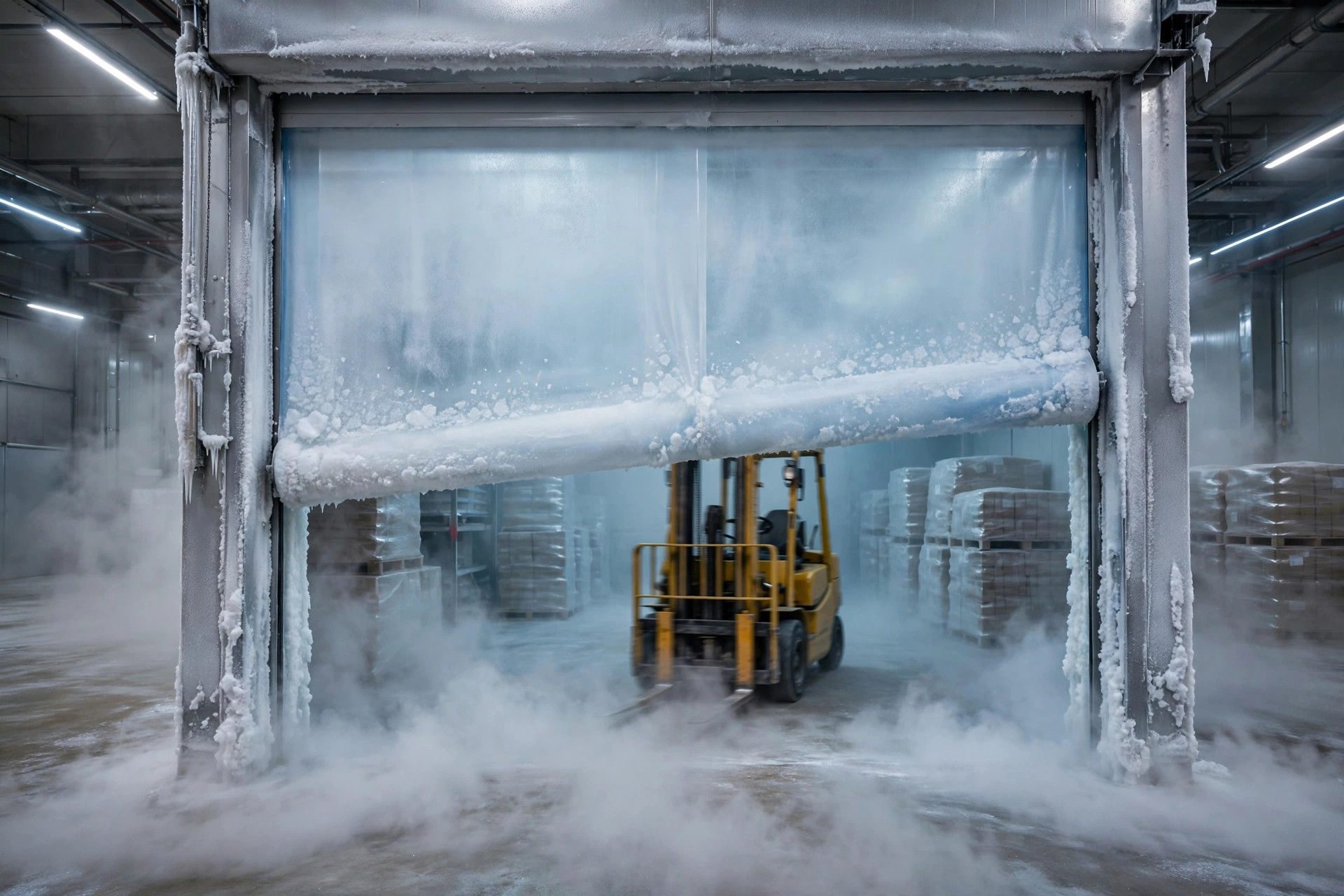
Start with the most ordinary scene. Inside a freezer at well below minus twenty degrees Celsius, the moment a conveyor stops, moisture in the air starts frosting over rollers, brackets, and photoelectric sensors. It is like leaving a car outside on a winter night: by morning the windshield is frosted over, and you have to scrape it before you can drive. In a freezer the frost grows faster, and scraping it is a production interruption rather than a morning chore. That Langfang warehouse began by defrosting its conveyor twice a week, which was enough at first. As throughput rose, frost grew thick enough to fool a sensor into reporting a pallet that was not there, and the line stopped three or four times in one month for that reason alone. Each stop lasted only about half an hour, but the forklifts, checkers, and loading crew behind it all waited. Frost itself costs almost nothing. The waiting it causes costs a great deal.
Frost Is Not a Minor Annoyance: This Is Where Cold Storage Automation Leaks Power
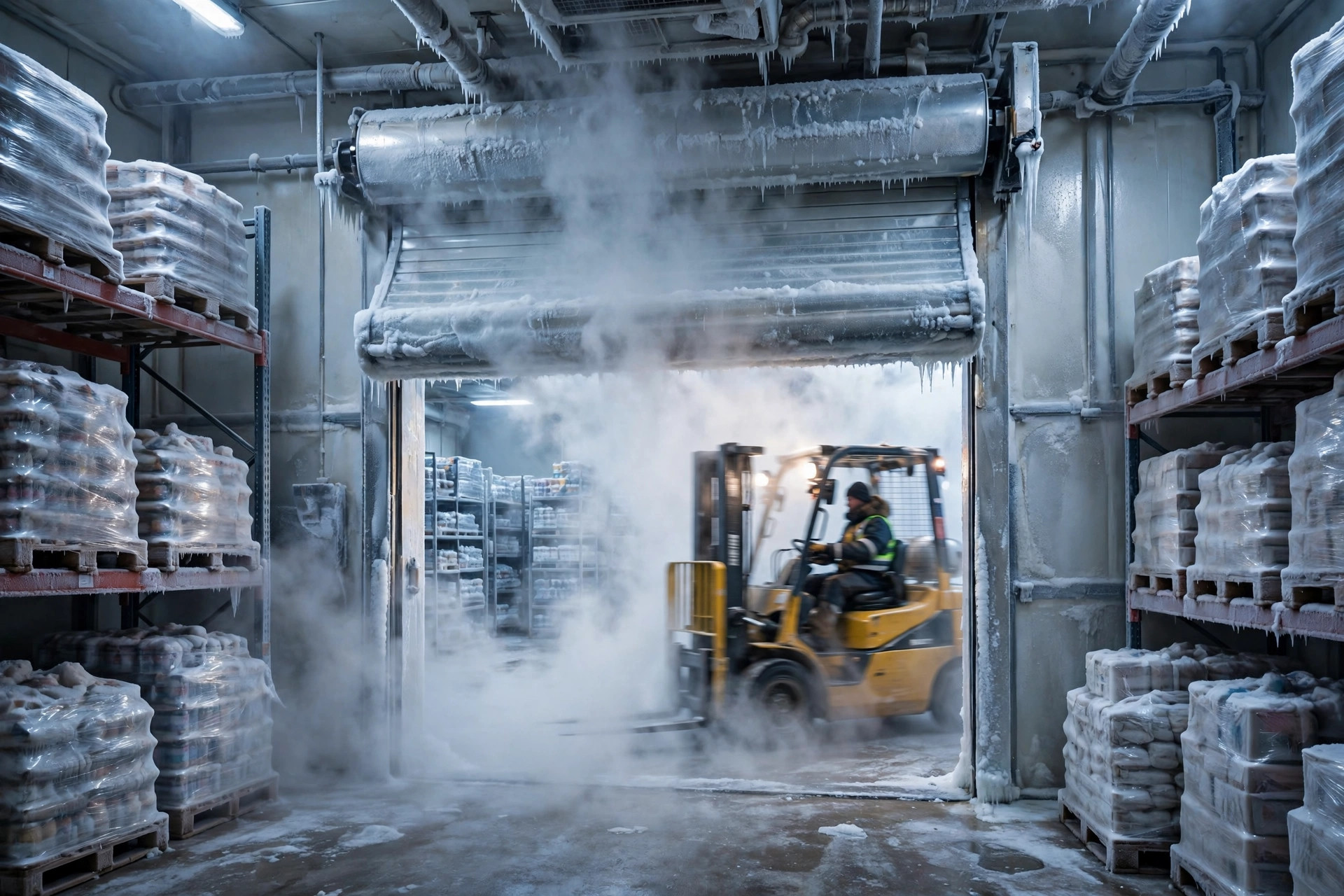
Frost hurts most not in a single defrost, but by keeping the whole system in a half-sick state. When an evaporator coil frosts over, heat exchange gets worse, and the compressor has to run longer to pull the room back to its set temperature. Door openings, conveyor wall penetrations, and lift shafts are all places where warm and cold air meet, and those junctions frost first. Given time, frost becomes ice, ice rubs against belts, resistance rises, and motor current rises with it. Many warehouses budget power from nameplate ratings for the refrigeration plant and the automation equipment, and they never budget for this extra work the system does just to fight frost.
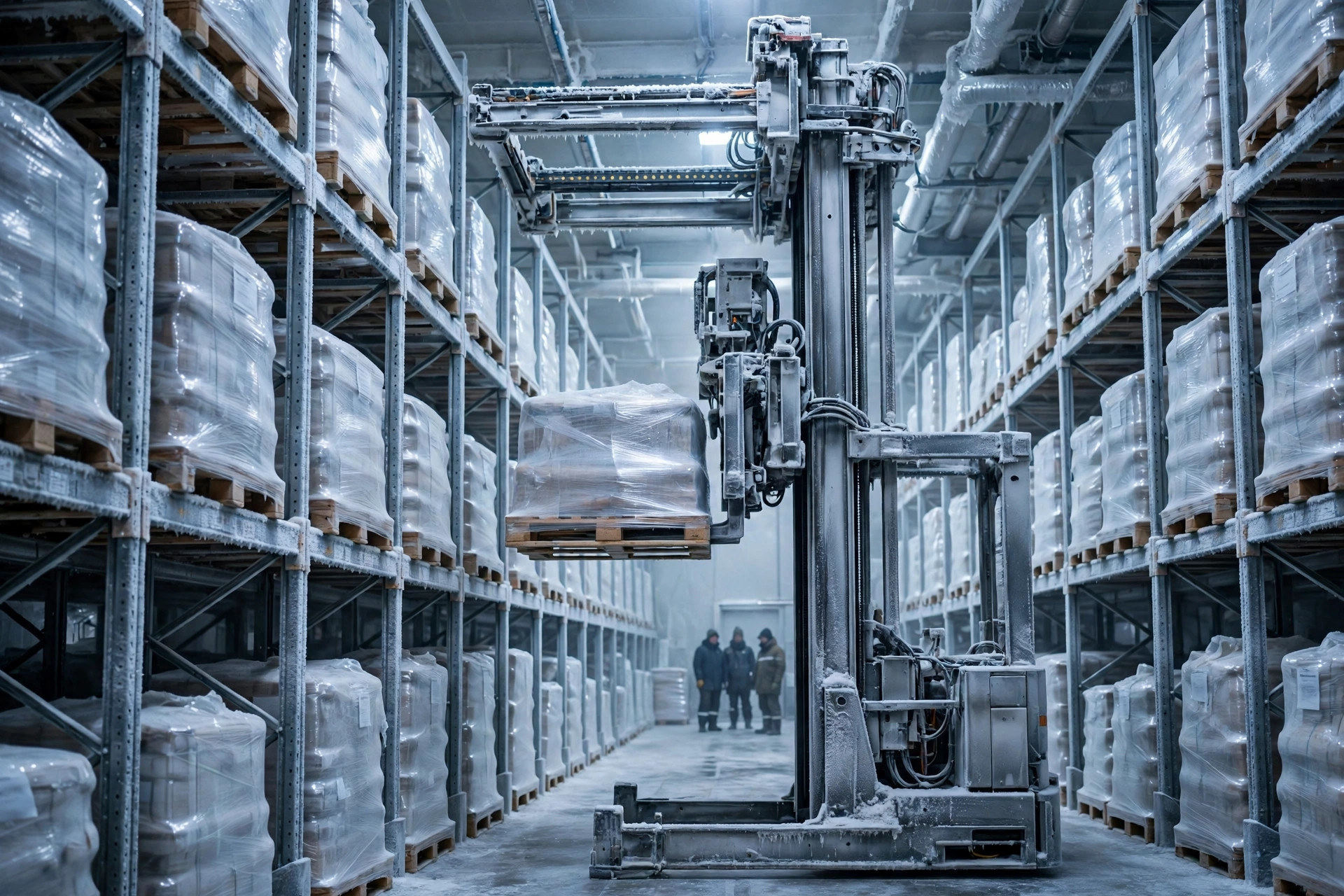
The fix is less exotic than people expect, and it starts with a map. Draw every frost-prone point: wall penetrations, both sides of each door, the face of each evaporator, and the area around each sensor probe. Give each point an inspection rhythm, and clear frost when it passes two or three millimetres rather than waiting until it has become ice. Air curtains at doors and proper insulation and sealing at conveyor penetrations look like small spending, and they often pay back faster than replacing a large piece of equipment. One detail is easy to miss: defrost drain pipes freeze in the cold too, and if meltwater cannot drain, it flows back into the room and becomes a new source of frost. Before go-live, every item on the low-temperature checklist should be verified against real cold-room conditions, including the low-temperature challenges automated equipment faces in cold storage, rather than discovered one by one after the system is running.
When Sensors Lie in the Cold, Cold Storage Automation Fails by Misjudgment, Not by Stopping
The second trap is sensors. Temperature probes, position switches, and barcode readers that are perfectly accurate at room temperature all behave differently at minus twenty degrees. That same warehouse once had a temperature probe drift by more than two degrees. The system believed the room was too warm, drove the refrigeration harder, and the goods were fine while the power bill climbed. On another occasion, frost on a pallet-position sensor blocked its signal, and a stacker crane waited in place for over ten minutes before raising a fault. Nothing had failed mechanically. The data had gone wrong first, and every action the system took from that wrong data was wrong too.
It is like driving with a broken fuel gauge: you do not know how much you have left, so every decision rests on a false premise. My approach is to give every critical sensor a second pair of eyes. Room temperature should come from at least two probes that check each other, and if their readings diverge beyond a set range, the system should alarm rather than act automatically. Position sensors should be checked against a real reference pallet on a schedule, not only against the system's own self-test. Calibration intervals also need to shorten for cold rooms. A six-month rhythm that works at room temperature may need to become every two or three months in a freezer. Calibration is small money. One line stop or one wrongly shipped vehicle caused by a bad reading is large money.
Batteries Lose Range in the Cold, and That Is Not Entirely the Battery's Fault
The third bill arrives with batteries. AGVs and electric forklifts running on lithium batteries lose usable capacity in the cold, so a vehicle that charges once per shift in summer may need a top-up mid-shift in winter. More charging cycles wear the battery faster, and after a year, some vehicles show noticeably shorter range than when they were new. There is another wrinkle: a battery driven from the freezer into a warm charging area condenses moisture on its surface, and over time that speeds up aging of connectors and wiring.
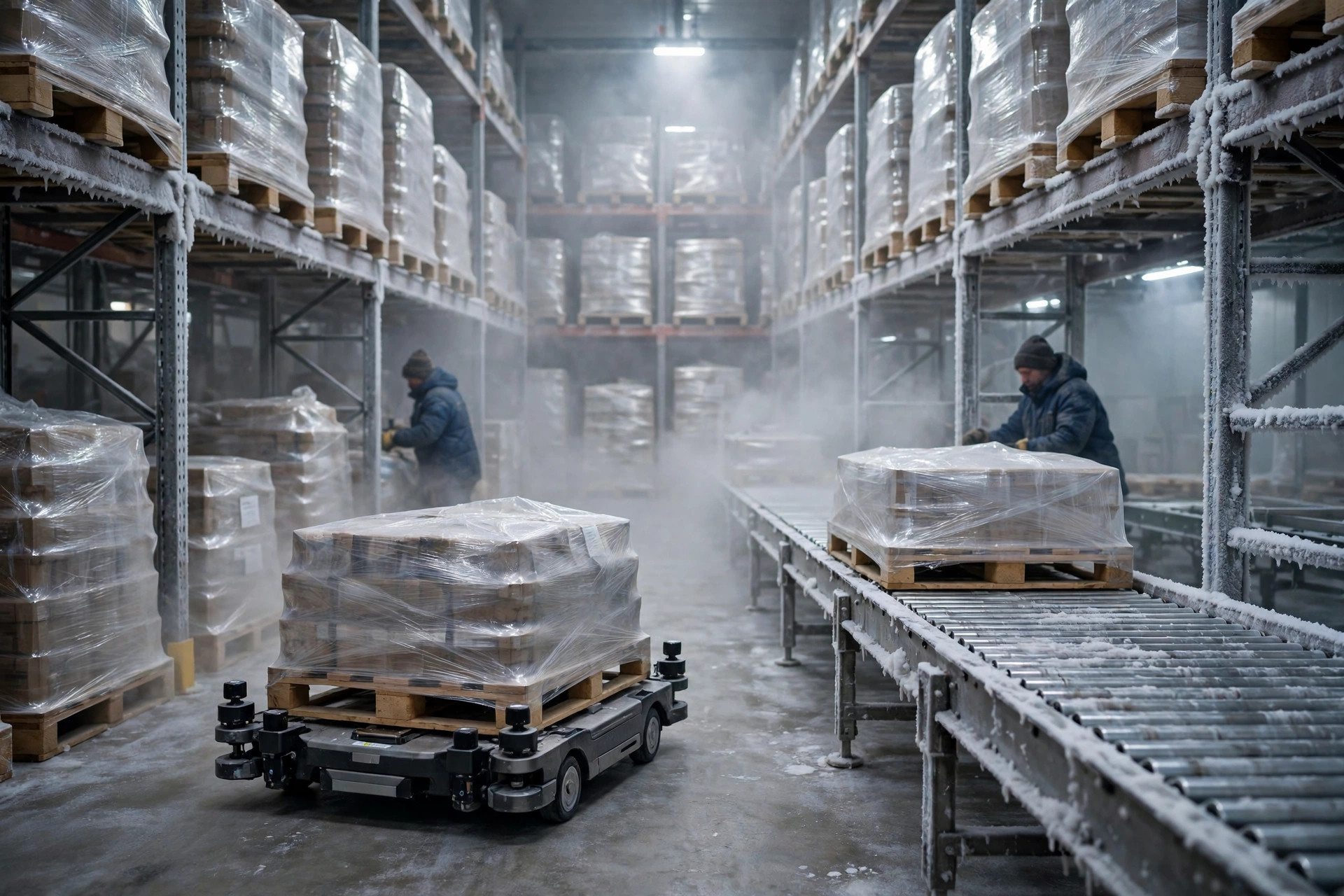
It is tempting to answer short range by buying bigger batteries or more vehicles, but check two numbers first. One is how much of a vehicle's shift is real productive work versus empty travel, waiting, and queuing. The other is how far each vehicle travels just to reach a charger, and how much of that travel could be avoided. I have seen a warehouse where AGVs collectively covered several laps of the site every day purely on charging trips, which meant the bottleneck was charger placement, not battery size. Moving chargers closer to the freezer exit, fitting battery insulation, and shifting charging away from peak-rate hours often relieve most of the range anxiety. Battery fade cannot be avoided, so budget for replacement roughly every one to two years for the hardest-worked units.
| Cost item | Labour-led operation before automation | Common change in the first year after automation | My read |
|---|---|---|---|
| Refrigeration power | Moves with room temperature and door cycles | Often up by roughly five to ten percent, driven by frost and bad readings | Do not budget from nameplate power alone; budget for fighting the cold |
| Defrosting and line stops | Found by people, fixed slowly | Defrosting more frequent; each stop short but stops more numerous | A point map plus a fixed rhythm beats emergency repair |
| Sensor calibration and replacement | Few probes, light calibration load | Many probes, faster drift, calibration becomes a fixed cost | Paired probes and shorter intervals are cheap insurance |
| Battery charging and replacement | Slow forklift battery rotation | More charging cycles, faster fade, replacement budget needed early | Fix charger layout before buying bigger batteries |
| Maintenance labour | Relies on experienced technicians | Handling labour falls, but inspection and maintenance labour must not | Part of the labour saved has to be reinvested in upkeep |
Here is the counter-intuitive part: cold storage automation saves labour, but it does not automatically save power, and the cold can claw back part of the labour saving as electricity, maintenance, and stoppage losses. That is not an argument against automation. It is an argument for changing how the case is calculated. Counting only "how many people we removed" overstates the gain, and counting only "what the equipment cost" understates the running cost. The honest test is the full cost per pallet from inbound to outbound after a full year of operation, not the first month's labour figure.
Use this short checklist directly. Once a week, walk the frost-point map and clear anything over the threshold. Once a month, compare paired readings on every critical sensor. Once a quarter, total up unplanned stops and their duration, and chase any figure above your threshold to its root cause. Once every six months, measure battery health, and move fast-fading vehicles to lighter work first.
Was the money worth it? Look at this one number: after a full year, is the all-in operating cost per pallet lower than before go-live? If it is, frost, sensor drift, and battery fade are problems worth solving. If it is not, do not add more equipment yet. Clean up frost, bad readings, and charger layout first, and the numbers often come back on their own.
By Da Liu, Automation Engineer