Here is the conclusion up front: the hardest part of cold storage automation is not the equipment. It is the fact that most people run the numbers with a room-temperature spreadsheet for a sub-zero warehouse.
A few years ago I worked on a frozen food warehouse that wanted an AS/RS. The owner's math looked beautiful: cut labor, cut footprint, pay back in three years. Then the first winter hit. Frost built up on the crane rails, the positioning sensors drifted, a fork extended and would not come back, and a whole aisle sat dead for most of a day. Once the real maintenance and downtime costs were added in, a big chunk of that payback model was gone. The equipment was not bad. The selection just never took low temperature seriously.
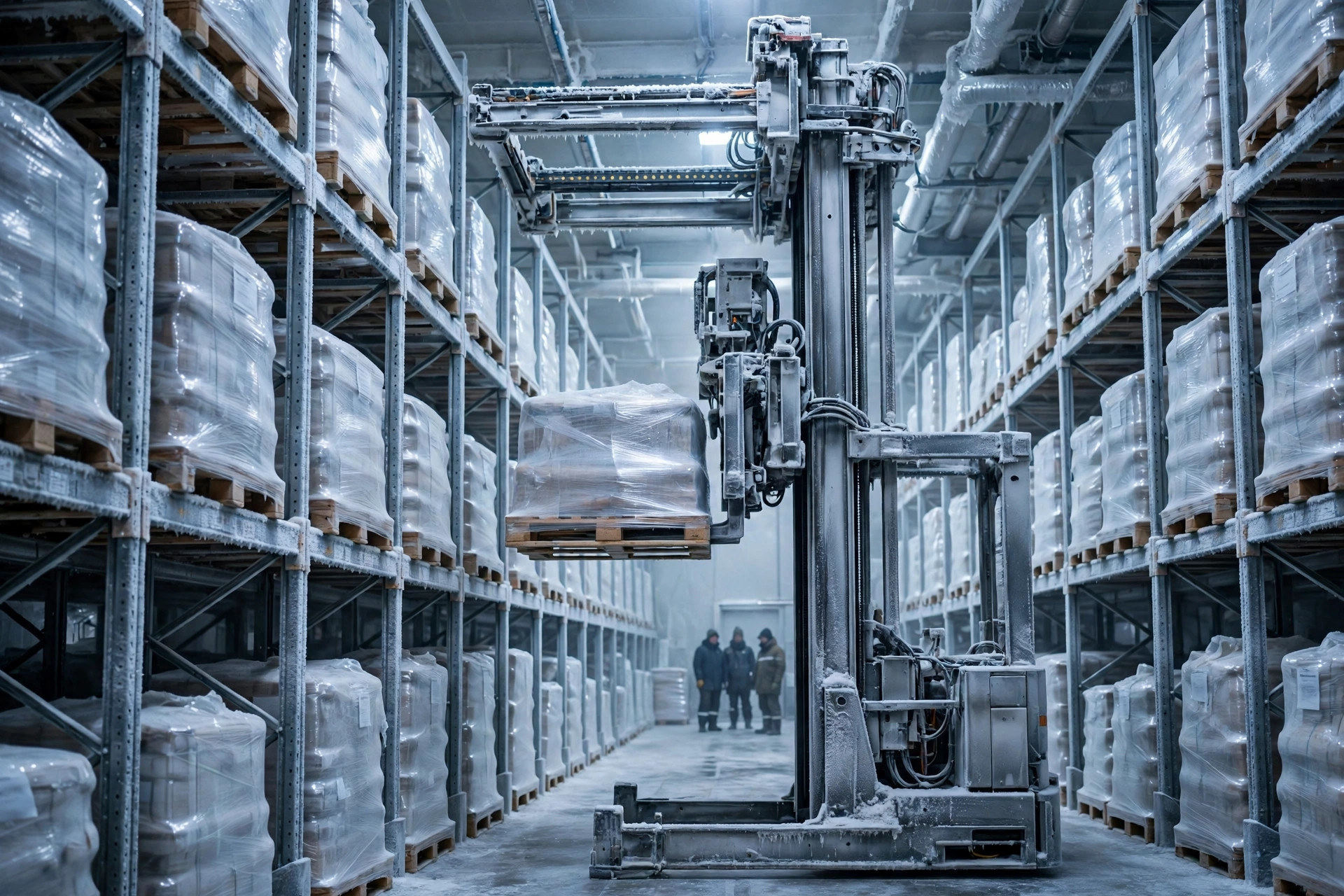
Think of an AS/RS in a cold store as a precision machine living inside a refrigerator all year. Room-temperature experience still applies, but with a discount.
Cold storage automation: what the cold actually does to the machine
Three chain reactions matter, and they feed each other: frost, lubrication failure, and electrical performance loss.
Frost is the most visible. Every time the door opens, humid air comes in and condenses on rails, rack beams, and positioning systems. Frost on a rail makes drive wheels slip and positioning accuracy drop; frost over a sensor or barcode means a failed read, and the system stops the aisle. It is like putting fogged-up glasses on the machine: it cannot see the road, so it will not run fast.
Lubrication is the second one. Grease that works fine at room temperature thickens well below zero, bearing resistance climbs, and motor load follows. Worse is the freeze-thaw cycle: the machine warms up during operation, freezes again overnight, moisture gets into the grease, and bearings die early. I have seen crane hoist-motor bearings fall far short of the manufacturer's stated life, and the root cause was simply lubrication selected for the wrong temperature.
The third is batteries and motors. Shuttle cars and AGVs lose usable battery capacity in the cold, so charging intervals shrink and you need more vehicles or charging windows for the same shift. Motors do not mind the cold, but condensation does: a machine driving out of the freezer into a room-temperature dock fogs up instantly, moisture works into electrical cabinets, and over time that means shorts and corrosion. I have seen this exact failure three times, always the same script — nobody designed a temperature transition zone.
For a more systematic discussion of the string of challenges low temperatures throw at warehouse automation, read that piece first. It covers why cold storage automation is hard in general; this one answers the narrower question — given how hard it is, should you still install an AS/RS, and how do you make the money work.
The cold storage automation selection line: three thresholds, and the answer draws itself
I do not like vague selection advice, so here are three thresholds. If your warehouse clearly misses any one of them, put the AS/RS on hold.
The first is throughput. An AS/RS is good at steady, high-frequency cycles, not at absorbing peaks and troughs. If your pallet flow swings wildly across the year — temp workers carrying peak season, aisles idling in the off season — the fixed cost never spreads thin enough and the cycle-rate advantage never shows up. The test is simple: plot daily pallet movements for the past year. A fairly flat band says go; a sawtooth says fix your waves and processes first, not your equipment.
The second is SKU count and product profile. AS/RS loves few SKUs, large batches, and standardized pallets. Frozen meat, seafood, and prepared meals in uniform cases are its comfort zone. A warehouse with thousands of SKUs, a few pallets each, and mixed pallet sizes will get poor aisle utilization and rising location-management complexity. Do ABC classification and pallet standardization before anything else.
The third is the temperature zone. Deep freeze below minus eighteen degrees and a chilled zone at zero to five are two different jobs. Deep freeze needs dedicated low-temperature configuration — cold-rated lubricants and cables, defrost heating, condensation-proof cabinets — and both price and maintenance go up. A chilled zone is close to room-temperature duty, and much standard equipment adapts with minor changes. So the practical line is: chilled first, deep freeze as a separate project with its own business case, never the same payback model.
Here is the counterintuitive one: expensive cold-store labor does not automatically make automation pay. High labor cost also means your equipment has to hold high uptime in a harsher environment — and when it stops, a cold store does not wait. Product temperature, orders, and customer claims pile up together. An hour of downtime has to be priced at cold-chain failure rates, not at "the shipment went out an hour late" rates.
The payback math: TCO first, payback second
I only trust TCO, not the equipment quotation. The machine price is just the first line, followed by a whole tail: low-temperature configuration, building and insulation work, WCS and WMS integration, spares, maintenance contracts, energy, and downtime losses. The table below is the framework I use on projects. Fill it with your own warehouse's real numbers, not someone else's.
| Cost / benefit item | The cold-storage extra that room-temperature projects miss |
|---|---|
| Equipment purchase | Low-temperature lubrication, cold-rated cables, defrost heating, condensation-proof cabinets |
| Building and insulation | Insulation of the AS/RS zone, floor anti-heave protection, temperature transition vestibule |
| Energy | Defrost heating, in-store lighting and equipment standby, extra refrigeration load from equipment heat |
| Maintenance | Higher service frequency in the cold, faster consumption of spares such as bearings and sensors |
| Downtime loss | Priced at cold-chain breach and product-loss rates, not just idle labor |
| Benefit | Labor saved, footprint saved (high-bay racking in a cold store is the most valuable square footage), product loss reduced, inventory accuracy improved |
One line deserves emphasis: footprint. Building and refrigerating a square meter of cold store costs far more than ambient space, so the floor area high-bay racking saves is often the largest item in the payback model. Plenty of owners count only headcount saved and miss this entirely. Flip it around: if your cold store is leased, height-limited, or on cheap land, that benefit shrinks and the payback stretches immediately.
The calculation runs in three steps. First, build the five-year TCO from the table above, not just year one. Second, split the benefits into three lines — labor saved, area saved, product loss reduced — with area standing on its own. Third, stress-test it: uptime down five points, maintenance up by a third — how much longer is the payback? If those two shocks stretch it from three years to six, the project is fragile. Fix the cheap things first.
One more case. A frozen food warehouse in East China had few SKUs, large batches, and steady daily flow — a textbook candidate. But on site, half the pallets were non-standard, plus a batch of odd-shaped crates. My advice: spend a few months standardizing pallets and zoning the odd freight separately first. The owner thought I was stalling. Six months later, with pallets unified, aisle utilization and cycle rate hit target on the first try. Be ruthless about fake requirements: automating a mess just gives the mess an expensive accelerator.
The maintenance traps: a go-live night checklist
Finally, maintenance. The traps come down to four items — put them on your go-live night checklist:
First, defrost and cleaning cadence. Rails, positioning components, and forks need scheduled defrosting and cleaning, not when an alarm fires. Set the cadence by door-opening frequency and humidity.
Second, lubrication and spares. Greases, bearings, and sensor components must be rated for your actual low-temperature duty, and the spares shelf must hold the cold-rated versions. A room-temperature part fitted as a stopgap will not survive a winter.
Third, temperature transition. Equipment moving in and out of the freezer needs a vestibule design, and electrical cabinets need condensation protection. This is money you cannot save, because the savings come back as a short-circuit bill.
Fourth, the maintenance contract itself. Response time, uptime commitments, and spares arrival time belong in the contract. Cold-store downtime burns money by the hour; a vendor offering "next business day response" does not work in a freezer.
So is the money worth it? Look at one number: five-year TCO divided by the pallets the AS/RS actually moves in five years — your cost per pallet. Compare it with your current per-pallet cost of labor, area, and product loss. If the automated cost is genuinely lower, and survives the uptime-down-five-points stress test, go ahead. Otherwise, do the cheap things first: standardization, wave discipline, transition zones. Automation is a good thing, but only where the numbers have been done properly.
By Da Liu, Automation Engineer