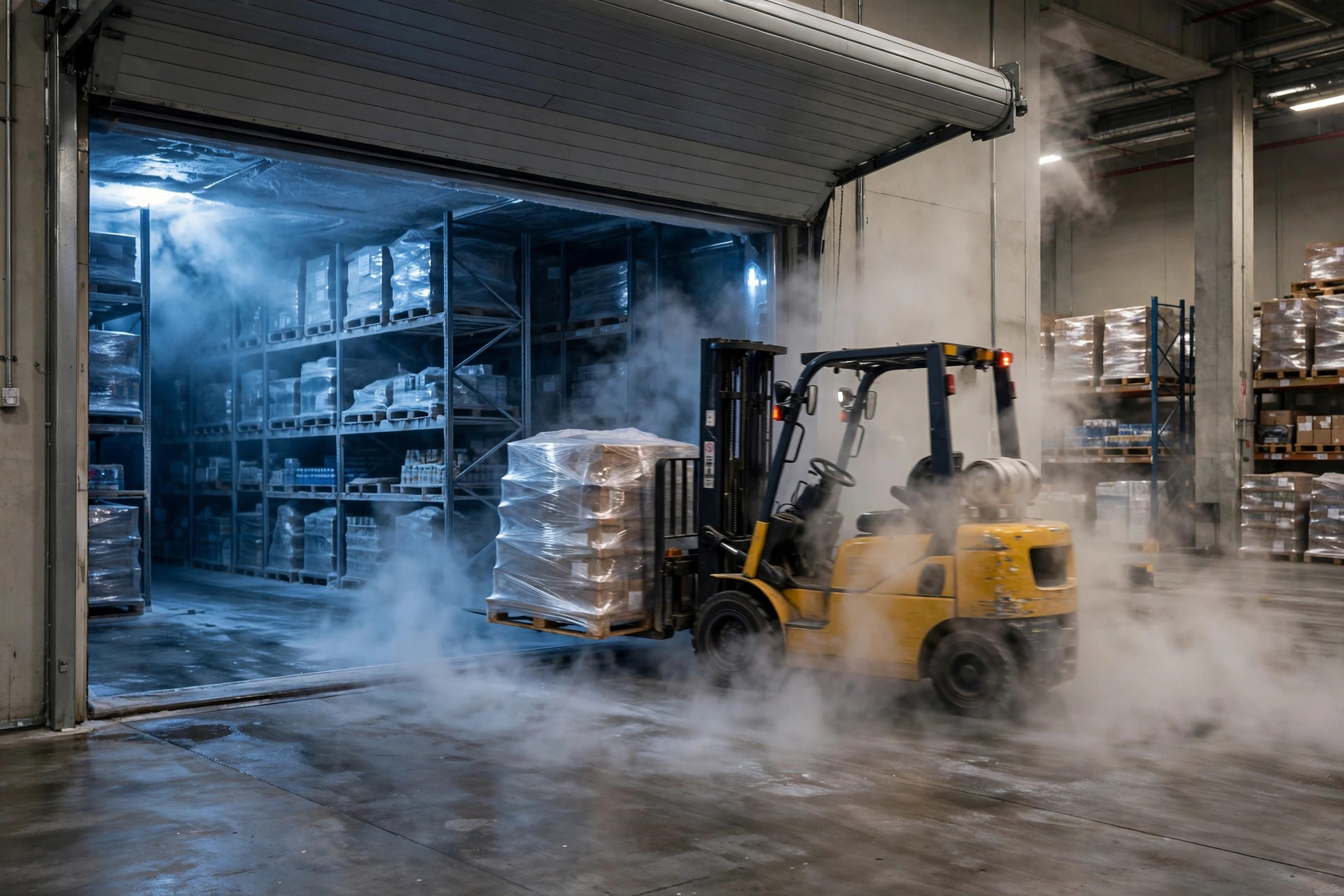
Let me open with the number that matters. On a freezer door cycling a thousand times a day, the wrong speed setting can quietly add enough to the annual power bill to cover a good chunk of a replacement door. I know because I reconciled it from two warehouses' meter readings, line by line, and in both cases the fastest setting was not the cheapest one.
The first warehouse stored frozen food inland in California. In the winter of 2024 I looked at their power bills and found the cold storage area costing noticeably more than the same period a year earlier, while throughput had not grown. The trail led to the doorway. Their high speed freezer door was set to its fastest mode, cycling in under two seconds, which made forklift drivers happy. But the door cycled more than a thousand times a day, and each pass involved triggering, slowing down, lining up, and waiting for the door to close fully. The total time the doorway stood open barely shrank. Worse, frost built up around the frame and the curtain edges, the seals stopped sitting flush, and the door started leaking cold air even when closed. They dropped one speed setting and replaced the worn seals, and meter readings over the next two months came down. The lesson was not about the door's headline speed. It was about how many minutes a day the doorway actually stands open.
High Speed Freezer Doors and the Myth of the Fastest Setting
The common intuition is that a faster door saves energy because cold air has less time to escape. That intuition is only half right. Cold loss depends on total open time across the whole day and the temperature difference, not on the fraction of a second saved in a single cycle. A forklift pass is a whole sequence: trigger, decelerate, pass through, and wait for full closure. The fastest setting trims the curtain travel time, but if operators trigger the door constantly or the next truck arrives before the door has sealed, those savings evaporate.
Then there is the wear bill, which most people forget to count. Running permanently at top speed wears curtains, motors, and seals faster. A curtain edge that deforms slightly or a seal that stops sitting flush does not announce itself. Power consumption creeps up month by month until someone finally notices the bill has been climbing for half a year. That is why I never recommend buying on headline speed and leaving the door on its fastest setting unattended. Before you settle a speed setting, it is worth reviewing door construction and sealing properly; a high speed freezer door selection guide covers curtain materials and seal designs in a way that helps you judge what your door can actually hold. Selection first, speed setting second.
Doing the Math: Speed Settings Against the Power Bill
You do not need a complex model to price this. Four numbers will do: daily cycles, open time per pass, the change in refrigeration load from the temperature difference, and your electricity rate. Use this table as a template and fill in your own warehouse's figures:
| Setting | Daily cycles | Open time per pass | Monthly refrigeration power | Notes |
|---|---|---|---|---|
| Fastest | About 1,000 | Short, but triggered constantly | Baseline | Curtain wear fast, seals degrade early |
| Medium | About 1,000 | Slightly longer | Noticeably lower than fastest | Longer seal life, often lowest total cost |
| Slow | About 1,000 | Clearly longer | Rises again | Open time dominates, cold loss takes over |
The point of the table is that power cost does not fall monotonically as speed rises. There is a sweet spot in the middle. The fastest setting's wear and seal decay claw back the energy saved, while the slow setting simply leaves the doorway open too long. For most warehouses the sweet spot sits near the medium setting, but the exact answer has to come from your own meters, not from someone else's conclusion.
The second warehouse, in Texas, did it the right way. Instead of guessing, they ran one speed setting per week for four consecutive weeks and logged three things each week: the cold storage sub-meter reading, temperature logs inside and outside the doorway, and how often frost had to be cleared. The medium-speed week had the lowest power consumption, and frost clearing dropped from twice a week to once. They locked in the medium setting and added two lines to their inspection routine: check seals monthly, measure curtain closing gaps quarterly. That routine costs almost nothing. The hard part is keeping the records.
When to Slow Down, and When Not To
Three situations argue for dropping one speed setting. First, doorways with extremely high frequency where forklifts queue up: the door gets retriggered before it seals, so the fastest setting never delivers its advantage and only accelerates wear. Second, deep-freeze rooms with a large temperature difference, where a degraded seal costs far more than in a chilled room; protecting the seal matters more than saving a second. Third, small doorways used by pedestrians and hand carts, where a high-speed curtain adds safety risk and false triggers that are not worth it.
There are also cases where slowing down is pointless. If the temperature difference is modest, daily cycles are low, and each pass is a full truck moving straight through, the speed setting barely moves the power bill; protect throughput instead of chasing a small saving. And one case where you should not touch the setting at all: a door already badly frosted, with deformed seals or a tracking curtain. Fix the door first. No speed setting rescues a door that cannot close properly.
Here is the calculable conclusion. Take one door in your warehouse and run a four-week test: one setting per week, logging the sub-meter reading, temperature records, and frost-clearing frequency. Pick the setting with the lowest consumption and the lightest frost, then write seal inspection into the monthly routine. If the medium setting's monthly saving, multiplied by twelve, exceeds one seal replacement plus labor, the setting is right. If four weeks of data show no meaningful difference, the door is not your main power problem; stop fiddling with speed and look at the refrigeration plant and building insulation. Calculate first, adjust second, and recheck afterwards. That is the order that actually saves money.
By Lao Zhou, Logistics Cost Analyst