Last August, I stared at our electricity bill for a full five minutes. July came in several thousand yuan higher than June. Same inventory, same setpoint — the only change was more trips in and out of our cold room during peak season. A salesman told me, "Just install a high-speed roll door, all the big warehouses use them." I stood at our cold storage door and looked at our PVC cold storage door curtain: yellowed, stiff, half the strips tangled into knots after years of forklift hits, a gap down the middle with cold air pouring out and a puddle on the floor. That's when it hit me: this humble curtain was quietly eating the cost of a used forklift every year.
Full disclosure: we're a 3,000-square-meter small warehouse that can't burn money like the big players. One high-speed roll door costs tens of thousands of yuan — the good ones over a hundred thousand, installation extra. I laughed out loud at the quote. But is a PVC curtain really enough? I've done this math so you don't have to — pick wrong, and the extra electricity in a year is no joke.
The PVC Cold Storage Door Curtain: Cheap — but Where It Wins and Where It Bites
Let me tell you about the thing we actually use. A PVC strip cold storage door curtain costs a few hundred yuan per doorway, hangs in half an hour with your own crew, needs no electrician, no power, no maintenance — snap off a damaged strip and clip on a new one. Sounds like a gift from heaven for small warehouses, right?
It bites in three ways. First, it doesn't take abuse. Forklifts hit it dozens of times a day; the strips bend and tangle, and once knotted they never close flat again — the gaps just keep growing. Second, it ages. At minus fifteen or twenty degrees, PVC yellows and stiffens after a year or so, loses its spring, and cold air leaks through the cracks. Third, and worst: it can't handle high-frequency traffic. A worker pushes a pallet jack through and the strips swing for ages before settling — a dozen seconds wide open, and the cold air sprints out.
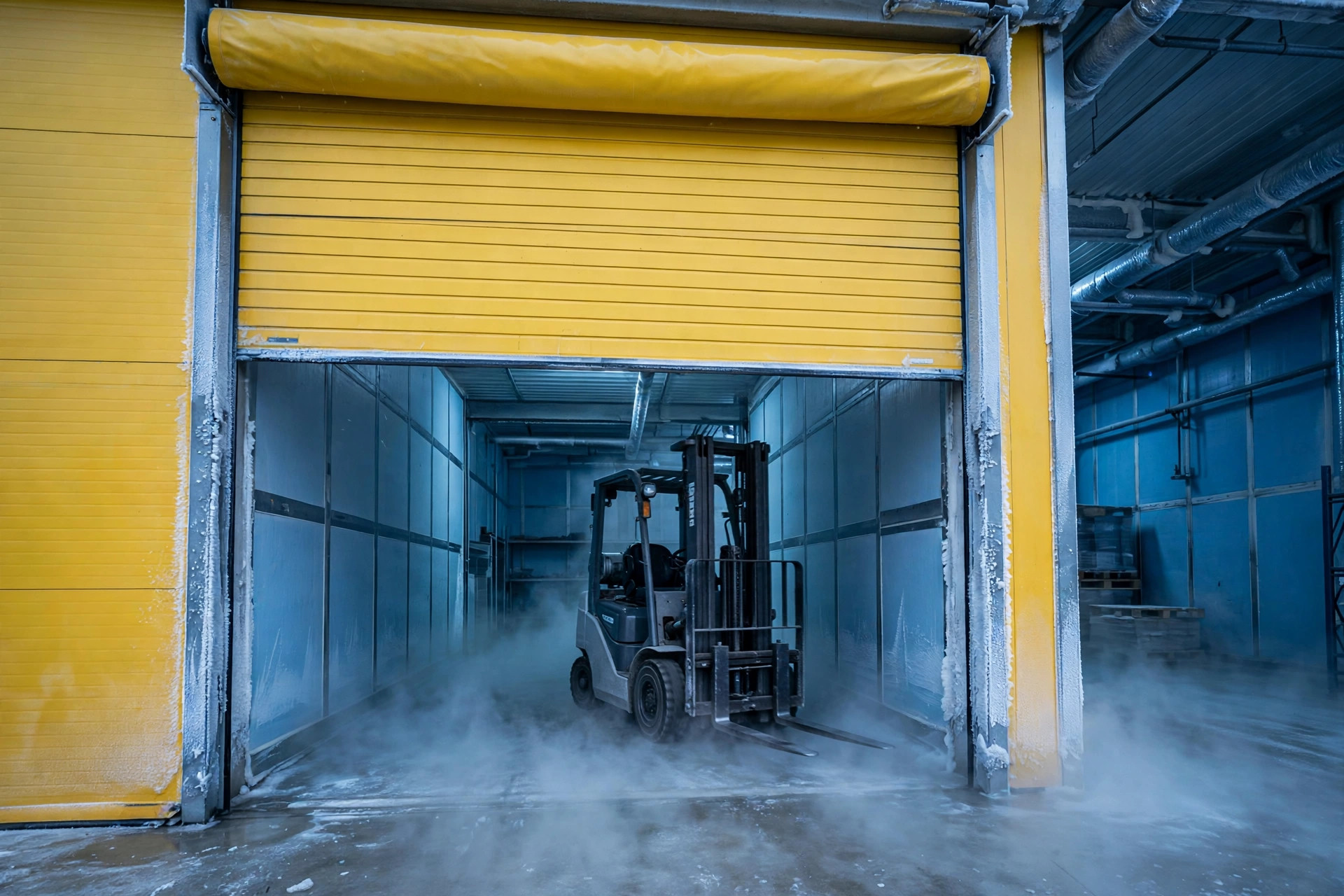
Summer 2024, my neighbor Old Chen's frozen-goods warehouse was the cautionary tale. Over a hundred door passes a day, his curtain was destroyed in three months, frost caked permanently around the doorway, the compressors basically never stopped. "The curtain is cheap," he complained, "but the electric bill sure isn't." He gritted his teeth and installed a high-speed roll door, and the bill did drop — but the story doesn't end there.
The High-Speed Roll Door: Genuinely Fast, Genuinely Expensive
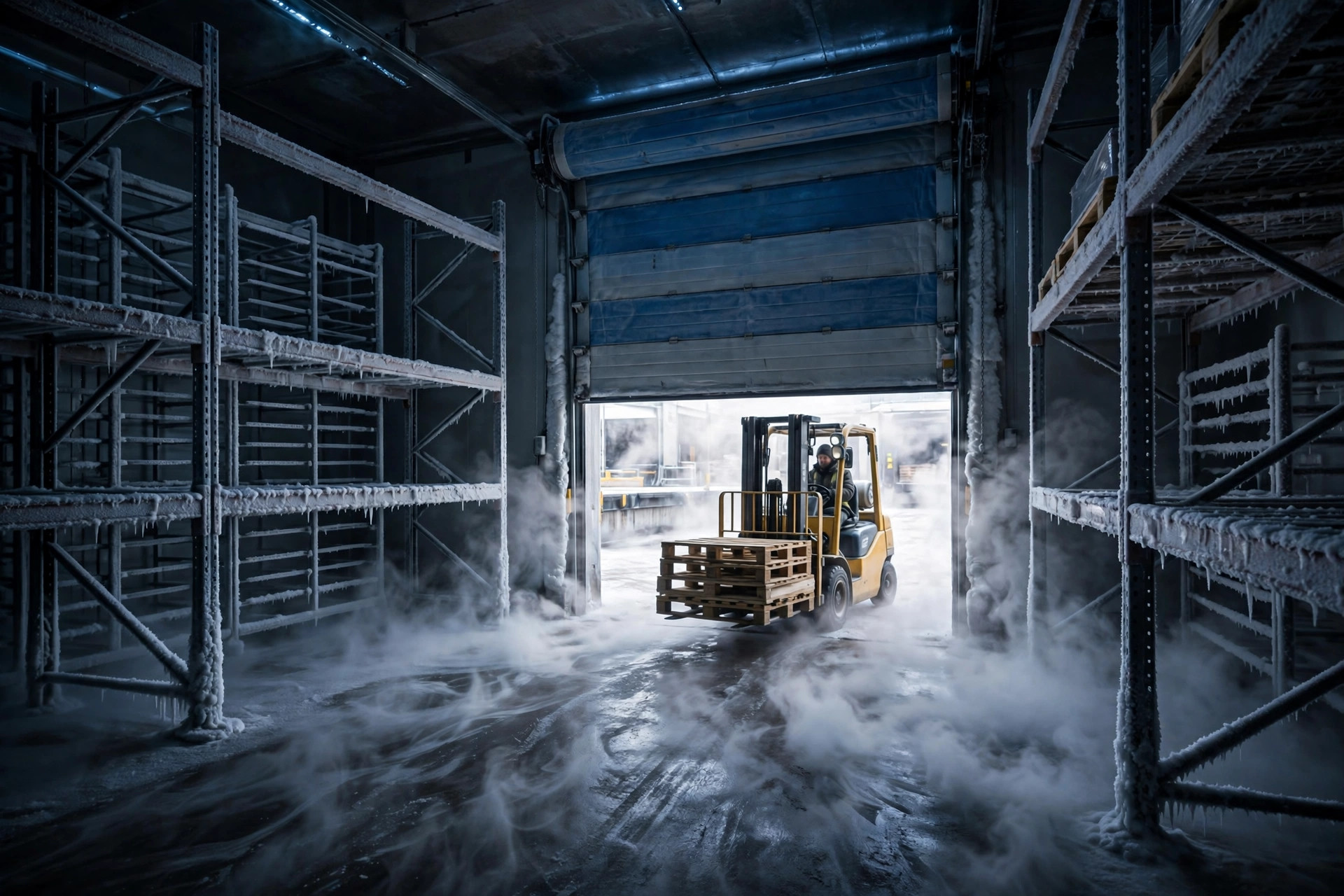
What makes a high-speed roll door good? One sentence: it opens fast and closes fast. The radar senses a forklift coming, the curtain zips up, and seconds after it passes, it's down again. The open-door time shrinks from a dozen-plus seconds with a PVC curtain to just a few — and the busier your doorway, the more that gap is worth.
But expensive is expensive. Tens of thousands per door — the good ones over a hundred thousand — plus 380V wiring and scheduled servicing. The motor, the radar sensor, and the curtain fabric are all consumables. Old Chen's door was less than a year old when the radar sensor died and the door wouldn't lift. The factory tech charged him several thousand yuan and the dock sat idle for half a day. He did the math with me: more than half his electricity savings went straight back to the repair guy.
Here's the counterintuitive takeaway: a high-speed roll door genuinely saves electricity, but "saving electricity" is not the same as "saving money." Purchase cost, the door's own power draw, maintenance — amortized over three years, a warehouse without enough door traffic can easily end up worse off than with a PVC cold storage door curtain. Don't get swept up by "all the big warehouses use them" — a big warehouse does hundreds of door passes a day, so their math works. You do thirty or forty. The big-company playbook doesn't fit a small warehouse.
The Dividing Line: How Many Times a Day You Open That Door
The whole calculation comes down to one number: daily door openings.
- Under 50 openings a day: a PVC cold storage door curtain is plenty. Take the tens of thousands you saved and spend them on something useful. Just replace the strips on schedule.
- 50 to 150 a day: the gray zone. In summer, cold air is expensive, so an upgrade is worth considering — or try the cheap hacks below first.
- Over 150 a day: stop hesitating, get the high-speed roll door. At that frequency a PVC curtain is basically decorative, the compressors run year-round, and the electric bill will teach you a lesson.
Here's the comparison, in our small warehouse's rough numbers:
| PVC strip curtain | High-speed roll door | |
|---|---|---|
| Cost per doorway | A few hundred yuan | Tens of thousands to 100k+ |
| Installation | DIY, half an hour | Technician + electrical work |
| Open time per pass | 10+ seconds (strips swinging) | A few seconds |
| Routine maintenance | Replace strips, tens of yuan each | Motor/sensor/fabric, several thousand per repair |
| Lifespan | Strips replaced every 1–2 years | 5–8 years for the unit, consumables extra |
| Best for | Low-traffic small warehouses | High-traffic large warehouses / sortation doors |
The total-cost formula is simple: the high-speed door's annualized cost (amortized purchase + power + repairs) versus the electricity it saves you each year. If the first number is bigger, don't buy it. We do forty or fifty passes a day; I ran the numbers and blocked the salesman's number. Not because the door is bad — because we're not worthy of it, ha.
The Small Warehouse Playbook: Squeezing Every Drop Out of a PVC Curtain
The big-company playbook isn't for us, but a PVC curtain can still be pushed surprisingly far. Three cheap hacks we're actually using:
First, double-layer with staggered strips. Hang two layers, the inner layer's strips offset by half a width so the second layer covers the first layer's seams. Sealing roughly doubles. Cost? A few hundred yuan more. Result? Visibly less frost at the doorway.
Second, replace strips on schedule — don't wait until they're fully yellow. PVC strips yellow and stiffen gradually, and most people only replace them when they snap. Our rule: inspect quarterly, cut off any stiff strip, clip on a new one. Tens of yuan per strip, ten minutes. Don't be stingy here — it saves you electricity money.
Third, slow down at the doorway, and train the crew. Forklifts limited to 5 km/h through the cold storage entrance cut curtain collisions in half. Don't laugh — this is the cheapest hack of all: strip life went from one year to nearly two, basically a free curtain. We also taped a handwritten sign at the door: "Easy on the curtain — break it and you lose your chicken leg." Works like a charm.
Since these three, the cold air loss at our doorway has visibly dropped, and the July–August bill came down noticeably from last year — on the order of ten to twenty percent. Total investment? Under a thousand yuan.
Maintenance: Every Small Warehouse Owner Should Know This
PVC curtain maintenance is one sentence: replace the strips often, don't put up with worn ones. Yellowed, stiff strips seal terribly — keeping them is keeping an electricity assassin on the payroll. Two people, ten minutes, negligible cost — no technician needed.
If you already have a high-speed roll door, remember two things. One: wipe the radar sensor regularly — doorways are humid and a fogged-up sensor goes blind. Two: don't cheap out on the motor brand; one repair bill will hurt for half a year. Get an annual service contract from the manufacturer — Old Chen paid for that lesson with two repair bills.
One last piece of advice for fellow small operators: don't start by asking "which door is better." Start by counting how many times a day your door opens. Squat by the doorway with your phone for half a day and count — the answer writes itself. The right fit beats the expensive pick — pricey isn't automatically correct.
Small warehouses have their own way of surviving: the big guys compete on equipment, we compete on attention to detail. Even one door curtain's money is worth half a day squatting by the doorway with a counter — because every cent is our own.
By Xiao Ma, Small Warehouse Owner