In early 2024, I gritted my teeth and ordered a conveyor sorting line plus two AMRs from a Chinese manufacturer — just over $120,000, FOB. The US integrator's quote? More than double. I felt like I'd robbed the bank. This is a field guide to after-sales service and spare parts support for automation equipment bought from China — the part nobody warns small warehouses about.
Three months later, the bank robbed me back: a roller motor burned out and the whole line went down. The sales rep replied on WeChat within seconds: "Dear, we'll ship a new one, two weeks." I believed him. Reality: a week for the factory to pull the part, two weeks in transit, a week stuck in customs, plus back-and-forth across a fifteen-hour time difference. Six weeks — right before peak-season buildup, with four people in our 3,000-square-meter warehouse moving everything by hand.
That's the truth about China automation equipment after sales spare parts support: the equipment is genuinely cheap, but after-sales is the real boss fight. Big companies have on-site engineers, spare-parts depots, and global service networks. We have me, my cousin, and a wrench.
No big-company playbook here — just how our little warehouse survived. One disclaimer: everything below is above board — honest declarations, proper certifications, clean payments. The street-smart tricks save money; they don't cut legal corners.
Lock These After-Sales Terms Into the Contract: Our Bloody Checklist
After the six-week disaster I learned: if after-sales service isn't nailed down in the contract, it's sweet talk. Before our second order I rewrote every service clause. The manufacturer grumbled that "nobody signs like this" — then signed anyway.
Here's the checklist — each item paid for in real money:
First, warranty of at least 12 months — the norm is generally 12 to 18, and anything under 12 is a walk-away. The clock starts at acceptance, not shipment: the equipment spends over a month on the ocean, and that shouldn't eat my warranty.
Second, a remote-response SLA: response within 24 hours, a fix or a parts-shipping plan within 48. "Technical support provided" without numbers means nothing. Ours: parts ship within 7 business days, 1% daily penalty per day late. An SLA without penalties is a wish.
Third, lock spare-parts pricing: attach the parts list with fixed unit prices, locked for 3 years. Otherwise this year's $30 sensor becomes next year's $300, and you'll have nowhere to complain.
Fourth, hold back 10% until 30 days of stable operation after acceptance. That 10% is the only card in your hand — don't play it early.
Fifth, documentation ownership: English electrical drawings, PLC program backups, alarm code tables — all delivered before shipment, ownership assigned to us in writing. A neighboring warehouse owner learned this the hard way: his contract never specified who owned the program backup, so when the manufacturer's engineer quit, nobody could change a parameter — and he paid a local integrator a fortune to rewrite the logic.
Sixth, UL certification: for equipment entering the US, control panels generally need to meet UL 508A, the US safety standard for industrial control panels. Spell out who handles certification — factory before shipment, or us with a US agency after — and who pays. Don't discover at the port that neither customs nor your insurer recognizes the panel.
Seventh, training: the manufacturer runs remote video training until our people can swap wear parts, read alarm codes, and do daily inspections. We record every session for new hires — no more begging for help each time.
How We Build Our Spare-Parts List: Only Stock the Line-Killers
Our first spare-parts order followed the manufacturer's "recommended list": 40-plus items, nearly $20,000. A year later we'd used fewer than a third; the rest collected dust — twenty grand, two months of our rent.
Then we changed our thinking: more spare parts is not better. For a small warehouse, cash flow beats "just in case." Our method is the "line-killer" list — stock only parts that kill the whole line when they fail and can't be bought locally.
Three buckets:
Must-stock: belts, rollers, photoelectric sensors, proximity switches. They fail eventually, they're cheap and small — stocking a set doesn't hurt. Many are available locally: sensors and belts are on McMaster-Carr and Grainger, arriving in a day or two. No six-week wait across the Pacific.
Covered by agreement, not stocked: motors, gearboxes, drives — expensive, but genuine line-killers. Sign a supply agreement instead: don't buy upfront, but lock price and lead time in the contract, then expedite when something fails. Meanwhile record full model specs of every motor and gearbox; local distributors can usually match a replacement — that's how we survived those six weeks. Just confirm voltage, mounting dimensions, and interfaces before substituting.
Don't stock structural parts, frames, or cables. They rarely fail, the local hardware store can sort you out in an afternoon, and stocking them just eats floor space.
Our framework is the "four quadrants": failure probability on one axis, downtime cost on the other. High probability plus high impact means must-stock; low probability plus high impact means agreement, no upfront purchase; high probability plus low impact means buy locally when needed; low probability plus low impact means don't stock. Run every new machine through it for a smarter list than the manufacturer's 40-item version.
Local Repair vs. Remote Support: Know Where the Line Is
This is the most important line in our whole system: software problems go to the manufacturer; hardware problems are on us — or on our local guy.
Know the limits of remote support. What the factory can fix remotely: parameter tweaks, software bugs, alarm-code interpretation, minor PLC logic changes — provided the machine allows remote access (require a VPN or cellular module in the contract) and alarms are in English. Our first batch alarmed in Chinese; the factory engineer translated line by line over video. Painful and hilarious.
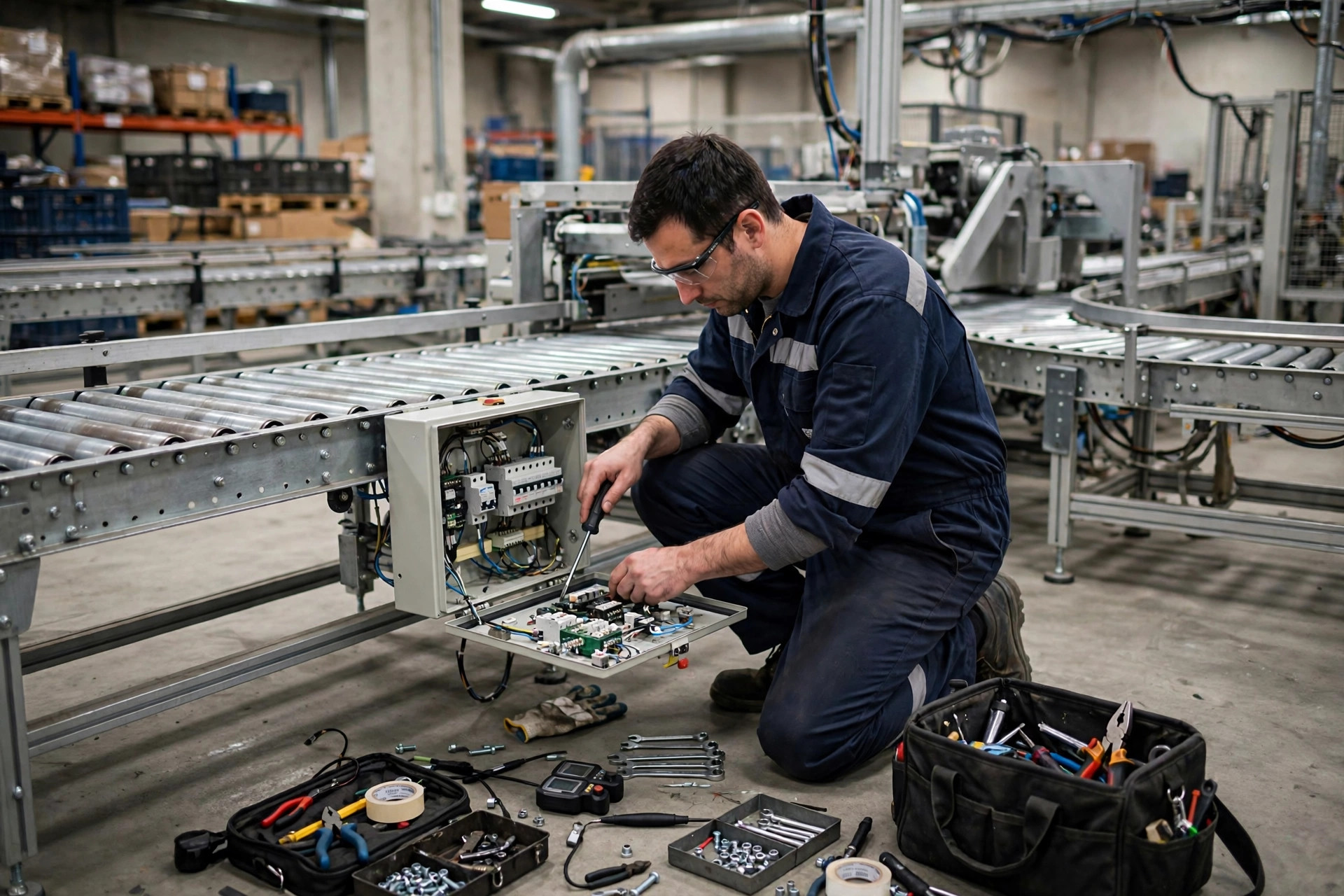
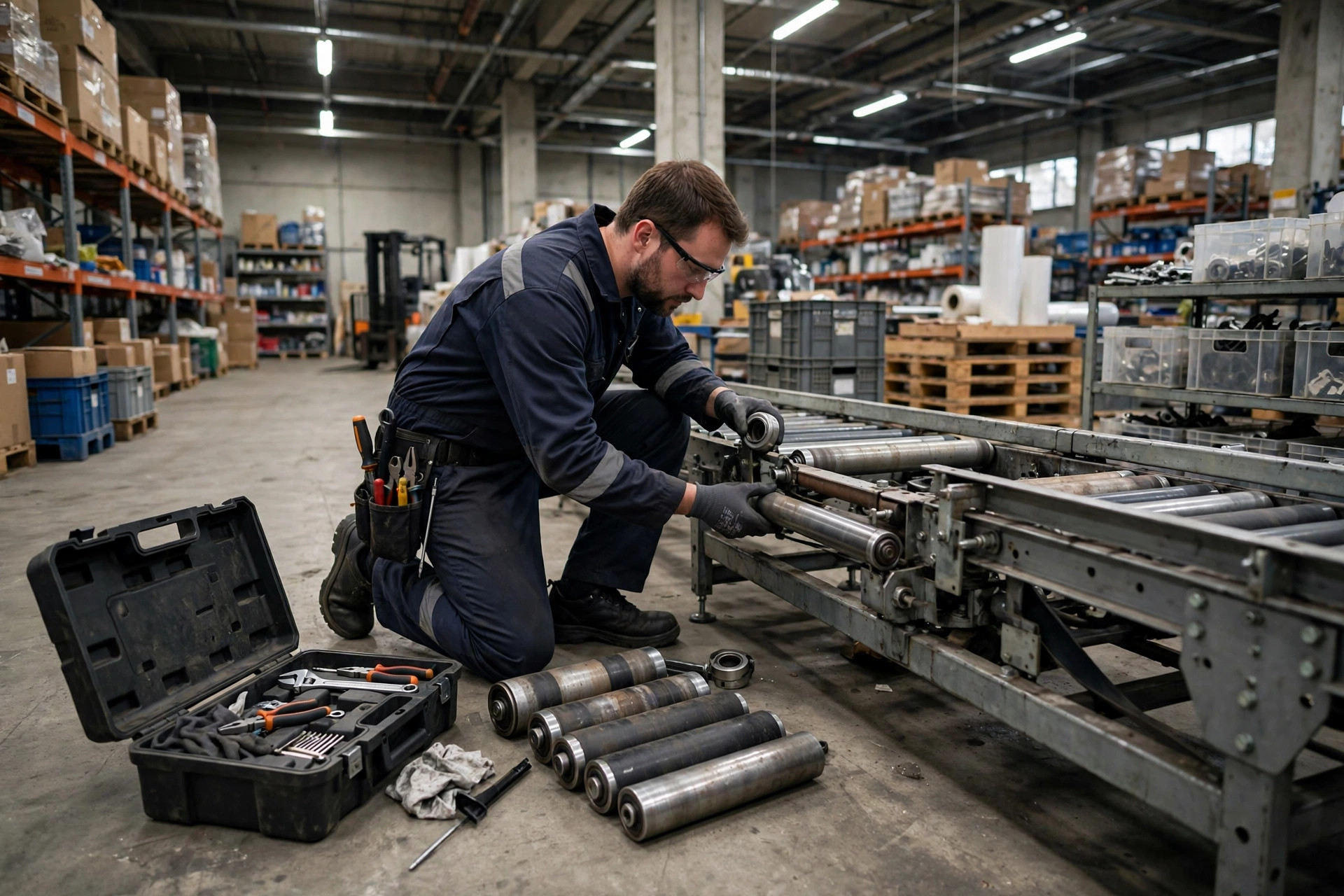
What remote can't fix: anything requiring a wrench — mechanical wear, burned electrics, belt tracking. Across a fifteen-hour time difference, nobody fixes those over the phone. Line up local repair resources before things break, not after:
First, a reliable licensed electrician — motor swaps and wiring checks are routine for them. Ours charges from $150 a visit, hourly after that: pocket change next to flying someone in from the factory.
Second, a local conveyor repair company — search "conveyor repair" plus your city. They stock common rollers and belts, and their emergency response beats anything crossing the ocean.
Third, stock your own generic-parts channels: bookmark McMaster-Carr, Grainger, and Amazon Business with your common sensor part numbers — one to two days to your door. We keep a shared "lifesaver list" doc of links and part numbers; every new hire gets it on day one.
Counter-intuitive take: most people assume more after-sales coverage is always better. We ran the numbers and woke up — a local integrator quoted us $30,000 to $40,000 a year for a maintenance contract, and flying a factory engineer over means airfare, visa, and labor on top. Half a day of downtime costs our little warehouse a few thousand dollars. Paying thirty grand plus for peace of mind? We small warehouses can't burn money like that. So our optimum: redundancy on critical parts, self-stocked wear parts, remote diagnostics — calling the local pro by the job only when something truly beats us. That's not being cheap. Fine, it's being cheap. But it's smart cheap.
Advice for Fellow Small Warehouses: Four Lines
First, the contract is your only after-sales guarantee; verbal promises are air. Walk the bloody checklist line by line before signing — if the manufacturer finds it annoying, they never planned to do after-sales properly.
Second, don't gamble on tariffs and compliance. Tariff policy changes fast — cost it at the latest official rates before shipment, never at signing-day numbers, and declare honestly at customs. Plenty of street-smart ways exist to save money; breaking the law isn't one.
Third, build your own spare-parts list — don't copy the factory's. Use the line-killer mindset and the four quadrants; the savings cover two months' rent.
Fourth, build local resources before things break: an electrician, a repair company, generic-parts channels. With those three you handle 80% of failures yourself and call the factory remotely for the rest.
A year in, our total maintenance cost dropped dramatically. Same Chinese equipment, same manufacturer — we just went from waiting to be rescued to holding the line ourselves.
Small warehouses have their own way of making it: big companies run on systems, we run on brains; big companies run on budgets, we run on checklists. Buy the equipment from China if you want — but the after-sales battle, we fight ourselves, one checkpoint at a time. Win it, and every dollar saved is real money.
By Xiao Ma, Small Warehouse Owner