Our little warehouse can't afford to burn money — but last year I nearly set a pile of it on fire buying imported equipment.
Last August, right before peak season, I gritted my teeth and ordered a small sortation conveyor line from China, hoping to replace half my manual sort labor. I negotiated the price down 5% and felt pretty clever about it. Three months after it arrived, a drive motor burned out. I called the manufacturer, and the sales rep was very polite: "You're under warranty, the repair is free, our engineer will fly over next week — you'll just need to cover the travel."
Next week?! We do 4,000 orders a day in peak season. The line went down, eight temp workers hand-sorted for six days, our sort accuracy dropped from 99% to 96%, a dozen orders went out wrong, and the customer service phone wouldn't stop ringing. The 5% I saved evaporated in a single breakdown — plus temp wages and late penalties on top. That day I learned the real math: when you buy imported equipment, the 5% you negotiate off the price is visible, but the 50% hiding in the warranty terms is what actually gets you.
The 5 warranty terms you must lock down
I went back and renegotiated, line by line, and came out with five items. Miss any one of them and it's a trap:
| Term | The usual trap | What to write in the contract |
|---|---|---|
| Response time | "Respond ASAP" = no commitment | Tiered by severity: respond within X hours for line-down failures, solution plan within Y hours — numbers in the contract, never "ASAP" |
| Where spare parts are stocked | Parts ship from China, 30 days by sea | Common spares stocked in the US — name the warehouse city and the delivery SLA |
| Who pays the engineer's travel | Repair is free, travel is on you — one trip costs more than the part | Travel covered by manufacturer under warranty, or a hard cap in writing |
| Remote diagnostics | Nothing happens until the engineer lands | Remote diagnostic access granted, with response times in the contract too |
| When the warranty clock starts | Starts on ship date — two months of ocean freight burned for nothing | Starts on completed installation and signed acceptance |
Let me walk through how each one bites. Response time: "ASAP" is the most expensive word I've ever seen. After our motor died, the factory "arranged ASAP" — which took nine days. Day three I called: "we're scheduling it." Day six: "the engineer's visa is processing." I learned the hard way that "ASAP" with no definition in the contract equals no promise at all. Spare parts location is worse: a motor air-freighted from China took three weeks — the air freight alone nearly cost as much as the motor, and that's before you discover that batteries and oil-stained parts have air transport restrictions that slow everything down further. Engineer travel: the rep said with a straight face, "repair is free, travel is at cost" — one engineer flying in, hotel plus daily rates, cost more than replacing the motor. The free repair is usually the most expensive one. Remote diagnostics was my late epiphany: 80% of electrical faults can be located by an engineer reading the logs remotely. A screenshot of the PLC error code, a photo of the inverter parameters, and they can tell you which part to swap in ten minutes. The warranty start date is the sneakiest: the contract says "12 months from shipment," but ocean freight plus customs plus installation eats two months — your real coverage is ten months. Nobody warns you before you sign, and nobody admits it after.
Here's the counterintuitive part: with imported equipment, warranty isn't about how many years they "cover." It's about how many days until you're running again after a breakdown. Three years of warranty with parts in China loses to one year of warranty with parts in a Los Angeles warehouse. A small warehouse can't survive downtime. We can't gamble on time — we can only gamble on terms.
The small-warehouse playbook: can't afford the service, buy the spares
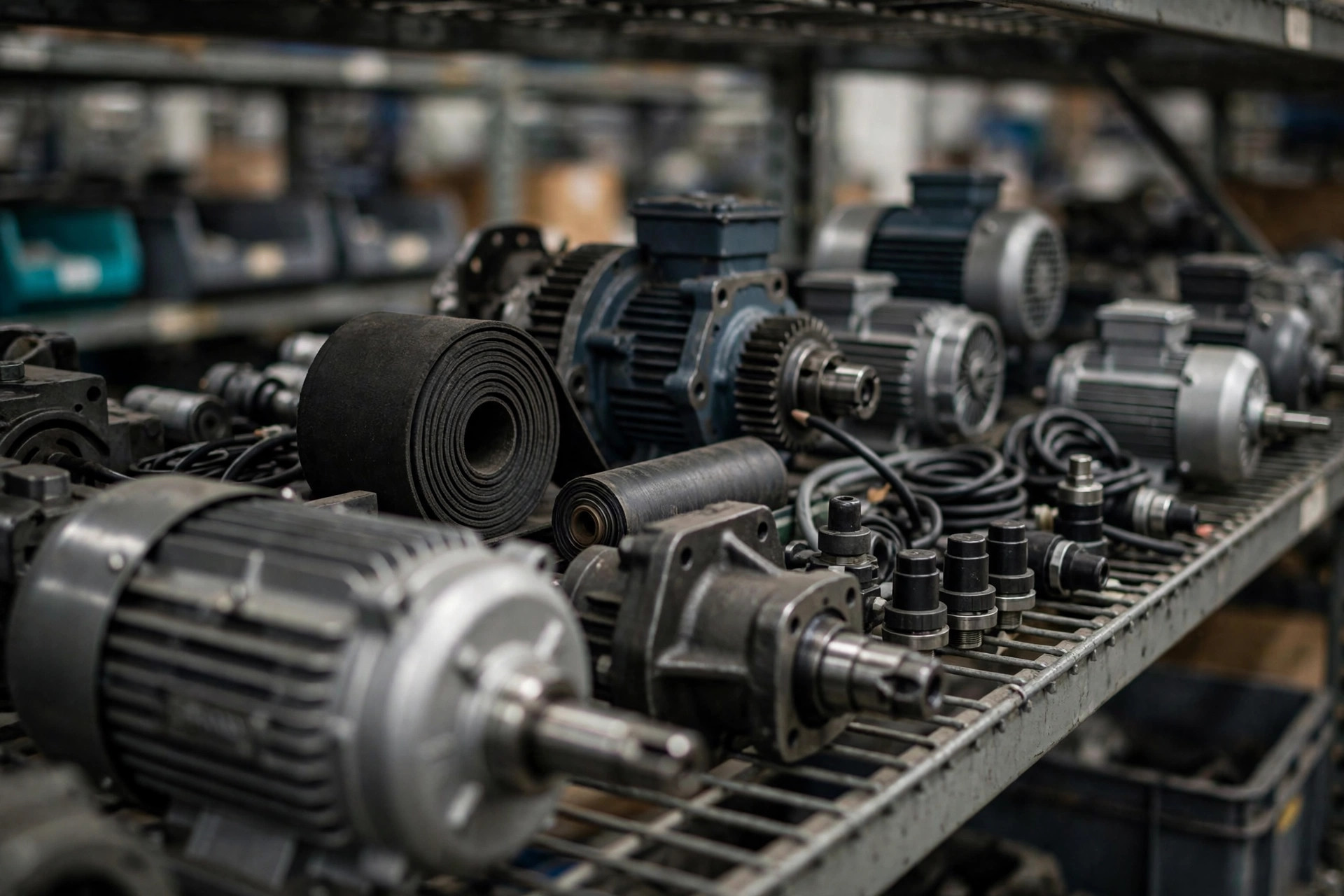
After renegotiating, I built myself a backup plan — the "emergency trio": one spare belt, two photoelectric sensors, one spare motor, on a dedicated rack in the warehouse. Small money. But when something breaks, that rack is the production line. How do you build the list? My method: ask the manufacturer for the wear-parts list with recommended stock quantities, then have their engineer mark which failures stop the line — stock only the line-stoppers, not the nice-to-haves. Generic parts like belts and sensors don't have to be OEM; if the model matches, they cost half. Core parts like motors and inverters — buy OEM, no shortcuts, not worth the gamble.
Last December a sensor died again. My electrician swapped it in 40 minutes. The line never stopped. Big companies buy service-response systems. Our small-warehouse version: if you can't afford the service, buy the spares and the terms. The rack stands by the electrician's room door, every part labeled with model number and replacement steps — because at 2 a.m. when the alarm goes off, nobody is in the mood to read a manual.
For contrast: my neighbor Lao Chen bought the same line, but his contract locked in "spare parts delivered within 48 hours, stocked in a US warehouse," plus remote diagnostic access activated from day one. Last month his motor burned out too. The engineer located the fault remotely in 20 minutes, the part arrived the next day, his electrician swapped it in two hours — back in production in under 30 hours. He spent half an hour negotiating the contract. I spent six days with a dead line. Negotiate 5% off the equipment price but fumble the warranty, and one breakdown hands all the savings back — that sentence is now tattooed on my brain.
Talking points for the negotiation: when sales says "we can't change it"
When you push on these five items, sales will almost certainly say: "This is our standard template, we can't change it." Don't believe it, and don't argue. My workaround: don't change the template — add a supplementary agreement. The template is for their legal department; the supplement is for the two of us. Same legal force.
Some lines that actually work: when they say spares can only ship from China, say "then give me the common-spares list and factory wholesale pricing, I'll stock them myself — you guarantee supply for five years." That turns "they stock" into "I stock, they guarantee supply" — a small cost moves to your pocket, but the control moves to your hands. When they say company policy makes the customer cover engineer travel, say "then put a cap in writing — no more than X per trip, you cover anything above." The word "cap" turns a bottomless pit into a budget line. When they say remote access can't be opened for security reasons, say "then when it breaks I'll send video plus a log package, and you owe me a preliminary diagnosis within four hours — in the supplement." Step back on access, but bite down hard on the timeline.
Remember: sales-speak for "we can't change it" usually means "it's a hassle to change." If you've already worked out the solution for them, they can take it straight to their boss — the approval rate is higher than you'd think. A small warehouse has no leverage in negotiation, so you win by doing the homework before they do.
So, three suggestions for fellow small-warehouse folks looking at imported automation: first, negotiate warranty before price. Price is what sales wants you to look at; warranty is what the owner should look at — don't reverse the order. Second, every verbal promise from sales goes into the contract appendix. A promise that can't make it into the contract is just a story — "we usually arrive in three days" means nothing if it's not written down. Third, the day the equipment arrives, get the wear-parts list and stock your own "emergency trio." Don't wait for the breakdown to start shopping. Parts you order after the breakdown are always still in transit when you need them most.
Small warehouses have their own way of surviving. Big companies compete on service-response systems; we compete on fine print and early stocking. Spend the money where it counts — and where it counts is those five lines in the contract. Next time I buy equipment, the first thing I do won't be haggling over price. It'll be sending the sales rep my draft warranty supplement — so they know they're dealing with someone who's been burned before.
By Xiao Ma, Small Warehouse Owner