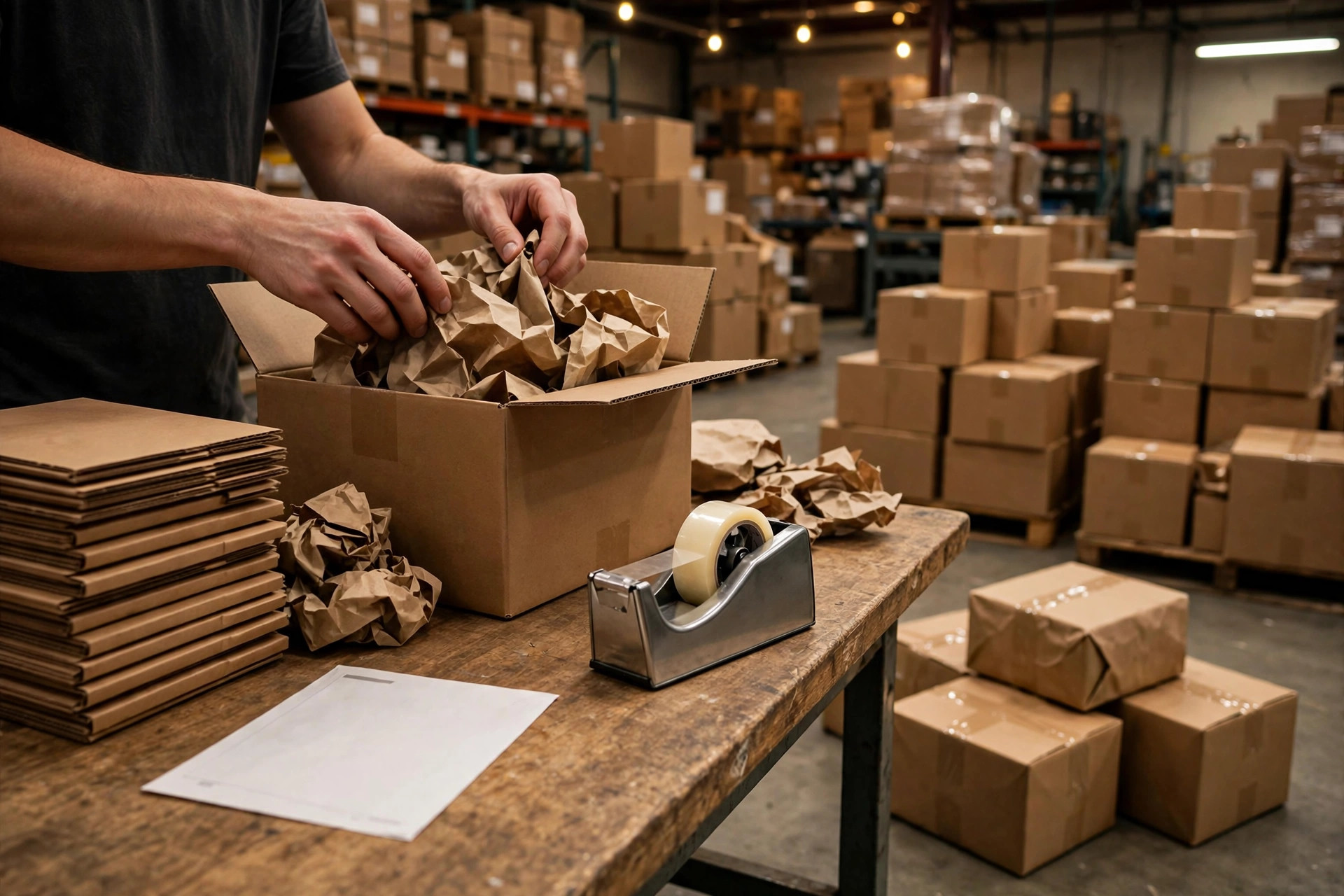
A 300-SKU e-commerce warehouse stocked 38 carton sizes. Carton standardization sounds like a rounding error of a project — so let me open with the bill: those 38 sizes cost roughly $90,000–$100,000 a year more than 8 sizes would. Cartons look like small money. Add up all the small money in a warehouse and you get the line that vanished from the P&L.
The Bill: 38 Sizes vs 8 Sizes, Four Accounts Compared
Headline first. Same warehouse — 300 SKUs, about 600,000 orders a year. Cut carton sizes from 38 to 8 and the four-account comparison looks like this:
| Cost account | 38 sizes (status quo) | 8 sizes (standardized) | Annual delta (order of magnitude) |
|---|---|---|---|
| Unit purchase price (weighted avg) | ~$0.45/carton | ~$0.32/carton | 600k cartons/yr → ~$78k saved |
| Cash tied up in carton inventory | ~$40k | ~$14k | ~$26k of cash freed |
| Void fill cost | ~$0.08/order | ~$0.04/order | 600k orders → ~$24k saved |
| Pick-a-box labor | ~10 sec/order | ~5 sec/order | 600k orders → ~800 labor-hours saved |
Four accounts, one year, roughly a six-figure difference. That money was spent for nothing. Worse: most warehouses never run this math, because carton costs are scattered across purchasing, consumables, and labor line items. Nobody assembles them into one P&L.
Tearing Down the Cost Structure: Where Carton Money Actually Goes
Carton cost is not "the price of the box." I split it into five pieces — walk your own warehouse through each one:
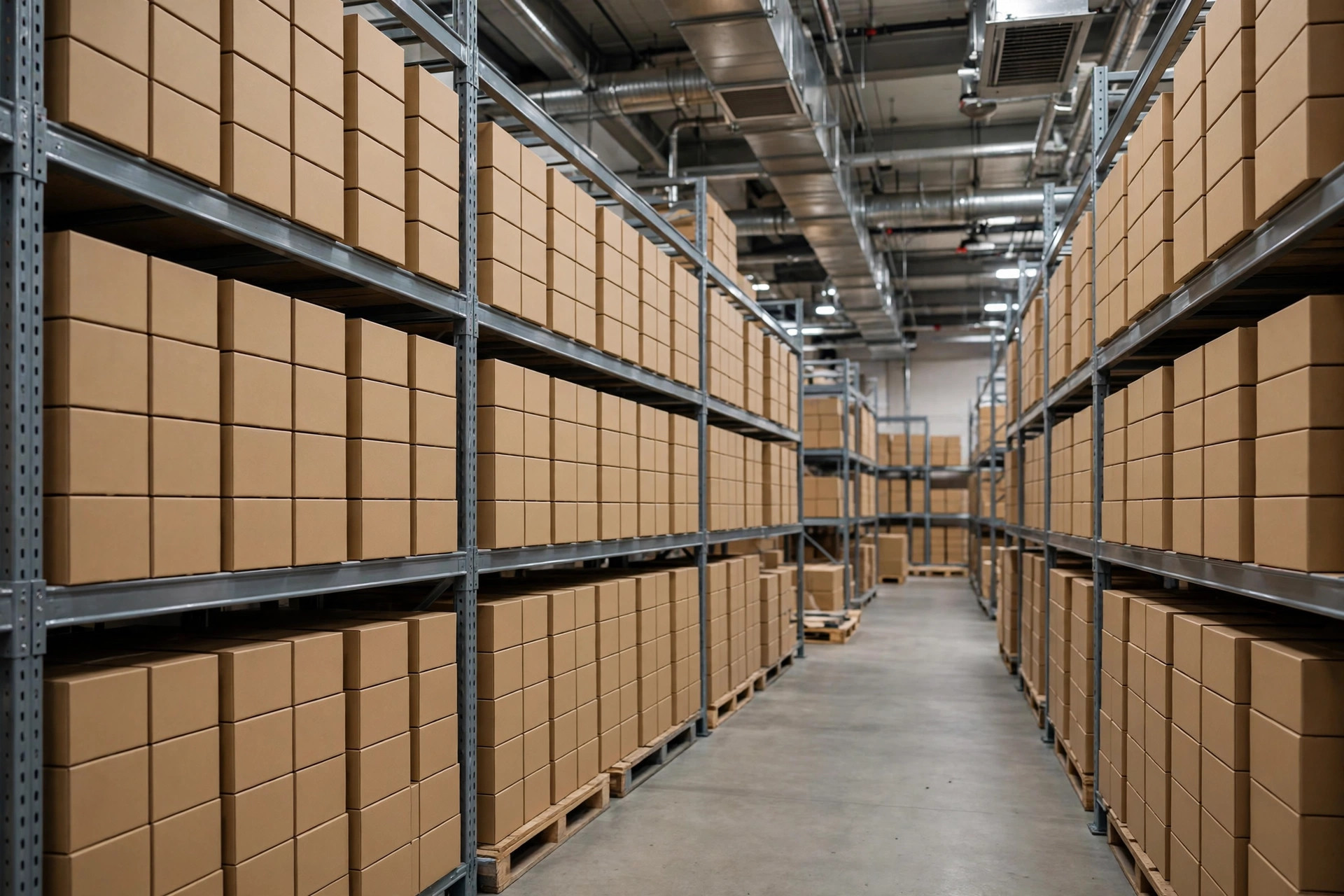
One: purchase cost. The only piece most people track. Low-volume sizes never hit the box maker's minimums, so unit prices stay high. In a 38-size warehouse, maybe 8–10 sizes are high-volume "core" sizes; the rest are long-tail — low volume, high price, and prone to stockouts.
Two: inventory cash. Every size needs safety stock. 38 sizes × 2–3 days of cover each easily eats 1,500–2,000 sq ft of carton storage. At first-tier-city warehouse rents, that floor space alone costs thousands a year. Halve the sizes, halve the footprint.
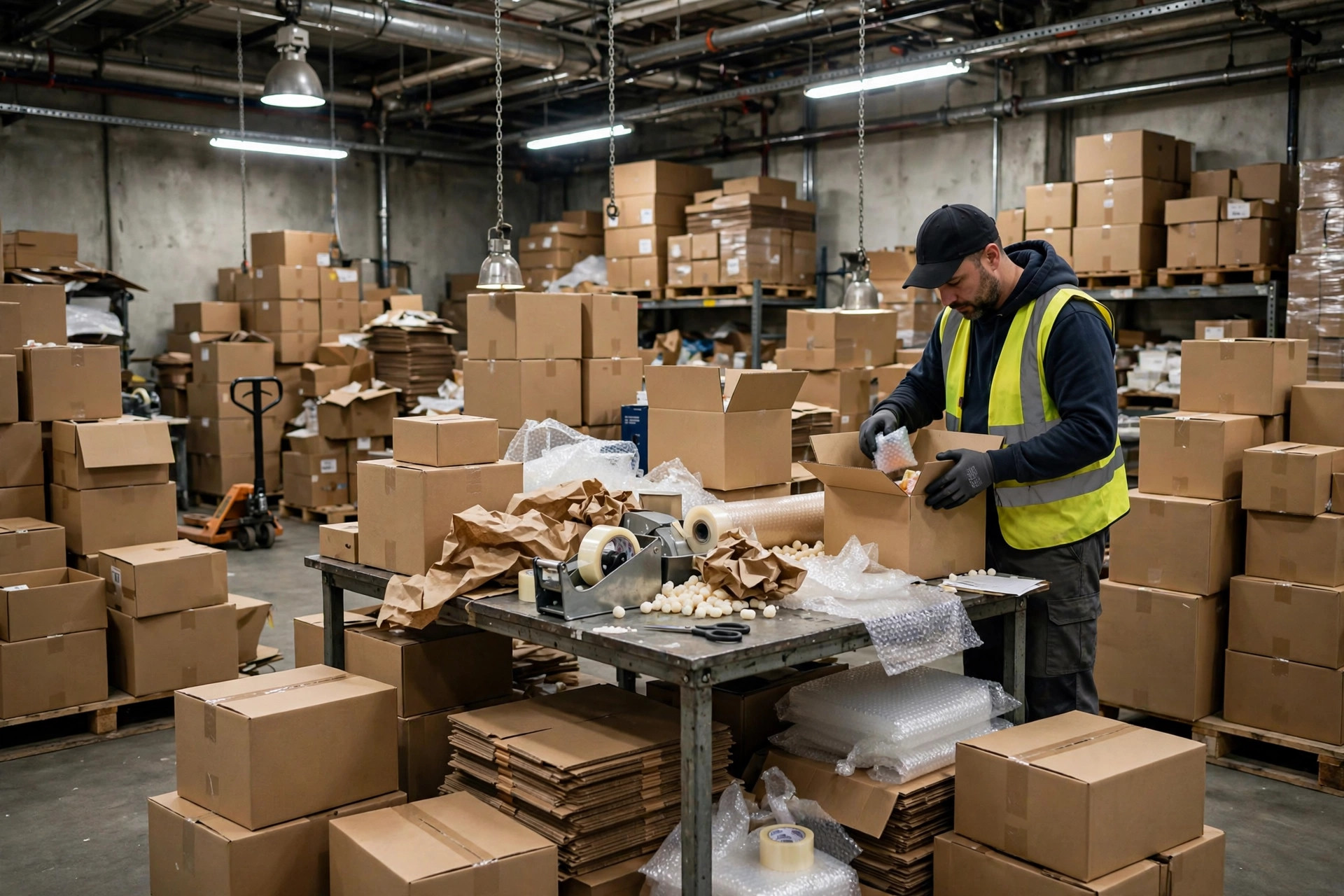
Three: void fill. The more sizes you stock, the more "make-do" boxes you use — small product, oversized box, and the gap gets filled with bubble wrap, kraft paper, or air pillows. Field sampling consistently shows "oversized box" orders cost $0.03–$0.04 more in void fill each. Three cents sounds like nothing; 600,000 orders turns it into real money.
Four: pick-a-box labor. 38 sizes means the packer spends ~10 seconds just choosing a box. Cut to 8 sizes and it's 5 seconds. At 2,000 orders a day, that's nearly 3 labor-hours saved daily — measured with a stopwatch, not modeled in a spreadsheet.
Five: dimensional-weight freight. Carriers bill on dimensional weight. One size up on the box bumps the DIM weight a tier, and the same item ships $0.10–$0.20 more. That money sits in the freight account, and most operators will never connect it back to "too many carton sizes."
Two Real Cases: How the Money Leaked
Case one: June 2024, a 3PL in Suzhou serving beauty e-commerce brands. 320 SKUs, 38 carton sizes in stock. I pulled 12 months of carton issue records: 11 sizes had annual usage under 500 cartons — stocked purely for peace of mind. Slow-moving sizes cost $0.60–$0.68 per carton; core sizes running 6,000–8,000 a month cost $0.28–$0.34 — in the same warehouse, unit prices differed by more than 2x. Annual void-fill spend was about $20,000, and a 200-order sample showed roughly 30% of it came from oversized boxes. First year after the carton standardization rollout: over $60,000 saved on purchasing and void fill alone.
Case two: March 2025, a cross-border e-commerce warehouse in Shenzhen. 280 SKUs, cartons cut from 27 sizes to 9. Before the cut, a 5-day sample (400 orders) clocked pick-a-box time at 11 seconds per order — packers said "finding the box takes longer than packing it." After: 5 seconds per order, weighted-average carton price down ~18%, carton inventory cash down from ~$37k to ~$16k. The surprise: mis-ship complaints from "wrong box" dropped 40%, because packers no longer had to solve a multiple-choice question at every order.
The Counterintuitive Part: More Sizes, Higher Unit Price
This is where intuition fails: the more carton sizes you stock, the more each carton costs.
"A perfectly fitted box for every SKU" sounds optimal — minimum void fill, minimum waste. But the math doesn't survive contact with the box factory: perfectly fitted means every size's volume is fragmented, and the maker's minimums, plate charges, and changeover losses all get amortized over your few hundred cartons. Economies of scale die in fragmentation.
Flip it: 8 standard sizes covering 300 SKUs means each size runs tens of thousands of cartons a year. The box maker gives you the big-customer price, and unit cost drops 20–30%. The savings on purchase price alone more than cover the slightly higher void fill from "a box that's a touch big."
Remember this: the cheapest box is not the best-fitting box — it's the box that's good enough and bought in volume. Chasing a perfect fit for every SKU is the most expensive kind of tenderness in warehousing.
How to Standardize Cartons: Three Levers
So you agree it's worth cutting. How? Three levers, in order:
Lever one: cluster by volume, not by SKU count. Sort SKUs into 6–10 bands by "packed outer dimensions." Note: volume bands, not SKU bands — of 300 SKUs, 200 may fall into 3 bands while the 100 long-tail SKUs split across 4–5. Once this is done, the size list almost writes itself.
Lever two: set a coverage rule. A box "fits" an SKU only if cube utilization hits ≥70% (i.e., void ≤30%). Combinations below 70% either move bands or accept the void-fill cost. Fragile and high-value items get their own band and don't participate in merging — don't save your way into damage claims.
Lever three: govern new sizes. Sizes are easy to cut and even easier to grow back. One for customer A today, one for category B tomorrow, and your 8 sizes are 20 again in six months. The fix is one line: new sizes need approval, and whoever requests one owns its cost — put the "annual cost of one new size" (purchase premium + safety-stock cash + floor space) on the approval form. 90% of "special requirements" get withdrawn on the spot.
A Conclusion You Can Calculate
Final deliverable — a conclusion you can take home and compute:
Action threshold: if carton sizes ÷ SKUs > 12%, it's time for carton standardization. 300 SKUs with 36+ sizes means your warehouse is almost certainly paying the fragmentation tax.
Target: for a 300-SKU e-commerce warehouse, 6–10 sizes covering 95%+ of orders. Cover the remaining 5% with "one generic large box + void fill" — never open a dedicated size for the long tail.
Savings formula: annual savings ≈ annual cartons × unit-price delta + annual orders × void-fill delta per order + labor-hours saved × hourly rate. Plug in your warehouse's three numbers; if the answer clears $25k, the project is worth chartering. At the magnitudes above, most 300-SKU warehouses clear that bar easily.
Carton standardization isn't glamorous — no automation, no robots. But it's one of the highest-ROI projects in a warehouse: zero capex, pure arithmetic and execution, six figures a year. Money like that, you don't leave on the table.
By Lao Zhou, Logistics Cost Analyst