What gauge stretch wrap for pallet loads — 60, 80, or 100? Three years ago, when I started my 3,000-square-meter warehouse, I couldn't have answered that if my life depended on it. A packaging salesman walked in, looked at my pallets, and delivered the magic line: "With cargo this valuable, you need 100 gauge. Thicker is safer." Sold. Six months later I stared at the stretch-film line on our expense report — it was eating nearly a third of our rent. That's when it hit me: the guy selling the film and the guy buying the film are not doing the same math.
What "Gauge" Actually Means: Thinner Film, Longer Roll
Gauge is just a thickness unit for stretch film: 1 gauge ≈ 0.254 microns. So 60 gauge ≈ 15 microns, 80 gauge ≈ 20 microns, 100 gauge ≈ 25 microns.
Here's the counterintuitive part: thinner film means a longer roll. For the same roll weight, 60 gauge gives you roughly a third more film than 80 gauge. That single fact became the entire basis of our savings — but don't rush to switch to thin film yet. Let me tell you about the holes I fell into first.
What Gauge Stretch Wrap for Pallet Loads: The Expensive-Film Trap I Fell Into
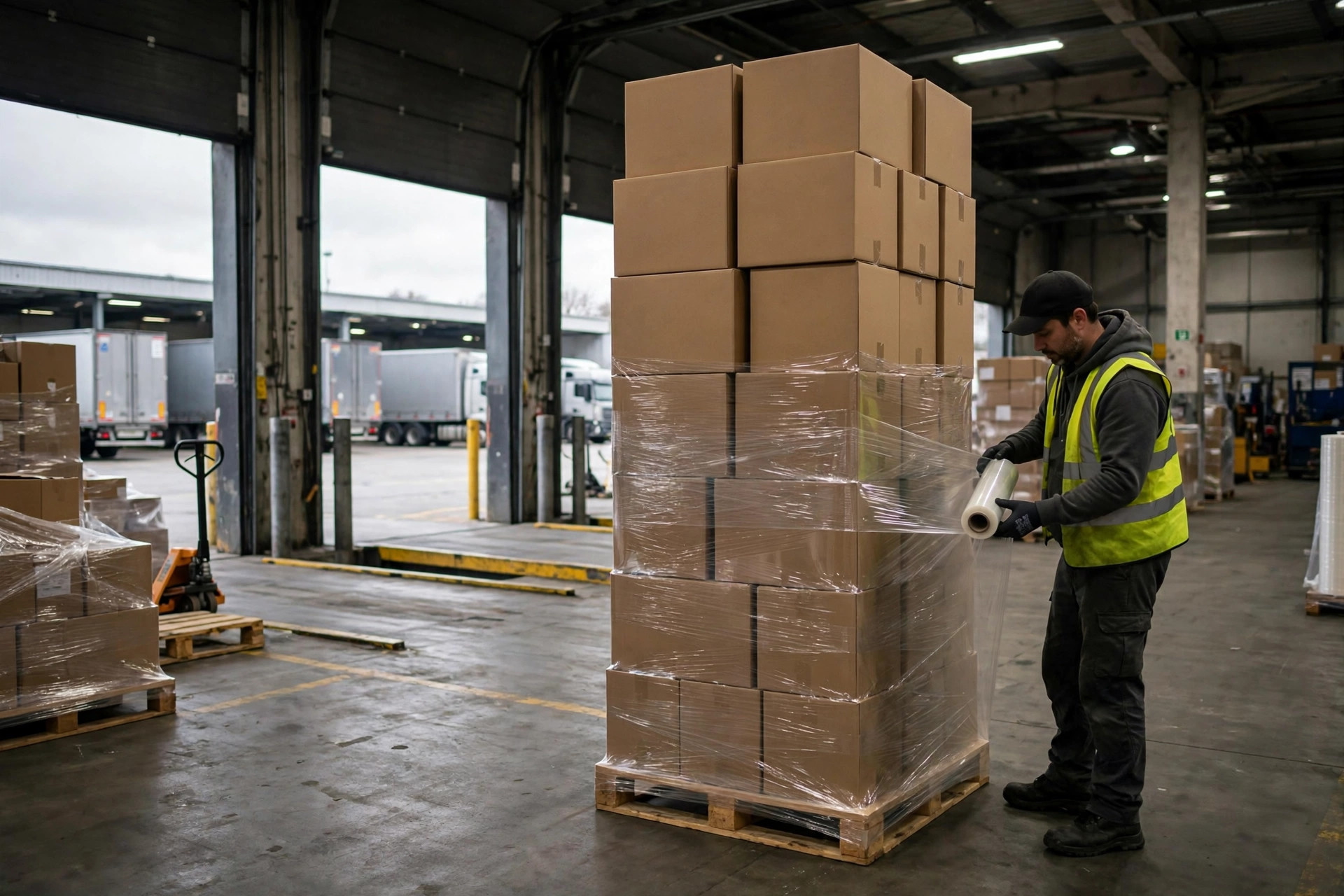
For our first six months, we ran 100 gauge across the whole warehouse. The salesman had charts: thicker film, better puncture resistance, lower tip-over rates. All true on paper. Then one day I watched our veteran guy wrap a pallet: the 100-gauge film was stiff, so he barely stretched it, looped it three lazy times, and left the top open.
That's when I got it: holding force doesn't come from thickness — it comes from stretch and rebound. Hand wrap has no pre-stretch mechanism; everything depends on the worker pulling the film tight by hand. Thick film is hard to pull, so people get lazy and wrap it loose. 80 gauge is softer, easier to stretch, and five serious wraps of 80 will hold tighter than three lazy wraps of 100.
No salesman will ever tell you this, because they sell film by the roll, not by the technique. "Thicker is safer" really translates to "thicker is more profitable — for me."
Case 1: Downgauging from 80 to 60 in July 2024 — Real Savings on Paper
In July 2024, a friend running an apparel e-commerce warehouse dropped by and said casually: "We switched the whole warehouse to 60 gauge. Saves us nearly twenty grand a year on film. You're still on 100? Big spender." I laughed on the outside and bled on the inside.
I ran a pilot: light, uniform cartons (apparel returns, neatly stacked boxes) switched to 60 gauge first; heavy cargo stayed put. Two weeks of bookkeeping — based on the quotes we got at the time, so check your supplier's latest pricing:
- Before: 80-gauge hand film, 400mm × 300m, about ¥18/roll. Roughly 28 meters per pallet → 10.7 pallets per roll → about ¥1.68 per pallet.
- After: 60-gauge hand film, 400mm × 400m, about ¥17/roll. Same wrapping style → 14.3 pallets per roll → about ¥1.19 per pallet.
We were shipping around 120 pallets a day — about ¥59 saved daily. Over 300 working days, that's roughly ¥17,700 a year — enough for two full forklift services with change to spare.
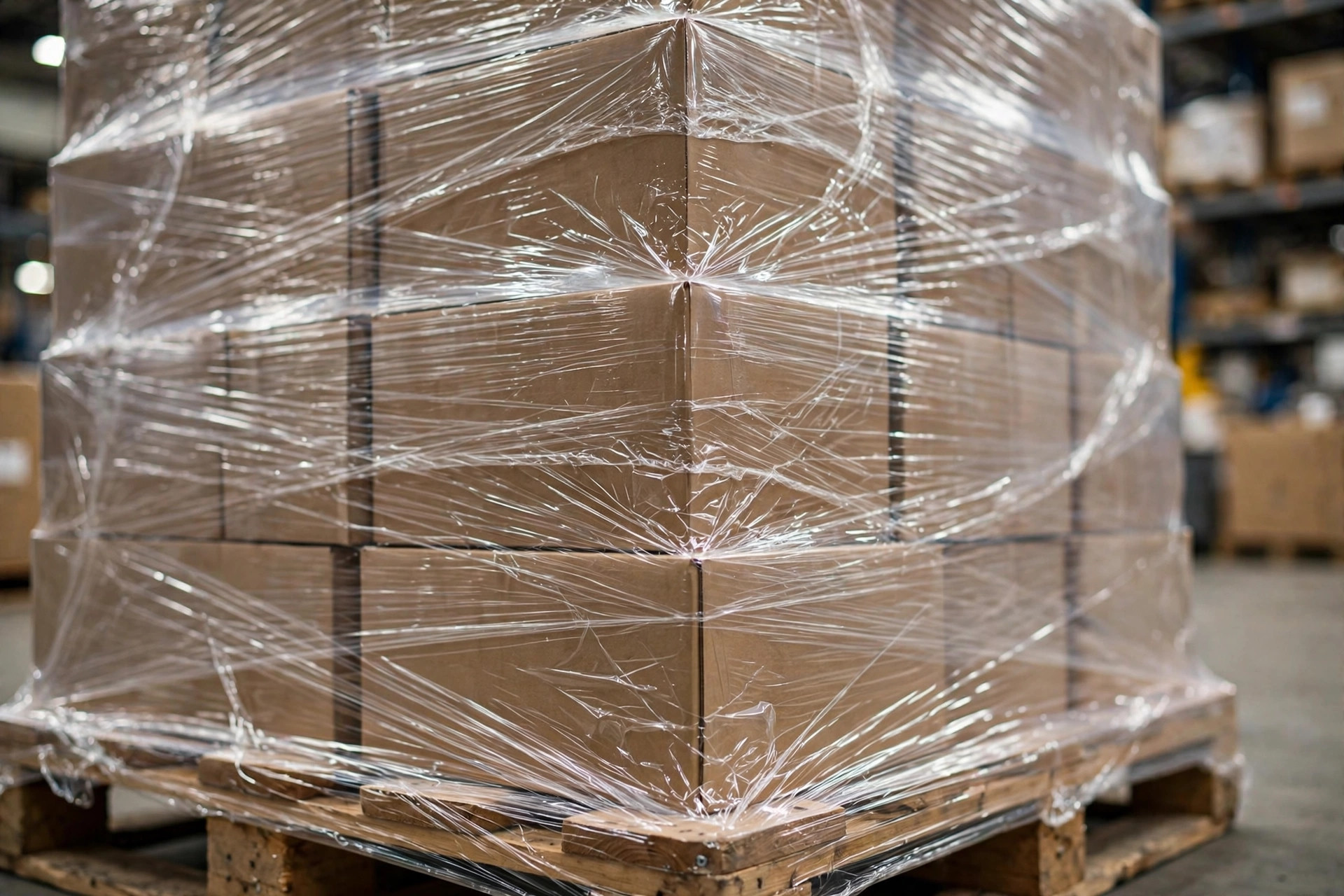
And the result? Three months, zero damage, zero complaints on light cargo. 60 gauge handles neat, light loads just fine. I got cocky and nearly switched the whole warehouse in one go. Good thing I didn't — or the second story would have arrived early.
Case 2: November 2024 — Thin Film in the Wrong Place Cost Us ¥3,200
In November 2024, a 1.2-ton pallet of metal hardware parts needed to go out — tall stack, sharp carton corners. The guy on shift grabbed the leftover 60 gauge, wrapped it three quick times, didn't cap the top, and loaded it. First intersection out of the industrial park, the truck braked hard, and the whole pallet exploded inside the trailer. Seven or eight cartons split open, hardware everywhere.
Three of us spent the afternoon inside that trailer re-stacking and re-wrapping. We ended up paying the customer ¥3,200 in damage claims, plus eating the freight cost. That ¥3,200 would have bought us half a year's worth of film.
The bloody lesson: thin film isn't bad — it's bad in the wrong place. Heavy cargo, sharp corners, pallets over 1.8 meters, long hauls: 60 gauge is tissue paper there. Saving pennies on film where you need 100 gauge costs you thousands when it fails.
60 vs 80 vs 100 Gauge Stretch Wrap: The Cost-and-Damage Comparison Table
| 60 gauge | 80 gauge | 100 gauge | |
|---|---|---|---|
| Thickness | ~15 microns | ~20 microns | ~25 microns |
| Film per equal-weight roll | Longest (~1/3 more) | Medium | Shortest |
| Best for | Light, uniform cartons, apparel | Standard carton loads, most cases | Heavy, sharp-cornered, tall pallets |
| Cost per pallet (relative) | Lowest | Medium | Highest |
| Biggest risk | Punctures, can't hold heavy loads | Still not enough for extreme loads | Expensive; too stiff to stretch well by hand |
Check current supplier pricing for absolute numbers — the table is about relative relationships, not quotes.
The Uncomfortable Truth: Downgauging Was Never the Real Savings
Those ¥17,700 in savings made me happy for three months — until I did another calculation and realized I'd been optimizing in the kiddie pool.
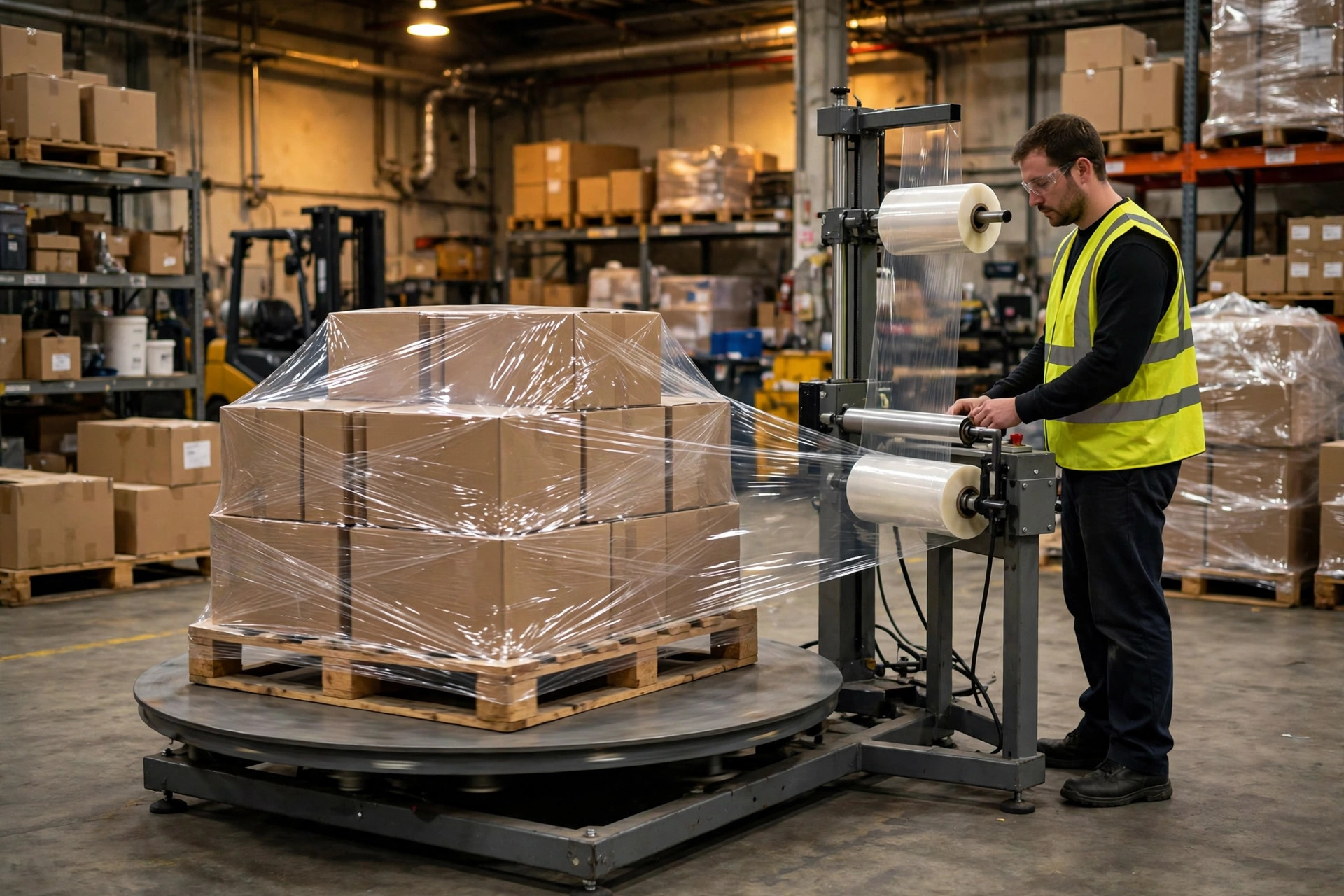
The real money is in pre-stretch. Hand wrapping stretches film maybe 30%. Even a secondhand turntable wrapper with pre-stretch rollers hits 200%+ — one meter of film does the work of three. In March 2025 we gritted our teeth and bought a used turntable wrapper for ¥8,000, switched to machine film, and our per-pallet film cost dropped from ¥1.2 to under ¥0.5. At 120 pallets a day, that's ¥80+ saved daily — payback in three months, pure profit after that.
Here's the kicker: with pre-stretch, you can drop a full gauge and hold tighter than before. Loads we hand-wrapped with 80 gauge now get machine-wrapped with 60 gauge — and they hold better, because holding force comes from stretch rebound, not thickness. That's why big companies never agonize over gauge: they're all machine-wrapping, playing a completely different game from us hand-wrap folks.
So here's my anti-big-company take: their playbook — "standardize on 100 gauge plus SOPs" — is something small warehouses can't afford and don't need. Our playbook: in the hand-wrap days, save money with smart gauge selection and good technique; once volume justifies it, buy a used wrapper and skip the gauge debate entirely.
What Gauge for Pallet Loads? My 3-Step Field Method
No theory, just what we actually do on the floor:
1. Look at the cargo. Light and uniform → 60 gauge. Standard cartons → 80 gauge. Heavy, sharp corners, or over 1.8m tall → 100 gauge. We stock two gauges (60 + 80, with 100 on call for heavy loads) — never one-size-fits-all.
2. Look at the journey. Moving around the warehouse → drop a gauge. Local delivery → standard. Long haul or ocean freight → go up a gauge. The rougher the road, the thicker the film. Physics doesn't negotiate.
3. Test and track. Every time we change film brands or cargo types, we pull one random pallet and have the forklift driver do two hard stops in an open area. Boxes don't shift, film doesn't loosen — it passes. Call it the "hard-brake test": zero cost, beats any lab data. And we keep a daily "film ledger": rolls used versus pallets shipped. The moment cost-per-pallet creeps up, we check whether technique got sloppy or someone swapped the film.
Three Honest Tips for Fellow Small Warehouse Owners
- Don't buy the "thicker is safer" sales pitch. Trust your ledger and your hard-brake test.
- Don't run one gauge for everything. Stock two, switch by cargo type — save money and stay safe.
- Hand-wrap optimization has a ceiling. When volume grows, bite the bullet on a used wrapper — that's where the real cost reduction lives.
We small warehouses can't afford to burn money — but being broke doesn't mean settling. Know the math on every roll, write down the cause of every tip-over, and a small warehouse can beat the big guys on packaging cost.
Small warehouses have their own way of surviving: big companies compete on standards; we compete on the ledger. It's not about thick film. It's about doing the math.
By Xiao Ma, Small Warehouse Owner