It was 6:30 in the morning when I walked into the cable drum warehouse storage yard and saw three big drums lying flat by the aisle. The night shift had done it to save time. Let me be straight with you: I lost my temper, and not because I enjoy it. I have paid for that exact mistake before. A cable drum looks like a tough, round beast of a thing. It is not. Store it wrong, damage the cable, and you lose a whole drum of cable plus the freight both ways and a chunk of your customer's trust.
We run a yard with several hundred drums: power cable, control cable, fiber. Every new hand asks me the same question: how do these things actually get stored? My answer never changes. Upright is the rule. Flat is the exception, and the exception needs my signature.
Cable Drum Storage: Upright Is the Rule, Flat Is the Exception
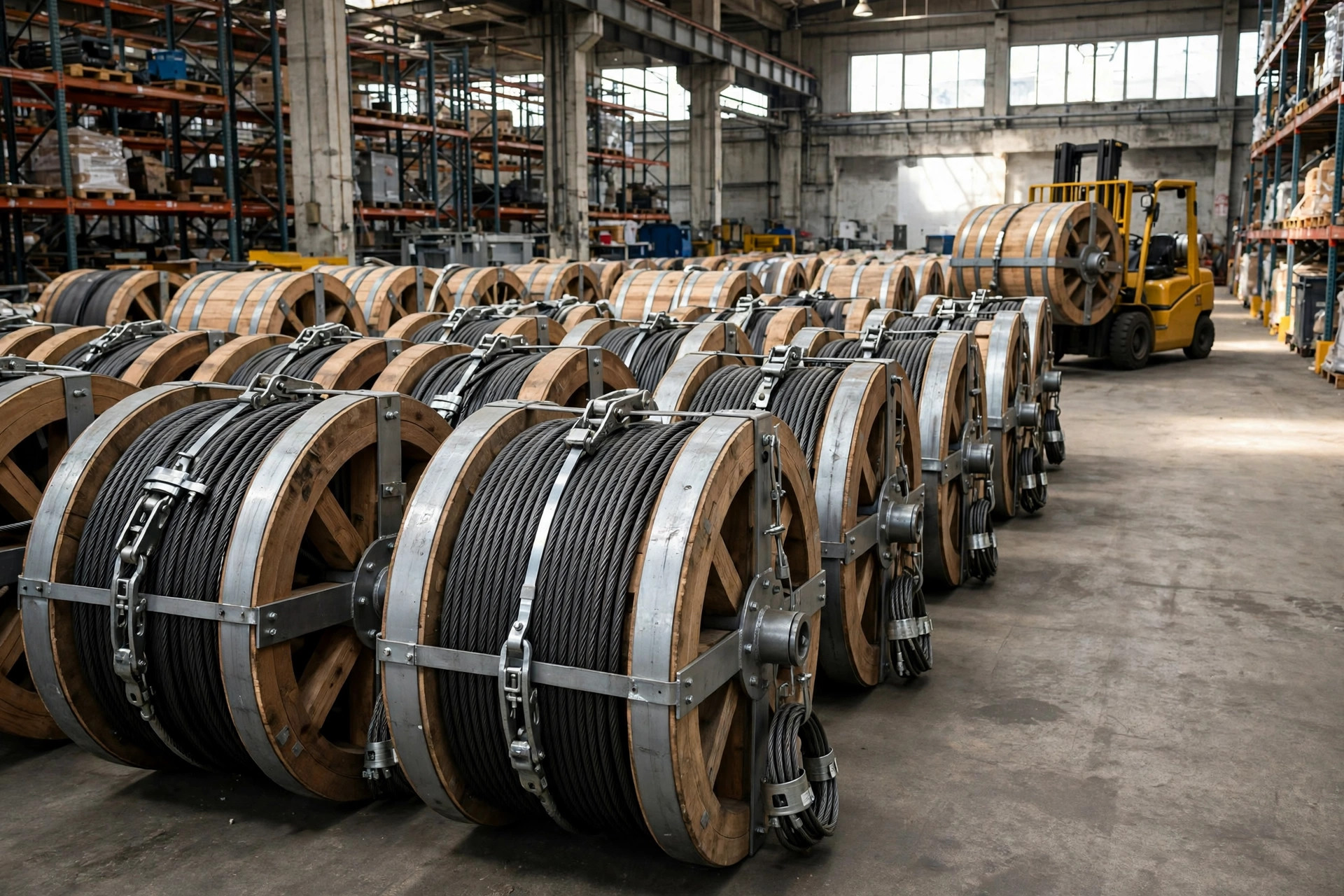
Storing a drum upright means the flanges stand vertical and the drum can roll. That position gives you three things. First, the cable carries its own weight evenly instead of pressing down on the bottom layers. Second, the drum rolls and turns, so you can push it straight onto a pay-out stand instead of lifting it around. Third, the label faces outward, so finding a drum means looking, not hunting.
Laying a drum flat looks tidy and stable. The trouble is all underneath. The whole weight of the drum presses on the outermost layer of cable. Leave it long enough and that outer layer takes a set, or worse, the insulation gets damaged. And when you need a flat-stored drum, you have to move everything stacked on top of it first. Every extra forklift move is another chance to knock something.
We learned this the hard way during peak season last year. A power contractor had a rush order, and the night crew laid three new drums flat by the door so they could ship first thing in the morning. The next day, the forklift shifted the top drum and its flange edge caught the cable on the drum below. The cable did not break, but the outer jacket had a visible gash. The customer spotted it at inspection and sent the whole drum back. We ate the freight both ways and lost half a day on their schedule. Since then, the rule in my yard is written down: flat storage needs my signature, and only for empty drums or small drums whose manufacturer manual explicitly allows it. Whatever the manual says goes. Gut feeling does not.
Cable Drum Warehouse Storage Starts with the Floor, Not the Racking
Ask me what most people overlook in cable drum warehouse storage and I will not say racking. I will say the floor.
A full drum of heavy cable is seriously heavy. One big drum can weigh as much as a small car. Line up a dozen of them and all that weight sits on two narrow flange contact patches per drum. A concrete floor looks indestructible, but older floors have cracks and patched sections, and they do not carry load like a new slab. Our practice is unglamorous but it works: before we open a new drum area, we check the total drum weight and the flange contact area against the floor's rated capacity on the building drawings. If we are not sure about a spot, we lay steel plates to spread the load, or we pick a different area. Do not wait until the floor starts spalling and the drums stop standing straight.
There is a space calculation too. Upright drums take floor area by diameter, and they save you height. But if the drums are wide and the aisle is narrow, the forklift cannot turn, and the whole layout is useless. Our rule is simple: aisle width is set by the biggest drum diameter plus forklift turning clearance. I would rather store two fewer drums than block an aisle. A blocked aisle during peak shipping season is the kind of problem that makes grown managers cry.
| Method | Floor space | Cable stress | Retrieval | Our call |
|---|---|---|---|---|
| Upright | One diameter per drum, in rows | Even, outer layer unstressed | Rolls straight out, forklift-friendly | Default |
| Flat | Looks space-saving | Bottom outer layer under constant pressure | Must move drums on top first | Empty or small drums only, signed off |
Pay-Out Order: If the Label Is Unclear, the System Has Failed
Let me be honest: the most grinding part of this job is not moving drums. It is finding the right drum and keeping pay-out order straight. A yard with hundreds of drums holds a lot of lookalikes. Two drums can share a spec and differ by a few dozen meters of length, and you cannot tell them apart by looking.
Two years ago we shipped to a municipal project that needed two drums of the same spec in two different lengths. The drum label had been rained on and the writing had blurred. The picker grabbed the wrong one from memory. The crew on site paid out half the run, ran short, and stopped work waiting for a replacement. We paid the return freight and burned a good chunk of that customer's goodwill. After that, we changed the routine. Every drum gets two waterproof labels on the outer flange at receiving: one with spec, length, batch, and receiving date, and one with its location and its first-in-first-out sequence number. Big print, readable from the aisle.
The pay-out rule itself is simple: first in, first out. It sounds like a platitude, and it is the easiest rule to break. A new drum arrives, someone parks it by the door, and the next shipment grabs the convenient one while the older drum sits inside for months. Cable does not go bad sitting there, but drums weather, labels fall off, and when a customer asks about batch traceability you have nothing clean to show. Every monthly stock count now includes a sequence check, and older drums get priority in the shipping plan. Here is the counterintuitive part most newcomers miss: leaving a cable drum untouched is not the safest option. A drum that never moves is a drum whose problems grow where nobody looks.
Long-Term Storage Checks: Find It Here, Not at the Customer's Site
Drums in long-term storage get a quarterly walk-through in my yard. The checklist is short. First, the drum itself: wooden drums for moisture, mold, and cracking; steel drums for rust and deformation. Second, the outer cable layer: pressure marks, jacket damage, rodent bites. Third, the cable end: is it secured, or has it come loose and started dragging on the floor? Fourth, the label: still there, still legible?
Checks do not work as surprise inspections. They work as a roster. Each drum area has a named owner, results go on the count sheet, and anything suspect gets photographed, tagged, and moved to a hold area on the spot. That is the quiet risk in cable drum warehouse storage: damage you only discover when it is too late. Last year one quarterly round turned up two wooden drums whose bottom rings had gone soft from moisture. Another month and that cable would have been downgraded. Catching it here cost us an hour. Catching it at the customer would have cost us the order.
So here is my reminder to fellow managers. Cable drum storage is not high technology. It is four things done as routine: position, floor load, labeling, and inspection. Write them into the shift handover sheet so a new hire can follow them and the system survives when a veteran leaves. The drums are round, but your management cannot be allowed to roll. Tomorrow morning, walk your drum yard before anything else. Look for a flat drum, a missing label, an old drum buried inside for more than three months. That one walk makes your yard a little steadier than it was yesterday.
By Chen Feng, Warehouse Operations Manager